"Unreliable Narratoris clever, beautifully written and next-level creepy. I loved it to death." —Lisa Jewell, bestselling author ofDon't Let Him In
A new twisted psychological thriller from the author of Imperfect Women—now a #1 hit Apple TV show!
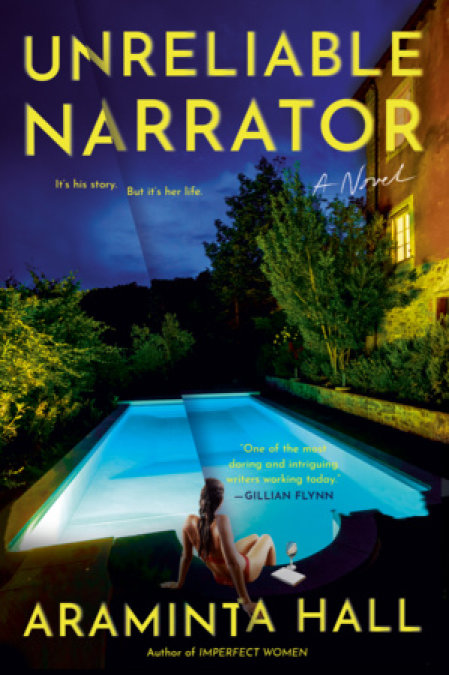
It's his story. But it's her life.
When twenty-three-year-old Hope Jenkins arrives at the isolated, otherworldly Shadowlands estate, she’s certain her life is finally about to begin.
Hope is eager to spend her summer assisting the up-and-coming literary star Ambrose “Rosie” Glencourt, but at Shadowlands, art and danger blur into one. Rosie and his enigmatic wife, Delia, preside over a circle of glittering guests with morals as questionable as their wealth. Hope is transfixed—by their beauty, their brilliance, and by Tom, the elusive young man who resides on the sprawling property and has captured Hope’s heart for the very first time. Hope quickly realizes she’s willing to do anything to secure her place among them—even if it ends in fatal disaster.
Ten years later, Hope lives in self-imposed exile. She has no family, no friends, and no future . . .until she opens Rosie’s runaway bestseller and discovers it’s an almost exact retelling of her story: the work, the sex, and the gunshot that ended it all. It is everything Hope swore to keep hidden, dragged out onto center stage. But this time, Hope isn’t going to stay quiet.
Riveting, compulsively readable, and surprisingly tender, Unreliable Narrator by Araminta Hall explores revenge, obsession, and the dangerous stories we tell to survive.
Release date:
July 14, 2026
Publisher:
G.P. Putnam's Sons
Print pages:
384
* BingeBooks earns revenue from qualifying purchases as an Amazon Associate as well as from other retail partners.
CAUTION: This email originated from outside of Penguin Random House. Please be extra cautious when opening file attachments or clicking on links.
I suppose I've been wondering what it's like to be damned by the story of your own life."
The words pulled Hope from sleep in that way where, as she struggled to consciousness, she wasn't entirely sure where she was. The room was dark, apart from the flicker of the television, but she realized quickly that she was lying awkwardly on her own couch in her own lounge. It was, after all, the only place she could have been, considering she never went anywhere else, apart from work. Her neck cricked as she sat up, her mouth already dry and beginning to taste of the familiar decay that came from having drunk too much, too fast.
"Considering the huge, worldwide success of The Ruined Girl, did you always plan to write a sequel?" Hope focused her bleary attention on the television, vaguely aware that something consequential was happening, when usually nothing of consequence ever did.
"No, not at all."
Her heart leaped chronically as she registered the second voice, a voice she knew so well it felt almost impossible for it to be outside herself. The rich confidence of words sounded out individually, their veracity assured before they'd even dissolved into sound.
"Has it surprised you that it's taken a decade for the story to emerge?"
"Not really. You can't write a sequel simply to satisfy the market, however much everyone wants it. You have to wait for a story worth telling."
Hope dropped to the floor and crawled on her hands and knees, right up to the television. She had avoided him for so long, but how could she be expected to resist when he had appeared, like magic, or maybe a sign, right there in her flat. Rosie crossed his legs loosely and she drank him in. He was still slim and dressed in his favored cords-a crinkled jacket matching his trousers, an open-necked linen shirt, beaten-up brogues and mismatched socks on his feet. But his hair had grayed and there were many more lines on his face. Lines that felt like arrows, because she hadn't watched them form and they spoke too loudly of experiences she hadn't been part of.
"Nothing really surprises me about storytelling," he said, smiling so his eyes twinkled, and Hope could almost feel the surge of female hormones in the audience.
"Can you tell us what this one's about?"
Rosie ruffled his hair in that abstracted way he had. "Oh, I guess memory and perspective. You know, versions of the truth, which is all life is, after all." He paused and Hope held her breath, her heart fast against her ribs. "The central question I've been pondering in this book is what does it mean to have murdered someone you love? You know, what Teresa did wasn't a mistake, she meant to pull that trigger. But what does that do to a person? How do you live with that knowledge about yourself?"
The bottle of wine she'd drunk that evening rose up Hope's gullet. She slapped her face, but she was awake. Rosie was laughing at something the interviewer had said, but she couldn't hear anything because the blood was thumping too loudly in her ears.
"No!" she shouted at the TV. "Stop it." Because how could he be so stupid as to ask her defining question, like that, out in the open, for everyone to hear? In their final conversation he had begged her not to say anything about what had happened that summer. And she'd kept to her word, wrapping her misery around her like a shroud, driving her mother away, shutting out the world, existing in only the smallest, most fragmentary way. And now here he was, just saying it. All to, what, promote a book?
Except that didn't make sense. Rosie's new book appeared to be addressing her life's central question. Her plot.
What does it mean to have murdered someone you love?
But how could that be right if it was a sequel? And what the fuck did that mean The Ruined Girl was about?
Hope stood, swaying slightly, and stumbled to her bedroom. The noise of laughter from the television followed her as she knelt by her bed, having to lie on her stomach to reach the box she'd pushed into the furthest corner. The dust tickled her nose as she pulled it out, making her eyes water. She sat back on her heels and lifted the lid, which made her stomach contract again as she looked at the contents: a delicate china bowl with a swirling pattern of roses winding down its interior, The Ruined Girl, and a battered black hardbacked notebook. She selected the bowl first, but even after all these years it was still charged with memories of Shadowlands, so the place rushed through her, weakening every muscle. But she forced herself on, picking up The Ruined Girl and flicking through the pages. Perhaps the time had come to read it? The thought was scary, although not as terrifying as the words contained in the notebook.
Hope let The Ruined Girl slide to the floor as she reached for her journal, laying it on her lap for a moment before daring to turn the first page. It wasn't a book she had ever intended to open again. In fact, the whole box was not something she would have imagined revisiting. But Rosie had ambushed her and what was she supposed to do?
She cracked the cover and saw on the first page, in her own rounded handwriting: Shadowlands, June 2016. She tried to focus on the curlicues she'd drawn around the letters, little childlike flowers sprouting from the large S. But it was all too late, already she could feel herself being pulled backward as if there were a rope around her waist. She shut her eyes and immediately they were all there, her and Tom and Rosie and Delia, sitting round the terrace table, the long lawn stretching away in front, the house rising majestically behind, and the heat of the sun beating into their bones. A little cry escaped as she opened her eyes again, because she had been so careful, doing everything she could to banish the memories. She'd locked away anything that led back to Shadowlands-been careful with the news; banned music, films, and novels from her life; discarded friends; and driven away her own mother. While always keeping enough wine on hand to blot away anything sticky.
Hope looked back down at the journal in her hand. It felt suddenly very foolish to have ever imagined that she could outrun the past. And besides, maybe it didn't even make sense. Pretending something hadn't happened didn't make it go away. Maybe she had always been who she was, and one way or another, with or without Rosie and Shadowlands, she would have always been someone capable of murder. She turned to the first entry and, like a cannibal, began to feed on her own words.
June 8
It's been only three days since I arrived at Shadowlands and it already feels almost unbelievable that I haven't lived here my whole life. How did I not know this place existed? I have begun again-ta-da!-reborn like a religious experience. When I duck my head under the water in the swimming pool it is a baptism. I am becoming my true self.
It's too simple to say that I've never been anywhere that comes close to Shadowlands before, because that would be true for most people-one of those places most of us will only ever see on TV. It reminds me of a giant's crown, built from honey-colored stone that shines like gold, long and sumptuous, with a row of urnlike structures running along the top. I like what they call the back of the house best, although to me it's the front as it's what you see when you first drive up. It's covered by a magnificently twisted plant, with thousands of elegant almond-shaped leaves, and these incredible dripping purple flowers that look almost decadent, or not real somehow (I thought it was a type of vine but apparently, it's called a wisteria). Anyway, whatever its name, it's managed to extend itself impressively, only leaving gaps for the windows and three massive sets of French doors. These doors open onto a stone terrace, where you can step down to a long lawn which runs down to the woods. Romantically planted borders wider than our lounge at home are dotted everywhere, and neatly trimmed hedges hide a vegetable garden and even a swimming pool. But this place is more than a definition of beauty. I can't put my finger on it yet, but there's something in the air, a sense of promise or abandon that feels as dangerous as it is exhilarating.
On the train here I felt overcome by a strange sense of newness; it felt a bit like a premonition, as if I realized that Shadowlands is going to be where I can clear my mistakes and launch myself fresh. I am twenty-three years old and that means I have so much in front of me, so much time to be a different, better person than I am now. Life doesn't come looking for us: we have to find our moment, and this has to be mine.
I'm done with waiting tables, holding my breath for some man (why do I always think it's going to be a man?) to thrust his business card at me and say that I have the exact star quality he's been looking for. Done, for that matter, with men who wouldn't know the truth if it hit them square in the face. Done with bad decisions that could see me on my own and pregnant like Mum was at my age. Done with doing nothing about my dreams.
Which isn't to say that I don't also feel scared. My mind keeps flashing back to the way Mum cried as I walked through the turnstiles at the station. How her face collapsed in on itself like a piece of paper being scrunched. It made everything feel unreal, like I was enacting a scene from a film. Because in some ways the situation was, maybe still is, absurd. I am here by chance-an advert seen just over a fortnight ago in a magazine that Mum brought home from work-Live-in secretary wanted for novelist. Generous salary. Based in Somerset.
She had shown it to me before she even took off her jacket, tripping over her words as she told me it was a wonderful opportunity, which of course it is, but I think her real motive was to get me out of London and away from all the mistakes of the past few years. I know Mum has aspirations for me-college, a faithful boyfriend, a good job with prospects. But all those traditional things have always felt too constricting, so sometimes I can't catch my breath with the thought of a steady life like that. When I told my careers tutor at school that I wanted to write novels, she actually laughed, countering by asking if I'd thought of nursing, or maybe working with children, perhaps office work. And in a way she was right; I have no idea how to actually become a writer. I once read an interview with a very successful novelist in which she said all that mattered was the story. But I don't even have a good one of those. Which is maybe why I bought this notebook before I left and why I'm writing in it now. Perhaps I'm looking for my story?
“And you’re so pretty,” Delia said at one point in our strange phone interview, which made me laugh sharply. “Sorry,” she said, “I hope you don’t mind. I stalked your Instagram before I called. I always think seeing someone is so important, it gives you such a sense of who they are.”
I blushed at the thought of her looking at my usually blurry photos of neon-lit nights out and sweaty faces pressed too close together. God, that one of me in a T-shirt and pants in my bedroom mirror. And all the traveling clichés of sunsets and cocktails and nearly naked boys.
"You simply have to say yes," Delia said in her languidly posh voice that almost works like a trance. "We've been looking for ages and ages and you are too perfect to let slip through our fingers."
And then she started talking about Rosie. Rosie this, Rosie that, until my mind spun with the thought of her writing away and making a living from it. Idiot! I can't believe I thought Rosie was a woman.
I meant to find Rosie's novels in the library, but the week before leaving was so busy, what with my last shifts and saying goodbye to everyone. And then that awful scene with Dexter's wife. I still can't wrap my head around the fact that he's married. Oh God, thinking about our mortifying slanging match, in front of all the customers, makes me want to hide under a bed for a year. It wasn't even me and her who should have been fighting . . . I wish I'd been calmer, and pointed out how I couldn't be a home-wrecker when I hadn't known he had a home to wreck. Moving forward I need to summon those lines quicker, not think them up after the opportunity to say them has passed.
Delia met my train, and as there was only one person on the tiny platform, I knew she had to be the woman shielding her eyes from the sun as she peered into the slowing carriages. Everyone in my carriage, probably on the whole train, turned to look at her. Three days of constant Delia hasn't reduced her impact. I'm not sure I've ever seen anyone up close who is both as pretty and as sexy as she is. Her features are so fine, her cheekbones so high, her eyes so green, her attitude so bloody nonchalant. She always looks like she should be walking down a Parisian catwalk because her clothes are stylish in a very relaxed way. Genuinely, I'd say she's as gorgeous as any film star.
That first day she was dressed in a loose white cotton shirt with rolled-up sleeves, tucked into a long red skirt printed with little birds. A brown suede belt was wrapped around her trim waist and lots of silver bracelets jangled up her arm. Her blond hair was piled up under a battered straw hat and she had flip-flops on her feet, revealing chipped red nail varnish. As I wheeled my suitcase toward her I was filled with a bursting sense of pride that she was there for me, while also feeling foolish in the smart white dress and sandals Mum and I had spent hours deciding would be the best outfit to arrive in.
We hope you are enjoying the book so far. To continue reading...

 Please log in to recommend or discuss...
