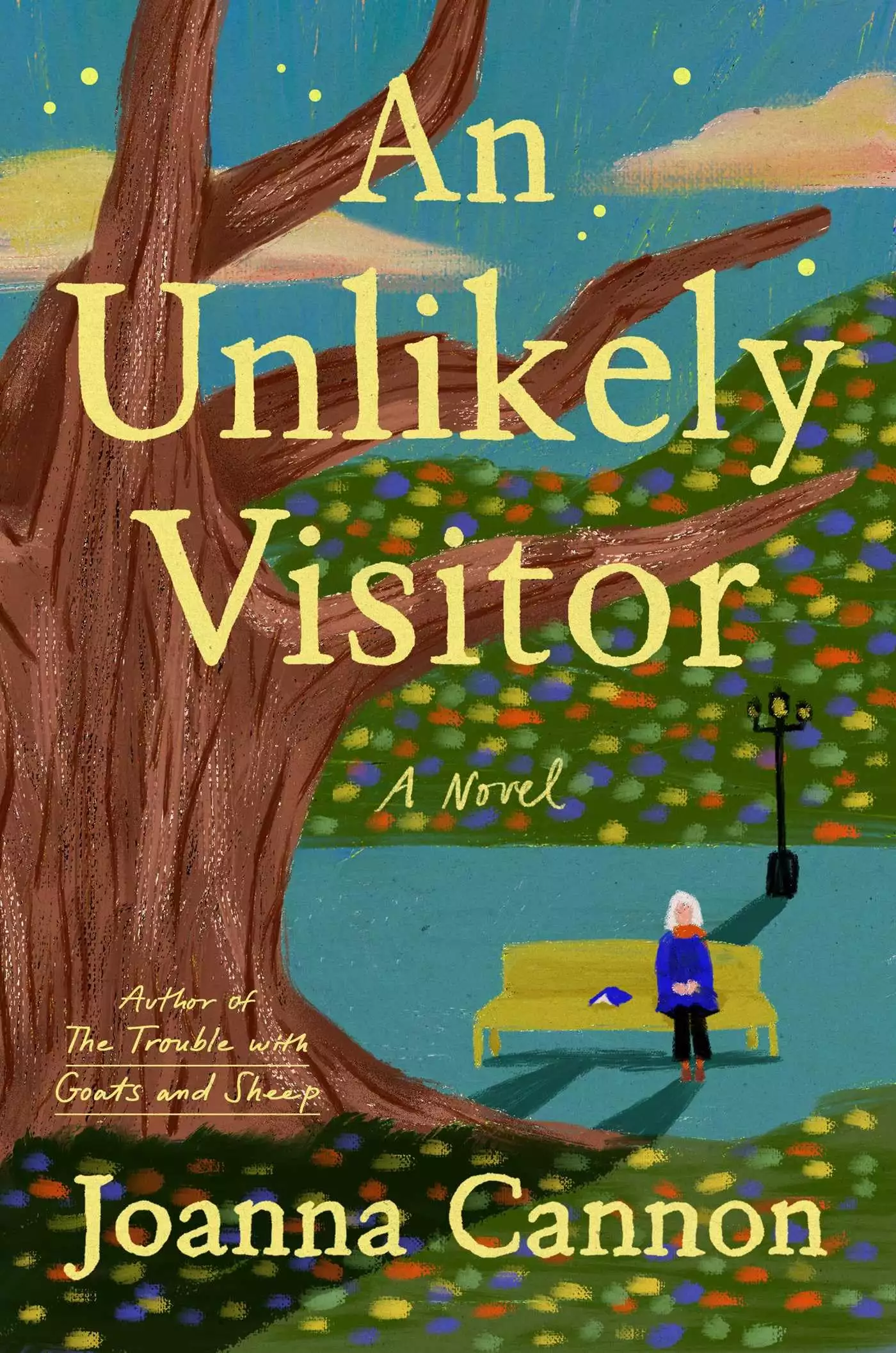
From the internationally bestselling author of the “unique and unforgettable” (The Wall Street Journal) The Trouble with Goats and Sheep comes a funny and poignant story of a woman who encounters the ghosts of her past as she untangles the mystery of her daughter’s disappearance—a powerful, hopeful reminder that the people we love are always with us.
Margaret thinks her time is up…
Things have been hard since her husband Derek died, and they never got over the disappearance of their daughter, Jeanie, all those years ago. With his support, it seemed like everything would be okay—okay enough, that is.
But now Derek’s gone. Margaret moves through the days slowly, quietly, alone. Then one day, Margaret returns home to an unlikely visitor, and together they set out to discover what really happened to Jeanie. Perhaps if she knocks on enough doors, she might find another end to the story.
Part mystery, part ghost story, part meditation on grief, An Unlikely Visitor is a warmhearted and hopeful reminder that the people we love are always with us.
Release date:
October 20, 2026
Publisher:
Simon & Schuster
Print pages:
320
* BingeBooks earns revenue from qualifying purchases as an Amazon Associate as well as from other retail partners.
Chapter 1 1 Dr. Petersen’s opinion was always delivered with a small sigh. He probably didn’t think it was particularly obvious, but I’m very good at noticing these things.
“Margaret, you need to establish a routine,” he said, after he’d given me his small sigh. “Routines are beneficial for our mental health.”
I wanted to say that Derek and I had established a perfectly good routine since we’d retired, and that conjuring up another one when you’re seventy-four and there’s only one of you is a challenging concept, but what would be the point. Dr. Petersen had a thick gold band on his finger. What would he know?
Instead I replied, “I’ll give it a try, Dr. Petersen,” because saying what people want to hear requires much less energy and I hadn’t got a great deal of it to begin with.
“Good, good. It’s been how long now?” He peered at the computer screen.
Ninety-four days.
“About three months, hasn’t it? Time to start getting back out there, Margaret. Living your life. Why not reach out to a few friends?”
“Reach out?”
He twiddled his fountain pen around, like a baton. “You know. Reconnect. Touch base. Reach out.” Rather alarmingly, he reached towards me with both hands, to illustrate.
I thought it might be a nice idea if other people reached in instead, but I kept my mouth shut.
“And how about taking up a new hobby? Something to get you out of the house.”
“Anything in particular?” I said.
“Well.” He began cheerleading with his pen again. “How about golf?”
“Golf?”
“Perfect for a woman of your age.”
I frowned.
“No need to worry, you don’t have to walk about. You can hire a buggy.”
“I can?”
“Oh yes. Motorised golf carts, buggies. No one has to walk anywhere if they don’t want to. You just turn up now and hit the ball.”
I think he was waiting for my frown to disappear, but it stayed put.
“Or something slightly less energetic,” he said. “What about macramé?”
“Macramé?”
“Where you make knots in pieces of string. Hanging baskets. That type of thing.”
“I know what macramé is, Dr. Petersen.”
“The world is your oyster, Margaret.”
It didn’t feel very much like an oyster. It felt difficult and unhelpful. I listened as Dr. Petersen continued to oysterise my world by going through a list of things I “might like to try,” but when he launched into a monologue about the many benefits of Nordic poles, I drifted off and looked around the room to pass the time. Mid-morning sunlight peered over the frosted glass of the window and it caught the gold of his ring. I wondered how long he’d been someone’s husband, someone’s father. I wondered how he’d feel if those things were snatched away from him. All disappeared in the blink of an eye, as though he’d never been entitled to them in the first place, because nothing is ever really ours. We might stand in front of God and make our vows and wrap gold around our fingers, as though we are perfectly within our rights to keep possession of all these things forever. We might take photographs of our new lives and hang them on our walls to show everyone what a splendid success we’ve made of ourselves, but nothing is permanent. One day, we will have to give all of this back and return to a life of solitude, and as you grow older, you realise that all the things you believe to be forever are only really just passing through. At the end of the day, the life we are so certain must be ours is only ever lent to us for a while.
I realised the room was very quiet and I looked back at Dr. Petersen. Clearly, in my absence, it had become my turn to speak.
“What do you think?” he said. “Will you give that a shot?”
“Of course.” I found my brightest smile. “Why not.”
Heaven only knows what I’d agreed to give a shot to, but it didn’t really matter. I was just one of many in a giant carousel of patients, and by the time it came around to my turn again this would all have been forgotten. It wasn’t Dr. Petersen’s fault. The GP practice was in chaos. One of the doctors had retired, one had dropped dead in the middle of morning surgery, and another had decided to up sticks and start a new life with his mistress in Tunbridge Wells. Dr. Petersen was as much a victim of the carousel as the patients were, but at least I could be ticked off the list. Another seemingly satisfied customer. Because doctors don’t just prescribe medication anymore, they prescribe fresh air and macramé.
I thought it had come to the point where I would be dismissed, but Dr. Petersen was still staring at his computer screen.
“You’ve had some…” He stared a bit more to give him time to hunt down the easiest words. “… challenging times in your life?”
He framed it as a question, but I didn’t answer, because Dr. Petersen was new and unaware. Joining in with his conversation would mean reading from a past chapter of my life, and it was a book I would much rather keep shut.
“I’m certain you’ll get through this, Margaret,” he said. “You are obviously a very strong woman.”
There were no small sighs this time and he looked at me with deeper eyes, as though he’d only just noticed I was sitting there.
I thought about his words on the walk home. I needed to go to the supermarket, but everything had to be carried because I rarely took the car out anymore. Derek always did most of the driving anyway, and now everything seemed too fast and loud. I especially didn’t enjoy parking. I would probably drive far more if I didn’t have to eventually stop at some point. Everyone watching you and shaking their heads because you’re taking a little bit too long for their liking. It’s much simpler to walk. It also means I can opt for a shortcut through the park and avoid going past the end of the lane. Because I do that even now. I always will. Even though all these decades have passed, and you wouldn’t even recognise the spot if you didn’t know. There’s something about that place, the way the air hangs, the stillness of it. I just can’t do it.
Derek understood, of course, but on the rare occasions I had to catch a lift from someone or take a taxi, I would ask if we could avoid the lane, even though it connected one side of the town to the other and was considered a useful shortcut. Whenever this happened, I was always expected to engage in a discussion. It’s a lot quicker… you’ll be adding twenty minutes to the journey… in this traffic, it’s best if we… no one ever said fine and just agreed with me. Only if they’d always lived here, and then they would almost certainly make the connection. However, very few people do these days, and even if they have a vague recollection, they can never quite pinpoint the details. They just know I am someone something very bad happened to, an awfully long time ago. But so many years have passed by, no one quite remembers what it was.
“I’m home!” I shouted into an empty space, and began unpacking the bright orange carrier bags onto the worktop. I hadn’t bought much because my appetite wasn’t what it used to be. Besides, I was out of breath just walking myself home, let alone carrying half the supermarket along with me.
“It was heaving as usual,” I said. “Pavements crowded with people, endless traffic, heaven knows where they’re all going. I suppose it’s September and the new school term’s starting.”
None of those crowds of people had even realised I existed, of course. I struggle to recognise myself sometimes, and if I catch sight of a woman in the bathroom mirror or in the reflection of a shop window as I walk past, it’s always a shock that she and I are the same person. I just drifted around the crowds, unnoticed. Clusters of schoolchildren with noisy feet, and their hands buried in packets of crisps. Young men in high-visibility jackets, carrying their lunches in plastic boxes. Weary mothers with different-sized children trailing behind them like Russian dolls. Each child deposited at a different building, the rest watching their future selves unfold into the distance. Everyone was too busy trying to find their way to the other side of the day to spot a woman with grey hair, weighed down by carrier bags and her own thoughts, never taking her eyes from the pavement. There was no point in looking at faces anyway, since I barely recognised anyone in this town anymore. It had grown so much since Derek and I had first moved here, housing estates racing each other across the fields, executive apartments and luxury dwellings springing up everywhere, because no one values being ordinary these days.
The oldest part of the town is made up of an army of Georgian houses with their rigid symmetry and sash windows. I always glance into the rooms as I walk past. Kitchen spotlights flood marble worktops. High-ceilinged drawing rooms and log baskets. Strawberry thieves and cast-iron grates. Rows of identical middle-class lives staring out beyond the glossy black railings and pale pavements. Occasionally you might spot a flash of colour, as a group of begonias break free from a hanging basket, or a front door is painted in a rebellious yellow, but otherwise the streets there are quiet and restrained. I always wonder where they put out their rubbish and hang their washing, because nothing quite so ordinary ever seems to disturb the landscape. A stone’s throw away, wheelie bins cluster in communal yards and wet clothes are pegged out on pocket balconies, in buildings eight lives deep. Each balcony tells a story. Some are crowded with plants, every surface filled with growth and greenery, as leaves run riot from pots and baskets. Others remain concrete squares, with just a cushion and a stolen pub ashtray. Single chairs and cat baskets. Signs betray confidences. HOME SWEET HOME. WARNING: CCTV. WELCOME! Other signs appeared over the years. THIS IS A CONTROLLED AREA. NO BICYCLES. NO BALL GAMES. NO LOITERING. I wonder where the bicycles and the ball games go to do their loitering now.
I walk past rows of terraces, with front doors that open to exhaust fumes and other people’s conversations. Through estates where children’s toys can no longer be contained within handkerchief gardens, and have spilled out onto grass verges. Then along leafy avenues with distant driveways, and houses named after trees that don’t appear to exist. There are no lime trees at The Limes and no pines at Pine Lodge, just neat expanses of gravel and collections of vigorous hedges.
Our house is somewhere in between. It sits on a housing development which was shiny and desirable when we first moved here, but as shinier and more desirable estates sprang up across the town, the sparkle wore off and it soon grew tired and old.
I picked out a tin from the carrier bag and put it next to the stove. “I thought we’d have tomato soup again for our lunch,” I said. “Quick and easy. What do you reckon?”
I searched around for the tin opener. In the last few weeks it had seemed more and more difficult to lay my hands on things. Nothing was ever where it was supposed to be. I found it eventually, lurking at the bottom of the sink, still wearing yesterday’s soup. The contents of today’s tin fell into a saucepan and I peered down at the orange sludge. I tried poking it a few times with the edge of a wooden spoon, but it didn’t transform into anything more appealing and so I left it where it was.
“Maybe later,” I said.
I sat at the dining table, even though I wasn’t dining, and peered through the window into the cul-de-sac. Bottom of the bag, it means. When we first moved in I used to think it was quite funny, but as the years have rolled by it’s become less amusing and more prophetic. Apart from the man with the dog at number four, and Ross and his wife next door, everyone living here is retired now, and it feels as though we have all settled at the base of the estate like elderly sediment.
I watched Mrs. Fellowes take out her wheelie bin and position it very carefully at the edge of the pavement. She was a day early again. Last year, and in no uncertain terms, I wrote to the council about people putting out their bins prematurely because it creates an unnecessary trip hazard, but no one takes a blind bit of notice and I haven’t even had the courtesy of a reply. I was going to speak to Mrs. Fellowes myself, but then her husband died and she now looks stooped and broken, as though life has snapped her in two. He passed away within a few weeks of being diagnosed, just like Derek. Cancer, I believe, because there’s a lot of it about. Either doctors are getting much better at diagnosing it, or we’re putting something inside ourselves which shouldn’t be there. At the time, Derek said I should go over and talk to her but I didn’t know what to say. Now, of course, I realise it doesn’t matter what you say, as long as you say something.
Mrs. Fellowes vanished behind her front door and the road was empty again. Majid from number four usually walks his German shepherd at all hours of the day and night, but I haven’t seen him do that in ages. That’s the thing about cul-de-sacs. No one travelling through, no passersby. Occasionally people find themselves down here by accident, heading in the wrong direction, and we all watch them perform their three-point turns and then disappear back into their lives again.
We thought about moving. Afterwards. Or rather, Derek did. He even brought up the idea a few times, but how could we?
“She wouldn’t know where to find us,” I said each time the subject was raised. “A stranger would open the door to her. She’d think we’d given up.”
Derek would take my hands in his, and he would sigh and shake his head, but he didn’t disagree with me. Back then it seemed important not to let go of the hope, you see. As long as I believed it might happen, it felt like there was a chance she would find her way home.
We hope you are enjoying the book so far. To continue reading...

 Please log in to recommend or discuss...
