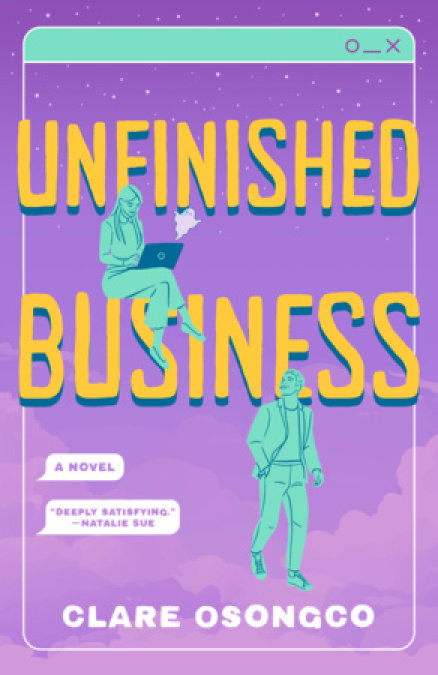
In this funny, warmly chaotic novel, a floundering office worker discovers her mother’s ghost is trapped in the company Slack server, and must free her by resolving her own troubled love life.
“Deeply satisfying . . . such a unique, surprising, and fun tale with a swoony romance perfectly woven together.”—Natalie Sue, bestselling author of I Hope This Finds You Well
A few months ago, Ruby Ocampo’s mother, Adela, died at her desk at work. Now, lost and driven by a misplaced sense of obligation, Ruby’s taken a job at the megacorporation where Adela worked for decades—and, to her horror, she discovers her mother’s ghost is trapped in the company Slack.
Ruby has never lived up to her mother’s expectations in life, but to set her free, she’ll have to resolve Adela’s unfinished business. She makes a list of all the ways she could live more like her mother would have wanted, covering everything from her stunted career to her love life (#5 on the list: date someone in a higher tax bracket!). Soon her quest to free Adela gets Ruby entangled with two men at the office who might be able to help: the estranged childhood friend her mom never approved of—who’s the only one she can confide in about this supernatural crisis—and the hot but vaguely sinister junior executive who’s been paying her a confusing amount of attention.
In order to give her mom a chance at the afterlife, Ruby must address her shortcomings one by one—and reevaluate her inherited ideas about love, work, and what’s truly important along the way.
Release date:
July 14, 2026
Publisher:
Dell
Print pages:
368
* BingeBooks earns revenue from qualifying purchases as an Amazon Associate as well as from other retail partners.
I grew up visiting the TKCORP head office. Mom worked here my whole life, and she always expected me to join her one day. The most prestigious megacorporation, she’d say with a hint of awe in her voice, as though it hadn’t gotten old after decades. And now I’m finally badging in for work as a TKCORP employee, but she’s not here to see it.
It’s my second week here; Mom died a couple months ago, and everything here reminds me of her.
That hall by the entrance leads to the mailroom, where she got her start through a work-study arrangement as an international student recently arrived from the Philippines.
By the time I was born, she was working a desk job in the Customer Experience Department on the third floor—and her boss was so checked out, sometimes Mom would sneak me into her cubicle for lack of childcare. She set up a crib under her desk so she could rock me to sleep with one foot while she fielded calls about malfunctioning products.
The chirping of chunky old landline phones still comforts me. Sometimes I pull up a video with that sound on YouTube when I have trouble falling asleep.
We rode this elevator when I visited her for take-your-kid-to-work day in fifth grade—Mom had been promoted again by that time—and I sat quietly behind her desk in the Logistics Department while she talked to me about supply chains. And she was still working on that team, bumped up a few ranks, when I betrayed her by moving across the country for college—and then taking a job out in New York, at some no-name company.
Of course, when I asked her if she was let down, she’d deny it. I just always pictured you here, she said, her disappointment palpable on the phone. Not on the East Coast.
And now I’m back at the center of this sprawling office park, the beating heart of the sleepy Southern California suburb I grew up in. The home base TKCORP chose in the sixties and never left.
Now I’m here and Mom’s not, but there’s no time to be maudlin. The company just had layoffs and I’m arriving in their wake, one of those cursed hires after a big culling. A cheap replacement, one person where three used to be. A fresh start with a hint of survivor’s guilt already.
On the way up to the eighth floor, I try to focus on composing my morning memo in my head—getting myself in the mood to write an ode to the new TKCORP line of aroma diffusers. Feeling fragrant, feeling fresh.
TKCORP dabbles in a bit of everything. It’s added to its diverse portfolio over the years as it acquired smaller companies and rebranded everything with the same ubiquitous logo. Home goods, pharmaceuticals, information technology, groceries. You can have your phone plan with TKCORP, have TKCORP toilet paper in your bathroom, eat your TKCORP frozen dinner out of your TKCORP fridge at night (and I do).
As soon as the elevator opens, the sixty percent staff reduction on our team is glaringly obvious. Lots of empty cubicles with abandoned belongings in them, like people left in a hurry after a disaster.
My desk still has the personal effects of a phantom co-worker in it. The drawer is stuffed with old napkins and packets of painkillers—Mom would approve of this level of thrift and preparation. There’s an old phone book and several half-filled notepads, the writing too spidery and cramped for me to make out any potential old gossip. But I haven’t had the energy to clean it out yet.
“Thought you might want this,” a familiar deep voice says. Before I can glance up from the wooden surface of my desk, Al, my mom’s oldest work friend, slides a glossy photo in front of me.
It’s a group portrait from a Customer Experience team retreat, almost thirty years ago.
There’s Al, the only Black man in the photo, wearing a salmon polo shirt that pops against his deep brown skin. There’s Mom, the shortest person in the picture, radiant in her silk blouse and pearls. Not as weighed down with worry as the person I got to meet.
It must have been taken in Mom’s first year in the department, because there’s my dad, a skinny white guy in the opposite corner of the frame. And even though he didn’t stay in the picture of our lives for that long, he’s the reason Mom is still here—in this country, this company, this town.
Wrong tense again. You’ll have to work on that.
Standing before me, Al has less hair than he did back then. He has a bit more of a gut, and his eyes crinkle in a kindly way when he smiles. But other than that, he’s the same.
“You look like her, you know?” he says wistfully.
Al cried at the funeral, and somehow having seen him like that makes me clammy and awkward now. There must be something wrong with me, but I haven’t been able to cry yet. Not when I got the news, not when I saw everyone at the memorial service, not that first awful night alone in our empty house. My eyes will burn, my throat will feel raw, but I can’t manage to tip over into crying. Mom never wanted me to cry in front of her.
I think the last time I did was in elementary school—about dodgeball, of all the stupid things, because I kept getting picked last, and I couldn’t stop spiraling about finding the root cause. Was it because I couldn’t do a high ponytail like the other girls, since my hair was short and choppy? Were my shorts too long? Was it because I didn’t chew gum like everyone else? (A waste of money! Mom would say. You just spit it back out again!)
“You’re so sensitive,” Mom said to my tearful face, grimacing like she smelled something bad.
It should have been a totally forgettable memory. Except it may have been the last time I ever cried to her about anything.
“Anyway,” Al says with a warm smile, a hint of sadness on the edges. “Glad you’re here, Ruby.”
My throat feels horribly tight as he gestures toward his desk—which, through the open side of his cubicle, looks like an unruly mound of papers—and pats my cubicle divider a few times. “I’ll be right over here if you need anything.”
Then a redheaded woman with perky pink lipstick and a pinched expression comes bustling over—our boss, Erica. She’s lugging a large plant in a bright plastic pot, probably from TKMART.
“A pop of color!” she exclaims as she sets it down heavily next to Al’s cubicle and peers disdainfully at the piles of papers inside. “Al, didn’t you read my memo about upkeep of the office aesthetic?” She purses her lips. “These mounds are not exactly in line with my vision.”
“Printing things out helps me get my head around them.”
“Fine.” She deposits the plant in front of his cubicle. “But throw some things away.”
The mint green planter seems like it’s trying too hard. The office is all gray—gray fabric cubicles, gray carpet, gray office chairs, the gentle gray hum of the building’s systems. Even the ceiling tiles, once white, have faded to a light gray. The place looks like it hasn’t been redecorated since the 1980s.
For years, TKCORP was all about tradition—great benefits, one of the last bastions of lifetime employment. But there was a changing of the guard a few years ago after the longtime CEO retired, and a new guy came in, cutting costs, slashing budgets.
“Ruby, how’s that memo coming?” Erica shoots over her shoulder.
“Good!” I squeak. And by good, I mean I haven’t started.
“Don’t take too long.” She hurries back to her office, floofing up some potted plants along her way with the energy of a hummingbird visiting her favorite flowers.
Slumping in my chair, I stare at my notes until the pixels blur together.
I close my eyes and think about how I’ll wander the aisles of TKMART alone after work, maybe buy a scented candle to make the house smell less like a time warp to my high school years. Or I’ll treat myself to another throw pillow—the couch has become buried in them since I moved back.
How can you be so unmotivated? Mom said the last time we spoke on the phone.
I have to focus! I should be grateful to be here.
Mom always wanted to work in this department, writing advertorial. She thought it was glamorous—your words in the pages of Elle and Newsweek, without the risks of a creative career!
She’d applied a few times over the years, but Erica never gave her a shot. And now I’m here instead, in Mom’s dream job. Somehow, impossibly, even though the print journalism industry it relies on is dying.
I had to come home after she died—I inherited the house, and there were so many things to attend to. When I saw Al at the funeral, he mentioned there was an open position in the department after the layoffs. And there was nothing calling me back to New York, anyway. Mom was right: I wasn’t going anywhere in my job, and somehow after years of living there, I hadn’t made any friends who would miss me after a couple weeks apart. It seemed too perfect; I had to apply, and when I got it, it felt like fate.
We hope you are enjoying the book so far. To continue reading...

 Please log in to recommend or discuss...
