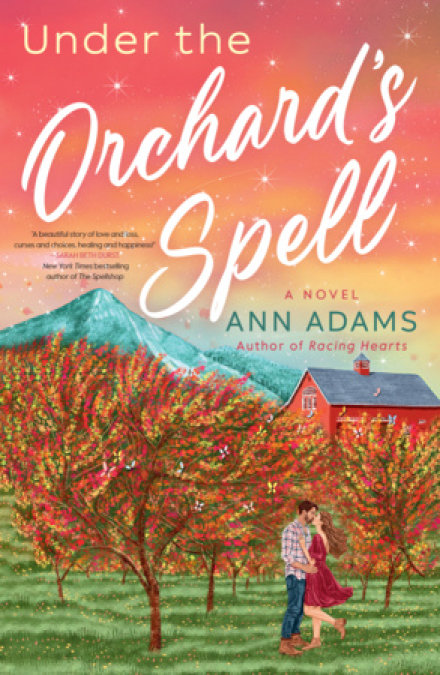
A woman reunites with her first love to solve the mystery of the strange occurrences plaguing her family’s pear orchard—only to discover the land holds more magic than she thought—in this cozy second chance romance.
“A beautiful story of love and loss, curses and choices, healing and happiness!”—Sarah Beth Durst, New York Times bestselling author of The Spellshop
Ali Reid has luck so bad she might actually be cursed. The pear orchard she inherited from her late uncle is drowning in debt, her fiancé and best friend have left her, and now, with picking season looming, she has no way to harvest all her fruit before it rots on the branch.
Desperate, Ali turns to Logan Wright—the town’s stoic carpenter, her first kiss, and the one she left behind. Now, fourteen years later, Logan agrees to move into her farmhouse to help, wearing plaid and a steady gaze, even though the land holds memories he’s not keen to revisit.
As they work side by side, Ali’s feelings for Logan come rushing back, and the orchard’s troubles turn increasingly bizarre. Unnatural storms rage overhead. Jewel-toned rabbits take shelter in the barn. And, worst of all, the pears are crystallizing on their branches, like some kind of fairytale gone wrong.
The deeper they dig into these mysteries, the more long-buried family secrets they uncover—and the more they begin to suspect the land itself carries a curse, one that touches any visitor who lingers too long. With the magic stirring once again, Ali must uncover the orchard’s secrets before she loses the one she loves all over again.
Release date:
October 6, 2026
Publisher:
Dell
Print pages:
352
* BingeBooks earns revenue from qualifying purchases as an Amazon Associate as well as from other retail partners.
“Well, if this ain’t weirder than a scarecrow on a trampoline.”
Ahead of me, Val storms down a row of trees, white hair spiking like a wild crown. She skids to a stop and glares at a branch in her eyeline, reminding me of the time she suspected she’d caught Uncle Martin counting cards.
“Do orchardists even use scarecrows anymore?” I ask as I hoist a ladder off the Gator and hurry to her side, brushing past branches that slap my shoulders like they’re urging me along. It’s still late afternoon, but the whole orchard is steeped in that golden hour light that September always brings a touch too soon. “Those machines with the percussive sounds seem much more effective.”
“Cherry guns, you mean.” Val claps her fingers against a palm to marshal me and the ladder to the spot where she wants us, then digs a pressure gauge out of her back pocket and scales the steps. “Sure, but it wouldn’t have been so funny if I’d said it was weirder than a cherry gun on a trampoline.”
“I mean the scarecrow thing wasn’t that funny, either,” I tell her.
She frowns down at me, brown skin breaking into even more lines than usual. “Because you have to picture it. Did you picture it?”
“I’m trying.”
“And?”
“And it’s a bit unclear. Is the scarecrow, like, bending its legs or—”
Val plucks up a half-rotten pear and chucks it at my forehead.
I snicker as I duck. “But I was right? Something is wrong with the color.”
I noticed it this morning. The pears looked like . . . green bananas. When they should be the color of a honeydew rind, right near the flesh.
It’s a color seared into my mind from the year Mom and I moved to Grand Rapids, Michigan. That fall, I didn’t start school until after Labor Day, so I walked this exact row with Uncle Martin at this exact time of year. He asked me what the fruit reminded me of, and when I said “a honeydew rind,” he wheezed out a laugh before cupping one of the pears in his hand and shout whispering: “Very good, but don’t let them hear you comparing them to a buffet fruit.”
Now, Uncle Martin is gone and the orchard is mine—far, far sooner than either of us would have wanted—and I’m always looking for that exact shade of greenish yellow, as if finding it might bring back an echo of his wheezy laugh from halfway down a row.
Val nods as she picks a fresh pear, expertly angling it upward to snap the weakest part of the stem, then flattens it against a ladder step while she spears it with the pressure gauge. The reading loads as she lumbers down.
“You sure were right.” She tips up the face of her gauge. “See it now?”
With a glance at the needle, realization dawns. What’s off isn’t just the color; it’s this pear’s color relative to the others.
“These should be the first to go,” I say, “but the pears in the Thompson block had higher readings.”
“Exactly right,” Val says, dropping the fruit to the base of the tree and dusting off her hands.
I look back at her, considering this. Fruit turns in stages on any orchard, including ours, depending primarily on the rows’ exposure to heat and sunlight, and the age of the trees. Those schedules should be predictable, though. Trees that get more sunlight one year will pretty much be the same as the next.
“That’s strange, isn’t it?” I ask.
Val lifts a shoulder. “Weird microclimates around here. Makes things unpredictable.”
It’s something I’ve heard her say a thousand times to explain all manner of oddities, including why my orchard remains the sole pear farm in a valley filled with apples. Or why our picking season always starts on September 30—a date that is both later and more clockwork precise than it should be.
Before I can ask about it, though, Val says, “You knew that because of the color?”
“Yeah.”
She arches an eyebrow.
“What?” I ask.
“Nothing,” she mumbles, stooping to hoist the ladder onto her shoulder and starting back down the row. “It’s just subtle, that’s all. Hard to see with the naked eye. That’s why we use the gauge.”
“Val. Did you just tell me you’re impressed?”
She spins, but she’s not laughing. “It’s something Martin would’ve noticed.”
And this time the compliment is loud and clear.
My throat tightens. “He taught me everything I know.”
Or, rather, everything I feel.
The weight he placed on feeling, not knowledge, is the reason Uncle Martin never showed me how to use a pressure gauge—much to Val’s chagrin—opting instead to get me to compare the fruit to fennel and zucchini blossoms. It’s why, when I was in eighth grade, he taught me to prune by running my hand along the branch, feeling where the growth was thin or crowded and instinctively finding the right place to cut. Feeling is how I knew last summer, when I came to visit right after he told me about his diagnosis, that a new disease had taken root on the north side. There wasn’t anything visible, really. It’s just that the branches seemed tired.
When I pointed it out, Martin clapped me on the back and said, “Ali, my dear, you’re going to make one remarkable orchardist.”
I only grimaced, not ready to hear it. I was convinced he’d pull through and farm this land for decades more. I was sure the pancreatic cancer wouldn’t—couldn’t—take him.
A few months later, he admitted he was starting hospice. I scrambled onto the next flight from Miami to Portland, a foolhardy attempt to convince him to keep fighting. But when I saw him, hollowed out and frailer than I could have imagined, I finally started to accept the truths I’d been railing against for too long.
I was going to lose the only adult who ever made me feel safe.
I was going to be the next owner of this land.
We—me and the trees—were going to have to face the world without him.
Over the next few months, these ideas turned from abstract concepts to practical inevitability. I told Mom I’d be moving onto the orchard and was met with a silence even sharper than usual. I gave notice at my consulting firm in Florida and transitioned my contracts and clients to another project manager. My uncle and I signed deeds and probate orders and transfers of water rights. Then, in a whirlwind, I packed all my belongings and rented what I hoped would be my last U-Haul.
Only, when I returned, I wasn’t alone.
My uncle’s farmhouse— so recently consumed by stillness—filled with new kinds of sounds. Tape ripped off boxes. Voices drifting between rooms. Glasses clinked, toasting what had been and what remained. I went to the hardware store to have three sets of keys made, all with matching heart-shaped fobs. At that time, just about everything came in threes: laptops on the kitchen table, mugs of coffee with cream, pairs of work boots by the front door.
But that was a month ago. Now there’s only one.
One laptop.
One mug.
One pair of boots.
And a new kind of silence. At least I still have the trees.
“So, how big of a deal is it that the fruit is ripening at weird intervals?” I ask, pushing out thoughts but also already bracing myself for a fresh round of bad news.
To my relief, Val lifts a shoulder. “Not at all. We’ve just gotta adjust our picking schedule.”
“The start date?”
“Nah. We’ll start the last day of September, same as always. I just mean the order we’ll go. You have your uncle’s aerial photos up at the house?”
“In the kitchen.”
“Good, we’ll just—” Val stops short, her gaze caught on a branch just above the parked Gator. I follow her eyeline to a pear. Like the others, it’s still small since it’s only early September. Unlike the others, it’s coated in a white-looking sheen.
“Wax bloom?” I ask.
Val reaches toward the pear and rubs her thumb against its surface. Oddly, the film doesn’t budge. Eyebrows pinched together, she studies her thumb, then her eyes flash to me. “You notice anything off lately?”
“Off?”
“About the land. Unseasonable weather. Unusual temperature changes. Since I was last here a month ago.”
A month ago. When three pairs of boots turned to one.
When they left.
The woman I called my best friend.
The man who was always, always, always supposed to be there for me.
I swallow, sorting through memories of those hazy, sticky-with-grief days that followed. In my bleary state of semiconsciousness, I barely registered what was happening outside the darkened bedroom, but . . .
There was the fog. The one that prowled over hills and across grass. Crept up trunks, swallowing my trees into silhouettes. Grew so thick that, when I leaned a temple to a cold window, I could barely see more than a yawning wall of gray.
We hope you are enjoying the book so far. To continue reading...

 Please log in to recommend or discuss...
