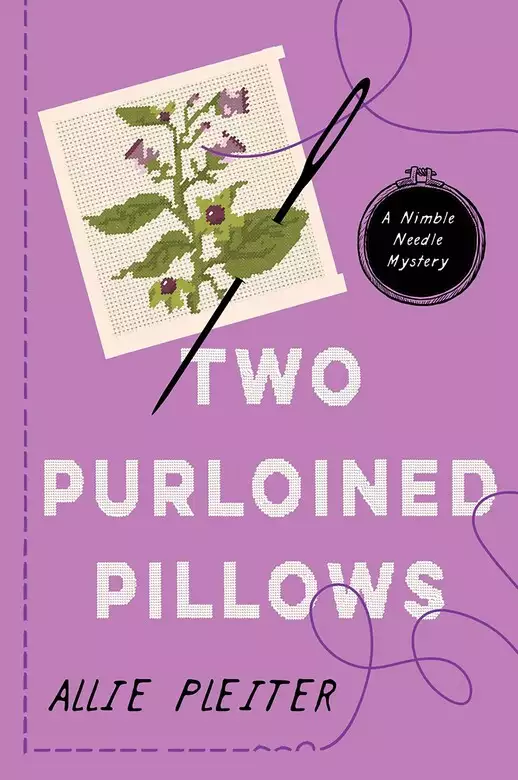
When 30-something graphic artist Shelby Phillips reluctantly returned to her small hometown outside Asheville, North Carolina to manage her mother’s needlepoint shop, she thought it was temporary. But getting entangled in murder investigations has a timeline of its own…
It’s been a little over a year since Shelby started managing Nina’s Nimble Needle following her office-romance and career implosion, and Shelby’s mom has finally handed her the reins—technically, at least. Next, Shelby is excited to oversee two well-known needlepoint designers who will be participating in the town’s first two-week-long arts festival . . .
Laura Bitters and Paul Bardo have each stitched up one-of-a-kind pillows that should be big wins for the Nimble Needle at the festival’s auction . . . until the pillows vanish amid a sudden string of shoplifting incidents.
To add to the knot in Shelby’s stomach, Laura proves highly anxious, while Paul is an egomaniac who believes Laura has been stealing his customers for years. But things go from bad to tragic when Laura behaves oddly at the auction dinner, then collapses—dead.
Soon after, Shelby makes a shocking discovery in Laura’s room at the local inn. Then tests reveal that Laura was poisoned. Resolved to piece together the truth, despite the police chief’s determination to keep her on the fringes, Shelby rallies her personal team, including her sister, Jessica, her friend Deb, and Jake, her potentially more than a friend. As an extra twist, a magazine reporter arrives with unsettling—yet useful—dirt that includes Laura and Paul.
What unravels is a skein of suspects, long-held resentment, bitter jealousy, and betrayal, from which Shelby will have to pull the one crucial thread tied to the killer: a murder-worthy motive . . .
Release date:
March 31, 2026
Publisher:
Kensington Books
Print pages:
272
* BingeBooks earns revenue from qualifying purchases as an Amazon Associate as well as from other retail partners.
I stared in disbelief at my mother. “We are talking about grown adults here, aren’t we?”
Mom offered me one of her more dubious looks. “I guess that depends. Behavior or chronology?”
Based on the series of warnings Mom had just given me about the two supposed grown adults in question, it was a valid distinction. We were discussing an upcoming event at Nina’s Nimble Needle, the needlepoint shop my mother owned and I’d taken over as manager. Event? Maybe. Circus of clashing egos? More likely. “Can’t we expect grown adult behavior from actual adults?”
“With those two? Not a chance!” came a declaration from an outlandish older woman named Dot, seated at the large gathering table in the back of Nina’s Nimble Needle. All the rest of the NYAGs—the Not Your Average Grannies, who have been shop fixtures for as long as I can remember—nodded in agreement. These women gathered nearly every day at the shop to work on their needlepoint and flex their considerable gossip skills. The NYAGs knew about all the goings-on in town and had opinions on most of them. They were some of our best customers, staunchest allies, sources of endless amusement, and some of Mom’s closest friends. I adored them as much as they frustrated me. And I knew enough to take their warnings to heart as much as Mom’s.
Evidently my worry showed on my face, because Dot consoled, “Don’t worry, hon,” with a dismissive wave. “You’re up for it. The trick will be to keep ’em apart.”
“Far apart,” added Tilly, another NYAG, as she looked up from the Christmas stocking she was working on for her fifth grandchild. It’s not at all uncommon to see people working on Christmas stockings in June here at the store. Or baby items the minute a pregnancy is announced (if even before). Needlepoint takes time to accomplish. Lots of it.
“Dot’s right. You can handle ’em,” cheered Livvy, another NYAG, in her musical Charleston accent.
I welcomed the consensus of NYAG support. After all, I’d been taking time to accomplish my work here, too. I’d been stepping farther and farther into my role as the permanent replacement for my mother, Nina. I’d been back in my hometown of Gwen Lake, North Carolina, and running the shop for just over a year now, and almost everyone considered me in charge.
Almost everyone.
In many ways Mom was the irreplaceable Nina of Nina’s Nimble Needle, and I respected that. I honored what she’d built here. I had no plans—ever—to make it Shelby’s Nimble Needle. But enough time had passed that I was now embracing the delicate task of adding my own touches to the enterprise. My role in the upcoming Gwen Lake Arts Festival was feeling like a major milestone in that transition.
The two-week arts festival was a big deal. Mom and Dad had been gone for a large portion of the past year, enjoying a spiffy artist-in-residence gig Mom had secured in Sedona. Mom insisted she’d returned to Gwen Lake “just to enjoy the festival,” but no one really believed her. The long lecture she’d just given me on how to keep rival needlepoint canvas designers Laura Bitters and Paul Bardo from making scenes told me otherwise. I gave Mom points for declaring she wouldn’t meddle, and I believe she was trying not to meddle, but the honest truth was Mom wasn’t particularly succeeding. She’d catch herself telling me how to do something, apologize, and back off, only to reinsert herself again on some new subject.
It had to be hard. The store was deeply connected to who she was and how she’d spent her time for so many years. Most days I gave her a compassionate benefit of the doubt and lots of understanding. And in this case, I genuinely needed her backup. The trouble everyone else seemed to be sure was headed our way was going to need all hands—and all wisdom—on deck.
“They wouldn’t really go at each other in public, would they?” I asked. These people were supposed to be seasoned professionals. Celebrities in the dignified sphere of needlework. Surely we could count on them to have better public manners than hotel-wrecking rock stars.
Evidently not.
All the NYAGs and Mom nodded a silent “They certainly would.” Even Leona, one of our two staff working behind the counter, tsked and made a face.
“Seriously?” I questioned, trying to imagine what a needlepoint smackdown might look like. Even with all my experience with ill-tempered artists from my former job at a Savannah graphic arts firm, I couldn’t believe the level of warnings coming my way. Based on my recent list of “don’ts,” it seemed dangerous even to put Laura and Paul in the same county, much less in the same room at the charity auction event taking place tomorrow night.
Mom drew my attention back to her notes. She’d come into the shop this morning with a typed list of warnings—not exactly a confidence-boosting maneuver. “Paul is set to come by in about an hour. Laura isn’t due until after three. Mayor Rose put Laura up at Kathy’s inn with all the other artists.”
“And Paul?” I asked, wanting to know just how much distance was between these two artists.
“He wouldn’t stay in town. While it’s usually Laura who needs lots of privacy, Paul now claims he needs seclusion.” Mom gave the last word a You’ve got to be kidding me emphasis. Mom and Gwen Lake’s Mayor Rose had come up with the idea to bring the two artists together in the hopes of spurring a charity auction bidding war. “Their appearances here at the shop are at least two hours apart tomorrow. I hope that’s enough.”
I’d followed Mom’s entire detailed list of instructions for setting up the shop’s role in selling each artist’s canvases and hosting some activities. Still, as the dueling pair arrived today, I felt like Mom should be drawing me a battle map.
I allowed myself one tiny complaint. “I wish you’d set it up so I could greet Laura first.” Laura Bitters was one of the first people to encourage me as an artist. In many ways, the camp summer I’d spent with her launched my career. Before Laura, I’d seen creativity only as something my mother possessed. Laura somehow saw the spark of creativity in me and nurtured it until I felt like maybe, just maybe, I was an artist, too. I had never really thanked her enough for that and was looking forward to a long-overdue catch-up during her visit here.
“You know Paul,” Mom said with a sigh. “He always has to be first.”
“Does he?” I pushed back, wishing I’d been a bit more forceful in voicing my opinion. I would have met with Laura first, even if Paul tried to throw his weight around. I told myself, for what felt like the hundredth time, to swallow my pride and be grateful for her strategic assistance.
“Paul’s pillow will have to be auctioned off first, too,” Mom warned. “Otherwise, he’ll make a scene.” Paul Bardo was a highly regarded canvas painter who specialized in architectural designs. We were counting on his rendition of Gwen Lake’s famous “Blossoming Bridge” to be one of the most highly bid on items at the charity auction. The stone bridge, with flowering plants blooming in containers built all along its expanse, was the town’s chief landmark. Everybody knew us by it and the charming beauty it brought to our lakeshore. So the fact that this landmark was depicted on a canvas not only designed by Paul but also stitched by the man himself made it hugely valuable.
Given that the auction was supporting arts programming in town, I took the view that if Paul and his work could bring in the big bucks, he was worth the coddling. Surely I could put up with a massive ego and a testy temperament for a few days if it sent funds to one of my favorite causes, right? How awful could the man be and still have such a loyal following?
Leona gave a soft laugh from behind the register. “He’ll make a scene no matter what you do. But Nina’s right. It will be less of a scene if he goes first.”
“But if Paul goes first, doesn’t that give Laura the advantage of knowing what high bid to beat if she wants to come out on top?” In courtroom cases, the defense always gets the final word, so it must be the stronger position.
Mom gave a small harrumph. “He won’t even consider the possibility that Laura could bring a higher bid. Paul has to be first in everything. If he weren’t so dang talented, I’d have dropped him as a vendor long ago.” She closed her notebook. “Laura will still make a scene about not being first, but she’s mostly all bark and no bite.”
“Full of sound and fury, signifying nothing,” Tilly quoted.
“Isn’t that from Macbeth?” I asked. “Maybe we shouldn’t be quoting from a play where so many people end up killing each other.”
“Laura’s far from nothing,” Mom chided gently. “She’s the best floral canvas designer there is, in my opinion. And while I’ll never say this in front of Paul, she deserves all the success she’s seen.”
“He’s a great talent, too,” Dot admitted. “He’s just a topflight jerk. How anybody with that prickly a personality makes all that gorgeous art is beyond me. Laura is a shy thing, but she’s so much nicer.”
“Artists are complicated people,” I appeased. I certainly knew that to be true. I’d spent several years refereeing artistic personalities at the design firm. In fact, it had been my experience that the more talent any artist had, the more difficult they were to deal with. Only graphic designers, while artists, didn’t have customers the way canvas design artists did. Many needlepointers were fiercely devoted to their favorite designers. They flocked to trunk shows and events where they could meet them. They paid high prices for their work. How could you be a topflight jerk and still keep that kind of following?
If there was a mark I could make on the needlework world in my time managing the Needle, I hoped to create a world that gathered artists who could be vastly talented and nice.
It’s always good to have lofty goals.
I just wouldn’t see that goal come to fruition with this upcoming pair of guest artists. In this case, it was sounding like “no blood spilled” was closer to reasonable.
“I know it’s a bit of a challenge,” Mom said, in the understatement of the day. “But it will work in our favor. Both of them will be bent on having their pillow outearn the other’s.”
“I know that.” We all knew that.
Mom leaned in. “I wouldn’t be surprised to learn either of them has planted bidders in the audience to drive the prices up.” She smirked. “Higher bids mean more money to the school art programs.”
“Sure, but is it worth the risk of such a drama fest?” I asked.
Mom nodded toward the shopwindow, where we all could see a short, dark-haired man strutting toward the shop door. “I guess we’re about to find out.”
What had to be the great Paul Bardo strode into the shop carrying a portfolio case and a Take notice smirk. In terms of ego per inch, the man packed a high ratio.
“I’m here,” he announced.
No doubt about that.
I merely smiled, mustered all the reverence I could, and replied, “So you are, Mr. Bardo. And what a privilege it is to be hosting you.”
He looked at me as if he couldn’t quite understand why I had replied. “I was talking to Nina.” The man had a voice that reminded me of steel wool—sharp, scratchy, and weirdly squishy around the edges.
“Paul,” Mom said, grandly ignoring the snub and extending her hand. “What a thrill it is to see you again.”
“Nina darling. Still as beautiful as ever.” He somehow managed to make the compliment sound like she ought to be thrilled to have been graced with it. There was something not quite sincere behind his eyes. I bet you say that to all the girls.
I’d wrangled enough massive egos in my day to know now was not the time to back down. I stepped forward and extended my hand for a shake, as well. “I’m Shelby Phillips, her daughter. I’m running the Nimble Needle these days.”
Paul did not look pleased to be dealing with what he considered the B team. “Is this no longer Nina’s Nimble Needle?” The situation clearly did not meet with his approval. He glared at Mom with an expression that roughly translated to You’re not really going to make me work with her, are you?
Mom gave an uncomfortable cough. “Now, Paul …”
I swallowed hard and applied a smile, as if I hadn’t heard the condescension in his voice. “The store name has not changed, Mr. Bardo. But I’ll be handling your appearance here.” Since he hadn’t accepted my offer of a shake, I held out the same hand toward the portfolio he’d brought into the shop. He was delivering canvases so we could hang them for display and sale.
He practically sneered as he clutched the case closer to his chest. “Not if I can help it.”
We were off to a stellar start. With no reason to think it wouldn’t just go straight downhill from there. Mom had warned me, but I had thought she was exaggerating. From behind me, I heard murmurs of disbelief and disapproval from the NYAGs. Mom was oddly silent. Shocked, I hoped, by the blatant condescension of our guest.
“Now, Paul …,” she said again after a wildly uncomfortable pause during which everybody stared at everybody else.
“Let’s just move things along, shall we?” I offered. “I will need to get started on these if you want them displayed to your high standards.” I tried—and failed—to take the case of canvases out of Paul’s hands.
Paul blinked at Mom, slightly stunned that I’d even attempted to yank the portfolio’s handle from his thick, short fingers. “Does she know the proper way to hang these?”
“Of course she does,” Mom replied. “Come on now, don’t be so difficult.”
I wondered if he caught the small snort I heard from the table of NYAGs behind me. Technically, Paul had asked a rather insulting question. Hanging canvases is an essential skill in running a needlepoint shop. And, I might add, not a particularly complicated one. The open-holed mesh on which Paul’s masterpieces were painted was quite stiff and durable. The edges were taped to keep them from any fraying, and there were no frames around these canvases. The process mostly involved carefully tacking them to a vertical surface so they could be seen by customers. Needlepointers never manhandled them and usually treated them like the art pieces they were.
Still, it was clear Paul viewed this as a test of my credentials. I wouldn’t be surprised if he thought anyone other than Nina would toss them in a shoebox on a table. I was more than ready to prove him wrong. Ready, in fact, to show off the ingenious display tactic I’d created exclusively for Paul’s and Laura’s visit.
The Nimble Needle was a long rectangular space dotted with two tables and a sales counter. At the back was the large oval table, where the NYAGs were currently giving Paul a combination of admiration for his well-known talent and side-eye for his condescension.
Closer to the front was a smaller table, reserved for specialty displays like seasonal items. Currently, it held an after-season sale of Easter designs. On the long wall on our left hung a series of large boards, vertically hinged like pages in a giant book. Normally, they held the many canvases in stock at the store so that customers could easily browse the large selection. Flipping those boards was always an inspiring experience—so much color and art ready to be stitched. It was a rare Needle customer who didn’t flip through those boards and discover three or four things they wanted to take home.
Yesterday I’d spent hours emptying those boards, so now they stood bare and waiting for one of our two featured guests. A front-and-center focus worthy of a needlework celebrity.
The shop’s other long wall, opposite, on the right, usually held the fibers. It was a carnival of color—the endless variety of colored threads, floss, wools, and silks used to stitch the canvases. Customers were always darting back and forth between the canvases and the fibers, choosing and combining to create their projects. Needlepointers call it “pulling colors,” and it is one of my favorite activities to watch. So much excitement and possibility!
That wall still held some of the fibers, but many of them had been moved to the back wall, so there was a large clear space on the right-side wall. It had taken a bit of ingenuity and planning, but I knew it was necessary considering our rival artists. Now there was a clear space on each opposite wall for Paul’s and Laura’s canvases. I’d guessed neither of them would consent to having their work displayed anywhere near the other’s—and boy, was I right. This bit of rearranging meant Paul’s and Laura’s art would be as far away from each other as we could physically manage.
I thought of it as the display version of the game of “keep them away from each other,” which we’d be playing all week. The whole strategy gave me a new appreciation for the high-tension act some of my married friends had bemoaned in needing to keep feuding family members apart at weddings and such.
The need for this unique display tactic struck me as ridiculous and territorial. A level of coddling that professional adults shouldn’t need. It was clear from Paul’s glare, however, that he took the whole display dynamic quite seriously. I had no doubt Laura would, as well.
I continued in my best I’m here to meet your needs voice from my design firm days. “Your designs will be exclusively featured on one of these walls. The pillow with your bridge design, of course, will be in the window at town hall.” His pillow and a pillow with one of Laura Bitters’s acclaimed botanical designs—both stitched by the artist themselves—would be featured. I didn’t mention that dual display at the moment.
“Your pillow is a one of a kind, after all. But the limited-edition canvases of the same design will be right here for sale. As well as all the other outstanding original designs you’ve brought with you. Our customers are eager to see them, I promise you.” Paul had hand-painted a limited edition of twenty-five of the same canvas featuring the Blossoming Bridge that appeared on the auction pillow. We were all sure they’d go fast, despite a hefty price tag.
Non-stitchers will occasionally ask me why needlepoint canvases come at such a high price. The simple answer is, because you are buying art. Yes, you embellish that design with your stitches, but a well-painted canvas gives you the artistic foundation. An elaborate version of coloring within the lines, if you will, only here you are adding fiber color atop the colors a talented artist painted on the mesh canvas.
It is 100 percent art, and a unique partnership between designer and stitcher. That’s one of the things I like most about needlepoint: it’s art and craft. You can spend less money for manufactured canvas—the needlepoint equivalent of an art print—but it’s always worth the higher price to get actual art painted by an actual artist. It’s not hard to see why they sign their work, as any painter would.
It was clear Paul thought of himself as a venerated artist. He was, but I didn’t think he needed to get quite so high-and-mighty about it. The man’s thick black eyebrows lowered as he glanced back and forth between the shop walls. “Which wall?” He said the two words so sharply they almost weren’t a question.
Here was the beauty of my scheme. “Your choice.”
It worked. It was clear this choice made the man very happy. He’d get to decide which wall was his and which would be relegated—because I’m sure that’s how he would view it—to Laura.
To my great satisfaction, Paul loosened his death grip on the portfolio and handed it off to me. Mom shot me a proud look. From behind Paul, Leona gave me a thumbs-up of victory.
Paul turned, steepled his hands, and walked slowly between the walls. He looked like a general choosing battle tactics. The man went back and forth no less than three times before selecting the spot on the wall with the threads. I could have guessed it: this meant no other canvases would be near his. He probably also had some theory as to why the wall on the right held more gravitas than the wall on the left, but I certainly wasn’t going to ask him the reason behind his choice.
“Excellent,” I said, trying to sound as if I found his choice brilliant.
“Show us what you’ve brought,” Mom said, walking back to where I’d set down the portfolio. “We’ve all been dying to see.”
Paul walked over and unzipped the case as if unveiling a statue. “The one,” he said with an And you all know which one I mean tone, “is already in the window at town hall.” He opened the case and took out one of the limited-edition unstitched canvases of the same design. Complete, unsurprisingly, with a huge signature in one corner. “But what do you think? So much better in person, yes?”
Gasps went up around the room. It was undeniably beautiful. I had seen a photo of Paul’s stitched canvas, made into a pillow, which evidently had been placed in the town hall window before his arrival here. In person, it really was stunning. Part of the reason Paul got away with such a monumental ego was that he was a monumental talent. He had gained some notoriety just from the fact that he was a man—the majority of designers and stitchers were women—but that just seemed to add to his well-nurtured mystique.
Mom put her hand to her chest. “It’s just gorgeous. Our little bridge, an exclusive Paul Bardo design.”
Paul leaned in. “Better than hers, don’t you think?”
Again, I’m sure no one in the room missed the derisive snort from the NYAG table. I could only muse about the irony of it all. They might take all the potshots they wanted at Paul Bardo, but I knew at least two of them would pay the hefty price for one of those limited-edition canvases. And, while I wouldn’t point it out at the moment, they’d do the same for Laura’s.
Mom applied her “customer service” voice, the melodic, appeasing tone of which she was a master and I’d become an eager student. “Paul, you promised me you wouldn’t get like that.”
“Whose idea was it to invite both of us, anyway?” Paul sneered.
“Mine,” came a commandin. . .
We hope you are enjoying the book so far. To continue reading...

 Please log in to recommend or discuss...
