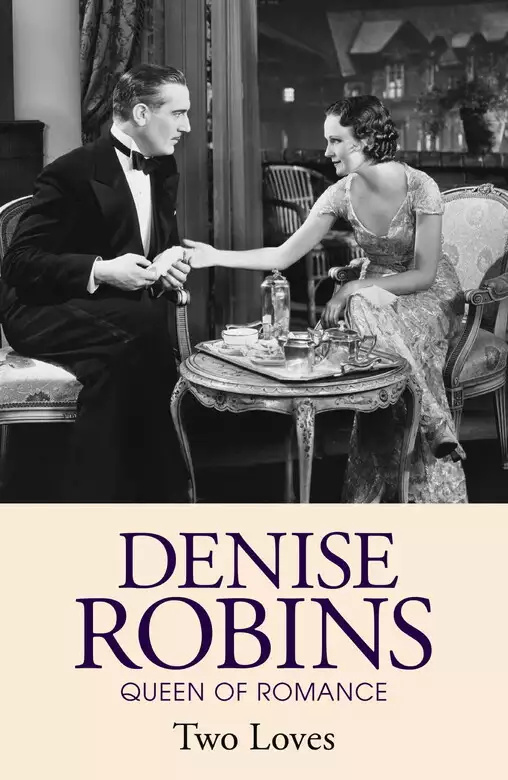
Bill is handsome, tender and exciting, but Cherry knows she can't live on love alone. Phillip does not attract her as Bill does, but his wealth can buy Cherry everything she's always wanted. Cherry is determined to have them both. Cleverly concealing one's existence from the other, Cherry begins leading a dangerous double life, unknowingly pushing all three of them towards disaster.
Release date:
March 27, 2014
Publisher:
Hodder & Stoughton
Print pages:
128
* BingeBooks earns revenue from qualifying purchases as an Amazon Associate as well as from other retail partners.
Even as a child Cherry Brown had longed for money and the things money could buy and wanted to be the centre of attraction wherever she went.
Her mother had often told her that when she was a tiny tot of four or five, she would preen herself in front of a mirror, satisfy herself that she looked “nice,” then run out and join her small playmates in the village; expect to be the leading spirit of the games and the queen of all the small boys. She was “Queen of the May” every summer, and she was belle of the village from her ’teens. She loved to feel that she was fascinating, that she had a strong appeal and charm for everybody, and while she accepted the simple, humble devotion of the country lads, she really disdained it; told herself that she would be a fool not to use her beauty and charm to climb the social ladder.
Yes, looking back now, she realised it was a sort of craze in her to be rich and adored. It burned inside her like a flame, although she had to live her life for a time where Fate had placed her—in Dalescombe as a domestic servant to the local doctor.
Cherry longed for love; but she wasn’t going to throw herself away on some farm boy or garage-hand. Her head ruled her heart. Her lover must be rich. And so, until she was eighteen, she kept herself away from the Dalescombe boys.
She cut out photographs of the glamour girls and models from old Society papers which some lady in the village had finished with, and plastered the walls of her tiny attic-bedroom at home with them. Titled women of fashion and film stars were her models. She intended to look like they looked. One day she intended to wear smart clothes with a good deal more grace than they wore them! She even bought an old book of etiquette from a second-hand bookshop and studied it.
Then love came into Cherry’s life. Not money, not any of the luxuries for which her soul yearned; but passionate love, as thrilling, as wonderful as any girl could desire. They are fools who say that there is no love at first sight.
There was a fair at Dalescombe every June. This particular June there was to be a small boxing contest. The local light, Ted Stevens, was to box a boy named Bill Carew from Little Cross, a village about ten miles away.
Cherry’s brother, Eric, took her along to the fair. He wanted to see the boxing match, and that is how she first met Bill Carew. He was then twenty-two, and only a motor mechanic at Little Cross, but he had more brains, more culture, and more charm than most of her friends. She was hard to please, but when she set her eyes on Bill when he came into the ring, she thought him the handsomest chap she’d ever seen.
Tall, of middle weight, he had magnificent shoulders, the long reach, the iron hands of a born boxer. The muscles rippled beautifully under his smooth, bronzed skin, and he had a fine head covered with dark, curly hair, a pair of amazingly blue eyes—his mother was Irish—and a rich beguiling voice. Cherry fell in love with those handsome, Irish eyes with their black lashes and his caressing voice just as soon as she met him.
One of the girls from Little Cross who knew her sister—who was a telephonist, told her that Bill Carew had no girl friends.
“Everyone says he’s hard to please,” she informed Cherry. “Smiles at all the girls and no more. Plenty have tried to catch him but he seems hard to get.”
That was a challenge, and Cherry’s heart thrilled in response.
Cherry knew she was looking pretty that night in her pink dress, with best best nylons covering slim legs—one of her good points; her hair, which was bright chestnut brown, in disorder about her face. She had pink cheeks and lustrous, hazel eyes, and attractive curved lips. She meant to make that young chap, who was so handsome and so “particular,” take notice of her.
Cherry said to her sister’s friend:
“I bet you I’ll catch him, Polly!”
Bill Carew had at that moment moved away from a circle of small boy admirers after the fight. He was just getting astride one of the rocking-horses on the merry-go-round. The music was playing noisily. Brights lights flared. All the boys and girls were laughing and shouting. It was a warm June night, alive with gaiety, with simple pleasures that satisfied Cherry’s ambitious soul for once. She had eyes only for the handsome young boxer on his horse.
The whistle shrilled. The horses began to move round, and her heart was pounding, her eyes riveted on Bill. The next instant she sprang onto the merry-go-round and clutched his arm.
“I’m going on your horse with you!” Cherry said, panting.
He smiled quickly and stared at her in amazement. She smiled, and, as light as thistle-down, jumped on to the horse in front of him.
“Catch hold, Bill Carew!” she said daringly.
Polly and her sister, open-mouthed, awed at her daring stood watching on the green. And then, a new, eager look came into Bill Carew’s blue eyes. He put an arm about her.
“You’ve got nerve, you little thing. But all right, hold on. I’ve got you!”
Round went the horses, swaying, rocking to the music. The lights, the faces on the green became a kaleidoscope of colour. She looked up into the eyes of the man who held her close to him and laughed.
“You boxed beautifully,” she whispered. “I’m glad you laid Ted out.”
“Thanks!” he said. “That’s nice of you. What’s your name?”
“Cherry Brown,” she told him.
“Cherry’s a pretty name,” he said, and stared down at her. She saw him taking in her looks, saw him becoming very aware of the pink of her cheeks and the length of her lashes and her smile. Before that merry-go-round stopped Bill Carew was holding her just a little tighter.
When it slowed down, Cherry jumped out of his arms and on to the ground.
“Good-night!” she said archly.
But he was after her like a shot.
‘Don’t run away. Come and have a dance,” he begged.
She danced with him quite demurely; saw he was puzzled by her; didn’t know what to make of her. She was shy and bold in turns. She interested him. Finally, he led her across the clover fields, to the fringe of Dalescombe Woods. And there, suddenly, took her in his arms and kissed her.
Cherry’s feelings were indescribable when she felt that kiss on her lips. She had flirted before, kissed lightly, but never had love touched her as it did with Bill’s first kiss. She wanted nothing, nobody but Bill Carew from Little Cross that night—Bill with his curly black hair and Irish blue eyes and warm and bronzed young face.
“Cherry, Cherry, how wonderful you are, you little thing. Sure, I felt something strange and wonderful happening to me when you jumped up on the merry-go-round with me. You were so cheeky and adorable.”
She looked at him. Her desire for riches was completely in the background then. She said:
“I love you, Bill! You’re so strong, darling! I love you!”
“Say you’ll walk out with me whenever I can cycle over from Little Cross to see you,” he begged. “Say you’ll marry me one day, Cherry.”
“Marriage!” Ah, that made Cherry hide her face on his breast and bite her lips. She was afraid of marriage where there was no money. Bill was telling her about himself. He cherished hopes of finding a backer to finance him; train him to become a middle-weight champion. At the moment in Little Cross he was a hero, but in the world—nothing. And his ambitions like hers, might come to nothing.
Cherry knew she could not marry on bread and cheese and kisses. But that night of the fair she was reckless—stupid with love. When she walked back to the fair with him to find her brother, she had promised to marry Bill Carew.
It was a great victory, and Cherry loved Bill Carew that night, and for many days after. But could she marry him? He wasn’t able to buy her the flowers and jewels and furs like the lover of her dreams. She was determined to be a rich man’s wife.
Suddenly she remembered that some new people had taken the Manor House, Dalescombe—a beautiful old Georgian residence, which stood in sixty acres of grounds. They wanted a parlourmaid. Most of Cherry’s girls friends refused to go into domestic jobs. But she thought a living-in post in a luxurious home might be amusing. And one was well paid on the staff there. Besides, she would catch glimpses of life—real life! She would be able to see how ladies lived in their own houses—rich ladies, what they said, how they behaved. She could take note; model herself on them. She would listen and learn.
Cherry wrote to Lady Bayfield, who had taken the Manor House, and asked if she would give her a trial. To her delight she was accepted.
Cherry told Bill about the new job one night when he cycled over from Little Cross to meet her at their trysting-place down by the woods. But the thrill of the new situation had gone. She had Bill’s arms about her then, his lips on hers. She wanted nothing but him. Her restless heart was at peace.
“If only I was rich and could marry you,” he said in a yearning voice, his blue eyes shining down at her in the starlight. “Cherry, little girl, I do love you!”
“I adore you!” she answered. “I wish we could marry now.”
He jumped off the stile on which they had been sitting, like any Dalescombe sweethearts, and circled her waist with his arms. His face had grown suddenly hard and white.
“Cherry, you lovely little thing, if ever you throw me over—I’ll want to kill you!”
Her heart gave a leap of fear. She put her hands on his head.
“Bill darling, I don’t want to throw you over.”
“But if you ever do. You’re so pretty, so fascinating. I’m terribly afraid some fellow will try and steal you, and if he did I’d put a bullet in his head!”
Then on the eighteenth of that sweet mad month of June, Cherry entered Lady Bayfield’s service—her first place “sleeping-in”—and the whole course of her life altered from that day onward.
Lady Bayfield was a widow. She had a large income, an old aristocratic title, and one daughter, her heiress, by name Veronica.
Veronica was, in her way, a very pretty girl. She was one year older than Cherry, and a woman of the world.
She had had all the chances that life had not given to Cherry—expensive education and an adoring mother to give her everything, within reason, that she wanted.
Cherry used to wonder how her charm would stand against Veronica’s. By some strange whim of Fate’s Cherry was given the chance a month after she became one of the staff at the Manor House.
Veronica went away for three weeks to stay with an aunt in London. When she came back she brought a fiancé for her mother’s approval. Lady Bayfield approved. The young man—Phillip Bellairs—was not titled, but he had an extremely rich father—one of the big ship-builders of England—who indulged his whims, and one day he would inherit a fortune.
He had been educated at Eton and Oxford. He was about twenty-seven years old, had travelled a good deal, was very intelligent, and considered an excellent “catch”. He had a shooting lodge in Scotland, lived either with his parents in their London house, or at his exclusive club, and owned racehorses at Newmarket.
Hearing all this, Cherry began to envy Veronica. She had all Cherry wanted. Phillip Bellairs seemed to be just the man of her desires.
She caught a glimpse of him in the hall just before dinner. He was slim, shorter than Bill Carew by a head, but very good-looking. He had smooth, brown hair, brushed straight off his forehead. His face was thin and a little lined for his age.
In no way was Phillip Bellairs as handsome or as arresting as Bill Carew. But much more fascinating to Cherry from that night onwards! He had so much more than good looks. He had money, and money was power.
Cherry watched him closely for several days and nigh. . .
We hope you are enjoying the book so far. To continue reading...

 Please log in to recommend or discuss...
