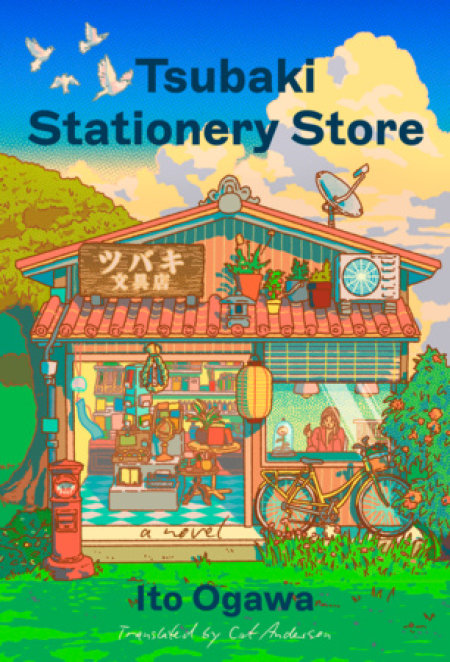
A spellbinding and heartwarming Japanese bestseller about a young woman who inherits a stationery store from her late grandmother and becomes the trusted scribe of the town
You always told me that writing is life itself.
After many years abroad, Hatoko reluctantly returns to Kamakura to take over the stationery store left to her by her late grandmother. As the custodian of the store, she also inherits the profession of public scribe, a role Hatoko trained for as a child under the guidance of her strict grandmother.
As the locals seek out Hatoko's help, she takes on all manner of requests: writing letters of greeting, condolence, farewell, love, and more on behalf of those who come to her. A local community forms around Hatoko and the store, and when the secrets of her late grandmother begin to unravel, Hatoko learns that the role of the scribe requires much more than putting ink to paper.
Set to the rhythm of the four seasons and the Japanese rituals and festivities that come with them, Tsubaki Stationery Store is a charming story about the importance of community and the reconciliatory power of the written word.
Release date:
July 7, 2026
Publisher:
Dutton
Print pages:
304
* BingeBooks earns revenue from qualifying purchases as an Amazon Associate as well as from other retail partners.
I live in a small house that sits at the foot of a little forested hill. My address is in Kamakura, in Kanagawa Prefecture-but while Kamakura is a seaside town, where I live is a little way inland and up toward the woods, some distance from the sea.
I used to live with my predecessor, but she died around three years ago and now it's just me in this old Japanese house. I should say that insofar as the blood relationship between me and my predecessor goes, she was my grandmother. But she never allowed me to call her "Granny" or "Grandma" or anything so familiar. It was she who brought me up single-handedly, all while keeping the business going.
I don't feel especially lonely now though, because there are always signs of other people around. At night my neighborhood is like a ghost town, blanketed in silence, but when morning comes the place livens up, and I catch the chatter of voices from here and there.
Once I'm up and dressed, face washed, the first thing I do every day is fill the kettle with water and put it on the hob to boil. While the kettle's boiling, I sweep the floors with a broom and then wipe them down with a damp cloth. The kitchen, the raised veranda that runs along the side of the house, the living room, the stairs: I clean them all in turn.
When the kettle boils, I pause my cleaning for a moment to make the tea, pouring a generous amount of hot water into the pot. While the leaves steep, I get back to polishing the floors with a dust cloth.
Once I've put the washing on, finally I sit down in the kitchen and have a cup of green tea, breathing in the aromatic, smoky scent that wafts up from the cup. It's only recently that I've developed a taste for coarse kyōbancha tea. When I was a child I couldn't understand why my predecessor would go to the trouble of brewing up those crispy old leaves for a drink. But now, even in the height of summer, I don't properly feel awake without my hot cup of tea first thing in the morning.
As I sit there daydreaming, sipping my kyōbancha, the little window in the wall of the house next door opens slowly. It's my next-door neighbor on the left, an older lady named Madame Barbara. There's nothing about her looks that suggests she's anything other than fully Japanese, but for some reason that's what everyone calls her. Perhaps she's spent time living abroad.
"Good morning, Poppo!" Her cheery voice comes in on the breeze.
"Good morning," I say, my own voice rising a little higher than usual to match hers.
"Another lovely day! Why don't you come over for a cup of tea in a bit? I've been sent some castella sponge cake from Nagasaki."
"I will, thank you. I hope you have a nice morning."
We exchange our daily greetings from our windows, Madame Barbara on the landing halfway up her stairs and me down in my kitchen. It always reminds me of Romeo and Juliet, and makes me want to giggle.
I wasn't sure how I felt about our proximity at first. Awkward as it is to say this, I can hear Madame Barbara when she coughs or when she's talking on the phone, and sometimes I even hear the noise of the toilet flushing. It almost gives the illusion that we're living together under one roof, and I find myself listening to the sounds from next door without even meaning to. It's only recently that I've finally got comfortable saying good morning to Madame Barbara. And with this exchange of greetings, my day well and truly begins.
My name is Hatoko Amemiya. It was my predecessor who named me. "Hatoko" means "dove child," and it was chosen for the famous doves of the nearby Tsurugaoka Hachiman-gū Shrine. The shrine is dedicated to the god Hachiman, and the "hachi" character in the shrine's name is said to look like two doves nestling together:八 And so for as long as I can remember everyone has called me Poppo, a sound like the cooing of a dove.
It's still only morning, but it's far too muggy here already. The humidity in Kamakura is no joke. Freshly baked French bread quickly goes limp and moldy, and even stiff sheets of dried kombu seaweed end up floppy.
Once I've finished hanging up my washing, I take out the rubbish. The collection point is by the bridge that crosses the Nikaidō River, which flows right through this area. The burnable rubbish gets collected twice a week. Other things-paper and textiles, plastic bottles, garden waste, glass and cans-each get collected once a week, and there's no collection at weekends. Other waste that doesn't fall into these categories gets taken away once a month. At first I thought it was annoying having to separate out the rubbish so meticulously, but now I actually find I enjoy it.
By the time I've put out the rubbish, the children are filing by the house on their way to school, schoolbags on their backs. The primary school is only a few minutes' walk from here, and a lot of the stationery store's customers are schoolchildren.
I pause for a moment and take in my house again. Across the glass panes on the upper half of the old double doors are written the words "Tsubaki" on the left and "Stationery Store" on the right.
ツバキ文具店
And just as the name says, outside the door, as though protecting the house, there stands a large camellia tree: a yabu-tsubaki.
The wooden nameplate on the wall beside the door is all blackened with damp now, but if you look closely you can just make out the faint word "Amemiya." The characters look as though they've just been dashed off, and yet the brushstrokes are exquisite. Both the shop's name and this nameplate were written by my predecessor.
The Amemiyas are a family of scribes, with a distinguished lineage said to date back to the Edo period in the seventeenth century. In olden times, professional scribes made their living by performing writing services for the nobles and lords. The most important requirement, of course, was skill at calligraphy-good handwriting. There were three eminent scribes who worked for the shōgun when the shogunate was based here in Kamakura seven or eight centuries ago. Later on in the Edo period, among the women of the shōgun's household, female scribes began to serve the lords' wives and concubines. One of these scribes who served in the shōgun's entourage is said to have been the first of the Amemiya line.
Since then the Amemiyas have been scribes by trade, generation after generation of women taking up the brush. The tenth-generation scribe was my predecessor, and the eleventh, the next one to take on the family business-without entirely realizing it was happening-was me.
The work of a scribe has changed since times past, however. Nowadays it mostly involves writing names on gift envelopes, inscriptions to be chiseled into stone monuments, calligraphy for babies' naming ceremonies, shop signs, corporate philosophies, messages of encouragement for important events and so on. My predecessor would perform any work requested of her, as long as it involved writing: the certificates for the gateball champions at the old folks' club, menus for Japanese restaurants, a CV for a neighbor's son to use when he was job-hunting. In short, this place is a one-stop shop for anything to do with writing and words-even if at first glance it looks like no more than the local stationery store.
My last task of the morning is replacing the offering of water by the fumizuka stone. To other people it might just look like some old rock, but to my family the fumizuka is more important than the Buddha himself. What it is, really, is a grave for letters. Just now, the stone is surrounded by a mass of fringed irises, glorious in bloom.
And with that, my morning chores are complete. Until half past nine when I open the Tsubaki Stationery Store, I have a little free time. On this particular morning I was off to Madame Barbara's house after breakfast to join her for a cup of tea.
Looking back over the last six months, I do think I was struggling to stay afloat. When my predecessor died, Aunt Sushiko took care of the bulk of her affairs for me, but there were still lots of bothersome bits and pieces left over that she couldn’t make decisions about single-handedly, and while I had fled overseas a whole heap of odds and ends had piled up that now required attention. So once I was back I got my head down and dealt with it all, bit by bit, feeling as though I were scrubbing and scrubbing at the blackened, burned stuff on the bottom of a pan.
This charred matter I was tackling mainly involved inheritance and rights, which to me in my twenties hardly seemed worth the hassle. My predecessor had been adopted into the Amemiya family at a young age, however, and so the situation was a fairly complicated one. I had the urge to just crumple the whole lot up and toss it into the bin-but when I thought about the grown-ups who would be rubbing their hands with glee, I found a last-minute burst of motivation to take on the house and the shuttered-up shop. Besides, if I went and gave it all up, the building would swiftly be torn down and turned into flats or a car park. And if that happened then the camellia tree that I loved so much would be chopped down too. I had been fond of that tree since I was a child, and it was the one thing I wanted to protect with my own hands at all costs.
Later that afternoon, I awoke with a start at the sound of the shop’s bell.
I must have drifted off to sleep. The pitter-patter of the drizzle on the ground outside had been the perfect lullaby. It had rained every afternoon for the last few days.
I usually open up the shop at half past nine, and then a bit later on I eat my lunch in the kitchen at the back while keeping an eye out for customers. All I have in the mornings aside from my cup of tea is a little fruit, so I tend to eat a fairly big lunch.
It hadn't looked like there would be many customers today, so I had had a careless lie-down on the sofa in the back, and what was meant to be a brief siesta had turned into a deep sleep. After six months back in the house, I was accustomed to living here; perhaps I felt more relaxed now, because lately I always seemed to be oddly ready for a nap.
"Hello?" A woman's voice rang out, and I hurried through to the shop. I thought the voice sounded familiar, and when I saw her it clicked: it was the lady from Fish & Fortune, the local fishmonger, who we called Auntie Fish.
"Poppo!" she said when she saw me, her eyes sparkling. Her voice was as brisk and clear as ever, and she was clutching a thick bundle of postcards. "When did you get back?"
"In January," I told her. She lifted up the hem of her long skirt, crossed one leg behind the other and then bobbed down in a playful, mock-elegant curtsey. Ah yes, I remembered fondly, she was always like that. Everything about her took me right back: her well-worn flowery apron, her white ankle socks, the large hair clip she wore to keep her fringe out of her face.
When my predecessor had sent me out shopping for dinner, Auntie Fish would always give me sweets or chocolate or karintō, something sugary to snack on. She would purposely press these treats on me, knowing that my predecessor had forbidden them. When I was young I would entertain fleeting dreams of how happy I would be if only she were my real mother. Auntie Fish had three children, but all boys; perhaps that was why she had doted on me like a daughter. Nowadays, she told me, her son and his wife looked after the fishmonger's, while she enjoyed looking after her grandchildren.
It did seem odd that I hadn't run into her in the neighborhood in the past six months, though.
"My mother's confined to bed all the time now, so I've been back in Kyūshū for the last little while," she explained with a smile. "I must have missed you. But I'm so glad to see you're looking well! I was always saying to my old man, 'I wonder how Poppo's getting on . . .'"
By her "old man," Auntie Fish meant her husband, who had fallen seriously ill a few years ago and had since died. Aunt Sushiko had emailed me to let me know. I'd been away in Canada at the time, on a working holiday.
"Anyway, thank goodness you're here!" Auntie Fish said brightly. "A lot of people look forward to our midsummer card every year, I didn't know what I was going to do. When I heard the store had reopened I didn't believe it was true, but I thought I'd come and see for myself-and here you are. How wonderful!" She held out the bundle of postcards. They were the special summer greetings cards issued by the post office, the ones where the recipient gets the chance to win a prize.
Auntie Fish didn't have bad handwriting herself-far from it. Her writing reminded me of a beautiful chiffon scarf floating through the air. And yet every year without fail, she requested the services of the Tsubaki Stationery Store. It was only because her business and ours had been acquainted since my predecessor's time.
"The same as always, please!"
"Certainly."
And with that, our business was concluded. Auntie Fish stayed and chatted with me a little while longer, and then she headed off.
I flipped through the calendar, using a pink highlighter to mark this year's dates for "lesser heat" and "beginning of autumn," two of the traditional seasonal divisions of the year. Up until "lesser heat" in July you sent rainy-season greetings cards, and then up until "beginning of autumn" in August it was midsummer greetings, and then once that was over it would be late-summer greetings.
This was the first big scribing assignment to come my way for a long time. I gave my face a wash to wake myself up again, and then I got started on the preparations straight away. First, I took the hanko stamp with the fish design, the one we had been using for years, and with it I completed the design on the back of the postcards. The back of the cards was a straightforward job that I could do while still tending the shop. We had been undertaking Fish & Fortune's midsummer greetings cards for years now-decades, in fact. The task itself was simple, but the sheer quantity of cards meant it wasn't a job to be underestimated. The various implements that we used from year to year had all been sorted into boxes by my predecessor. Fish & Fortune was a long-time client, and by now I was so well acquainted with them that I could make up the midsummer cards in a style that suited their business without having to run each and every detail by them.
We hope you are enjoying the book so far. To continue reading...

 Please log in to recommend or discuss...
