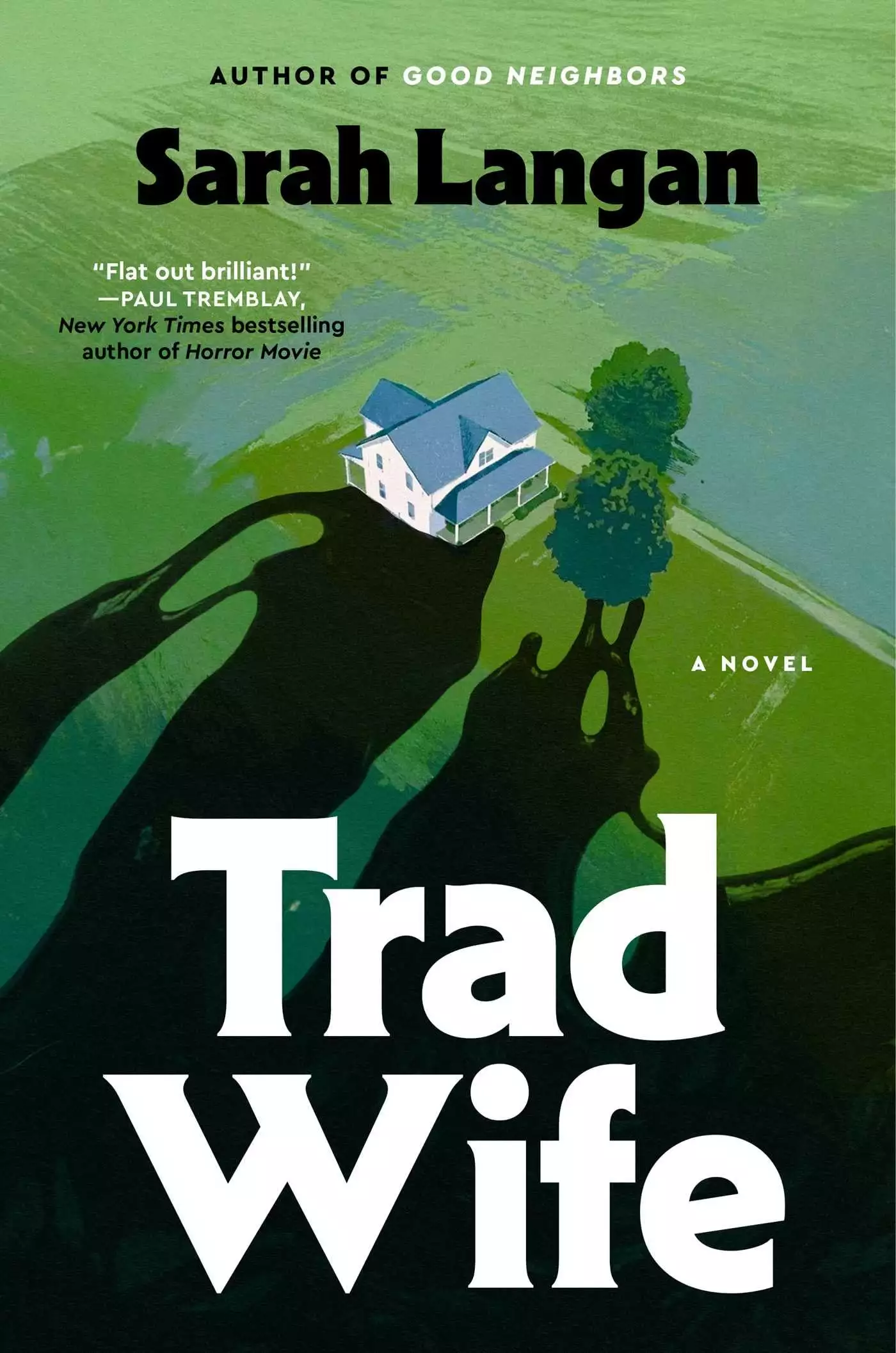
From the three-time Bram Stoker Award–winning author of Good Neighbors comes a chilling tale of a journalist's descent into horror as she uncovers the dark secrets behind a trad wife influencer, blending suspense with a critique of modern femininity and the manipulative forces of social media.
Every day, millions watch Mia Wright, the “trad wife” queen, on her idyllic 300-acre farm. With her handsome husband, seven perfect children, and a life of from-scratch meals and pastoral bliss, she’s an icon of modern femininity. But behind every perfect image is a secret. And in this case, the secret is a horror.
Desperate to save her tarnished career, journalist Jenny Kaplan arrives at Black Swan Farm to profile Mia. Jenny is ready to write a scathing exposé, determined to expose the deception behind Mia’s curated life. But soon, Jenny has more to contend with than staged videos and picture-perfect poses. There’s something wrong at the farmhouse. Something slithers through Jenny’s dreams, and at night, the children sing strange nursery rhymes.
She’s losing time. She’s losing her hair. She starts to worry that she’s losing her mind.
There is a horror at the heart of Black Swan, and it’s waiting just for Jenny. Trad Wife will make you question what’s real and what’s just a perfectly curated deception…
Will you see the lie?
Release date:
September 29, 2026
Publisher:
Atria Books
Print pages:
320
* BingeBooks earns revenue from qualifying purchases as an Amazon Associate as well as from other retail partners.
If asked, Jenny Kaplan would not have been able to pinpoint the moment at which Black Swan Farm took over her life. Does fate begin with a snap! when the trap is sprung, the rabbit snared? Does it begin with the rabbit’s first sight of the lure? Or does it go back even further, to the reason the rabbit is attracted to the trap in the first place?
It was the morning of Kaplan’s thirty-second birthday, a Monday in May in the city that never sleeps but does enjoy sleeping in. She squinted into her bathroom mirror and thought: I’m so fucking old.
In another reality, she was married to Jarron Stills right now: justice of the peace, a lilac bouquet, their nice friend Victor and her obnoxious little sister, Melissa, as witnesses. But things between her and Jarron had ended months ago. Thinking about what happened still knotted her stomach. So she didn’t think about it. She kept it in a pile in her mind like unsorted dirty laundry, to be accounted for tomorrow, or the next day, or never.
Forget her personal life. Too big a shit show. That left work.
Nobody in charge had ever thought Jenny was special. No gold stars for exemplary work, no recommendations for advanced placement classes or special employee-of-the-month parking spaces at the Taco Bell.
At Rutgers University, she’d written passionless human interest pieces about people who kept iguanas in their dorm rooms as pets, the worst campus cafeteria, and the best local study nooks. None of her professors had thought she belonged in the program. They’d let her know this, in the petty ways mid-level artists love to do. Well written and researched but boring, her senior seminar professor had scrawled on her final piece, about the decline in Sadie Hawkins dances around the country: B minus. Those publishing mixers sponsored by the journalism department, to help students find jobs? Never once had she been invited.
Only her mom had expected her to make a career of it. There’s a reason you’ve been keeping a diary since you could hold a pen, Christine Kaplan had told her. Stop putting a clock on this. You’ll find your voice when you’re damned good and ready. Christine hadn’t been an especially present or interested mother, but she’d seen her children clearly, and in Jenny’s case, she’d believed.
Writing was free. Writing came from within. Her desk and laptop and a little silence were the three things in life that reliably made her happy. On good days, when she entered the zone, it felt like reaching through the dark and tugging the shirtsleeves of the divine.
She’d worked at Bread and Circus magazine for a decade now. Early on, the job had been genuinely glamorous. One flash of the corporate credit card at Delancey Rooftop and she’d been at the front of the line, where somebody’d handed her something wet and free.
The Condé Nast building used to house every slick on the East Coast. She’d sometimes spotted Anna Wintour noshing on Nicoise salads in the VIP section of the Frank Gehry–designed cafeteria. The fancies all sat together—GQ, The New Yorker, Vanity Fair, Wired. The women’s magazines sat together—Vogue, Mademoiselle, Glamour, Allure. The lesser slicks like Bread and Circus were satellites around them, crouched and eager for gossip scraps.
One building to rule them all.
That was the Wild West of the industry, when the slicks expanded their staffs to accommodate an ever-growing thirst for online content. Clickbait, listicles, long-form journalism, advertorials—you name it, they’d paid somebody to write it. For a few shining years, the internet democratized rich-kid magazine culture. You didn’t have to have money or important parents or professors who’d singled you out as chosen. All that mattered was that you could write.
“I’ll do anything. I’ll wear any hat,” Jenny’d promised at her Bread and Circus interview. She’d been working in academic publishing since college, writing curriculums and brochures. She’d hated it.
“Good,” the editor who’d hired her had answered. He was gone now. Moved to LA to be a screenwriter. “Can you start tomorrow?”
Bread and Circus was small but feisty. It covered the intersection between culture and politics, a lowbrow Vanity Fair. She started as an online staff writer and worked her way up. In that time, she published a slew of comedic pieces and lists—puff stuff. She interviewed B-list celebrities on Zoom, too. She played it off like it was no big deal, but every time someone like Natalie Dormer or Jason Momoa popped up on her screen, she was thrilled.
The problem: She never wrote anything serious or important. I have time, she thought. But soon, the hiring craze ended. The bottom fell out. Condé Nast moved to a building downtown with cheaper rent and a cheaper restaurant. The credit cards got canceled. The industry standard pay of three dollars a word fell to fifty cents. Quality suffered. The same force that had democratized publishing began to destroy it.
Bread and Circus got lucky. The Judge Will Stoughton Trust bought it as a tax shelter. Their offices moved again, this time to the Meatpacking District. She kept working, though she noticed she was doing more for less. She was managing the website and writing listicles and assigning and editing features. She was submitting receipts for her entire department, and standing during meetings to write ideas on the whiteboard, because the assistants and interns never stayed long enough to get it right. She was making coffee. A ton of coffee. Though the stakes got lower, the staff meetings intensified: Who’d be fired next? When would the shrinking end?
Thirty’s not old. It’s a celebration. Thirty-one is the alarm you press snooze on. Thirty-two, though, is practically Jesus aged.
She realized that morning that she’d been climbing a sinking ladder. She’d made bad choices. She’d wasted years on a dying industry. Every second that passed was more time wasted. Guttered. Nothing. It was as if an invisible goblin were chewing the string of her life, digesting it, leaving a dirty package behind.
Looking at herself in the mirror, disappointed by the aging, stalled woman reflected back, she came to a resolution. Now or never, Jenny Heloise Kaplan.
She marched into Bread and Circus that morning, knocked hard on the door of the editor in chief, Milton King. He was the institutional memory of the magazine, the silver daddy who everybody, including Jenny, adored. “I want to write something important.”
“Delightful. What, pray tell, is the subject of this magnum opus?” Milton asked. Though he’d grown up in a trailer outside Buffalo, he talked fancy. He dressed fancy, too, in bow ties and dapper paisley shirts. Without irony, he called this his brand.
“The religious revival in America,” she said. “I’ve done some research. Nobody’s written anything long-form about it. But it’s everywhere and it’s billions of dollars.”
He frowned. “There was a Dateline no one watched. They’re calling it the Fifth Great Awakening.”
“Let me pull together a proposal. I can do this. I swear,” she said.
“I’ve no doubt. But think of all the legwork. We don’t have the budget.” He looked down at his desk again, where he was red-lining a mock-up of this month’s YouTube’s Hottest Influencers! issue, his lefty fingers ink-stained.
Despite the dismissal, she stood in the doorway, her heart pounding. She was wearing loose jeans and a blue hoodie. She kept her fingernails very short to hide the fact that she bit them. The cuticles sometimes bled, but not today. Her hair was unusually fine, and she was sensitive about that.
“What about that gerrymandering piece you ran last month? That had to be expensive,” she said.
He looked up at her, eyes steady as bollards, and sighed with genuine sadness. “Half that research came from the Associated Press. What little money we paid never earned out. The Stoughton family sent a memo just this morning. No more long-form.”
“Oh,” she said. “Really? That’s insane.”
“Perhaps if the Stoughton family backed it,” he said, and this time he didn’t return to his work. He stayed with her, a kind of commiseration. In the heady early days, writers covered any and every subject. That had changed, especially here, under this new ownership. The scope of what you could say—and how you could say it—had shrunk.
Milton’s office was nice, though it lacked the sheen of golden-era publishing. The brown, nailhead-trimmed leather couch he’d brought with him through the downsizings was deep and long. He kept a bottle of Moët & Chandon in the mini-fridge for celebrities, though they never visited anymore. Along the walls were framed photos—Milton’s glory days, posing with ’00s monoculture stars like Lindsay Lohan, Keegan-Michael Key, Heath Ledger, and Lucy Liu. These had a museum quality: This industry used to be important. If you squinted, it still was.
“What would appeal to the Stoughton family trust?”
Milton lifted and dropped the mock-up like it was trash. “My hope was that they’d stay out of editorial, but in this morning’s memo, they mentioned Hallmark movies. They’d like our tone to be light like that, uplifting—more Nashville based than Hollywood.”
“That’s ominous,” Jenny said.
Neither of them said anything after that. Despondent, she was about to head to her cubicle when she realized she didn’t want to sit down, edit any of the cutesy lists on her desk: “How Xers, Millennials, Z, and Alpha Wear Their Jeans”; “Ten Reasons Why 13 Reasons Why and Adolescence Are Pain Porn.” She used to love writing this kind of content. Now it felt stale. She was thirty-two, and yeah, that was old. But she was too young to give up.
“It’s my birthday,” she said.
He flashed a slim, closed-lipped smile. “Happy birthday.”
“Can I go home?”
He checked the time on his phone. “And miss the staff meeting?”
She didn’t answer. Yes, obviously. She didn’t want to be here, in this place where the ladder had no top. This sinking place.
He waved the back of his hand at her, a kind of scoot, then went back to work.
Optimistically (or perhaps wishfully), she decided the wave had meant Go home. She left the office, took the subway. Her thoughts buzzing and stinging too wildly to sit, she held the strap. The train emerged from the 63rd Street Tunnel, entering Queens. Manhattan looked frustratingly far away.
Before heading home, she hit the local bodega, where she bought a four-pack of Underwood rosé. Then up the stairs to her apartment.
She keyed open her door. Jarron Stills was written in Sharpie in the jamb. During his slide into madness, he’d been into that: writing his name in small places. His break hadn’t been a cute, my-shaman-fixed- it-with-weekly-ketamine-shots kind of break. It had been very real and very scary.
She’d been at work when he left, the sneak. He rented a U-Haul and took everything: his stuff, her stuff, even the thirty or so diaries she’d been keeping since childhood. Now her apartment was so empty it echoed. She’d replenished the necessities—the bed, couch, and toiletries. But she was often missing things when she needed them, like the spaghetti strainer, and the stapler, and the toilet plunger. It’s shocking, being robbed by a guy who once promised to lasso the moon for you. She still hadn’t recovered. She didn’t think she ever would.
The one thing Jarron hadn’t taken was her desk. It waited in the center of the empty front room. She cracked open a birthday can of rosé, bowed to the desk: “Hello, friend. Did you miss me?”
She’d researched many subjects over the years as possible articles. Before today, she hadn’t pitched any of them. Sometimes a thing is too momentous. It’s scary to pull a dream out from its locked place, dust it off, find out if it’s silk or rags.
She sifted through the material she had on the new evangelism—the Fifth Great Awakening. By the time the can of wine was done, she agreed with Milton: This mammoth subject would take more resources than the magazine had. Should she pitch The New Yorker? Vanity Fair? The New York Times Magazine? No, those places were trimming fat, too. They had their own staff reporters. Without clips to prove she could handle this, they’d never hire her.
Fundraise?
No.
Spend twenty or thirty grand she didn’t have and write it on spec?
Of course not.
She came to a painful conclusion. A serious, long-form article under her own byline wasn’t going to happen. She’d missed her shot. This was not her time.
What now? She had the day, the quiet, a screen, and an empty room. She could write her own story. But she’d never been a very open person. She’d always saved her feelings for her journals.
Then again, her journals were gone.
So was Jarron. And all her shit. That was gone, too.
She opened a second can of wine and thought an angry thought: Write something. Write anything, or else, why bother being alive? Listicles? B-list celebrity puff pieces? A lonely walk-up in Queens? What’s the fucking point?
She started typing. She had no idea what she was going to say, or whether it would be any good. But it came out easily and in a rush. It was as if a stuck part of her had been waiting for a very long time to break free.
She wrote about her little sister, Melissa, and their mom, who’d died of breast cancer five years before. She wrote about bikini waxes gone bad and bloody. She wrote about how her hair was so fine that the kids in Catholic school teased her relentlessly for it until she lied and told them the reason was tragic: She’d accidentally swallowed Drano. Happily, she’d survived, but the chemicals had messed everything up and her hair would be fine forever.
Confusingly, like there’d been a glitch in the multiverse, those gullible kids had believed it. They felt sorry and backed off.
She wrote about a high school boy feeling her up behind the 7-Eleven when she was fourteen, and how someone recorded the act and it went viral through her middle school. She wrote about the haunting sounds of ambulances in New York during quarantine, and the way Jarron had shut down—how scary that had been, to be trapped alone with him for months upon months. She wrote about the clinic she’d visited in secret, and the nice nurse who held her hand while she cried.
She’d always believed that tell-alls were solipsistic. It was women who tended to write them, typically because they couldn’t cut it as real writers. They doled out bad advice that they mistook for good advice, and exposed their train-wreck lives with confused pride. They were not serious writers. This, therefore, was not serious writing.
She kept typing.
Friends texted warm birthday wishes. Lilacs arrived from her sister, Melissa. Her friend Victor asked if he could take her to dinner.
She’d thank them tomorrow. For now, she kept typing. This work was her birthday present. The best possible present.
She wrote about stuff that was shameful, stuff that was dark, stuff that was angry. Frenzied, her fingers typing so fast they hurt, her body hunched, Jenny worked all day and half the night. The world fell away. She reached through the dark oblivion and, for the first time in a very long time, felt something divine.
She finished with this: The hardest part is: You don’t know what you don’t know. And once you see it, once you figure it out, you can’t believe you missed it, because the call is always coming from inside the house.
Before heading to the office, she cleaned the piece up, read it, and thought, Not bad.
Should she self-publish? But she had only a few thousand followers, most of whom weren’t active. What would that accomplish, except allotting that past-chewing goblin more gold to spin into shit?
There was another place she might send it. A venue with a readership. Bread and Circus.
Do it, a voice whispered. Her own voice? Possibly. But it felt deeper and more primitive. It felt like an intelligence from the future, telegraphed backward—the voice of the woman she’d always hoped to become. The well-heeled success with thick hair and a slim waist who was better at navigating personalities and bureaucracies, who took initiative instead of waiting for charity that would never come. The unstuck journalist who would one day take the world by storm. Do it, that smart, successful version of Jenny said.
She pressed send.
Two hours later, running on zero sleep, Jenny arrived at Bread and Circus. Milton was waiting at her cubicle. He leaned his five-foot-eight stature against the gray fabric wall, his bow tie crisp.
“I sent you something crazy. Please don’t fire me,” she said.
“Two things. One: I did not send you home,” Milton answered.
She started to apologize. He held up his hand. “Two: The piece is a barn burner. Why haven’t I seen this intensity from you before?”
Around her were more cubicles. Back at the office in Times Square, Bread and Circus had occupied two floors. Now, they were down to just this ninth floor of a much smaller building. “You don’t think it’s… self-absorbed?”
Polka-dotted bow tie perfectly knotted, suit jacket unbuttoned, silver beard meticulously trimmed, he held her gaze and waited, willing her to respond with the correct answer. She didn’t know the answer. “Will people be interested?” she asked.
“Abandonment… abortion… a psychotic break… larceny… inheriting a spoiled earth and a stunted future.” He itemized with his ink-stained fingers.
Her heart pounded. “I always thought real journalists told other people’s stories.”
“The truth is the story,” Milton said, blue eyes steady as ever. More so. She realized then that he wasn’t being nice. He was never being nice when it came to Bread and Circus. He wanted this piece. She felt a swell of pride. Was it really that good?
“Yeah… I guess I’m just embarrassed. And I’m afraid Jarron won’t like it if he ever reads it.”
Milton made a tsk-tsk sound, like she’d said something absurd. “You wrote that you make yourself small to please others.”
“So?”
“Stop!”
She studied him. Decided: now or never. “Let’s do it.”
It was Milton who shaped the shaggy dog of a narrative. She’d named it “Love in the Time of Quarantine.” He renamed it the far catchier “Bad Boyfriends: Is Gen Z Drinking Drano?”
Timing is everything. There was a lull in the news cycle. A brief, eye-of-the-storm lacuna perfectly shaped for “Bad Boyfriends: Is Gen Z Drinking Drano?” People didn’t just read it; they consumed it. They posted and reread and shot viral reaction videos about it. It was cited so many times that it passed a tipping point, and even people who had no interest in Bread and Circus or New York or single women felt they had to read and react to it. Bankers read it. Cosmetologists read it. High school kids read it.
People she hadn’t seen or spoken to in years dropped lines to congratulate her: Wow! Is that you? Shit, girl, you’re amazing! Even her kid sister, Melissa, treated her like she was important. Or, not a loser. Briefly, she stopped treating Jenny like a loser. The only person who might have objected was Jarron, but he never surfaced.
“Drano” wasn’t that different from all the other tell-alls. There were smarter stories and more lascivious stories. Crazier, messier stories. Funnier stories. It was a needle in a pile of needles at the needle factory.
Still, it pricked.
For a brief and glittering instant, Jenny Kaplan was the most viral writer in the country. She got invited to book festivals, to parties, and even to a lecture series at the Center for Fiction. The freaking Center for Fiction! Hollywood called. The producer who made the Barbie movie wondered if she’d adapt “Drano” into a screenplay. “What’s the action?” he asked. “How do we give this story more juice?… Also, I’m as open-minded as the next guy—I have daughters!—but we gotta screen in Kansas and our hero’s gotta be likable. How about you take out the abortion?”
Her piece was a hit. Her dream had come true. At last, she had something to show.
But before the studio finalized the contracts, before she had to decide what to cut from the adaptation, before the fancy appearances and festivals, before the big Met Gala, to which she’d finally snagged an invitation, an ugly development occurred. The studio canceled the contract. The invitations were rescinded. Like a wave that pushes into the beach but must inevitably return to the ocean, the backlash began.
When you reach your hands out into the magic dark, you have no idea what creatures lurk. You have no idea what specific kind of monster you might wake.
We hope you are enjoying the book so far. To continue reading...

 Please log in to recommend or discuss...
