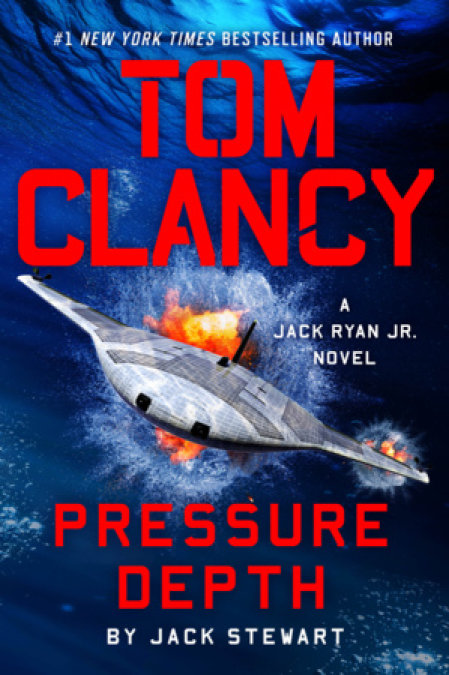
Some secrets are best left at the bottom of the ocean. But since that’s not in Jack Ryan, Jr.’s nature, he’ll battle all of China to stop them from finding a weapon of immense destructive power in the latest entry in the #1 New York Times bestselling series.
Jack Ryan Jr. is on Guam to work on a project for Hendley Associates. It's a perfectly ordinary insurance matter, but trouble finds the Ryans wherever they go. So, it's no surprise when Jack's involvement with a US Navy dive team working off the coast uncovers a threat to international security.
For years, rumors persisted that the Soviets had placed a device for tracking American submarines on the sea floor. By now, the technology should be outdated. But the Americans are still interested in recovering it. It's a seemingly routine mission until they make a shocking discovery: the defensive network they thought they were looking for is actually a weapon unlike anything they’ve ever seen.
That explains the arrival of a Chinese special operations team who seem determined to get their hands on the aging tech, even if they have to kill to do it. They're sure they can handle the Americans. But they don't know Jack.
Release date:
September 1, 2026
Publisher:
G.P. Putnam's Sons
Print pages:
416
* BingeBooks earns revenue from qualifying purchases as an Amazon Associate as well as from other retail partners.
CAUTION: This email originated from outside of Penguin Random House. Please be extra cautious when opening file attachments or clicking on links.
1
Federated States of Micronesia
Without a second thought, Jack Ryan, Jr., stepped off the platform and plunged into the warm water. The sea closed in over the top of his head like a coffin lid. One moment, the sunlight burned hot on his broad shoulders. The next, it fractured into shimmering glass as he exhaled, and bubbles shot upward in silver columns that vanished into the glare above.
It wasn't that Jack had an affinity for mathematics or routinely pondered complex algorithms. But as he bled air from his buoyancy compensator device and felt pressure building in his ears, he couldn't stop himself from thinking of a certain Swiss physician whose model would become extremely important in short order. The gradient factors employed a theory regarding nitrogen saturation that, like the water, went way above his head. But that didn't keep him from going over the values he had already calculated. Again.
The water was startlingly clear with visibility stretching nearly a hundred feet in every direction. But that only made the isolation seem worse. Jack felt like he was falling through the sky, with each release of bubbles carrying him deeper into a silence so complete that it roared in his ears.
Sixty feet down, the colors began to bleed away. First, the reds vanished. Then, the oranges. Until all that was left was a blue-green wash of a world that appeared to live without warmth. To combat the overwhelming feeling of despair, Jack turned on his flashlight and aimed it into the abyss beneath him. But the nothingness seemed to swallow its pale cone of light at the edges.
As cold as it looked, the water was surprisingly warm at ninety feet down. The absence of an obvious thermocline-where the temperature dropped sharply-was a new experience for Jack, and he clenched his jaw and continued his descent. Even so, he couldn't help but feel as if something vast and unseen was watching him from the darkness below.
He flashed a glance at Doug Park, who was just beyond his reach. The retired Navy master diver's expression was hidden behind his mask, but he caught Jack's glance and flashed him a hand signal with the thumb and index finger pinched together in a circle and the remaining three digits extended.
Are you okay?
Jack repeated the hand signal.
I'm okay.
They continued descending.
At one hundred and fifty feet down, Jack began to make out the ocean floor materializing from the inky darkness. Directly beneath them, just the smudge of a shadow transformed into a black shape with sharp edges rising from the silt. His heart suddenly pounded faster, spurred by an irrational fear that the object was moving and drifting upward to consume them.
But then his light caught its rusted skin, and the ship's steel plating loomed like the flank of a drowned leviathan.
The San Francisco Maru.
Often referred to as the Million Dollar Wreck because of the estimated value of its cargo, the steamship sat upright in two hundred and ten feet of water. It was an iconic shipwreck, and the reason Jack had agreed to take a job on the Pacific island in the first place. It seemed like the perfect way to clear his head.
Only, his head didn't seem to agree.
Located just six hundred miles from the U.S. territory of Guam, Chuuk Lagoon was once home to Japan's main naval base and considered the "Gibraltar of the Pacific" by Allied forces. But following a three-day aerial assault during Operation Hailstone, forty-five vessels and numerous aircraft plunged into the depths of the lagoon. The San Francisco Maru was just one of them.
At one hundred and eighty feet down, Jack adjusted his buoyancy and carefully finned into Holds 1 and 2, taking in the spectacle of tanks, mines, and bombs stacked haphazardly atop one another. If not for Torakku-tō Kūshū-the air strike on Truk Island-the San Francisco Maru might have left the Fourth Fleet anchorage east of Eten Island and sailed on to deliver its cargo to another Japanese stronghold.
Jack wondered how that might have changed history.
As he contemplated the myriad events that led him there-from a well-placed five-hundred-pound bomb dropped by a TBF Avenger from the USS Essex to Lisanne Robertson calling off their engagement-he finned slowly across the wreckage and studied its wounds. He swept his flashlight's beam across a porthole, its glass long gone, and for an instant swore he saw movement retreating into the dark. His heart bolted, but he steadied his breath. At this depth, panic meant death.
As he and Park pushed toward the yawning mouth of the cargo hold, Jack couldn't shake the feeling that the ship had been waiting for them. He kept his hoses tucked in tight and finned just hard enough to float effortlessly inside the submerged behemoth, pivoting and twisting through bars and ducking below hanging lines.
Jack was completely engrossed by the sea life that had adapted to the depth and claimed the ship as its home. But he stopped when Park swept his light's beam across the wreckage in front of him to get his attention. Jack turned to look back and saw the experienced diver twirling a finger in the water.
Time to turn the dive.
They were nearing the end of their bottom time.
Jack gave him the OK hand signal, then reluctantly followed Park, and exited the ship.
Once outside, Park led them to the guideline and they carefully began their ascent inch by agonizing inch. Beckoned by the filtered daylight hundreds of feet above them, it would have been so easy to abandon caution and fin for the surface without slowing.
But Jack knew better than that.
As the water above grew lighter with the promise of air and safety, he fought against his instinct to kick for the surface without pause. He knew that if he did, his body would be racked by a deep and grinding ache, like splinters working their way into every joint.
Jack knew they needed to stop. They needed to stick with their decompression schedule and hover in the darkness for . . .
One minute at one hundred and twenty . . . one minute at one hundred and ten . . .
Jack was an accomplished deep-sea diver and had long since beat back the fear that tried convincing him that the black would swallow him whole if he stopped. He knew the consequences for giving into his fear and patiently waited for his dive computer to signal it was okay to continue to the next stop, while continuing to breathe. He knew that if he held his breath, his chest would knife with sudden pain and the air in his lungs would expand like a grenade until the alveoli ruptured and punched bubbles into his bloodstream like microscopic bullets.
Never hold your breath.
Jack looked at Park, who hung in the void, suspended by faith in his dive computer. One minute passed. Then another. The San Francisco Maru was already forgotten; nothing more than a memory swallowed by the dark.
They stopped twice more before switching gases, letting their regulators hiss like serpents in the abyss. Jack knew his patience would pay off. His ears crackled as they adjusted to the change in pressure, getting closer to normal with each stop. Six minutes at sixty feet. Seven minutes at fifty. His body released its grip on the nitrogen it had absorbed, dissolving the inert gas into his bloodstream so that it wouldn't be ripped from his tissue and boil under his skin.
Their stops became longer the closer they got to the surface. Ten minutes at forty feet. Fifteen minutes at thirty. Jack exhaled and watched his bubbles wriggle skyward, mocking him with their freedom.
Finally, at twenty feet, Jack switched to his final gas and hovered in filtered daylight for twenty minutes. His body trembled from the mental and physical toll the dive had taken. But he took long, slow breaths and savored the end of another successful dive.
After ten more minutes at ten feet down, Park pointed to his dive computer and gave Jack a thumbs-up.
Ascent complete.
Jack Ryan, Jr., and Doug Park broke the surface in a rush of spray and light. They bobbed in the water next to the dive platform attached to the stern of the Motor Vessel Pelagia, a ninety-five-foot liveaboard that offered eight cabins with private bathrooms and accommodations for up to sixteen guests. It had been their home for the last six days; their base of operations as they dove fifteen wrecks in the lagoon, including the cargo ship Yamagiri Maru, the destroyer Fumizuki, and a Kaidai-class submarine, the I-169.
Jack tapped the top of his head and made an exaggerated OK hand signal to confirm he was conscious and had successfully beat back the depth that begged to bury him. Park repeated the signal to the dive master on the boat, then removed his regulator and let a broad smile stretch across his face.
"She's something else, ain't she?" Park said.
"Sure is," Jack said. "I only wish we could have stayed on the bottom longer."
Park didn't argue and finned his way to the dive platform to exit the water. As Jack patiently waited his turn to doff his gear and scramble aboard the vessel, he couldn't help but reflect on the opportunities his job as a senior analyst and venture capitalist with Hendley Associates had given him. He'd come a long way from the naive and brash Georgetown graduate who once cornered Senator Gerry Hendley in his office in West Odenton, Maryland, and badgered him into a job offer.
Back then, Jack had been long on confidence and short on experience. But the senator knew his pedigree. His father, John Patrick Ryan, had been "one of the best spooks who ever lived," according to Hendley. But, more than that, he was the reason Hendley Associates existed in the first place. The senator had taken a chance on young Jack, and that was all the motivation Junior needed.
Park extended a hand and helped Jack into the boat. "I'd say that was a pretty good way of ending your vacation. Wouldn't you?"
It's not a vacation, Jack thought.
But he nodded in agreement. "It's one I won't soon forget. That's for sure."
"Come on, let's clean up and get some chow."
Jack's stomach growled as he glanced back down at the water and wondered what other secrets he might find hidden in its depths.
2
After dinner, Jack and Doug Park sat near one of two Jacuzzis on the Pelagia's sun deck and looked out across the railing at the lagoon. Sunlight flickered across its calm surface at a low angle as they sipped on warm and lightly spiced twelve-year-old single malt Scotch from their tulip-shaped Glencairn glasses. Their dive on the San Francisco Maru had left Jack feeling contemplative, and he casually swirled the whiskey; partially to release its full bouquet, but mostly to give him something to do while thinking about the upcoming operation.
"We'll pull into port tomorrow morning," Park said. "But I booked us seats on the last flight to Guam, just to be safe."
Jack understood. The Divers Alert Network published recommended preflight intervals that prevented adding physiological stress due to the cabin pressurization of commercial aircraft. Twenty-four hours on the surface before flying was generally accepted as the minimum for a single deep dive with full decompression. But that could easily stretch to forty-eight hours following multiple dives, like the ones they had completed while aboard the MV Pelagia.
"Good call," Jack said.
"The Pacific Resolve should be in Apra Harbor by the time we get there," Park said. "I'm assuming you'll want to get a jump on inspecting her equipment to determine if we need to source replacements."
Some of the equipment Park was referring to included a complete state-of-the-art diving support system with mixed-gas fill stations, surface-supplied air and communication lines, life-support monitoring, and a recompression chamber. It was only part of what they would need to dive on the MV Meridian Star, a container ship that sank in the Philippine Sea west of Guam.
Jack flashed him a look. "Do you think they have everything we need?"
"Everything we asked for," Park said. And it was his job to know.
That was the reason Jack had hired the retired Navy master diver. Now in his mid-fifties, Doug Park had begun his diving career straight out of high school when a Jacques Cousteau documentary prompted him to enlist in the U.S. Navy. He went on to specialize in deep mixed-gas diving and earned a reputation as the man you called on when the job was too complex, too deep, or too dangerous for anyone else. In short, Jack knew he was the right person for the job of dive supervisor on the Meridian Star operation.
The "white side" operation, at least.
Unlike most private equity firms that were motivated purely by profit, Hendley Associates used its legitimate "white side" business dealings to fund a covert "black side" organization known as The Campus. Though the lines between the two were sometimes blurred, this particular operation had seemed pretty straightforward. A major U.S.-based insurance company-who Hendley routinely did business with-had hired them to provide a deep-dive forensic financial and operational review of the shipowner.
But it wasn't that kind of deep dive that prompted Jack to accept the job. A month or two on Guam seemed like just the kind of thing he needed to occupy his mind and help him get over his breakup with Lisanne.
"But we may not even have to dive the wreck to know their claim's fraudulent," Park said.
Jack took a sip of his whiskey to give himself time to think. The tricky thing about straddling the line between legitimate and covert work was knowing what he could say and to whom. But this wasn't his first rodeo. "Are you saying you don't want the work anymore?"
Park tossed his head back and laughed. "We're not all mercenary hose-breathing mechanics, you know."
"So, you do want it."
"I'm just saying that we received a preliminary report from satellite AIS tracking that shows the Meridian Star altering course unexpectedly before it went down. Worse, other vessels in the area-including ones who responded to the captain's distress signals-reported that there was no severe weather at the time."
Jack already knew this, but he was pleased that his dive supervisor had taken the initiative to investigate the incident on his own. Their client had suspected the Singapore-based shipping company of committing insurance fraud when they filed a one-hundred-and-fifty-million-dollar claim as soon as the ship was reported missing.
We hope you are enjoying the book so far. To continue reading...

 Please log in to recommend or discuss...
