
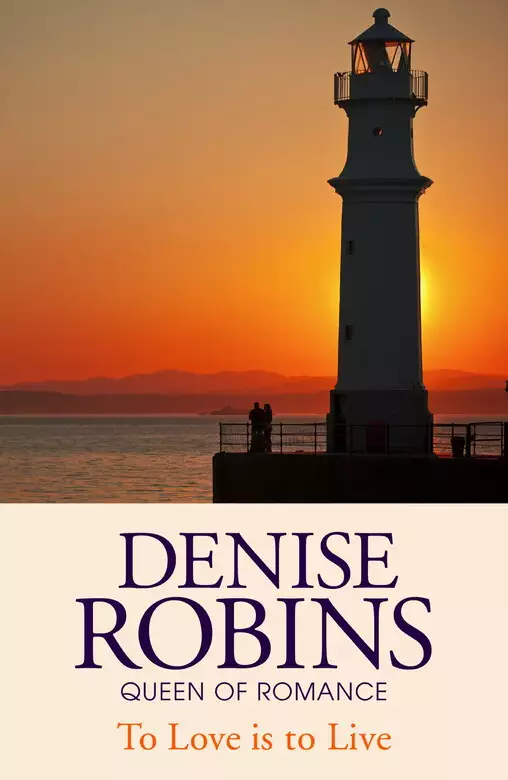
To Love is to Live
Available in:
- eBook
- Paperback
- Hardcover
- Book info
- Sample
- Media
- Author updates
- Lists
Synopsis
A captivating love story from the 100-million-copy bestselling Queen of Romance first published in 1940 and available now for the first time in eBook.
Release date: March 27, 2014
Publisher: Hodder & Stoughton
Print pages: 400
* BingeBooks earns revenue from qualifying purchases as an Amazon Associate as well as from other retail partners.
Reader buzz
 Please log in to recommend or discuss...
Author updates
Close
To Love is to Live
Denise Robins
It seemed to Gail Partner a significant fact that the very day on which she accepted Bill Cardew’s offer of marriage, England declared war against Germany.
A war! Not only a World War, but a little private war within herself. Because only last night when Bill had made his sixth proposal within the month, Gail had said:
‘What’ll you do if there is a war, Bill?’
And he had flung back that golden, rather arrogant head of his; a familiar gesture with its faint suggestion of scorn, and answered:
‘Be called up, of course. I’m a Territorial.’
She had looked at him a moment, aghast, for the Bill Cardew she had known for so many years, and whose home was only a stone’s throw from her own, was junior partner in a City firm of electrical engineers. And to Gail he had never been anything except an habitually well-dressed young man with the stamp of London on him; interested in his job; mechanically-minded rather than artistic. Fond of tinkering with his old open Lagonda. Faithful to golf in the week-ends, and with his fair share of faults and virtues.
Although he had been in the Territorials since the crisis of 1938, and done his ‘summer camp,’ his occasional training, Gail could never really think of Bill as a soldier. And now she was facing the fact that he would, of course, be called up immediately. And that fact brought to her consciousness a train of memories connected not with Bill, but with another young man, who was in the Regular Army. A soldier born, not made as Bill would be, when he exchanged his striped trousers, his black suit, his bowler hat, for a uniform.
It was a very long time since Gail had allowed herself to remember Ian. (It must be three years, quite, since they had said good-bye in Paris.) During those years she had schooled herself sternly not to wince at the sight of a kilt, the skirl of a bagpipe, pictures of the Lowlands, and all the little heartbreaking things which had reminded her of a lieutenant in a Scottish regiment; a man whom she had once loved.
On the third of September, that Sunday when she stood in the drawing-room with the rest of the family listening to the Prime Minister’s grave announcement, the whole thing seemed to her unreal and fantastic. And although the memory of Ian had leapt back to life and startled her by its very vividness, its potency to stir her to a faint wild thrill of pain, it was upon Bill she concentrated her thoughts.
Gail’s young sister, Anne, still a schoolgirl of fifteen, and affectionately known in the Partner family as ‘Scampie,’ brought the thought of Bill right into their midst. When Mr. Partner turned off the radio, Scampie looked at Gail and exclaimed:
‘I say, Gail … will Bill have to go and fight?’
Gail, still feeling mentally bruised and bewildered by that announcement which must have shocked millions, even while it had been expected, drew in her breath:
‘I suppose so.’
Mrs. Partner, short, plump, grey-haired, but with a charm and vitality which made a young woman of her despite her forty-five years, looked slowly round the room, examining all her family with a mother’s brooding anxiety. She thought:
‘I’ve already lived through one war. Dear God, it’ll be hard to get through another with the added responsibility of these dear ones of mine.’
Her gaze fell upon her eldest daughter, Gail, who was so lovely—much the best-looking of the family. Slender, with small bones like her father, and his delicately-cut features, but with her mother’s colouring. The same burning beauty which had been Mary Partner’s greatest asset in her youth. An almost passionate beauty with that red-brown hair, the sweep of dark lashes, the wide grey eyes with such big black pupils that they looked enormous, the red young mouth with an upper lip which seemed to challenge life. A lovely mouth when she was laughing, a slightly sad one in repose. Ever since her nineteenth year, there had been an almost brooding sadness in the girl which, at times, had worried Mrs. Partner. An absorption into self. As though she had something on her mind. She’d been like that since she had returned from Lausanne where she had gone to study languages. She had never said anything, and Mrs. Partner was not the sort of woman to badger or demand confidence when it was not voluntarily given. And anyhow, lately there had seemed nothing to worry about in Gail. The thing that the family had always wanted was coming to pass. She was going to marry Bill Cardew.
In Mrs. Partner’s opinion, for Gail to get married would be the very best thing that could happen. She was twenty-two now and the right age for marriage. They all knew Bill and liked him. He had a side to him which worried Mrs. Partner sometimes. There was a slight suggestion of the braggart, even the bully, in Bill. But that could be excused, because he was still young. Twenty-four and hopelessly spoiled. The only, idolised son of a widowed mother. But Gail had a forceful character. Yes, there was a lot of spirit and fire in that slip of a girl. Surely she would be able to ‘manage’ Bill when she was his wife! He obviously adored her.
Past Gail, Mrs. Partner’s gaze swept to Anne. Nothing to worry about where Scampie was concerned. Plump, mischievous, crazy about games, gold band on her teeth, glasses because these big blue eyes were a little short-sighted, giggles, hockey, typical schoolgirl humour. And then Mary Partner’s gaze came to rest upon Chris, her only son. And her heart gave a horrid jerk. It was upon him she focused, with all the concentration of her mother-love and purpose.
Chris, aged sixteen, due back at his public school at the end of the month. Safe enough now. Like Scampie, mad about games. A cricket enthusiast and in the Eleven. Could she ever forget how proud the family had been when they watched his innings—the white-flannelled hero of that summer’s day! Darling Chris with his rough red-brown head, the same colour as Gail’s. A snub-nose, freckles, and the fact that he was on the short side only just saved him from being too conspicuously handsome.
How long would this war last? In two years, Chris would be eighteen. In the last war they had taken the eighteen-year-olds.
Mrs. Partner crossed the room and stood beside her husband trying to steady her nerves. He had worn khaki in that other war. And she had been a nurse with a Red Cross on her apron when she had met him. Dear Charlie! After twenty-four years there was nothing much left of his figure or good looks. At fifty, he was bald and tired, an overworked solicitor who had had a struggle to make life what he had wanted for his family. But he had achieved it. And here they were in the big sunny house on Kingston Hill, full of the treasures they had collected together. At the back a good-sized garden and tennis court. They had had so many jolly week-end parties here, and considered themselves so lucky. A happy united family.
And now—war!
Mr. Partner looked up at his wife and smiled. He had a slow, reassuring smile. Twinkling eyes, comforting her over the rim of his glasses.
‘Well, Mogs, I don’t suppose they’ll take me in the Army now. What about that Red Cross uniform of yours? Would it fit still, d’you think?’
‘Certainly not. I’m much too fat and I got rid of it long ago.’ She laughed. And she thought how foolish and sweet it was to be called ‘Mogs’ at her age, the mother of a grown-up family. The sound of her pet-name from Charlie, and his matter-of-fact speech, dissipated some of her dreads concerning Chris. Not that there weren’t other terrors. The fear of air-raids! Not for herself but for these young things who were just beginning life …
‘Mum,’ said Scampie, ‘can I cut out some more black paper for the windows?’
‘Yes,’ put in Chris, ‘you’d jolly well better not show any lights tonight.’
‘We’ll get busy on it directly after lunch,’ said Mrs. Partner.
Then Gail turned to her mother.
‘I must ring up Bill,’ she said breathlessly.
‘Are you going to become engaged?’ asked Scampie with a child’s tactlessness.
Gail answered without looking round from the door. She said:
‘Married, I expect.’
The family broke into a hum of discussion as she left.
She only got as far as the hall. Bill had just opened the front door, letting himself in with the air of one who was privileged to walk in and out the house as he wanted.
She looked at him. She remembered that they had been going to play tennis this morning, if it was fine. But he had not brought a racket. He wore grey flannels. She liked him in those better than in his dark City clothes. They made him look younger, more appealing. Sometimes Bill was so cocksure of himself. ‘Bossy,’ Scampie had once called him when he had annoyed her. And Gail never cared for him in his bossy moods. But this morning she saw him only as Bill who would shortly be joining up, and who might be swept from her, suddenly, into the vortex of a dreadful war.
She could not look at him through ordinary eyes. Everything had changed in this last hour since the Prime Minister’s speech. Their whole world, that happy, secure little world in which they had all been living in Kingston, was rocking on its foundations.
Gail was over-excited, thrilled, afraid, a great many things rolled into one.
Somehow she found herself walking straight into his arms.
‘Oh, Bill,’ she said.
The touch of superiority which always marked Bill Cardew’s entrances and exits, vanished entirely from the young man’s face as he held her. It was the first time she had ever allowed him to do more than kiss her cheek or touch her hair, her hands. But now her lips were warm and yielding, and he kissed them with an intensity which had always been within himself waiting for Gail.
‘At last,’ he thought. ‘It’s taken a war to shake Gail into my arms …’
He said:
‘Darling, I’m crazy about you. And you’re going to marry me. At once. I’m not going to wait. I’m chucking the office and going straight into the Army. And you’ll go with me as long as I’m on British soil, I hope’
She did not answer verbally. Her hands were clasped about his neck. She looked at him with eyes full of tears. She could not possibly have explained her sensations in that moment. Only one thing was clear to her, her love for Bill. He had always attracted her in a way with that very golden head of his, the well-shaped mouth under the slight, fair moustache, the healthy glow of skin, the blue eyes which could blaze with temper or be soft and passionate as they were today. And in this hour she believed that she loved him and it was no use holding back any longer. No use allowing that other love to chain her, or any memory of Ian to creep like a destructive shadow across the eager fire of her imagination.
Ian was a ghost. She would never see him again. She didn’t even know where he was. And, anyhow, he didn’t even love her. But Bill did. And she wanted to be loved. Wanted to be taken out of her loneliness, wooed from repressions, from inhibitions, lulled into the acceptance of a concrete devotion such as Bill had shown her for the last three years.
They stood in a soundless embrace for a few moments, murmuring to each other between their kisses. Bill said:
‘You really mean it? You aren’t just carried away by Mr. Chamberlain and this idea that I’m a hero going into battle, and all that?’
She laughed and shook her head.
‘No. I know my own mind. I’ve been a long time making it up, but I know it now. I love you, Bill.’
‘It’s grand to hear you say that,’ he said, then took one of her small white ears between his fingers and pinched it a little. ‘And about time too, young woman …’
At any other time that gesture, those words, would have annoyed her. They were just slightly patronising. Bill was like that at times, and if there was one thing Gail hated, it was being patronised. But this morning she laughed. She was carried away on a tide of enthusiasm for him and for marriage with him. If that ghost of Ian lingered at all to refute the statement she had just made when she told Bill that she loved him, she banished it once and for all. Just as she had long since banished the memory of a foolish, very young Gail, crying, crying desolately … on the deck of a cross-Channel steamer, for an Ian who had just said good-bye to her.
She clung to Bill in bliss, listening to his plans for an immediate marriage. His mother would be delighted, he said, and he knew that her people would give permission. They couldn’t afford to wait in these times. Financially they were all right. He had his father’s money. It was time that was dear and precious. They must save every scrap of that in case he got sent to France at an early date.
She was happier, more content than she had felt for a very long time. It was good to be treated in this possessive manner; to be held and kissed and adored and dictated to by Bill. And she wanted to agree to all his suggestions. Yet it seemed unreal, still, like the thought of the war.
Nothing had really changed her, so far, in this home wherein she had lived for the last sixteen years and where both Chris and Scampie had been born.
In this very hall everything was the same. That big oil painting of Daddy’s uncle, with his scarlet face, his side-whiskers, in Dickens-like collar and cravat. The stand with Daddy’s hat on it, and Chris’s school scarf, Scampie’s old mack, Mummy’s umbrella. The semi-circular table up against the wall, bearing a china bowl of flowers. The family clothes-brush which was never there when Daddy wanted it.
Ever since Gail could remember, they had had to chase that clothes-brush before Daddy went to his office in the morning. And either Chris had it up in his room, or Scampie had been using it to brush the rabbits which she kept in her home-made cage at the bottom of the garden.
The sight of the familiar things was comforting to Gail. Like the close pressure of Bill’s arms; the roughness of the little fair moustache against her lips.
‘Darling, darling Bill,’ she murmured.
‘Come back with me and tell Mother,’ he said abruptly, releasing her.
‘Let’s tell the family first.’
‘All right.’
They walked arm-in-arm into the drawing-room. Gail’s eyes swept round the room, challenging her family, gay, proud, pleased.
‘Mum. Daddy … all of you. Bill and I are going to be married.’
There was a rush, Scampie knocking off her glasses in the effort at a frenzied hug. Mr. and Mrs. Partner quick with kisses and congratulations for their eldest daughter, with handshakes and congratulations for Bill. Only Chris refrained from any energetic display of enthusiasm. He stuck his hands in his pockets and gave a quick, frowning glance past his sister at the arrogant, fair young man beside her.
‘Congratters,’ he said, muttering to himself rather than voicing his emotions aloud.
Gail took no notice of that lukewarm response. She knew Chris did not care for Bill, and that Bill was not on the best of terms with her young brother. They just did not ‘get on.’ But what did that matter? The rest of the family liked Bill enormously.
Mr. Partner went down to the cellar to find a bottle of champagne. He had one or two put aside for family celebrations.
Gail and Bill were toasted, and the possibilities of a hasty marriage discussed. And after that Bill took Gail down the hill to his mother’s house.
When she emerged from it, an hour later, flushed and smiling, it was with Mrs. Cardew’s blessing, and a diamond ring—one of Mrs. Cardew’s rings—on her finger.
The first day of war marked the first day of Gail’s brief engagement to Bill. An engagement which was to last barely a fortnight before her marriage to him, and his obtaining a commission in the Territorials, soon to be classed as one with the whole Army.
But on the very day of her wedding Gail was troubled by the old searing memories of Ian. Memories that not even the feverish excitement of this precipitous marriage with Bill could destroy.
Gail was not a person who cared much for ostentation or fuss. And because of the past she would have liked a very quiet little wedding, after which she could just creep away with Bill for their honeymoon and give herself up to the peace and happiness of this new and concrete devotion which he had offered her.
But Bill had other plans. In his masterful fashion—he was exerting that arrogance of his rather more strenuously now that they were officially engaged—he demanded what he called ‘a good show.’
‘I wish to let the world know that you’re mine,’ he said, ‘and even if it is war-time, we’ll show Kingston what we can do.’
Gail felt that too much of a celebration was not only undesirable to her personally, but rather hard lines on her parents who, like everybody else, were financially hit by the times. But Bill was not to be put off.
‘What I want, I get,’ appeared to be his motto, and his mother had no say in the matter at all.
Mrs. Cardew was kind and sweet to Gail and kind and sweet to Bill. An elderly, rather stupid woman, who had had her son late in life, and now, nearing sixty-five, was insanely devoted to him. She encouraged him to think himself a young god, and would have been shocked if Gail had expressed an opinion that he was anything less than god-like.
Bill ruled her with a rod of iron, and there were moments when Gail disliked to see any woman so completely under a man’s thumb. But rushing headlong into this marriage, she was given little or no time to analyse her feelings or dissect them in the cold clear light of reason. There was a war on. Bill might be killed. They might all be killed in air-raids. She, who had been quiet and introspective for so long, was flung into a state of neurotic excitement, and she allowed Bill to sweep her along on the tide of his particular enthusiasms.
They were married at the Kingston Church at which the Partner family worshipped. Gail had no time to deck herself out in white satin and orange-blossom, but she found a long chiffon dress of lovely mistblue, and a little hat which was nothing but a handful of blue flowers perched on top of her red-brown curls, a soft veil across her face. Bill sent expensive pink tiger-lilies for her bouquet. She did not like tiger-lilies and had expressed a fancy for more simple flowers, but he had said:
‘They are rather exotic. I like you to be exotic. It amuses me.’
That sort of remark gave her a curious mental chill, but at the time she forgot it. There was so little time for thinking in the rush and excitement of getting her clothes and preparing for the ceremony.
When she finally stood at the altar beside Bill and took the solemn vows, she tried also to offer him her whole heart and to blot out that other love and stamp it for ever from her memory.
But she could not. It was a dreadful fact that the ghost of Ian was there again in the very church, close to her, looking at her with dark, reproachful eyes. She hardly heard the little sermon which the vicar was giving them. She felt faint, weary, anxious that it should all be over. And when at length she walked out of the church beside Bill into the sunshine she breathed a sigh of relief.
There was a rush from Scampie to shower her with confetti and rice. Cheers from the little crowd which had assembled, eager to see a war wedding. The bride was an exquisite girl. Bill looked handsome and glamorous in his new uniform. An old woman called out:
‘God bless you both …
Gail said:
‘Thank you so much,’ with a catch in her voice.
But Bill frowned and said:
‘What cheek these people have!’
In the car, driving back home where the family had a big white cake and champagne ready, Bill took his wife in his arms and kissed her repeatedly.
‘Mrs. William Cardew,’ he said between the kisses. ‘Well, you belong to me at last, my darling, and I enjoyed every moment of that wedding. Didn’t you? Look at me. Tell me you’re glad that I’m your husband.’
She looked at him, feeling slightly dazed.
‘Of course …’
‘Kiss me, Gail.’
‘Darling, wait … you’re crushing my dress … my flowers …’
He drew back with a little laugh.
‘Better not crush them, perhaps. They cost a packet.’
That jarred her. She found herself instinctively thinking:
‘Ian wouldn’t have said that. He never spoke about money. He couldn’t.
No! Ian had bought her so many flowers in Paris. She had never been without them. But what they had cost did not matter. Anyhow, he preferred the simple flowers, as she did. Violets … Dear God, why must she remember that day when she had worn violets which he had sent, and when they had met he had held her close, so close, and when she had warned him to take care of the flowers, he had answered:
‘What does it matter! I’ll buy you some more.’
‘Yes, I enjoyed every minute of the ceremony,’ repeated Bill, sitting back in his corner of the car, stroking his little fair moustache, and adding in a very soft voice:
‘“With my body I thee worship …”’
She sat still. Unable to make any kind of response. But her heart was jerking and she knew that it was not with excitement and happiness, but with fear. Fear of these strange, unaccountable feelings which were sweeping over her within ten minutes of her wedding with Bill. Terrified because something had leapt like a menace out of nothing and nowhere to make her ask herself why she had done this thing. She ought to react rapturously to what Bill had just said. To the look in his eyes. To the touch of his hand. But a coldness had come across her which made her tremble as she sat there even though the warm September sun was beating through the thin chiffon of her bridal dress.
‘With my body I thee worship.’ That was how Bill felt about her. That was how she ought to feel about him. Yet she didn’t like the way he had said it. And if those same words had been whispered to her by Ian, her heart would have leapt in sheer ecstasy.
She began to pray dumbly, furiously, that this feeling would pass from her. Otherwise she had made the greatest mistake of her life in marrying Bill today. She began to pray, too, that Bill would be at his very best and draw out the best in her, as he had done on that day that war was declared.
But he was not at his best. Once they got back to the house and he had drunk some champagne, he was flushed and overbearing in his manner toward everyone.
He ignored his own mother who hung round timidly, waiting for him to say a word to her. He had little to say to his new father-and mother-in-law. He paid attention only to two people in the room, beside his wife. To Sir Reginald Pakin who was the one man he knew with a title; the head of his old firm who had condescended to attend the wedding. And to Gail’s godmother, old Mrs. Latchett, who was supposed to have a great deal of money and who the Partner family had once said might leave Gail a bit of it.
Gail had had a restless night with little sleep and she was tired before the day commenced. Now she felt exhausted. Curious, for as a rule she was strong and alert. She did not want any of these people who were gathered here. She only wanted her own family. She longed to take Mummy into a corner and talk to her, or to wake her brother Chris out of his ‘mood.’ Christopher didn’t like Bill. There was no doubt about that, and neither did he l. . .
A war! Not only a World War, but a little private war within herself. Because only last night when Bill had made his sixth proposal within the month, Gail had said:
‘What’ll you do if there is a war, Bill?’
And he had flung back that golden, rather arrogant head of his; a familiar gesture with its faint suggestion of scorn, and answered:
‘Be called up, of course. I’m a Territorial.’
She had looked at him a moment, aghast, for the Bill Cardew she had known for so many years, and whose home was only a stone’s throw from her own, was junior partner in a City firm of electrical engineers. And to Gail he had never been anything except an habitually well-dressed young man with the stamp of London on him; interested in his job; mechanically-minded rather than artistic. Fond of tinkering with his old open Lagonda. Faithful to golf in the week-ends, and with his fair share of faults and virtues.
Although he had been in the Territorials since the crisis of 1938, and done his ‘summer camp,’ his occasional training, Gail could never really think of Bill as a soldier. And now she was facing the fact that he would, of course, be called up immediately. And that fact brought to her consciousness a train of memories connected not with Bill, but with another young man, who was in the Regular Army. A soldier born, not made as Bill would be, when he exchanged his striped trousers, his black suit, his bowler hat, for a uniform.
It was a very long time since Gail had allowed herself to remember Ian. (It must be three years, quite, since they had said good-bye in Paris.) During those years she had schooled herself sternly not to wince at the sight of a kilt, the skirl of a bagpipe, pictures of the Lowlands, and all the little heartbreaking things which had reminded her of a lieutenant in a Scottish regiment; a man whom she had once loved.
On the third of September, that Sunday when she stood in the drawing-room with the rest of the family listening to the Prime Minister’s grave announcement, the whole thing seemed to her unreal and fantastic. And although the memory of Ian had leapt back to life and startled her by its very vividness, its potency to stir her to a faint wild thrill of pain, it was upon Bill she concentrated her thoughts.
Gail’s young sister, Anne, still a schoolgirl of fifteen, and affectionately known in the Partner family as ‘Scampie,’ brought the thought of Bill right into their midst. When Mr. Partner turned off the radio, Scampie looked at Gail and exclaimed:
‘I say, Gail … will Bill have to go and fight?’
Gail, still feeling mentally bruised and bewildered by that announcement which must have shocked millions, even while it had been expected, drew in her breath:
‘I suppose so.’
Mrs. Partner, short, plump, grey-haired, but with a charm and vitality which made a young woman of her despite her forty-five years, looked slowly round the room, examining all her family with a mother’s brooding anxiety. She thought:
‘I’ve already lived through one war. Dear God, it’ll be hard to get through another with the added responsibility of these dear ones of mine.’
Her gaze fell upon her eldest daughter, Gail, who was so lovely—much the best-looking of the family. Slender, with small bones like her father, and his delicately-cut features, but with her mother’s colouring. The same burning beauty which had been Mary Partner’s greatest asset in her youth. An almost passionate beauty with that red-brown hair, the sweep of dark lashes, the wide grey eyes with such big black pupils that they looked enormous, the red young mouth with an upper lip which seemed to challenge life. A lovely mouth when she was laughing, a slightly sad one in repose. Ever since her nineteenth year, there had been an almost brooding sadness in the girl which, at times, had worried Mrs. Partner. An absorption into self. As though she had something on her mind. She’d been like that since she had returned from Lausanne where she had gone to study languages. She had never said anything, and Mrs. Partner was not the sort of woman to badger or demand confidence when it was not voluntarily given. And anyhow, lately there had seemed nothing to worry about in Gail. The thing that the family had always wanted was coming to pass. She was going to marry Bill Cardew.
In Mrs. Partner’s opinion, for Gail to get married would be the very best thing that could happen. She was twenty-two now and the right age for marriage. They all knew Bill and liked him. He had a side to him which worried Mrs. Partner sometimes. There was a slight suggestion of the braggart, even the bully, in Bill. But that could be excused, because he was still young. Twenty-four and hopelessly spoiled. The only, idolised son of a widowed mother. But Gail had a forceful character. Yes, there was a lot of spirit and fire in that slip of a girl. Surely she would be able to ‘manage’ Bill when she was his wife! He obviously adored her.
Past Gail, Mrs. Partner’s gaze swept to Anne. Nothing to worry about where Scampie was concerned. Plump, mischievous, crazy about games, gold band on her teeth, glasses because these big blue eyes were a little short-sighted, giggles, hockey, typical schoolgirl humour. And then Mary Partner’s gaze came to rest upon Chris, her only son. And her heart gave a horrid jerk. It was upon him she focused, with all the concentration of her mother-love and purpose.
Chris, aged sixteen, due back at his public school at the end of the month. Safe enough now. Like Scampie, mad about games. A cricket enthusiast and in the Eleven. Could she ever forget how proud the family had been when they watched his innings—the white-flannelled hero of that summer’s day! Darling Chris with his rough red-brown head, the same colour as Gail’s. A snub-nose, freckles, and the fact that he was on the short side only just saved him from being too conspicuously handsome.
How long would this war last? In two years, Chris would be eighteen. In the last war they had taken the eighteen-year-olds.
Mrs. Partner crossed the room and stood beside her husband trying to steady her nerves. He had worn khaki in that other war. And she had been a nurse with a Red Cross on her apron when she had met him. Dear Charlie! After twenty-four years there was nothing much left of his figure or good looks. At fifty, he was bald and tired, an overworked solicitor who had had a struggle to make life what he had wanted for his family. But he had achieved it. And here they were in the big sunny house on Kingston Hill, full of the treasures they had collected together. At the back a good-sized garden and tennis court. They had had so many jolly week-end parties here, and considered themselves so lucky. A happy united family.
And now—war!
Mr. Partner looked up at his wife and smiled. He had a slow, reassuring smile. Twinkling eyes, comforting her over the rim of his glasses.
‘Well, Mogs, I don’t suppose they’ll take me in the Army now. What about that Red Cross uniform of yours? Would it fit still, d’you think?’
‘Certainly not. I’m much too fat and I got rid of it long ago.’ She laughed. And she thought how foolish and sweet it was to be called ‘Mogs’ at her age, the mother of a grown-up family. The sound of her pet-name from Charlie, and his matter-of-fact speech, dissipated some of her dreads concerning Chris. Not that there weren’t other terrors. The fear of air-raids! Not for herself but for these young things who were just beginning life …
‘Mum,’ said Scampie, ‘can I cut out some more black paper for the windows?’
‘Yes,’ put in Chris, ‘you’d jolly well better not show any lights tonight.’
‘We’ll get busy on it directly after lunch,’ said Mrs. Partner.
Then Gail turned to her mother.
‘I must ring up Bill,’ she said breathlessly.
‘Are you going to become engaged?’ asked Scampie with a child’s tactlessness.
Gail answered without looking round from the door. She said:
‘Married, I expect.’
The family broke into a hum of discussion as she left.
She only got as far as the hall. Bill had just opened the front door, letting himself in with the air of one who was privileged to walk in and out the house as he wanted.
She looked at him. She remembered that they had been going to play tennis this morning, if it was fine. But he had not brought a racket. He wore grey flannels. She liked him in those better than in his dark City clothes. They made him look younger, more appealing. Sometimes Bill was so cocksure of himself. ‘Bossy,’ Scampie had once called him when he had annoyed her. And Gail never cared for him in his bossy moods. But this morning she saw him only as Bill who would shortly be joining up, and who might be swept from her, suddenly, into the vortex of a dreadful war.
She could not look at him through ordinary eyes. Everything had changed in this last hour since the Prime Minister’s speech. Their whole world, that happy, secure little world in which they had all been living in Kingston, was rocking on its foundations.
Gail was over-excited, thrilled, afraid, a great many things rolled into one.
Somehow she found herself walking straight into his arms.
‘Oh, Bill,’ she said.
The touch of superiority which always marked Bill Cardew’s entrances and exits, vanished entirely from the young man’s face as he held her. It was the first time she had ever allowed him to do more than kiss her cheek or touch her hair, her hands. But now her lips were warm and yielding, and he kissed them with an intensity which had always been within himself waiting for Gail.
‘At last,’ he thought. ‘It’s taken a war to shake Gail into my arms …’
He said:
‘Darling, I’m crazy about you. And you’re going to marry me. At once. I’m not going to wait. I’m chucking the office and going straight into the Army. And you’ll go with me as long as I’m on British soil, I hope’
She did not answer verbally. Her hands were clasped about his neck. She looked at him with eyes full of tears. She could not possibly have explained her sensations in that moment. Only one thing was clear to her, her love for Bill. He had always attracted her in a way with that very golden head of his, the well-shaped mouth under the slight, fair moustache, the healthy glow of skin, the blue eyes which could blaze with temper or be soft and passionate as they were today. And in this hour she believed that she loved him and it was no use holding back any longer. No use allowing that other love to chain her, or any memory of Ian to creep like a destructive shadow across the eager fire of her imagination.
Ian was a ghost. She would never see him again. She didn’t even know where he was. And, anyhow, he didn’t even love her. But Bill did. And she wanted to be loved. Wanted to be taken out of her loneliness, wooed from repressions, from inhibitions, lulled into the acceptance of a concrete devotion such as Bill had shown her for the last three years.
They stood in a soundless embrace for a few moments, murmuring to each other between their kisses. Bill said:
‘You really mean it? You aren’t just carried away by Mr. Chamberlain and this idea that I’m a hero going into battle, and all that?’
She laughed and shook her head.
‘No. I know my own mind. I’ve been a long time making it up, but I know it now. I love you, Bill.’
‘It’s grand to hear you say that,’ he said, then took one of her small white ears between his fingers and pinched it a little. ‘And about time too, young woman …’
At any other time that gesture, those words, would have annoyed her. They were just slightly patronising. Bill was like that at times, and if there was one thing Gail hated, it was being patronised. But this morning she laughed. She was carried away on a tide of enthusiasm for him and for marriage with him. If that ghost of Ian lingered at all to refute the statement she had just made when she told Bill that she loved him, she banished it once and for all. Just as she had long since banished the memory of a foolish, very young Gail, crying, crying desolately … on the deck of a cross-Channel steamer, for an Ian who had just said good-bye to her.
She clung to Bill in bliss, listening to his plans for an immediate marriage. His mother would be delighted, he said, and he knew that her people would give permission. They couldn’t afford to wait in these times. Financially they were all right. He had his father’s money. It was time that was dear and precious. They must save every scrap of that in case he got sent to France at an early date.
She was happier, more content than she had felt for a very long time. It was good to be treated in this possessive manner; to be held and kissed and adored and dictated to by Bill. And she wanted to agree to all his suggestions. Yet it seemed unreal, still, like the thought of the war.
Nothing had really changed her, so far, in this home wherein she had lived for the last sixteen years and where both Chris and Scampie had been born.
In this very hall everything was the same. That big oil painting of Daddy’s uncle, with his scarlet face, his side-whiskers, in Dickens-like collar and cravat. The stand with Daddy’s hat on it, and Chris’s school scarf, Scampie’s old mack, Mummy’s umbrella. The semi-circular table up against the wall, bearing a china bowl of flowers. The family clothes-brush which was never there when Daddy wanted it.
Ever since Gail could remember, they had had to chase that clothes-brush before Daddy went to his office in the morning. And either Chris had it up in his room, or Scampie had been using it to brush the rabbits which she kept in her home-made cage at the bottom of the garden.
The sight of the familiar things was comforting to Gail. Like the close pressure of Bill’s arms; the roughness of the little fair moustache against her lips.
‘Darling, darling Bill,’ she murmured.
‘Come back with me and tell Mother,’ he said abruptly, releasing her.
‘Let’s tell the family first.’
‘All right.’
They walked arm-in-arm into the drawing-room. Gail’s eyes swept round the room, challenging her family, gay, proud, pleased.
‘Mum. Daddy … all of you. Bill and I are going to be married.’
There was a rush, Scampie knocking off her glasses in the effort at a frenzied hug. Mr. and Mrs. Partner quick with kisses and congratulations for their eldest daughter, with handshakes and congratulations for Bill. Only Chris refrained from any energetic display of enthusiasm. He stuck his hands in his pockets and gave a quick, frowning glance past his sister at the arrogant, fair young man beside her.
‘Congratters,’ he said, muttering to himself rather than voicing his emotions aloud.
Gail took no notice of that lukewarm response. She knew Chris did not care for Bill, and that Bill was not on the best of terms with her young brother. They just did not ‘get on.’ But what did that matter? The rest of the family liked Bill enormously.
Mr. Partner went down to the cellar to find a bottle of champagne. He had one or two put aside for family celebrations.
Gail and Bill were toasted, and the possibilities of a hasty marriage discussed. And after that Bill took Gail down the hill to his mother’s house.
When she emerged from it, an hour later, flushed and smiling, it was with Mrs. Cardew’s blessing, and a diamond ring—one of Mrs. Cardew’s rings—on her finger.
The first day of war marked the first day of Gail’s brief engagement to Bill. An engagement which was to last barely a fortnight before her marriage to him, and his obtaining a commission in the Territorials, soon to be classed as one with the whole Army.
But on the very day of her wedding Gail was troubled by the old searing memories of Ian. Memories that not even the feverish excitement of this precipitous marriage with Bill could destroy.
Gail was not a person who cared much for ostentation or fuss. And because of the past she would have liked a very quiet little wedding, after which she could just creep away with Bill for their honeymoon and give herself up to the peace and happiness of this new and concrete devotion which he had offered her.
But Bill had other plans. In his masterful fashion—he was exerting that arrogance of his rather more strenuously now that they were officially engaged—he demanded what he called ‘a good show.’
‘I wish to let the world know that you’re mine,’ he said, ‘and even if it is war-time, we’ll show Kingston what we can do.’
Gail felt that too much of a celebration was not only undesirable to her personally, but rather hard lines on her parents who, like everybody else, were financially hit by the times. But Bill was not to be put off.
‘What I want, I get,’ appeared to be his motto, and his mother had no say in the matter at all.
Mrs. Cardew was kind and sweet to Gail and kind and sweet to Bill. An elderly, rather stupid woman, who had had her son late in life, and now, nearing sixty-five, was insanely devoted to him. She encouraged him to think himself a young god, and would have been shocked if Gail had expressed an opinion that he was anything less than god-like.
Bill ruled her with a rod of iron, and there were moments when Gail disliked to see any woman so completely under a man’s thumb. But rushing headlong into this marriage, she was given little or no time to analyse her feelings or dissect them in the cold clear light of reason. There was a war on. Bill might be killed. They might all be killed in air-raids. She, who had been quiet and introspective for so long, was flung into a state of neurotic excitement, and she allowed Bill to sweep her along on the tide of his particular enthusiasms.
They were married at the Kingston Church at which the Partner family worshipped. Gail had no time to deck herself out in white satin and orange-blossom, but she found a long chiffon dress of lovely mistblue, and a little hat which was nothing but a handful of blue flowers perched on top of her red-brown curls, a soft veil across her face. Bill sent expensive pink tiger-lilies for her bouquet. She did not like tiger-lilies and had expressed a fancy for more simple flowers, but he had said:
‘They are rather exotic. I like you to be exotic. It amuses me.’
That sort of remark gave her a curious mental chill, but at the time she forgot it. There was so little time for thinking in the rush and excitement of getting her clothes and preparing for the ceremony.
When she finally stood at the altar beside Bill and took the solemn vows, she tried also to offer him her whole heart and to blot out that other love and stamp it for ever from her memory.
But she could not. It was a dreadful fact that the ghost of Ian was there again in the very church, close to her, looking at her with dark, reproachful eyes. She hardly heard the little sermon which the vicar was giving them. She felt faint, weary, anxious that it should all be over. And when at length she walked out of the church beside Bill into the sunshine she breathed a sigh of relief.
There was a rush from Scampie to shower her with confetti and rice. Cheers from the little crowd which had assembled, eager to see a war wedding. The bride was an exquisite girl. Bill looked handsome and glamorous in his new uniform. An old woman called out:
‘God bless you both …
Gail said:
‘Thank you so much,’ with a catch in her voice.
But Bill frowned and said:
‘What cheek these people have!’
In the car, driving back home where the family had a big white cake and champagne ready, Bill took his wife in his arms and kissed her repeatedly.
‘Mrs. William Cardew,’ he said between the kisses. ‘Well, you belong to me at last, my darling, and I enjoyed every moment of that wedding. Didn’t you? Look at me. Tell me you’re glad that I’m your husband.’
She looked at him, feeling slightly dazed.
‘Of course …’
‘Kiss me, Gail.’
‘Darling, wait … you’re crushing my dress … my flowers …’
He drew back with a little laugh.
‘Better not crush them, perhaps. They cost a packet.’
That jarred her. She found herself instinctively thinking:
‘Ian wouldn’t have said that. He never spoke about money. He couldn’t.
No! Ian had bought her so many flowers in Paris. She had never been without them. But what they had cost did not matter. Anyhow, he preferred the simple flowers, as she did. Violets … Dear God, why must she remember that day when she had worn violets which he had sent, and when they had met he had held her close, so close, and when she had warned him to take care of the flowers, he had answered:
‘What does it matter! I’ll buy you some more.’
‘Yes, I enjoyed every minute of the ceremony,’ repeated Bill, sitting back in his corner of the car, stroking his little fair moustache, and adding in a very soft voice:
‘“With my body I thee worship …”’
She sat still. Unable to make any kind of response. But her heart was jerking and she knew that it was not with excitement and happiness, but with fear. Fear of these strange, unaccountable feelings which were sweeping over her within ten minutes of her wedding with Bill. Terrified because something had leapt like a menace out of nothing and nowhere to make her ask herself why she had done this thing. She ought to react rapturously to what Bill had just said. To the look in his eyes. To the touch of his hand. But a coldness had come across her which made her tremble as she sat there even though the warm September sun was beating through the thin chiffon of her bridal dress.
‘With my body I thee worship.’ That was how Bill felt about her. That was how she ought to feel about him. Yet she didn’t like the way he had said it. And if those same words had been whispered to her by Ian, her heart would have leapt in sheer ecstasy.
She began to pray dumbly, furiously, that this feeling would pass from her. Otherwise she had made the greatest mistake of her life in marrying Bill today. She began to pray, too, that Bill would be at his very best and draw out the best in her, as he had done on that day that war was declared.
But he was not at his best. Once they got back to the house and he had drunk some champagne, he was flushed and overbearing in his manner toward everyone.
He ignored his own mother who hung round timidly, waiting for him to say a word to her. He had little to say to his new father-and mother-in-law. He paid attention only to two people in the room, beside his wife. To Sir Reginald Pakin who was the one man he knew with a title; the head of his old firm who had condescended to attend the wedding. And to Gail’s godmother, old Mrs. Latchett, who was supposed to have a great deal of money and who the Partner family had once said might leave Gail a bit of it.
Gail had had a restless night with little sleep and she was tired before the day commenced. Now she felt exhausted. Curious, for as a rule she was strong and alert. She did not want any of these people who were gathered here. She only wanted her own family. She longed to take Mummy into a corner and talk to her, or to wake her brother Chris out of his ‘mood.’ Christopher didn’t like Bill. There was no doubt about that, and neither did he l. . .
We hope you are enjoying the book so far. To continue reading...
Copyright © 2025 All Rights Reserved
