
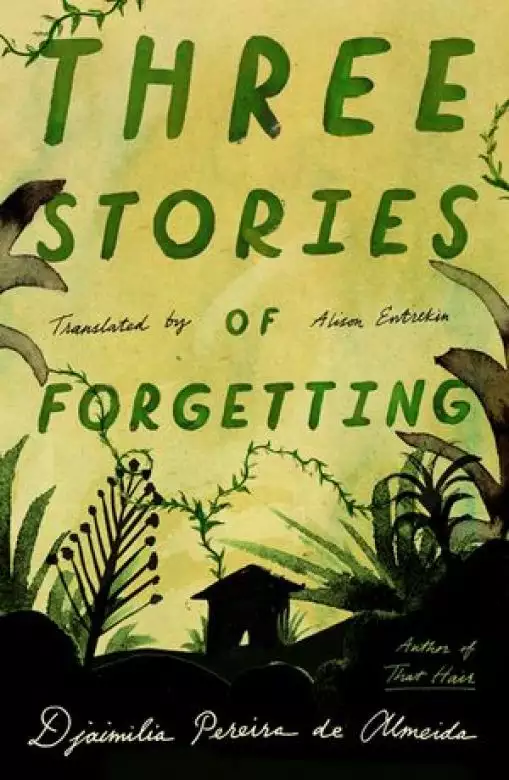
Three Stories of Forgetting
- eBook
- Paperback
- Book info
- Sample
- Media
- Author updates
- Lists
Synopsis
A haunting exploration of the memories of three men and the reverberations of slavery, colonialism, and empire.
The discrete yet overlapping tales in Djaimilia Pereira de Almeida's Three Stories of Forgetting explore the lives of three men—perhaps already dead in the eyes of God—who live within the legacies of slavery, colonialism, and the spoils of the Portuguese Empire. They are all incarnations of our despair in the face of the questions that history does not answer. In "The Vision of the Plants," Celestino, an old slave trader, returns to the solitude of his home and garden after a life of horrors. In "Seaquake," Boa Morte da Silva, an Angolan who served on the Portuguese side in the Colonial War and has become a valet in Lisbon, writes to his daughter asking for forgiveness. And in "Bruma," an old slave initiates a young Eça de Queiroz into the world of French literature, even as he finds himself trapped by his own demons.
Left to their agony, remorse, and guilt, or undeserved peace, the three men may be tormented ghosts who cannot find rest. Perhaps the land they aspire to, their home in this world, is a place hidden in their souls, somewhere between nowhere and goodbye. Their lives are unstable chapters in postcolonial history and allegories of the reading and rereading of that history, and of literature. All three have been expelled from their lives, sent on a solitary journey into the night.
Release date: December 9, 2025
Publisher: Farrar, Straus and Giroux
Print pages: 304
* BingeBooks earns revenue from qualifying purchases as an Amazon Associate as well as from other retail partners.
Reader buzz
 Please log in to recommend or discuss...
Author updates
Three Stories of Forgetting
Djaimilia Pereira de Almeida
Now, of the people who used to make the crossing with me, when Aninhas—Jeremias’s Aninhas—used to hold my hand and walk me to school, I will never forget Captain Bernardes; a fellow by the name of Carvalho who made admiral; Uncle Bento; the irascible Captain Sena, about whom terrifying stories were told, him caught on the high seas with a hold full of gunpowder in a lightning storm—sparks raining down; the cheerful Captain Serrabulho, married to a ghost woman, a prodigious man with a large belly that shook with laughter—“The world ends here with a supper of fish!”—and who had sent the Foz do Douro and the Baía to their deaths in a whirlpool; and, above all, Captain Celestino, who, having begun life as a pirate, ended it as a saint, tending to a garden with such diligence that to this day I can’t picture it without feeling envious. He didn’t say much. He was always smiling with a full, perfect inner satisfaction, his bright face rosy and innocent, framed by a completely white chin-strap beard. His prior life had been mysterious and cutthroat. He had poured bags of quicklime into his ship’s hold to swiftly put down an uprising of Blacks who he’d gone to fetch on the African coast to sell in Brazil. Other, worse things were said of Captain Celestino … But what I know about him with any accuracy is that for growing carnations from cuttings there was no one better in the world. All day long a trickle of water running through invisible conduits to which only he knew the secret would drip continuously on his whitewashed flower boxes; all day long, in rapture, with the gentle hands of a woman, the old corsair would tend to the flowers he grew as if they were his daughters. And that is how he saw out his days, weeding and pruning, his conscience clear and untroubled …
—RAUL BRANDÃO, Os pescadores (The Fishermen)
Blessed night. He woke up at home, restored, after a full life. But the house had changed. With the shutters locked, furniture covered with sheets, the wine-stained cloth on the table, the closed hope chest in a corner, the black velvet drapes made ragged by silverfish, everything was different and yet the same. In the penumbra, the shapes of the furniture suggested ghosts. The dust, come to life, danced through the air, lit by the sunlight coming through gaps in the windows. The penumbra almost said: breathe, son, you made it back. A trace of dry lavender perfumed the musty air. Or was it wax? His ears had always been better than his nose. No sound but his footsteps, as he felt his way down the hall. The black fireplace on which the copper damper and iron pot still sat in the ash of a stamped-out fire: mute. The furniture didn’t welcome him back. He had no one else in the world. All he had left was the dining room, the small sitting room, the two damp little bedrooms, the kitchen with its blackened ceiling, which opened onto the pantry, the jars, boxes of maggoty corn flour, bottles of firewater, and the garden, overrun with bramble, nettles, and thistles.
Seen from the outside, the house invited the imagination to play. The facade, whitewashed years earlier, peered discreetly at the street across the poplar-lined footpaths. Covered with a beard of ivy, the facade could barely be distinguished from the garden, which, though neglected, insisted on facing the sun and hugged the walls. Moisture from the plants had seeped into the sandy foundations, covering the ceilings with mildew, gnawing at the skirting boards, rotting the gables. Nature’s hunger was slowly eating away at the house, and the captain, standing before his relic, was a particle of this hunger, which spilled down to the street and heightened the dreamlike dimension of the architecture. The roofs and eaves had been transformed by the fates of their inhabitants as each of them had left and died. The sea, coming up from the beach, had changed the house, drying out the beams on which, now, as if on the hull of a boat, woodworms rejoiced when the temperature rose. Little by little it had become a thing and lost whatever human will had impressed upon it. It had been licked by the wind, just like the coast, the sand, and the forests. The salt air had toughened its skin and that of its owners. It was no longer a person, in the image of the one who had built it, but a mass of rock, lime, and wood.
Hedges hid the door and the shuttered eyes of the windows.
He opened the shutters and the air rushed in like an exorcism. The sheets on the furniture fluttered and the captain was afraid the soul of the house might slip through the window and disappear down the street. He closed the shutters again and silently breathed in the dust.
The dead of the house allowed him to wake up. The perfume of the thistles in the sun wafted in from outside, he sensed sap reaching flowers, milky and astringent. The smell of earth provided relief from the dust. A fireplace alight up on the hill: dry wood darned with spider eggs, damp rust, mildew, funk, shellac. The notes came and went through the partially open door at the whim of the breeze, while, eyes closed, the captain shrugged off his sleepiness. What was he going to do with his days, now that he was near the end? His childhood home hadn’t traveled, though its walls were scorched like the captain’s skin. It hadn’t killed anyone, yet it bore scars that contained silent pain. All it had was the tattoos of time and the nests of swallows, which had soiled the eaves as a soul soils itself.
The ladybird eggs hatching on the windowsills, incubated by the heat on the frosted glass, didn’t remind him of the eyes writhing with larvae he’d seen on his travels. The house and he who had inherited it were old. It was a tomb for his heart, nonhuman company he’d done nothing to earn.
He got rid of the worm-eaten furniture. A month after his arrival, the only things left were two chairs, the dresser, the paintings of his ancestors, and the table near the fireplace, where he ate meals and jotted things down. His boots made the dried-out floorboards creak. It didn’t bother him to hear his own footsteps. The solitude was music to his ears.
With great purpose, he opened the women’s hope chests. Outside, he dug a pit and laid in it the dresses, slips, towels, sheets, bedspreads, blankets, pillows, swaddling blankets, socks, aprons, gloves, shawls, and bonnets. He set them alight. There was nothing dramatic about it. He watched the melted bobbin lace and the hems and trims of dingy fabrics crackle in the flames. Ablaze, the story told by the needlework sputtered out in the pit. The embroidery lit the bramble, sparks flying, a final farewell with no applause.
It didn’t bother him to lie every night on the thin straw mattress atop the white iron bed where his mother had died not knowing what had become of him, nor did he miss her, not even in the first few months. He didn’t allow himself to be lured away by the sky full of stars above the house when he went outside to smoke before heading back inside. Where once he had conversations with his sailors in the prow, now he exchanged whistles with the crickets and listened to a cuckoo pecking rhythmically at the trunk of the pine tree. The delicious monotony of the habits of an old sea captain stayed with him, now returned to his family home, unburdened, to die in peace.
He needed so little, the company of no one. He found a reason for being in the unkempt garden, abandoned by the caretaker, also dead. If he was going blind, better to die among the consolation of plants, surrounded by hues and scents.
He retrieved the hoe and the rake from the shed. The weeds had taken over the property, as plants will do. Not even the healthy arum lilies that poked out like a leggy armada, between the cattails drooping over the accidental spring peas—an erratic overlay of the charms of spring on the remnants of autumn and the leftovers of summer—and the bamboo that peeked out between branches of holly, its geometric foliage tangled in the ivy, strangling the ancient oak with its gnarled trunk, not even the white elms and their question mark–shaped styles could hide the fact that, begging for order, the unruly garden’s mission was to work its way through cracks in the doors, sully the well water with poisonous fungi, take possession of the furniture, get into drawers, spread branches up to his ancestors’ eyes in the paintings, and carry away the memory of human life that had once called it home.
The chaos of the plants didn’t send him back to the open sea. He had his feet planted in the same here and now that had kept him alive when he first lived there. He didn’t have his former strength, but he had a lot of free time on his calloused hands. After a cup of very dark tea, he would head outside to weed at around six in the morning, when the sun was rising. He’d weed until eleven and then nap. He’d eat a hunk of bread with a slice of sausage. When he didn’t go back to sleep, into the village, or to the port for the first sea breeze of the afternoon, he would weed all afternoon, piling up the thistles, bramble, and dry leaves, pulling up handfuls of relentless nuisances. He fetched water from the well. He wet the sandy soil, turning it over with his hands; he gave it water and time.
He was weeding his way toward death to distract himself from the fact that we are swallowed every day by currents, skies, plants. Guts, blood, spittle, tears, first cries, last whimpers, nothing was strange to him. Gardening the seas delayed the march that would have swallowed him like a shark. He had burned down huts, cut off heads, and let everyone know it. And the world did nothing. Nothing did anything. Palm fronds tore away from their trunks, the cedars held hummingbird nests, the bats in their loop-de-loops swooped before him, like burnt testaments. There wasn’t a soul alive who could interrupt the course of the waters, stanch the current.
But some things came to destroy. He was afraid he’d go mad with the passing of the hours, the cadence of the waves, at the end of the day the hourglass was his enemy. New leaves following dry leaves, a new thread on the spiderweb he’d glimpsed the day before, raindrops covering the spikes of pine trees, dried and gone by tomorrow, all proof that God never sleeps. He wanted to stop time because he took part in it and knew the secret: that nature conspires to put us to sleep, that at the end of the world there are no people, just sick tree
trunks scattered about, fish hands, a soup of water lilies and cockroaches, weeds, mouse skeletons, fungi, thorn-eating snakes, a stream of Sundays.
The monotony of the helm would cling to his muscles until his eyes became heavy with sleep. Celestino would then cease to be human. His profile was blurred by droplets of spray, his beard whipped by the wind, his skin polished like the inside of a barnacle. The spirit of the sea dazed him, drugged him with its iodine and blasts of air. The sea had varnished him, as he had the figureheads of the ship. The waves lifting the prow wore away at him. All the same at all times. The sun, the moon, the wind in the sails that damned him, the days unfolding into one another, faces, rags, snuff, fingers.
The Atlantic wanted to addle the captain’s brains. Celestino wanted to stop the clock. The ship’s hold that mattered was in his head, the carnation with its clove pinks, its aura of nauseating heat. His head was full of carnations, piled on top of one another. Even the stars on the water challenged him with their punctuality. God keeps at large those who resist, ready to trip up the happy in the back of an alleyway, to relieve his boredom. Despite the tumbles, their cheerful commotion unto death is tiresome. Perhaps God has no control over his troop of gardeners. He watches their number from above, sitting beside the devil. They go forth like ants who have lost their anthill, rakes in hand, urged on by hunger, by thirst, by lust, frothing at the mouth.
Water and care gave rise to an infinity of beings that he discovered with his fingers as he tilled the soil: worms, green beetles, wood lice. Life was returning. Celestino planted rosebushes, carnations, camellias, wisteria, a plum tree, tomatoes, turnips, and onions. In the mulch he used seaweed, branches and leaves, fruit peels. He made a row of pots for aromatic herbs. He pruned a hedge in the shape of a rabelo boat. He planted two fir trees. He whitewashed the borders of the flower beds. He germinated roots in the sun, in a nursery improvised on a slab of wood that had been a door. When he didn’t go into the village or to Porto to buy seeds, the neighbors would offer him cuttings of this or that, or he would take plants he found while he was out and transplant them. At one stage he had more than twenty cacti, whose prickles he counted. He made a pebbled path along the edge of the stream and a skull of shells in the bamboo thicket, which spread color and life, growing in a snap, four or five inches overnight.
Padre Alfredo visited him for the first time that week. The captain was so unaccustomed to having visitors that when he heard the bell he didn’t go immediately to the gate. “Senhor Padre, good morning, what brings you this way? I was taking a siesta, come in, come in,” and Celestino guided him to the garden. “So this is where the fierce Captain Celestino spends his days. What splendid roses,” said the priest as he leaned over the rosebush. The roses looked varnished, bursting with song. Truth be told, he had come to see what was behind the hedges. The flowers silenced him. Their perfume, intensified by the light of the sun, which was now high in the sky, put a damper on the sermon he had prepared. Celestino was friendly. “Did you plant curry, Captain? There’s a strong smell here.” Mixed together, diced by the light, the aromas of the fruits and flowers were inebriating, with several confused notes—citrusy, but also deep, woody, and spicy. The garden around him, with its flower beds of carnations and red geraniums, the bright pink sweet peas, the carefully pruned plum tree, each leaf designed and lacquered by a lovestruck painter, the conduits of the watering system the gardener had invented, the colorful strings that held the highest branches of the tea-colored roses to the walls of the house, the peace of the garden, the love poured into everything, at odds with the sullen figure before him, who, he’d just realized, had been talking nonstop ever since the gardening that kept the yard so perfect bloomed as a pretext.
Celestino kept talking while the priest studied him closely. He explained that there was a secret to propagating carnations: “It’ll die with me, no one is interested.” He gesticulated as if he had longed for someone to talk to for a long time and, also, as if the priest had touched on the only subject that mattered to him. He talked about the carnations, the pots, the cacti, the gladioli (which he had yet to plant) that had surprised him by popping up next to the rosemary, as if he were talking about the loves of his life. To the priest, who wasn’t young himself, the captain seemed so old in the early-afternoon light. The cheekbones cut by two veins parallel to his pointy nose, his small, very blue eye, almost closed, his bushy eyebrows, the long beard of many years, white and very tidy and combed. The priest had come to assess his living conditions. He wanted to take him to the church to confess. “You know, I wouldn’t like you to want for anything. I still remember your mother, a fine woman, God bless her. May she rest in peace.”
On cloudy mornings, Celestino liked to go out to watch the comings and goings. In a gray overcoat and tall felt hat, his silhouette wandering through the changed village caught the eye of the same people who had seen him leave. The long beard, the sour, scowling face, and the black leather eye patch suggested mysterious adventures to the locals. The murmur of dresses rustling through the streets put him in a bad mood. He shot smiles only at the children, who looked up at him from between long skirts and occasionally poked their tongues out at him. He had a fondness for children, like an admirer of perfect artworks. That they were perennial and alive, led by the women who, still young, already wore on their heads the kerchief of resentment, hurt, and superstition. He cut off a dwarf’s head. He hacked a woman in two. Over in the Congo he set fire to an elephant. No, it was in Salvador, and apparently it was a bison. He keeps skulls in chests and charms snakes in the moonlight. The women would cross themselves and clasp their hands to their mouths to hide their teeth. The men would guffaw and order another round. The children’s eyes shone with curiosity and fear,
imagining what was behind the eye patch.
During playtime at school, the children would cover an eye and reenact the mysterious captain’s adventures. At night, they would ask their mothers to tell them what his life had been like. When did he get here? Where did he go? How many people did he kill? Who made him blind? Mothers told fathers that Celestino was back on land. They’d have to keep him away from the little ones. Early on, the captain’s house acquired the features of a haunted dwelling. The hedges above the wall were green and dense, but gaps in the leaves allowed passersby to glimpse his shadow as he walked in the garden and to hear his shovel striking the earth, which they thought sounded like sinister business. The villagers would cross the street, hoping to see something through the leaves. The children saw a bearded figure, a shovel over his shoulder, a tattooed torso. At first, not even the dogs dared venture that way. When they did, they were shooed off with a stick by the owner of the house. Sensing eyes behind the hedges, Celestino drove away the neighbors with roars and promised them death.
To shoo away busybodies, he made a scarecrow out of the tattered drapes from the sitting room and placed it in the vegetable patch. The scarecrow’s cape flapped in the wind. When he saw it, the caretaker of the house next door told his wife he’d seen a ghost in the field. The wife thought her husband was lying and went to see for herself. That night she didn’t sleep for fear that death might climb into their bed. They said nothing more, and the next morning she headed for the confessional. “Captain Celestino has sold his soul to the devil,” she told Padre Alfredo, beside herself. “He even made an altar to him in the backyard. At night, he paints his face with blood and goes about in a cape speaking in the tongue of Black folk.” The priest reassured her. “Say five Hail Marys and light a candle.” But the damage was done.
At the fish market, at the fair, in coffee shop doorways, on the footpath, the velvet scarecrow became the patron saint of gossip. He talks to the spirits and has killed over a thousand Blacks. At night he dances with the devil.
Peering through the hedges, three children climbed on each other’s backs to get a look at the devil’s abode. No sign of the captain. The blooming garden was calm. If the devil lived there, he was a good gardener. With a boost from Raul, Pedro clambered up the wall. “Can you see him? What’s he like?” asked Luzia impatiently. But, on top of the wall, all Pedro saw was a saucer with three cubes of candied marmalade and three slices of cured cheese left by a prankster who had read their minds.
Life on the seas seemed more certain to the captain than on land, less susceptible to the passage of time and the decrepitude that had transformed the houses of his childhood hamlet, whose facades now looked narrower, more askew, buckled, stained. Not even the fog struck him as auspicious, as he strolled along the quay; it had lost its allure. To escape his unease, he went into the church and sat on a bench to admire the altar.
Padre Alfredo recognized the sound of his boots and felt intimidated. Celestino didn’t have the knees to kneel, much less the desire to do so. He liked to sit as if something were soothing and holding him.
From the sacristy the priest saw him staring into space, his stiff hands clasped on his knees. “Maybe he wants to confess.” “They say he cut out six boys’ tongues,” whispered the altar boy. “Auntie Aurora told me. Apparently, he drinks blood and sold his soul to the devil. His mother was no good either.” As circumspectly as he had entered, the captain left.
And all conversation would stop when, in passing, he would tip his hat to the ladies in friendly insolence.
“Captain Celestino, have you been back long?” asked the priest one day when he found him in the church again.
“It’ll be a year.”
“If there’s something bothering you, know that the ears of this house are yours.” Celestino remained impassive, as if he hadn’t understood. The fearful tautness of his lips almost moved the priest. Celestino smiled, revealing his decayed teeth, smoothed his beard, and, muttering “Before it gets dark,” disappeared.
The conversation didn’t rouse the captain, who, after expounding on watering, was now going on about the study he was conducting on petals. Maybe he didn’t like people, or even miss their company. The place wasn’t haunted. The man who lived there was only thinking ahead, planting flowers for his grave. Alone with him, Padre Alfredo didn’t dare broach the pirate’s past. The man before him was a gardener. His hands, which in times past must have stunk of rum and blood, smelled of curds and tilled soil. Celestino was a little muddled. He’d switch names, talk about plums, and then halfway through graft on the idea of getting pineapples; he’d start with propagating carnations and veer into picking turnips. The devil didn’t reside in him. Even if he did, death would get the upper hand faster than Alfredo had imagined. They barely said a word of goodbye, even though Celestino had seen the priest to the gate. Madness is the sweetest of remedies. Contrary to what people were saying in the village and what the tongue-wagging altar boy assured him, that house wasn’t occupied by a monster, but by a man busy with preparations for his own funeral.
Come to me, children, don’t be afraid. What do you want me to tell you? I was born here. My mother and aunts embroidered with tiny, sleepy fingers. I never saw my father. He died at sea. Brave Captain Nuno had a big, silent nose. At night, lying in bed, I would think of him and moan with fear. I could hear him pacing through the house. I saw giant puppet heads covered with sheets. I thought they were in my room, rustling the curtains. Outside, the sound of the waves would come up the hill from the beach. I’d cover my head. I used to dream of myself as a man, master of this big house. The dark hallway, the corner bedroom where I slept. The two small inner bedrooms, the dining room, and the kitchen, I’d make it my kingdom. I’d fire the caretaker, old Amadeu of the trellises, staggering drunk. I’d eat whatever I wanted, when I wanted. I’d burn the women’s clothes in a fire.
“Want some more blackberries?” Shadows had fallen across the garden. The wind dragged dry leaves across the paving stones. The roses withdrew to sleep. The daisies put their hair up. Why did he need an audience if he was making it all up? The children’s eyes begged for the knife, curiosity working its way into their muscles like a weed. He should have taken a quick dip to wake himself up after drinking.
“I’m telling you truthfully, I left this house to go to sea. My mother gave me my father’s coat and this gold chain. See. We got to Africa in less than a dream. Youth has no grasp of time. My mind was on fire. When we got there, the night tickled me. I walked along the beach in the mist, and then through the jungle. After a night, I caught sight of a village. Alone in the forest, I felt like there was someone with me. The dew on my palms spoke to me in the language of happy things. After ten days, a young Black man came along on a donkey. I offered him a coin in exchange for a chicken. He came back in two hours with a gourd of fresh water too. I made him taste the water, in case he wanted to poison me. I thought about killing him. But I was exhausted from waiting.
“That’s when the fever got me. I wandered about in circles until I stumbled onto the beach, sapped of strength. And then the Dutchmen appeared. One of them was traveling with his niece. They talked about the big crocodile they had to find and led us all the way through the black forest. I was burning up with fever, I could hear them in my sleep. The girl fed me. She sang me lullabies, washed my forehead, spoon-fed me corn porridge. She washed my hair with fresh water, combed it with her slender fingers. One night I surprised the Dutchmen in their sleep and slit their throats. I bound the girl’s hands. I blindfolded her. I left her alone in the forest, tied to a log. Make no mistake, children, I was born afraid of nothing and that is how I became a man. To hell with the girl. Now try this.
“Come to me, children, to me who has slit throats and who sleeps the sleep of the righteous. Do you want to know what I’ve killed? I’ve killed monkeys and horses. Snakes, wasps, an elephant. A crocodile the size of a raft: I cut it into five parts, as I laughed at the fortune the giant would bring me. I’ve killed ten women, cut the feet off of one. I killed a crow to eat it. Foxes, rats. I’ve killed hundreds of men with these very hands and they haven’t fallen off. I’ve killed the dreams of a thousand others. I’ve burned down huts. One day, I bit into a man’s neck and tore his veins out. I put a spear in a friend’s chest. I’ve stolen money. I smashed an albino’s skull against a rock. And then I hacked him up. As I dozed off, my mother’s hand would steal into me with a cup of very sweet, warm milk, and carry me away in the hands of sleep.”
His cavernous voice echoed like a choked song. Transported by the melody, the little audience imagined colors. It was more tantalizing than the saucer of sweetbreads of the imagination—cut throats, stumps of limbs, hair, the remote, gray Levant, flags hoisted, the roar of the waves. The greedy listeners licked blackberry seeds from their teeth, begging for more, sucking their fingers, more death, more blood, numbed by the bittersweet song of the captain at the wheel.
“Seeing the garden wake up is worth a lifetime. The sun peeks out, I go say good morning to them, not at all sleepy, I make coffee, sing them a morning prayer, we say good morning all together and I lie down with them, kneeling, I prune the ones that died during the night, for some leave in the dark, I barely notice them, I almost want a thimble to touch them with, for their fresh joy burns my fingers, my beard still smells of the night, the sleep in my eyes, my beloved flowers, carnations, stubborn, always mischievous, eyes puffy, my
carnations are dawdlers, but I wish them no harm, rather, I want to sprinkle water on them, water rather than quicklime on those little fuzz-heads of light, my beloved carnations, they’re the ones who sleep most soundly, almost snoring, but at night no one is to blame and their snoring bears me away from here, it almost puts me to sleep, if I sleep I die, I never sleep, a drop of water on the head of each one, water rather than quicklime, which tames them.
“There’s nothing like my carnations sleeping, the perfume of fantasy they give off as they dream. I watch them fall asleep and wake up, all mine, all so silent, they no doubt wish they could run away from me, for I could tear them from the earth with this hand, flowers of mine, as soon as the day rises and, on my knees, I get ready to tend them, dreaming they’re asleep again, willing night to come quickly so they may sleep. I pluck off their old petals, as all things in excess are poison, I sprinkle water on them with these old fingers, I marry them to one another. By night, I sit and guard them. By day, I go out on the footpath and people ask after my carnations. ‘How’s your garden, Captain, your carnations?’ They want to steal them, I know it, the drugstore man’s grimy fingernails, chattery hands, if he so much as touches my carnations I’ll split him in two, but I say yes, I fill their mouths with petals, up to the throat with beautiful phrases to shut them up, I know they don’t care for me, I don’t care for them either, I prefer my carnations swaying in the breeze, chattering, they talk to each other all day long, like critters deep inside knots of wood, they tell each other stories that only I hear, of great suffering, trifles, and then they grow tired, their backs hurt, that’s when I help them, tuck them into bed, tell them it’s late, that night is almost here, dear carnations, they yak their heads off and drop like children, that’s why I like them so much, they’re bolder than children, they grow tired, Captain Celestino’s carnations, blessed things, all they want to do is laugh and eat and kiss butterflies.”
The children got sick of blackberries. But the wind would stir the burlap covering the porch, the geraniums would smile in the breeze, the street of poplars emptied and naught but the captain’s words, like a spell: “To me who sli … slee … right … come … to … cro … co … dile … smashed…”
Behind the fence, the neighbor listened and choked on Hail Marys. “What does that pig want with the little ones? What if he kills them?” she asked her husband that night in bed. He rolled with laughter, and tickled her on the knees. She knew what she had heard, “monkeys … ditches … crows.” The roof beams lit up in the dark as a shooting star went past. The bedsprings creaked. Sleep wouldn’t come, not even after twenty Hail Marys. The poplars outside waking up for the dance. The mountainside lit up in the moonlight. She lay there, alone in the dark, sweating questions.
After his brief conversation with Padre Alfredo, rumors about the old pirate took on a life of their own. For two years, no one went near his gate. Children on their way home from school glimpsed a figure in suspenders, a hoe over his shoulder. Was he the devil? He was strong and broad-shouldered, but he had so many flowers and was so patient with them. He touched the roses, admired them, feeling the petals with his fingers. Then he sat on a chair in the sun and leaned back. For a pirate, he was boring. Maybe he was only pretending to be one. Raul wished he had a rose garden as beautiful as that. Celestino stopped caring if they spied on him, if they didn’t talk to him. The scarecrow had done its job.
Mothers covered their children’s eyes with their hands when they passed him on the street. If you don’t finish your soup, I’ll take you to the captain’s house, where he’ll chop you up like a grouper, grandmothers would tell their grandchildren. At the seed dispensary, they sold him seeds reluctantly. He’s building an altar to Judas Iscariot, good grief, heaven forbid. If he wasn’t so discreet, they’d have run him off the land or gathered at his gate with torches ablaze one cold morning and driven him out of town. Over time, with new boats and new people arriving from the sea, the rumors were diluted. He was old and spoke little. He walked with difficulty. He was going blind and didn’t mess with anyone. It was a land of seamen, whose terrible stories wheeled through time until, like the thick fog coming up off the beach in the morning, they merged with the material from which the houses, bedrooms, clothes, people, and sleep were made.
Young and old alike felt a curiosity approaching lust when they smelled the sweet perfume of fresh roses and jasmine that wafted out of the pirate’s garden on spring days, to those passing on the street.
When dusk fell, the captain would peer at the wall to see if the treats had reached their recipients. He always found the saucer empty.
Blood, light. A little mouse. A rectangle of boxwoods with camellias in the center. Cuttlefish bone—mango pit.
Things I saw at sea.
Blood and light tonight. Mice in my pocket. A blackbird has fallen under the fir tree.
A coffin the size of my life. The church ladies weep and I belch.
Today it was just one fat rat. The barber says tomorrow it’s going to pour with rain. I never saw Manel again.
I got in from Leiria yesterday. Tired as a horse. I brought a tulip. Weeping willows along the way.
Yesterday I emptied every last drawer. My dream since I was a boy. Sobs. Blood and light tonight. Third time this week.
The carnations are very much alive. The neighbor lady brought a moist pound cake.
Night on the stream. Get from Noval Seed Dispensary (in Espinho): cranberry beans and purple corn.
I used to want to gouge out her eyes. Bad day. I lost two dahlias. Now I’m drying roses in the cupboard with their little heads upside down.
I found a fishbone in the vineyard. Tea with Padre Alfredo. Leprous throat.
Behind the house, the well and the forgotten vineyard. Celestino didn’t have the arms for it. He had planned to salt the land. He had wanted to call Manuel and then Bentes, a Brazilian acquaintance of the priest’s. The stone was fleshless: skin still damp and gums exposed to the worms. There was no hair, except the spidery hairs of the vine that had been green and lime and had provided shade for the table on the porch, now in danger of collapsing. Grapes were shriveling on the branches and oozing a sugary syrup that the master of the house left to the ants, flies, and bees. Neither the oven, when he baked corn bread or roasted meat on it, nor the smoke rising to the sky from the chimney, giving off warmth and a promise of stillness, could disguise the fact that, from the front, the old house had little roses tucked behind its ears; from the back, it was molasses and blowflies. Or maybe it was nothing of the sort, but a molar that hides its rot behind gleaming enamel.
Light and blood. India Route. Amaro shouted: “Halt!” Her chest split open. Two handfuls of sand and she didn’t even moan.
I can’t bear the smell of the sea. The old woman who sells mackerel there says it consoles her. The newspaper said the snow will reach Porto this month. Two pigs in Tuscany. As for the mice, nothing.
If I eat the mice—into the well with me.
The priest. The church reeks of incense and mold. Give me the ship’s hold of my time: 1833. Portside. Get spring onions. I’ve lost the war against the thistles. A cannon of gunpowder in the priest’s mouth. One of my teeth fell out near the fir tree. I’ve lost count of them all.
The breeze sprang from the mountains and woke up the oaks. Before it ruffled the leaves, the shadows of the trees drawn in darkness, black on black, covered with sleep, looked to Celestino like a fence. But the wind rose, still unseen, and quickly took the valley, as if it had risen from the earth. It whooshed up trunks. The treetops fluttered in the night, ticklish. Their quivering reassured him and made him a little nervous.
The cadence of the breeze, its to-ing and fro-ing, coming and going, haunted him.
His heart sped up and he stopped walking. The oaks, awakened by the breeze, were saying something. The wind first reached one or two branches of the row of poplars and sent a cool shiver through the others.
He remembered the sound of water on the beach. The rhythm was that of a tide. Its rush, a riot. Its retreat, a relief followed by a shudder.
The captain would often sit on the ground to watch the trees swaying in the wind. “Where did he get to?” the neighbor would wonder, no longer able to see him from her bedroom window. If he concentrated, the captain’s heart would even find the tide, and heart and leaves would fall into step.
Along came the wind, and Celestino’s heart filled with blood. The leaves rustled and the blood raced out again.
He was invaded by the present. He stared into the darkness. From land, he revealed himself to the night and to the sea as having reached his destination. If the wind wanted to come take him, he felt ready to face it down. If it had been wicked to plant death, it was too late. He had found a home and wasn’t ready to give it up yet.
He waited for the wind in the leaves to respond to his ultimatum. The tide came and went with deaf ears. The leaves fluttered in the darkness. The tremor rose from the trunks, seized the crowns, and then, at the same pace, abandoned them. ...
We hope you are enjoying the book so far. To continue reading...
