
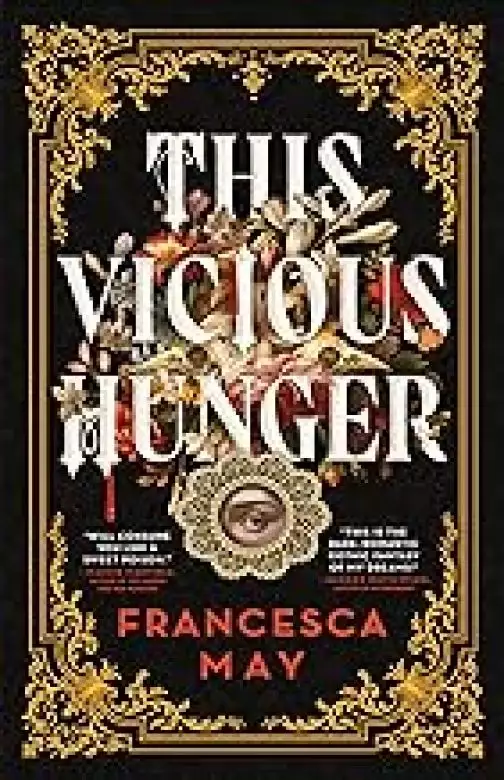
This Vicious Hunger
- eBook
- Audiobook
- Hardcover
- Book info
- Sample
- Media
- Author updates
- Lists
Synopsis
From the author of Wild and Wicked Things comes a dark gothic fantasy about two young women struggling to find the freedom of choice in a world where their path feels predetermined. Turning to each other, they soon find themselves sinking deeper into a world of beauty, poison, and the insatiable quest for knowledge.
Thora Grieve finds herself destitute and an outcast after the sudden death of her husband only a few weeks into their marriage, but a glimmer of hope arrives when a family friend offers her spot at a university to study botany under a famed professor. Once at the university Thora becomes entranced by a mysterious young woman, Olea, who emerges each night to tend to the plants in the professor's private garden.
Thora soon learns that a mysterious illness prevents Olea from leaving the garden. Hungry for connection, Thora befriends Olea through the garden gate and their relationship quickly and intensely blossoms. The visceral connection between Thora and Olea unlocks an obsessive desire in Thora as she throws herself into finding a cure for Olea's ailment. But is this really love or is it merely lustful intoxication? Thora's finally found the freedom to pursue her deepest desires, but at what cost?
Release date: August 26, 2025
Publisher: Orbit
Print pages: 384
* BingeBooks earns revenue from qualifying purchases as an Amazon Associate as well as from other retail partners.
Reader buzz
 Please log in to recommend or discuss...
Author updates
This Vicious Hunger
Francesca May
I have dreamt of it my whole life and I dream of it still. When I was a child my father described it like one of the Isliano palaces of old, a parade of white columns and sculpted stone women carrying water in vast urns. I imagined what it would be like to stroll through halls hung with masterpieces in gilded frames, to smell the smoky sweetness of clove cigarettes in the mouths of scholars.
My father described the university as though it was inevitable—as though I would one day see it. I did not realise until I was much older that he told such richly embellished stories because he never expected me to see it, and never expected he might see it again either, since he had never had a son. He took solace in the tales he told as I watched from my perch in the corner of the embalming room or looked on from the grassy slopes as he tended his garden of herbs; by the time I left home I could recount each story word for word, as I often had at bedtime to ward off the thoughts of what would come if my parents ever received an offer for my hand.
When I was a wife, the vision in my head became twisted by desperation, the university an oasis of dark cubbies, vaulted arches, and the cool darkness of libraries recessed deep underground. I never stopped thinking of it as mine, my story, my fairy tale. I knew by this time that I would never have the honour of attending as I might have if I’d been a boy instead of a wretched girl, but I longed for nothing more. I should never have been a daughter of Death, learning my father’s profession despite my mother’s protests, condemned to a life as little more than Aurelio LeVand’s wife. If my father had had his way—and if I had had mine—I would have been a son of science.
Instead, I was married and ordered to leave any childish dreams of education behind. I made a good match in Aurelio. His mother said he was charmed by my beauty, some softness in me that hadn’t been lost during the years of constant mourning—or perhaps a softness that had emerged from it. My father said there had been some scandal, years ago, and while Aurelio was a very good match for me, with my rising age and my diminished dowry, I was also a welcome match for him, even despite my strange upbringing and his family’s standing. He should have married a countess, but instead he got an undertaker’s spinster daughter.
Although Aurelio’s family settled for me, my husband himself was agreeable enough. He seemed relieved that I wasn’t ugly and was eager to teach me the proper behaviour expected of a respectable lady. I’d never considered what might happen if I ended up with a society husband because I’d always hoped I would never be a society wife, but my father assured me on my wedding day that all fresh brides fear change, and my only duty was not to let Aurelio see it.
I assumed, naively, that Aurelio’s teaching would open this new world up to me. After all, my father had nothing but my best interests at heart, so surely Aurelio must as well. I’d expected to make some sacrifices, of course—my father’s rules for the rules of domesticity, the trade of mourning for other wifely duties—but I wasn’t prepared, when it came to it, to release the hold my father’s tales still had on me.
Women, Aurelio had informed me the week after our wedding, do not read. I’d been holding a paperback novel—hardly scandalous material—and he swept it from my hands without pause, dashing it straight into the open fireplace. Now that you are grown you must set aside these childish fancies. Didn’t your father know he was doing you no favours by filling your head with such silly stories?
Aurelio never understood that these stories were the sun that warmed me through the winter days of my marriage; when all I had of my old life was the familiar scent of loamy dirt in the greenhouse and the steady growth of the unfurling leaves I’d cut from my father’s prized pothos vines, these remembered fantasies of the university reminded me that Death had taken my father but he was not entirely absent.
I never told Aurelio that my father’s stories about the university were perhaps the most normal parts of my childhood. The reading was foreign enough to him. Most women mourn perhaps five times in their whole lives: they celebrate their fathers and mothers, suffer the loss of their new babies, grown sons gone to war, or daughters taken in the birthing bed; if they are lucky, they might live long enough to mourn their husbands. I have mourned more in my life, spent more days in thoughtful, solemn Silence, than Aurelio has—had—spent days in the schoolroom. He might have assumed I had helped my parents on occasion, but I suspect if he realised how much of my life I’d spent wearing the veil of death, he would have decided to give me thirteen hundred days of mourning instead of thirteen.
And now Aurelio is gone and the ceremony, and my Silence, is done. There are no more secrets I must keep from him. The house we once shared echoes with his absence, with the memory of how much space he demanded, how much clatter and bulk there was to him, and I spend the days after my mourning ends rattling around it like I still wear the chains of my Silence.
The servants stay out of my way as I catalogue the house and all its contents through the lens of my widowhood. Uncertainty colours the airy rooms, my thoughts returning, as they did during my Silence, as they have done my whole life, to the familiar stories of the university.
I know it is callous to say, but as I wander the halls of our home I’m struck not by the loss of my husband, of the life we shared and the potential of our future, but by the sequestered dreams of the university. I hadn’t realised how badly I had hoped, deep, deep down, that Aurelio might one day grow to be more like my father. How eventually he might have come around to my reading, my learning bits and pieces of science or history—and how one day, maybe, just maybe, he might have considered becoming a benefactor, letting me attend a few lectures as a guest… It was a stupid, senseless dream, not even something I paid much mind to while he was alive, but with him dead… It is even less of a dream than before, and the loss is a wave big enough to engulf me whole.
Now I am at the mercy of his family, nothing more than a tool to be bartered, another moving piece on the chessboard. I await my fate like the condemned awaits the axe. Is it too much to hope for a life of solitude, to be left alone to run my household and tend to my plants in the greenhouse? The alternative—the prospect of remarriage so soon after Aurelio’s death—leaves an ashy taste in my mouth. Will I have to simply trade one set of chains for another?
I am in the greenhouse three days after my mourning ends when Madame LeVand finds me. She insists we all, her children and their spouses included, call her that—Madame. Perhaps she thinks it is sophisticated; perhaps it makes her feel strong. She always marches about this house as though it is hers, coming and going without warning, hosting dinner parties at our table without even so much as telling me in advance, directing our staff by first name in very nearly the same tone she uses on me. Aurelio always told me that it wouldn’t be this way forever. Once you have children, he’d say, it’ll be different then. Once you have children, as though it was my job—and mine alone—to create this new life.
With Aurelio dead it’s exactly as it was before. Madame stomps into the greenhouse while I am in the middle of repotting my poison ivy—I believe its proper name is Toxicodendron radicans, though I’m not sure I’m remembering that correctly; I only ever saw it written in one of the books I left at my father’s house before he died. This time I’m wearing gloves. The rash on my left arm is still there from my last attempt the day before Aurelio died; I’d thought it was a kind of creeper, a mistake I won’t make again. Others might have had the servants throw it out, wretched little thing, but I’m surprisingly fond of it.
I half turn as my mother-in-law enters; I smelled her before I saw her, the clack of her heels accompanied as always by too much sickly rose perfume. Madame is tall and thin, not unlike Aurelio in the quiet strength in her shoulders, her stern jaw, straight nose, and piercing blue eyes, but she’s lost weight with the death of her only son—just about the only visible evidence of her loss.
“What are you doing rooting around in the dirt?” Madame says sniffily.
Politeness dictates that I should have stood a little straighter to show interest when she entered, or at least pulled off my gloves; I still could do both of those things. Instead, some small spark of defiance holds me bent slightly over the potting bench with soil on my dress. I doubt my behaviour will change anything she has to say.
“Aurelio liked when I maintained the garden,” I explain. “So I’m maintaining it.”
That much was true enough. Or at least he hadn’t disliked it. Growing, nurturing, those are women’s work and they suggest a kind of maternal feeling I’m sure Aurelio was relieved to see. Of course, he never knew about the books I’d read about the science of plants, how sometimes I dreamt in kaleidoscopic images of what their leaves and stems might look like under a microscope. I never let him see how much I liked the germination stage, how I’d started to make my own herbarium sheets, and how badly I preferred this preservation and study to the endless flower arrangements I left to the housekeeper… More secrets.
Madame huffs. She glances around the greenhouse, which is already transformed from the pallid, empty space it had been when Aurelio and I first married. Now it is roaring with colour, the trellises overloaded with roses and honeysuckle, ivy and jasmine and clematis. The air is thick with the floral scent—and still Madame’s perfume dominates. I try to hide my distaste.
“Well. You certainly have green fingers.” She smiles as she says this, a wry smile the likes of which I’ve never seen on her face. It unsettles me. Finally I pull my gloves off, inching my sleeve down over the poison ivy rash and turning to face her fully.
“Did you need something…?” I ask. “Only I ought to go and talk to the cook if you’re staying for dinner—”
“No need.” Madame runs a hand under her greying chignon, smoothing it in the way I know she does when she is under pressure, the way I have seen her do during dinner parties when her grandchildren complain. Manners, I’m sure she is thinking. I shrug. “Let’s not beat about the bush, Thora dear. With Aurelio… gone…” She swallows. “With him gone. Well. There’s your future to consider, and I really don’t think—”
“Ah.” It’s come sooner than I expected, the axe landing thud. I assumed I’d have a week at least before questions of my future began. “So soon?”
If Madame is offended she doesn’t show it, blustering on as though I haven’t even spoken.
“I still have three daughters looking for good matches—dowries needed, you understand, that are much larger than yours ever was. I simply do not want you here, cluttering up the house, nor do I think you’d wish to stay any longer than your mourning requires. The LeVand obligation was in sickness and in health, not into the great beyond.”
I stay silent. Madame is not inclined to let me get many words out once she starts, and frankly I’m happy to let her talk.
If I was another sort of woman I might be panicked. All this talk of dowries and obligation—I should be wondering: What will happen to me? I have no father to return to. My mother is dead. I have no other family, no other marriage prospects. Aurelio was my only shot at this marital life. I suppose the fear is there, somewhere, in the questions I know I should ask, but most of the time it hides beneath the numbness, which I suppose looks a little like grief.
“I’m not trying to be unkind, girl,” Madame continues. “I should never allow you to be thrown to the wolves. Which is why…” She pauses, her expression growing furtive. Then she pulls out an envelope from inside her spencer, bent where it has rested between the jacket and her gown. Its side is torn neatly with the edge of a letter opener. “I thought, perhaps, you might consider this.”
She hands it to me. The paper is creamy, heavy, and I imagine that I can smell grass tangled in the weave of it, and the warm, dusty scent of books. Not only is it open; it is addressed to me.
I raise an eyebrow and glance at my husband’s mother, but she doesn’t flinch. She only nods at the envelope again, waiting for me to pull the letter from its sheath. I don’t know if she is expecting me to kick up a fuss about her keeping the letter from me, if that’s why she’s come to speak to me herself, so it doesn’t spread through the house and make her look bad—or if she wants to gauge my reaction for another reason.
Either way, I fight to keep my expression neutral as I pull the paper out and unfold it. I scan the letterhead, its curling scroll like the ironwork of an old gate, and my breath catches. The university. St. Elianto. I want to murmur the name like a prayer. My heart thumps wildly, pulse thundering in my ears.
Suddenly the numbness is gone. I read the letter, limbs buzzing nervously.
“What is this?” I demand, glancing at Madame and then back to the paper to make sure it’s real. “This is postmarked weeks ago. Who is this Petaccia?”
“He’s a botanist—a fellow at the university. I opened the letter by mistake,” Madame says in a way that makes me think this is a lie. I wonder how many other communications I might have received if not for her. “And since the letter arrived so soon after your marriage I thought it best that I dealt with it. Your grief over losing your father was still much too raw to be responding to condolences.” I say nothing, forcing my jaw to lock so I don’t snap at the absurdity of this coming from the woman who forbade me from wearing mourning black after my father’s funeral because it wasn’t “befitting a new bride.” “Apparently your father and this doctor of science were good friends years ago but lost touch.”
“This says something about a scholarship.” I force the words out. “What scholarship? Why does it matter?” The beginning of an emotion too big to process begins to unfurl in my belly. I clench my fists and my teeth and take comfort in the dull ache.
“That’s what I wanted to talk to you about. There was an offer of some sort between this doctor and your father when he first married your mother. We received something similar for Aurelio’s education—”
“Yes, I’m familiar with the general idea. If my father had a son, he would have had a free education,” I say, bitter understanding washing through me. All this time, all those stories, they weren’t just fanciful what-ifs from my father; he had an offer of a scholarship—only all he had was a daughter. A fresh mixture of guilt and shame curdles inside me. “Why is any of this relevant?”
“With Aurelio’s passing I have taken the liberty of writing to this doctor on your behalf.” Madame’s expression shifts again, pride lighting her up like a candle. “I informed him of my son’s death, your widowhood. He expressed his deep condolences, you see, and I thought he might be the sort of man who could be persuaded, given a little nudge…” She pauses, watching my face like I’m a mouse and she a hawk. I feel as though she has punched all the air from my lungs.
“You asked him to take me on?” I whisper. “As a student?”
“I did.” Madame’s smile grows, a little sly now. “I know it’s not what you would have hoped, but really your prospects are extremely limited. And a life of study is far better for the LeVand name than that of the nunnery…” Madame says. There’s a note of genuine condolence in her voice and I realise with a jolt that she has no idea. She has no idea what this means, how badly I want this, what I would do to get it. She does not realise that this is the gift I have prayed for my whole life. I forcefully straighten my face once more.
“Thank you, Madame,” I say, infusing my voice with a hint of regret. Just a hint. It wouldn’t be polite to argue anyway, but it’s best she thinks I am speechless from courteous disappointment rather than sheer excitement. “I appreciate all you have done for me.”
She takes in the riot of plants in the greenhouse again, eyeing the dirt on my gown with a flicker of disapproval. “Think nothing of it,” she says. And I know what she is really saying is Let’s not speak of this again. “It’s what Aurelio would have wanted.”
Less than a week after my mourning ends, I leave my marital home and all its secrets behind. This morning when I dressed I shed my mourning clothes and headwrap and joyfully greeted the spring warmth where my shorn hair curled at my neck.
It takes three hours to reach St. Elianto from the city. On the journey I hum the marching song my mother always favoured and engage in polite conversation with the driver of my cart, delighting in the sound of my boxed luggage bouncing as we hit stones in the road.
“A female student,” the driver murmurs to himself when we are long out of the city. “Well, I never.”
“Yes,” I say hesitantly. “I know it’s unusual.”
“Stranger things have happened, I’m sure. Though I’ve never heard it.” The driver chuckles. “What are you going to study? Nursing or something?” I rankle a little at his suggestion. This Dr. Petaccia is a doctor of medicine, true, but just because I am a woman doesn’t mean the care of others is what I’m best suited to.
“Botany, actually.” I hide a smirk at his blank look. “It’s the study of plants. A science. And maybe I’ll take some classes in medicine too,” I add, although the idea seems absurd. “I haven’t decided yet.”
“What’s your husband have to say about that?”
I glance down at the ring I’m still wearing on my wedding finger—half because I know it will be easier to avoid attention as a widow than as a spinster, but also half because this is the last reminder I have of my father. I left all his plants behind this morning, and the small gold band was purchased with my dowry, money my father scrimped and saved for many years for my future. Madame could have asked for it back, but she seemed only too happy to get rid of it—along with all other evidence of my existence.
“My husband has nothing to say,” I reply coolly. “He’s dead.”
The driver sinks into silence, eyeing me warily but asking no more questions. I turn my gaze back to the road ahead, delighting in the way the scenery changes as we draw away from the roll of open fields.
We first pass the small chapel used by the villagers, and then the market square and a tavern—silent at this hour. My father said that the village existed long before the university, but as we approach I am not sure how that can be possible. The village looks lived-in, the stone buildings old and heavy enough, but it exists entirely in the shadow of the St. Elianto campus.
The truth of the university is somewhere between my father’s stories and my lonely dreams. It is a collage of white columns and twisted terra-cotta spires above pale flat roofs embedded in the hillside. It is dust rolling up around the wheels of the pony cart and flourishing fields behind us.
We leave the village and it isn’t long before the only sound is once again the beat of the pony’s hooves and my driver haughing and hmphing to himself. It is late morning and the sun is fierce, the air baked and green scented; as we approach the campus the air grows cooler, though, an oasis of dusty shade.
The driver guides the pony trap through the gates, scrolling text above giant columns, and along a lane lined with trees. Ahead I can make out what may be a clock tower, though all I can see are a turret and bells. I crane my neck back to read the words above the gate as we trundle beneath the arch, the hairs rising on my neck and arms as the temperature dips.
Doctrina est vita aeterna, the same words my father once muttered to me like an oath. Learning is life eternal.
I straighten my expression, wary of the excitement that flips in my belly. I may no longer be in mourning dress, but I’m not foolish enough to assume that the people here won’t gossip about my arrival the way they would back home. I still wear the shorn hair of sorrow—though of course how are they to know I gave more of it to my father’s cradle than to my husband’s?—and I’m sure many of them would have opinions about my being allowed to study here in the first place, widow or not.
The driver stops the trap at the end of the lane. There is a grand central square ahead, a handful of robed scholars crossing with their heads bent together and bundles of books dangling from string. They look hardly old enough to be away from home. One shades the sun from his eyes with his hand, but I’m invisible, not yet one of them, and they don’t pay me any mind.
“S’far as I go.”
The driver’s gruff voice startles me and I clamber down as gracefully as I can manage without taking his hand, my thick skirts swirling dust over my boots. Sweat drips down my spine. There’s no way I can manage to carry all my luggage alone, or even one of the individual trunks, but most of it came from the house I shared with Aurelio, clothing and jewellery I never had a chance to wear during our marriage. I don’t wish to be ungrateful, I’m lucky Aurelio had so many things made for me after all, but still I feel no attachment to any of it.
I leave the luggage on the edge of the stone steps and cross the square empty-handed.
The room I have been allocated isn’t with the majority of the students here at St. Elianto. Generally the scholars and professors are men, educated in serious subjects—philosophy, medicine, astronomy, and mathematics—and the few women on staff are of the serving class, happily boarding in mixed accommodation.
Although I no longer possess the social rank I did before Aurelio’s death, somebody, somewhere, obviously decided I was not a poor enough relation to share the fate of the staff. Mind you, I’m not rich enough (or poor enough) for my risk to the morals of the young male scholars to be ignored either; instead, the room that is to be my home for as long as the university will have me is a good walk—or, apparently, preferably a short trap ride—from the main halls, classrooms, and two libraries boasted by the central campus and its square.
It is a thin, tall building that looks something like an old miniature mill, with dozens of windows and small balconies. It hardly matters to me what it looks like, but I appreciate that it is quiet.
The day has been a blur of paperwork, of dim, smoky reception rooms and men who all look the same to me. My arrival is clearly a bit of an inconvenience to most of them, though I haven’t encountered any downright hostility yet. For the most part they seem glad that I am somebody else’s problem and have been content to point me onwards to get me out of the way.
I arrive at my rooms just as dusk is settling over the turrets and casting long shadows on the flat roofs below. In the distance the hills are hazy, purple and willow green. There is the softly distant sound of laughter, and I imagine the gentle rattle of clinking glasses and scratch of once-expensive cutlery on worn china in the dining hall, though this is pure fancy as I’ve yet to see the place. My own evening meal is waiting for me in my new room, or suite of rooms, which comprise a cramped sitting room with a desk pressed tight against the only window and a stove on the opposite wall, and an even smaller bedroom—washstand in the alcove that perhaps once housed a wardrobe, and another tiny window.
My luggage is already here. I try not to feel disappointed, but it looks about as out of place as I feel; the cream leather is flecked with dried mud and stands stark against the terra-cotta tiles. I press my back to the door, feeling the last of the day’s warmth seeping away. The sigh that escapes my body might as well be the fleeing of my spirit.
This morning I was full of zest. Everything had seemed like a fresh start, even the maps and papers, the list of dos and don’ts, the warnings about summer storms and promises of isolating winters when the campus is closed to all except the year-round boarders. After the last hours in the baking heat of the administration office, no ocean breeze to take the edge off, not even a whiff of snow-scented air from the hills able to infiltrate the campus, the warnings of winter never seemed farther away and I am almost ready to turn tail and run.
The reality is I have nowhere to go. The feeling weighs me down like a sack of soil, crushing the air from my lungs. Fighting it seems impossible.
It is one thing to dream of this place, to replay the stories in my mind, but the truth of it is something entirely different. This room, isolated from the scholars and the staff alike, is a reminder: I am not welcome here. I may have been invited, but I am not favoured. I am not a scholar, not a student, nor a professor. I am not here because I have earned my place. I am a widow, here by sheer chance because my father once received an offer from a friend in the right place, and my mother-in-law couldn’t wait to get rid of me.
Still, beneath the heavy exhaustion, my heart flutters. I feel sick with guilt, Aurelio’s memory large in my chest, and yet I’m also giddy with excitement. Tomorrow I will meet Dr. Petaccia. A professor of botany—a tenured and respected academic whose work has no doubt been published throughout the country, maybe even the world.
By all the criteria I have been taught since I was old enough to think, my life is over. I have nothing but Aurelio’s name and the clothes and jewels he once bought for me; I have no prospects, no social skills, nobody to broker another match, and nothing to offer in my favour even if I did. I am a charity case, standing here in rooms smaller than any woman my class should consider her own…
And yet, somehow, I am staring down the barrel of an education with one of the most well-regarded botanists in our fair world.
Although my first meeting with Dr. Petaccia isn’t until midmorning, I awaken at dawn, my limbs thrumming restlessly, the nightmare scent of smoke still in my nostrils from the dreams that twisted from one to another all night long. It’s always smoke, the tickle of dust in my throat turning to ash as the walls crumble around me—my own golden cradle licked with the flames of death until I awaken gasping for breath.
My bedroom is dim and relatively cool, but I can tell from the warmth of the light that the day is already stifling. I stare at the ceiling for long minutes, where I fancy that the cracks in the paint and plaster look almost like the curling tendrils of a passion vine.
I have no idea what to expect from this doctor who holds my future in his hands. I never even knew he existed. For all my father’s talk of the university, he never mentioned him in any of his stories—only lamented his damned inability to produce a son, which makes so much sense now that I know about the scholarship.
Perhaps I should feel betrayed. All these years there has been a way out for me, a future that didn’t involve a lifetime of husbands or marriage or undertaking… I might not have felt so trapped if I’d known—though, of course, I would never have been able to take this path without Aurelio’s death, and it’s not as if I could ever have predicted such a thing.
That thought sends a nervous shiver through me and I shake it off.
It’s not that I would expect any different from Aurelio’s mother, really. Her only interest was first finding her son a wife—even if said wife’s background and rumours about her lack of suitors did raise a few eyebrows—and then keeping her spoiled son happy. How was she to know she held my future in her hands? Why should she care?
My father, though… I’m disappointed that he never fought for me. If the doctor was persuaded by Madame LeVand as she said, what’s to say my father couldn’t have achieved the same? This is the thought that needles me as I stare at my ceiling: perhaps my father was so caught up in his dismay at not having a son that he never stopped to wonder what his daughter might do.
Eventually I can lie still no longer. It isn’t in my nature to dwell, but since Aurelio died it’s all I have been able to do. I fling open the shutters and let fresh waves of sunlight into the room, shielding my eyes from the early golden rays. The view from this window when I arrived last night was disappointing, barely a view at all in the unfamiliar dusk. This morning I’m greeted by a much more welcome sight; beyond the isolation of my rooms, through that little square window, my desk is situated so that I may look upon a garden as I study.
The garden is lush and overgrown, surrounded by high walls topped with wrought iron and coiling plants, running in both directions as far as I can see. There is a tower at its verdant heart, the stone pale and shining, its base awash with colourful blooms and climbing vines. The area outside the garden closest to my window is sparse and scrubby against the retaining wall, the cobbles turning slowly to spiky grass and dusty dirt, in strong contrast to inside the walls, where I admire the riot of
We hope you are enjoying the book so far. To continue reading...
