Booker shortlisted author Jill Paton Walsh introduces us to popular detective Imogen Quy.
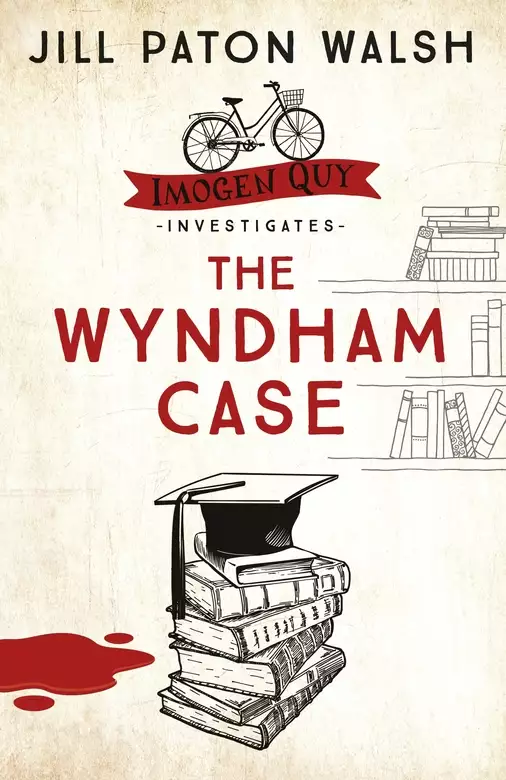
The locked library of St Agatha's College, Cambridge, houses an unrivalled and, according to certain scholars, deeply uninteresting collection of 17th-century volumes.
It also contains one dead student.
Tragic and accidental, of course, even if malicious gossip hints that Philip Skellow had been engaged in stealing books rather than acquiring knowledge when he'd slipped, banged his head, and bled to death overnight.
Only Imogen Quy, the college nurse, has her doubts - until another student is found, drowned in an ornamental fountain....
Release date:
November 24, 2011
Publisher:
Hodder & Stoughton
Print pages:
224
* BingeBooks earns revenue from qualifying purchases as an Amazon Associate as well as from other retail partners.
Imogen Quy looked out of her office window into the Fountain Court of St Agatha's College. It was just after nine in the morning. The famous turf maze of the court, with the ‘Arab’ fountain in the middle, was shining with dew in the soft sunlight of a February morning. The exquisite Jacobean brick of the court, with its Barnack stone windows and doors – reputedly the finest door cases in Cambridge – showed, she thought, better in the cool fenland light of winter days than in the warmth of summer. Imogen liked her view. So many of her colleagues, college nurses in other colleges, had offices in dark basements and remote, ugly corners. It was not so much the rooms themselves, she often thought, but the clear indication they gave as to what degree of importance the senior members of college attached to the health and welfare of themselves and their students. She had had her share of bad luck in her thirty-two years, but she was lucky in St Agatha's.
Sir William Buckmote was coming towards her down the southern side of the court. She frowned. She was very fond of the Master, and she could see at once that he was very agitated. He seemed in haste, but he was walking a wavering course, as though his right foot were taking a different direction from his left. His hands were flapping about. Imogen sighed, and used the little key on
her châtelaine to open the medicine cupboard. Before the Master had got halfway across the court, his tranquillisers were on her table, and she had counted out a day's dose for him. She frowned more deeply. She would have liked a word or two with the doctor who had started the Master on these.
The Master was trying to get himself off the things. They damped him down, and took the cutting edge off his wits when he was working. They were, in fact, a disaster for him. But he had so many worries. The crisis over the Wyndham audit was barely over, and now he was intolerably harassed by a possible benefactor to the college, whose generous intentions were hedged round with detailed conditions, and who seemed to think the Master should be at his beck and call for days on end. So Imogen had charge of the bottle of pills, and kept them under lock and key. He had made a rule for himself that he was to take them only one day at a time, and only when he could give his college nurse a reason for being under special pressure. She confidently expected him to arrive in her office, sit down, push his glasses up on to his forehead, and tell her some tale of woe, before taking two with water, and departing with the rest of the day's pills in his pill-box.
But she was wrong. The Master stumbled in without knocking, and said, ‘Miss Quy, you must come at once, please! There has been a calamity in the library – oh, do please hurry!’
Imogen was hurrying. But she was not going anywhere leaving pills on the desk and the cupboard unlocked. ‘I'll be right with you,’ she said, putting the pills away and turning the key.
‘What has happened, Master?’ she asked him as they descended the staircase on which her room was located, and emerged into the court.
‘I hardly know – I hardly know – I shudder to think!’ he said. ‘We must be quick!’
Imogen turned through the arch towards the Chapel court, but the Master seized her sleeve and drew her the other way.
‘You said the library?’
‘Not the real library; the Wyndham Case!’ He broke into a lumbering run.
They reached the door to the Wyndham Library, with its elaborate decoration, and the words FINIS EST SAPIENTIA carved above it.
Imogen's duties did not take her into the Wyndham Library very often. It was a large vaulted room, lined down one wall with the famous ‘Wyndham Case’ – a huge two-storey bookcase of ancient oak, with a set of steps at one end, and a little gallery running along it from end to end to give access to the upper shelves. It was glazed and polished, and the magnificent books it contained in sombre bindings scented the whole room with a fragrance of old leather, saddle soap and dust. There was no time to admire it now; the Master almost pushed her through the door, stepped after her, and locked it behind them. The room was not deserted. Crispin Mountnessing, Wyndham's Librarian, was standing by one of the tables provided for readers, with a shocked and tense expression on his face. At his feet, spread-eagled on the floor, a young man was lying. He was wearing a lilac silk shirt with a narrow white tie, and a black leather jacket with a wilted white carnation in the buttonhole. He had long, tousled, mousy hair. His bland, unlined face wore an expression of mild surprise. His right arm was extended, palm upwards, at shoulder level. Under his head there was a large pool of bright red blood, which had flowed widely, towards and around the leg of the table. It was now edged with a darkening rim,
like an island on an old map. All three of the people in the room knew very well who he was. He was Philip Skellow, a first-year undergraduate, the first student St Agatha's had ever taken from his provincial school: a very bright young man, who had been expected to get a first.
‘I found him like this when I unlocked the library this morning,’ said Mr Mountnessing.
‘We can't rouse him,' said the Master.
Imogen knelt beside Philip, and took his wrist between her fingers. He was quite cold. She tried gently lifting his head. His neck was stiffening. Blood flowed over and between her fingers, cool and shocking. Looking up, she saw there was blood and hair on the corner of the table above him and a little to the left.
‘Too late, I'm afraid,’ she said. ‘No one can rouse him now.’
The Master put a hand to his eyes. ‘Dead?’ he said.
‘I'm afraid so. Master, I'm afraid you must call the police,’ said Imogen. She noted with clinical detachment that she herself was trembling very slightly. She was surprised. The eminent and unworldly men in the room had probably never seen a dead body before; but Imogen had. She had seen injuries much more gruesome than the violent blow of head against table that had apparently killed Philip Skellow, and though death is an extreme kind of injury, and always, she knew, an outrage, she had seen many deaths. Only, of course, though on very slight acquaintance, she had liked young Philip, and... She looked at her blood-smeared right hand, baffled.
‘A doctor?’ the Master was saying. ‘The next of kin?’
‘The police, Master. This looks like murder.’ She had never seen murder before. This was different from other deaths.
‘Murder?’ wailed Mr. Mountnessing. ‘Oh, no! Surely he just fell, and...’
‘I do not see how a fall could have been hard enough. I think he must have been pushed. But we do not decide; we just call the police. Master, you absolutely must call them at once. Think of the scandal.’
‘Yes,’ said the Master. ‘I see that. Where is there a phone?’
‘I have one in my study,’ said Mr Mountnessing.
‘We should not touch anything,’ said Imogen. ‘Where can I wash my hands?’
The three of them went through a doorway at the end of the room into a side-room where Wyndham's Librarian had a cosy study. A little lobby with a tiny window had been made into a kitchenette for him. While Imogen washed her hands, the Master picked up the phone. He seemed not to have dialled 999 but the number of the local police station. Imogen had spotted an electric kettle on the side-table, and was hastily making therapeutic tea. She thought the next hour would be rough on everyone.
The Master was saying, ‘We have found a body in a locked library at St Agatha's... Yes, there was a college feast last night... What do you mean, tell you another? No, I do not read detective stories...’
Imogen took the handset from him. On impulse she asked for Sergeant Michael Parsons, the only police officer in Cambridge whom she knew.
‘Who shall I say is calling?’ demanded the voice on the other end.
‘Imogen Quy. No; it rhymes with “why” but it's spelt Q-U-Y. This is a very urgent matter...’ To her relief, the operator put her through to her friend. ‘Mike, this is Imogen Quy. I'm sure you remember me from that St John's Ambulance training course. ‘Good. Mike, there's been a... an accident. It might be foul play. Please get
someone over here as quickly as you can.’
An hour later, Imogen was sitting in Mr Mountnessing's study, overhearing conversations in the library next door, and sunk in misery.
‘But who could have done such a thing?’ the Master kept asking. ‘A perfectly inoffensive young man like that!’ His interlocutor was a policeman – Detective Inspector Balderton.
‘First find out why, and then it's usually easy to find who,' said the Inspector. ‘What do we know about the body? Debts? Girlfriends? Enemies? Supporter of silly causes?’
‘You must talk to his tutor,’ said the Master. ‘Mr Benedict will tell you anything the college knows about him.’
‘Later,’ said the Inspector. ‘When the pathologist and the fingerprinting boys have done their stuff. Hallo; what's this?’
Someone had found a book. It was lying on the floor, under the lethal table, and wedged against the skirting, as though it had been projected from the outflung right hand of the dead young man.
‘Where does it belong?’ asked the detective. ‘Was he stealing it, perhaps?’
‘No,’ said the Master.
‘Why do you say that, sir?’
‘Well, it would be such a wicked thing...’
‘Does it come from one of these shelves?’
‘I'll tell you if you let me look at it,’ said Mr Mountnessing.
‘Look without touching, please, sir. There may be prints.’
‘Nova et Antiqua Cosmologia. Yes: it belongs in the Wyndham Case.’
‘Valuable, is it?’
‘Fairly. Not by any means the best book here.’
‘This room kept locked?’
‘Always. It is a condition of the Wyndham Bequest.’
‘Can I see the keys? Strewth! That might be the bloody murder weapon! Where the hell did you get one like that?’
‘It's Christopher Wyndham's own design. Made in 1691.’
‘If you could possibly do without me...’ said the Master. Imogen walked back to her office with him and shook out three more of his pills. He sat in front of her little fire, sunk in despondency, while she tried to comfort him.
‘Would you like me to contact his parents for you?’ she asked.
‘No, no. That's my responsibility. Can't shirk that. But thank you. A kind thought,’ he said.
The day was getting worse and worse. And the Master had hardly left her for five minutes when a girl undergraduate appeared, looking upset. ‘Miss Quy, could you come, please? There's someone locked in the girls' toilet on E staircase, crying her eyes out, and we can't make her come out.’
Imogen accompanied the girl to the toilets. The sound of racking weeping filled the chill, tiled little room.
‘Who is it?’ she asked.
‘We think it's Emily – Emily Stody – but we haven't seen, only heard her,’ the girl said.
It took Imogen ten minutes of exasperating pleading to talk Emily into unlocking the door and emerging, tousled and red-eyed, a picture of misery.
‘What's it about, then?’ Imogen asked, kindly enough.
‘Philip's dead,’ said one of the bystanders.
How had it got round the college so fast? The body had not yet been covered and taken away. ‘Oh, well,
colleges are like that,’ thought Imogen.
Emily at once began to weep again, gasping for breath between sobs.
‘Emily, you'd better come to the sick room,’ said Imogen, leading her away. Emily was a healthy, a positively glowing young woman who had never visited Imogen's ‘surgery’, not even for the kind of advice young women in a mixed college usually requested, so Imogen knew nothing about her except by repute. Her friends were an assortment of classy youngsters – Jack Taverham's crowd – given to wild parties about which wild rumours went around. A confident and dominant sort of girl. But she was certainly in something of a state now. Imogen – with a motherly arm round the girl's shoulder as they walked – could feel her trembling. And yet, once she was sitting comfortably in Imogen's room, with a cup of hot sweet tea in her hands, and confronted with Imogen's professional kindness – ‘Now, what is all this about? Can I help you in some way?’ – Emily suddenly sobered up, and clammed up.
‘Miss Quy, I'm awfully sorry. I'm a bit of a pig to take up your time like this. I'm all right now, really.’
‘Don't worry, Emily; that's what I'm here for. Of course you don't have to tell me what has upset you, but you can if you want to. I keep people's confidences, and often I can help.’
The girl said nothing. Imogen risked, ‘Is it about Philip?’ At that Emily looked up at her, as if startled. Her pale blue eyes met Imogen's.
‘Everyone is upset,’ she said.
‘But not everyone is bawling in the loo,’ thought Imogen, though she said only, ‘Were you fond of him?’
‘No,’ said Emily. ‘Why should I be? I hardly knew him. Only at parties.’
‘But you did know him; and now...’
‘Oh, Miss Quy, people are saying he's been murdered! That's not true, is it? It can't be true!’
‘I honestly don't know what happened, Emily. The police are here to find out.’
Emily's face looked about to crumple into tears again.
‘Anyone would be upset the first time someone they know dies very suddenly,’ Imogen said, gently. ‘It's perfectly natural.’
Then, when the pause she left open in case Emily changed her mind about confiding in her was left in silence, she returned to her brisk manner and insisted on taking Emily back to her room, and helping her to bed with a hot-water bottle.
‘You honestly don't have to bother,’ said Emily. ‘I'm all right.’
But she obviously wasn't all right. Imogen escorted her back to her room, which was in the Garden Court, high up; a pretty attic with sloping ceilings and a view of the castle mound rising from the immaculate lawns and trim flowerbeds which were the pride and joy of the college gardeners. The room was chaotic, full of discarded clothes and scattered books, but the bedder had cleaned around the mess, and the bed was made. Emily dropped her culottes to the floor, pulled off her Benetton sweatshirt, and climbed into bed in her peach satin undies. ‘I expect I've got flu,’ she said.
Imogen opened the cupboard in which the architect concealed the washbasins, looking for a tap to fill a kettle for a hot-water bottle. The basin was heavily stained, and there was a large number of test tubes and glass bottles around. A strange and pungent smell was released into the room by the open door. On the mirror above the basin a sticky note bore the message:
‘Please conduct experiments in the laboratory, not in your room. M. Hillaston (your bedder).’
Imogen was hardly surprised at this. She filled the hot-water bottle, and brought it to Emily with two aspirins and a glass of cold water.
‘I can't go to sleep,’ said Emily. ‘I've got a supervision this afternoon.’
‘I thought you had flu,’ said Imogen. ‘I'll cancel it for you. You just sleep it off.’
‘Whatever it is,’ she added, under her breath.
When Imogen got back to her room she found Roger Rumbold waiting for her. Roger was the college librarian – ‘the real librarian’ he always called himself, in ironic contrast to the Wyndham Librarian.
‘I thought I'd drop in and see how my favourite nurse is surviving,’ he said. ‘I expect you're having a bloody awful day. Come for a drink?’
‘I mustn't, Roger, thank you. I've hardly been in my room all morning, and I don't suppose the usual crop of student ills is suspended just because of poor young Skellow. Another time. How's your mother?’
‘She's all right in herself,’ said Roger. ‘But her roof still leaks. I can't get our blasted Bursar to do anything about it. Couldn't you mention to him that damp brings on bronchitis, which brings on death in the aged, and the college might be liable?’
‘I could vouch for the damp to bronchitis part of that,’ said Imogen. ‘You're right, Roger, I could certainly do with a drink. If you'd care to have a whisky with me right here...’
‘Yes, please, Imogen.’
She set out two plain medicine glasses, and produced her bottle of The Macallan from the back of the cupboard.
‘Mmm,’ said Roger, ‘Just the ticket. I didn't know you were a secret drinker, Imogen.’
‘I'm very careful, Roger, as it happens. It takes a dire emergency to drive me to drink as a pick-me-up. And I never drink alone. A person who lives alone can't afford to.’
‘That's a touch puritanical for me, Imogen. Your health. Besides, you don't live alone. Your house is packed to the attics.’
‘Well, I do and I don't,’ said Imogen, collapsing into the other armchair in her room, ‘like you.’
Roger lived in college. Rather few of the college fellows did that nowadays, most of them having families to go home to. A live-in fellow was so valuable that when, a few years back, Roger had announced that he would have to live with his mother in future, as she was becoming too frail to manage, the college had hastily found Mrs Rumbold a place in Audley's Almshouses, just a step from the college in Honey Hill, and belonging to some trust entangled with the college by the Wyndham Bequest. Ever since then, Roger had been grumbling in a mild way about the administration of the almshouses, which he said needed money spending on them. Personable and hard-working as he was, he was one of life's grumblers.
Roger was always nice to Imogen. He chose to regard himself, though he was a senior member of college, as, like herself, an empl. . .
We hope you are enjoying the book so far. To continue reading...

 Please log in to recommend or discuss...
