1. Merek
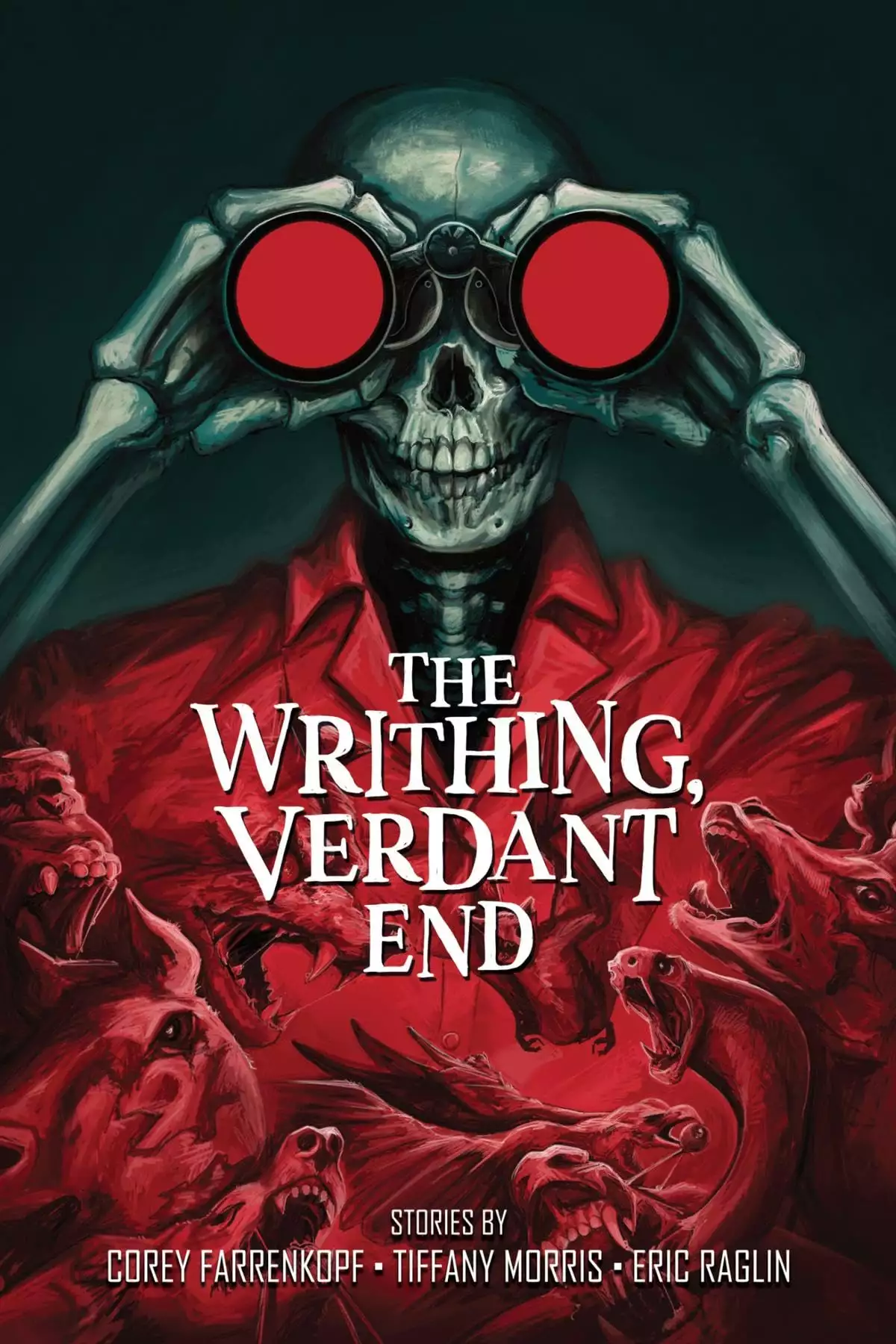
They sit with binoculars raised, concave lenses staring across the chasm to the green expanses beyond, verdant trees in full bloom, bird song glimpsed, but never heard. Some haven’t moved in days. Some in weeks. The stench is awful. The rusting beach chairs crumble beneath their reclined forms, holdovers from ages past, when there were actually beaches. Their stare never drifts down to what seethes in the pit, what keeps them from spanning the distance to inhabit that other realm of evergreen splendor. There’s a reason the Watchers don’t leave their seats. There’s a reason they have accepted the lives they’ve inherited. The withering. The supposed glory of the final sight. The realm after this realm.
It is said that the last sight you see upon death, that will be the space your mind inhabits for the rest of eternity, the promised heaven you could never step foot in while your lungs drew breath. That is why half of the chairs are filled with the dead, heads lulling, binoculars stolen by the next generation of devotees.
But we will not be like them.
We will not press those lenses to our eyes.
The chasm drops away just beyond the Watcher’s boots, hundreds of feet down, incline steep, almost unscalable. I still don’t know how those creatures survive the fall. The jagged rocks. The sudden stop. But there they are, the warped amalgams of deer and gull and bear and coyote and shrew. If the Watchers were to tilt their binoculars down, they’d view the broiling mass, bodies welded together, muscle and sinew stitched through chemical exposure and drinking water residue, all those compounds that should never have existed in the soil, in the air, flesh folding into flesh. They amble and shiver like leaves in the wind, life fled from eyes, yet still somehow present in their limbs. They tear at those who try to make the crossing, those that descend the lone ladder to the base of the gorge, to where our neighbors had corralled the monstrosities for generations, never realizing they were sealing off their one escape route, their one chance to avoid the same end.
For a time, the gathering horde hadn’t been more concerning than everything else in our blood-blighted lives. Food was scarce. Drinking
water the same. So we worried about those immediate things … and other things. The regional territorial wars. The rise and fall of cul-de-sac fiefdoms. The blood mold. The night vanishers. The cannibal cults. The cannibal religions. The so-called cannibal deities. The amalgams were low on our priority list. Low until more human shapes started to amble about the gorge. No one noticed their warped neighbors descend the ladder, the way growths twisted arms, their necks, the muscles in their face. The way a frog might meld with the skin on a leg, how a horse might drag them forth as a forever rider, a haunted centaur grafted at the wrong angle. But there was no doubt, the amalgams called to other amalgams, drawn like magnets to cursed metal.
And it was happening fast, our populace dwindling even more than it had dwindled from all the other horrors, the wars and the pox and the cannibalism.
The only way we’re going to avoid the grafted end times is by crossing the chasm, actually setting foot in that green world where every berry doesn’t contain traces of poison, where flowers don’t offgas chemicals slumbering in the soil beneath.
Some in our small town listen to me.
Some do not.
Some are willing to leave, to drop down the ladder and try to ford the sea of corrupt flesh.
Some prefer to wait for what is to come, to join the Watchers in their cryptic calendars, that final sight anchoring consciousness, heaven glimpsed for all eternity though feet never travel the winding paths of splendor.
rivals. One month to prepare, to gather a life into a pack, to learn how to defend oneself, to obtain the means to defend oneself. The pilgrimage has been made before. Or so it’s said. But who can ever believe a story?
Slow death or possible salvation.
Those are the only two options left.
So we leave in one month.
I pray we are ready.
2. Breeze
Mom says we’re leaving. Mom says Dad is already in the pit. Mom says there was no way we could have saved him. Mom doesn’t say how it happened, or why, or which of the cannibal gods cursed us. All she says is we’re leaving with Merek and the others, that there isn’t much time.
You can hear them, down there at night. The cries. The animal barks. The yowling and cackling and throaty warble. It’s why I first walked to the edge. Mom would kill me if she knew, but I thought I heard Dad’s voice, thought I caught his pleading tongue on the wind, lifted from the beasts below. I took the binoculars from one of the dead Watchers. He didn’t need them anymore. The moon was full, so I had the silver light to go by. I sat, legs dangling over the edge, peering into the thousand thousand flailing limbs so far below, looking for my father’s kind face, for his gaunt body, for whatever was left of him before his skin became the skin of another.
We drank the same water. Ate the same meat. Played soccer each night. Worked the garden each morning.
We only slept one room apart.
I didn’t know why it would come for him. Why it wouldn’t come for me.
Dad would have been able to help mom cross. He was strong, good with a blade, quick with a thought. I’m small. I know how to urge plants to grow from our sick soil, but little else. That’s all I thought I’d ever need to know. How to get the beans to sprout, the potatoes to thicken, the onions to resist the rot. So few in our town have a green thumb, cursed gardens foresting most backyard plots. I knew my life’s trajectory, at least before our neighbors started to disappear. Before they started to reappear. Now, all of my garden beds will be abandoned. One final harvest, seeds saved for future sewing, and down the ladder.
Through the binoculars, I saw the bulk of a bear with a dog’s head rising from its back, jaws snapping and snapping. I saw a flock of vultures tumbled together, wings only good to jostle them against the hard-packed soil. I saw things that should still live in the ocean, though the ocean is hundreds of miles away and full of toxins. Tentacles. Beaks. Eyes once intelligent, now muted.
There were the men and women, bare skin turning green, all breeds of life fused to their bodies in a pulpy organic mass. Some
traveled on all fours. Others were left with a single functioning arm to pull themselves along the dust. At once, they seem separate, but at others, I have trouble telling one from the next. It’s as if some thin sinew runs between all, many organisms trapped in one organism, but I don’t know. It was dark out, impossible to see clearly.
It must have been hours before I saw my father. I didn’t know what the thing that now rode his back had once been. Turtle or amphibian or newborn cow? He struggled to lift the weight, to stumble forward, eyes dead, raised to the moon, face washed in silver.
I couldn’t mistake the pain.
When we go down there, I’ll save him the only way we know how. Merek has been handing out the pikes, the daggers tied to rake handles, improvised spears of weather-hardened wood. Long-distance weapons he calls them. Keeps them at bay. But I don’t want to keep my father at bay. I want to let him see heaven, not remain trapped below.
If he had only seen fit to train me with a blade instead of just playing games, kicking the rope ball endlessly around our plot…
A month is rarely enough time to learn.
3. Hearth
Scientists predicted the fault line would calve, sending a third of the continent into the ocean, drowning millions. When the quake hit, the fault split, but nothing fell away. Only the chasm opened, separating one world from the
next by a few thousand feet, one continent made into two. It is said that early on, some migrated from one side to the next, to be with whatever family members survived, to seek out the rich lands in the north, but that was before the amalgams were herded, jabbed and prodded over the cliff’s edge. No one wanted their toxic bodies decaying in their backyard. No one wanted to burn their flesh for fear of inhaling their disease. Out of sight, out of mind.
But now they’re on everyone’s mind.
Merek and Gail and Beth have handed out the improvised pikes, all manner of pointy objects fastened to poles: broken bottles, lawn mower blades, honed car bumpers. They teach thrusts. They teach parries. They teach sweeping arcs.
The weapons are ill fitting in most hands. I can’t get the hang of it, my movements too slow, which is why I’ve volunteered to be a mule. I have the bulk, the broad shoulders to carry the load of our caravan. People are sorting through their lives, determining which relics will make the trip from one home to the next, or one home to their grave, depending on how we fare. Necessities come first. Water jugs and cooking pans. Flint. Bedrolls. Rain slickers. Bows and arrows, any hunting implements we can gather. But I’ve seen the odd vain addition. The cracked mirrors. The family journals passed down from the times when printing presses still ran. Religious reliquaries of uncorrupted flesh. Dead electronics.
After Merek’s lesson, Breeze comes to me with a framed photo of her father’s great great great grandfather, image water stained and faded. The man looks just like her dad. At least, like he did before he changed, before his
skin became shared.
“This is the only thing I care about,” she says. “Can you find room?”
I look to my pack, the heap of items stacked one on top of the other, wrapped in an old blue tarp and canvas fabrics, thin ropes encircling the mess. She hands me the photograph. I nod.
“I’ll make it fit,” I reply. “Can’t leave dad behind.”
“That’s not the plan,” she replies, her words grim for a teenager. Something else lingers beneath the surface.
“But you can hold on to it for now. We have time before we go. Would you prefer that?” I ask.
Breeze looks down to the fading image, her father’s ghost staring back at her. She shakes her head.
“I don’t think I can keep looking at him,” she replies. “I know what I’m doing. This will be the memory I keep for the other side.”
And she hands me her great great great grandfather before scurrying off to the crumbling house she and her mother inhabit, to that thick green garden that marks their land as different from their neighbors’. I hope she brings seeds with her when we go. A photograph is nice, but if you’re starving, there’s little nutritional value in waxy, time-worn paper.
I’ll remind her before we leave.
I will always have room in my pockets for seeds.
The trees are as tall as a building stacked on top of a building stacked on top of a building stacked on top of another. They are immense. Belonging to the past. Trunks swollen, roots thick. I no longer have measurements for such. The canopies open, shading what grows in the understory, a rooftop of wide undulating leaves, green on top of green on top of green. If my binoculars were stronger, I might sight the swollen berries growing on groundward shrubs, their pink and blue and yellow skin. But I only have stories, the words Hearth remembers for us all. So my eyes remain in the canopy, with the birds and the mammals with their prehensile tails, their grasping claws and footpads. I imagine myself sitting beside them in the high boughs. Occasionally sparrows land on my shoulder. Occasionally they drop berries in my lap. ...

 Please log in to recommend or discuss...
