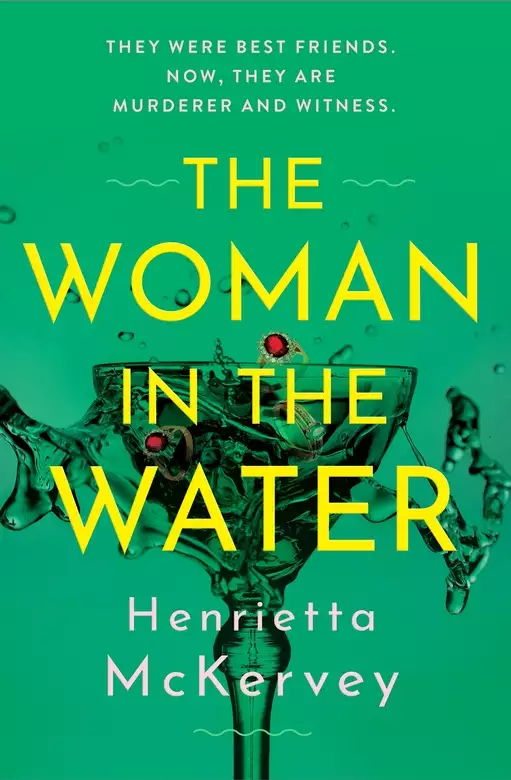
Pearl Day has always lived in the background - companion to her childhood friend, the dazzling and unpredictable Lady Eleanor Nicholson. Their bond was forged at Alderleigh, Eleanor's crumbling country estate, but now they share a sleek London home where Eleanor's life of indulgence is spiralling into chaos.
When Eleanor shoots her lover in a drunken rage, Pearl becomes the key witness in a scandalous murder trial. But she knows more than she's revealed - and with Eleanor behind bars, she sees a chance to escape her quiet desperation. Their bond, once forged in friendship, is now warped by grief, envy and power. And Eleanor's reach is long.
Set between 1930s London and the windswept Cornwall coast, this taut, gothic thriller dares to answer one of literature's abiding questions: Who is the woman in the water?
Release date:
March 5, 2026
Publisher:
Hachette Books Ireland
Print pages:
320
* BingeBooks earns revenue from qualifying purchases as an Amazon Associate as well as from other retail partners.
Pearl Day is in her attic room, lying on the bed, fully dressed and half-asleep. She spends most of her free afternoons this way, whiling away the hours, bored and listless. Fun, she thinks bitterly, is a luxury a woman in her position can ill afford. She raises her left leg, twisting it to better admire the back seam on her new silk stockings. Eleanor’s new silk stockings, she corrects herself, for she is wearing one of the four sets Eleanor charged to her mother’s account at Selfridges on Monday. Should Eleanor happen to recognise them, Pearl will tell her they are an older ripped pair, which she has mended to wear herself. Eleanor would never dream of wearing a darned stocking. Darned anything, for that matter. Pearl is responsible for Eleanor’s wardrobe and laundry. These are thankless tasks, so occasionally taking little things she knows Eleanor won’t miss places a small but satisfying credit in the mental ledger Pearl keeps of their relationship.
The char has just finished upstairs and is hauling the carpet cleaner back down to the scullery, bumping it carelessly against the brass runners. Mrs Goodge doesn’t care how much noise she makes around Pearl. If Eleanor were here, she would be all head bobs and beggin-your-pardins. But Eleanor is not here. She is spending her father’s money in Bond Street, and Hickey … well, Pearl rarely knows where he is, and it’s not her business to ask. It’s clear to Pearl – indeed, blindingly obvious to everyone except Eleanor – that Hickey is entirely motivated by self-interest and in any given moment will do only what suits him best.
Five minutes later, Mrs Goodge slams the front door behind her, leaving Pearl alone in the house. She likes being here by herself. This silent attic, hushed and cool, but not yet cold, is pleasant. She’s so tired of hearing Hickey and Eleanor going at each other in the room below night after night. Eleanor’s screeches, and him heaving and harrumphing like the sea elephant in Regent’s Park Zoo coming up for air. Pearl closes her eyes and lets her head sink deeper into the pillow.
A low creaking noise rouses her. She tiptoes onto the landing and is about to cry down a nervous ‘Who’s there?’ when she notices the soles of Hickey’s shoes protruding through the open door of the bathroom on the floor below. Why is he kneeling? Is he sick? He must have slipped quietly into the house while she was dozing. Unusual of him not to shout out his customary hullo, followed by a louder request for a drink or something to eat.
Peering over the banisters, she watches him remove the wooden panel from the side of the bath and prop it against the wall. What on earth is he up to? His head and shoulders disappear into the dark space, as if searching for something in the cavity underneath the bath. Holding tight to the rail for support, she leans as far over as she dare. The wood creaks under her hands. She jumps back, pressing herself against the wall. Blood pounds in her ears, so loud she thinks he will have heard it too.
But he hasn’t. She inches forward once more. He is sitting on his heels again, holding two small bags. Pouches, she realises, tied at the neck by drawstrings. One is a bright mustard colour, the other black. He removes two ring boxes from the yellow one and examines the contents of each in turn. She notices an emerald-green flash as he holds the rings up into the light, twisting them to better admire the stones. He carefully returns these to their pouch. He produces two similar boxes from his jacket pocket and, without opening them, adds these to the yellow pouch. Next, he opens the black pouch. It holds three more small boxes, each containing what looks like a solitaire diamond ring. His head and torso briefly disappear as he puts both pouches away, tucking them out of her sight, and carefully refits the wooden panel onto the side of the bath. By the time he gets to his feet, she has slipped back into the shadows. He saunters down the stairs, two steps at a time, whistling.
Seven rings! They must be worth a fortune. Cleaning Eleanor’s jewellery is another of Pearl’s responsibilities, so even though she didn’t see the rings close-to, she’s certain none belong to Eleanor. Has Hickey been stealing from his customers at the Café de Paris?
She sighs, realising that she will have to let Eleanor know, for whatever Hickey is doing, he is clearly up to no good. But almost immediately, Pearl doubts herself. What good would come of telling her? Finding herself embroiled in a scandal wouldn’t trouble Eleanor, but the Mildmays would be furious should their daughter become, once again, the subject of gossip. Eleanor is entirely dependent on her father for her income, which means that Pearl too is financially reliant on him. The jewellery must be hidden for some nefarious reason, but Hickey would be sure to spin Eleanor a convincing story, and it would be Pearl, not Hickey, who would end up in hot water – except with them both. Pearl knows what it’s like to be in mercurial Eleanor’s bad books, and how quickly a dazzling sun replaces her raging storms, but she has witnessed enough spats between Eleanor and Hickey to know that angering him is a different matter entirely. He has a harsh streak and is quick to lash out, which Eleanor passes off as nothing more than his tempestuous nature. Eleanor, Pearl believes, desires the heat of attention so much she has persuaded herself that pain is an overspill of passion.
On reflection, the best course of action would be to say nothing. Despite her unease with whatever wrongdoing Hickey must be up to, she will assume the jewellery is merely passing through the house and put it out of her mind.
An even better idea would be to leave Wilford Mews and move somewhere new, but the thought of starting yet again, of willingly putting herself through that soul-destroying struggle for a live-in position, is overwhelming. Long before she moved in with Eleanor, she had spent years working for a succession of elderly women who needed a female companion. Someone to boss about in front of visiting relations. To check the baggage didn’t get lost on holidays and calculate how little one might get away with tipping porters. It was deathly dull, but for Pearl, dull and existence might as well be synonyms. Finding employment as a shopgirl or barmaid is out of the question; such jobs aren’t for a woman like her, one with the voice and manners of Eleanor’s class, but without her privileges or income. Imagine the embarrassment of working in Selfridges and serving people she knows socially? And no landlord would hire a woman who sounds like Pearl to pour pints for working-class men. Standing behind a mahogany counter lined with advertising mirrors with a grubby beer towel in her hand? Unthinkable.
An alternative is to return to secretarial work. She’s had plenty of office positions in the past – that course in Queen’s Secretarial College was expensive yet has served her well – but the downside is that she would also need to find new digs at the same time. When she had first tried office work, she had expected it to feel more liberating than the confined life of a companion, but for the most part, the firms she had worked for had turned out to be traps of a different sort. The bosses expected to be coddled and humoured, their dyspeptic tempers overlooked and their shortcomings ignored. It was, Pearl slowly came to understand, an equivalent of the workload of a wife, but without the status, home or children to authenticate her position. Anyway, as she reminds herself, there are so few good office positions on offer these days that even if she touts herself around the agencies first thing it could take weeks to get fixed up. And all the while, she’d have to deal with Eleanor, who would be sure to be highly put out when she heard Pearl intended to leave.
If only she had money! Wealth has the same powers as a magic cloak in a fairy tale. It can turn you into whoever you want to be. Since moving into Wilford Mews sixteen months earlier, Pearl has often found herself thinking that, had she been gilded with Eleanor’s privileges, she too would regard money as the net to be cast over her every desire.
She leans back against the pillow. The view from her bed has become as familiar as the tufted tracks of the candlewick bedspread. One window is ajar and a faint dampness scents the air. A gust of wind whips around the eaves, rattling a couple of roof tiles which have worked loose. Oh, how Tom would have hated to see her living in such a reduced way! And in his sister’s house of all places, tied to Eleanor’s purse strings. Today would have been – should be! – Tom’s birthday. Thirty-seven years old. Old, she thinks, tears pricking behind her eyes, quick and hot, like those of a little girl. The privilege of ageing was stolen from him. They should be long married by now, at home in Cornwall with a clutch of children. With a life. She might be standing on the long terrace at Alderleigh at this very moment, delighting in the mild sun of an early autumn afternoon while watching their sons run to and fro. Gently reminding the older ones to wrap up warmly when scampering to the cove to fish for tiddlers, or cheering on the youngest lad through yet another endless game of cricket on the lawn, his little legs aching from trying to keep up with his brothers. At five, Tom would stroll up from home farm for tea in the library, whistling, his boots caked in fresh mud, and seeing her waiting patiently would smile and take her hand, and together they would breathe in the salt-tinged air and gaze at the soft blues and greens of the endless sea.
In the eighteen years since Tom’s death she has got on with her own life as best she could, yet she hasn’t met a man since who matched her criteria for a husband. That she is from a generation of surplus women who lost their future husbands to the war hasn’t helped, but even despite that, she had always assumed she would find the right man eventually. All that time spent as a live-in companion to those elderly ladies was such a quiet existence as to remove the possibility of encountering someone appropriate, while the few still-unmarried men she met while working in offices tended to be either too young, too old or – she would not admit it aloud, but it’s the truth – too common. As the child of two people who had adored each other, she never wanted to compromise on a marriage that was lacking in love, and as a woman who had grown up seeing how powerful money was, she never wanted to compromise on a marriage that was lacking in income. Every time she had truly loved a person – Mother, Father, Tom – it had ended in heartache. On her thirtieth birthday, three years earlier, she had decided that, after years of false starts and faithless hopes, one could remain open to the possibility of love without actively seeking it out.
She hears Hickey slam the front door behind him. She is alone.
The prospect of continuing this way is suddenly unbearable. ‘By Christmas,’ she says, a promise whispered to the empty room. ‘Life will be different by Christmas.’
The wind plasters a leaf to the window. It is a surprisingly lustrous green, reminding her of the emeralds in the rings Hickey was hiding. She is still staring at the leaf when a second gust peels it from the glass. It flutters once, dancing and free, then disappears.
Her tears fall unchecked, and the chimney pots blur red against the September sky.
Hickey is the only man Eleanor knows who would ever dare to be late for her. They had arranged to meet at Brown’s because it is around the corner from Bond Street and, more importantly, Boodles. She signals to the waiter for another drink and lights a cigarette. Tiresome as it is, she still prefers waiting for Hickey to the company of one of the dolts who openly adore her and would trail her around town, panting at her heels, if she let them. He’d better not have sneaked off to see his wife, she thinks irritably. No, she reassures herself. Hickey hasn’t visited whatever-her-name-is in months. Not that Eleanor cares whether he sees her or not – Hickey is not her property, nor she his; the magnetic pull they have for each other is a force entirely of their own making – but she abhors being lied to. Catching a man out in a lie is a crack in the ice. Crack, crack, crack until even the largest frozen lake fissures like glass.
Hurry up, Hickey! She taps her foot impatiently. Pity today isn’t a boost day. She adores boost days. This afternoon is what Hickey sweetly refers to as a ‘recco’. A term from the war, he explained, when she asked what it meant. ‘For a man too young to have enlisted,’ she had replied drily, ‘you use a lot of soldier’s slang.’
It’s hard to believe their first boost was a mere four months earlier. How time flies when one is having fun at others’ expense. She laughs aloud, causing the man at the next table to frown at her over his Times. She glares back until he gives the newspaper a cross shake and disappears behind it again.
That first boost exists for her now as a series of heightened images and sensations … the toadying staff, the highly polished glass-and-mahogany display cases, the black-velvet-lined trays of rings Hickey encouraged her to try on, as one might idly pick at a box of chocolates at the theatre. The elation on his face when he turned to her on the street and told her what he’d done. And the ring! A diamond solitaire, shining like the brightest star in the night sky. The sensation then of pushing her body against his, of feeling the same jubilant thrill of victory sparking to life in him, and knowing they would soon be screaming each other’s names, hungry and ecstatic.
Eleanor has met plenty of men who make their living by night, their charisma a matter of a well-cut suit, flattering night-club lighting and a constant flow of champagne. By day, these delights sluice away, revealing the common, uncouth boys who play dress-up for money, donning a persona every evening at seven along with the dinner jacket. Hickey is different. His allure is instinctive and irresistible. Eleanor might as well have a wild animal slinking by her side – something sensuous and dangerous and entirely, naturally, itself. A leopard, she thinks with a thrill, tethered to her naked body by a dazzling gold chain.
A young woman – she can’t be more than twenty, though the drab hair and frumpy coat add a decade – waves shyly over from the far corner of the hotel lounge. She half rises from her seat, as if hoping Eleanor will invite her to cross the room and join her. Deborah Vaughan. Richard married her eldest sister last January. This girl looks mousy enough to be related to Angela, that’s for sure. Eleanor turns her head away without acknowledging her. Deborah sits down again, blushing furiously.
The Vaughans are welcome to Richard! How foolish, how shamingly, excruciatingly foolish Eleanor had been to believe Richard Nicholson had ever loved her. This is the problem with being a beauty, she believes: no one knows quite what to do with her. Eleanor understands now that, eleven years earlier, when Richard first looked into her face, all he saw was a perfectly pristine slate waiting to be chalked upon. A charming, well-bred young lady who would run his house. A woman his friends would envy, but would never dream of pursuing. The mother of however many brats he might desire to have. A wife who could be relied upon to put her energies into remaining adorable, no matter how carelessly she was treated.
Together, Richard told her, they would become the toast of society. More, she had joked in return. Far, far more! The Escoffier soufflé of the country. The beef Wellington of the Empire. But the bride Richard had actually wanted was the finest pig of the litter, gagged by the apple shoved in her mouth and skewered on a spit. That his wife turned out to be a real woman, not the submissive dolt his limited imagination had conjured up, was entirely his fault. It certainly wasn’t, as she had shouted at him many times, hers. The exuberance he found so charming before their engagement became increasingly unseemly once they were married.
‘You’re too much,’ he once told her, a groan in his voice as his hands roamed the soft silk of her gown, fabric filling his fists as he tugged the skirt up, his fingers seeking out soft, hidden flesh. That was exactly what he wanted when they met, yet by the end of their third year, ‘too much’ had become an oft-repeated grievance. The set she ran with – her darling butterflies – who, when he was pursuing her, he claimed were his dear friends too, he began to decry as vulgar. Their antics attracted too much attention. The parties and Soho nightclubs she adored were vetoed one by one. He would look at her, dressed in her evening clothes, and frown and comment that her gown was too loud, or tasteless, or some such rot.
‘How can I be tasteless when I am the one determining my own taste?’ she replied the first time, and again the second and third, before she stopped replying at all.
Richard, she came to realise, believed his wife ought to be kept close and little used. Perhaps he thought use would wear her down to nothing, like the hooves on one’s hunter. He assumed she would submit entirely to him, but to do so would be to quench the same flame he once claimed to adore. Richard, Richard, she thought. If ever there was a man who thought he could have everything all at once, Richard Nicholson was it. He had convinced himself that she could – no, worse, should – be tamped down. The prince was revealed to be a tyrant.
For a number of years, she survived by managing to ignore their marriage entirely. She had remained in London for the duration of his posting to the embassy in Pera, occasionally telling her parents she was visiting him in Turkey but in reality spending a month in Berlin, devoting night after night to the bacchanalian charms of the Eldorado. When Richard was sent back to London, they found themselves living together once more, instantly angry and squabbling. At the end of a month during which every conversation felt as though her husband’s two hands were pressing her head underwater, she left, turning up at her parents’ house one soft May evening with a suitcase, a mink from Selfridges charged to Richard an hour earlier and the raging headache of one whose morning hangover has been pummelled into shape by an afternoon’s drinking. Mother was furious, insisting she turn around on the spot. If Eleanor hurried, she suggested, Richard probably wouldn’t have noticed she had gone.
‘Keep the fur,’ Mother had urged, as though Eleanor had left her husband because he refused her a coat. ‘Order half a dozen more if that’s what you want. But marriage vows are not to be broken. In this family, when we make a promise, we keep it.’
‘Promise?’ Eleanor sneered. How typical of Mother to treat her as a counter to be moved in a life-long game of status and wealth. ‘I can’t think of a single promise you ever made me.’
Eleanor explained that they had better move quick smart to get her a divorce (how Mother had paled to see that word form on her daughter’s lips!) and an excellent settlement. She didn’t care whether the source of this settlement was Richard or Father, which was actually very generous of her when one thought about it. And if they didn’t comply, she was simply going to find herself a chap in a nightclub and have his baby.
‘Everyone would know it wasn’t Richard’s,’ she said. ‘Think of the scandal.’
‘Not if we said otherwise. No one could ever prove it,’ Mother replied, leagues behind as ever. ‘I did not raise a bolter! No one wants a divorced woman.’ Nothing is so brutally shaming as a marriage that has publicly failed, she believed, and for this to happen to a Mildmay was a degradation like no other. ‘Having a child is exactly what you and he ought to do,’ Mother added, her face blotchy and tearful. ‘I expected you to have had several by now. All that nonsense one hears peddled these days! A baby is the making of a woman, everyone knows that.’
‘Not of me. And do you know why? Because I’ll ensure your darling grandchild isn’t white. Do you think we could entice Nanny back from the dead, or Bournemouth, or wherever she retired to? Wouldn’t you adore seeing a Mildmay in the nursery again? A baby’ – she paused, grinning wildly at the horror on their faces – ‘a little coloured baby. The angel!’
She laughs. She’d have done it too, of course she would. Hutch would have been sure to oblige, if the rumours flying around Quaglino’s were anything to go by. It’s almost a pity she didn’t have to go through with it, because it would have been fun. Well, except for being lumbered with a brat, though she could have made arrangements. Her parents caved, saving her the bother.
Richard had wanted her to be something she had never claimed to be, and he was determined to torture her for his mistake. In the middle of one argument, he even suggested she visit a psychoanalyst. How she had laughed. Perhaps seeing one of the Freudians could help explain her to herself, he said. Help her understand her impulses and instincts. He didn’t give a hoot about her impulses or instincts – of course he didn’t. What he wanted to understand – by which he meant change – was her behaviour.
‘I know who I am, Richard dearest,’ she had replied. ‘Anyway, I thought my lying down in private rooms with strange men wasn’t something you favoured?’ She hooted at her own joke. ‘Yet you’re suggesting exactly that and calling it a cure?’ He had been so furious. But Richard was always furious about something. The one and only time he had visited Wilford Mews – some pompous nonsense about informing her in person he was to marry that hideous Vaughan creature – he professed himself shocked by the mural she had commissioned.
‘And here you are,’ she said, ‘ten minutes later and still poring over every detail.’
She and Richard could have stayed married if only he’d known how to turn a blind eye. Wives do, so why shouldn’t husbands? She should have been a man, she often thinks. For a woman to be truly happy, she needs to live as a man does. Strength is welcome, necessary, in a man. Determination, too. All that insistence on bravery, on winning – she would have loved that. But in her, those exact qualities became labelled as wanton, careless and unfeminine. ‘You are a damn traitor to your sex,’ Richard had shouted at her once. ‘You’re not normal.’
‘Good!’ she screamed back. ‘I should die if I were normal.’
How humiliating to wake up every morning with a man who, even as he pushed himself . . .
We hope you are enjoying the book so far. To continue reading...

 Please log in to recommend or discuss...
