The year 942 CE
Ingvar Ruriksson stood in the space between the living and the dead.
He was in a crow-black courtyard, staring through shadowed gloom at the hunched silhouette of two burial chambers, both slumped before him like long-dead giants. A glimpse of moonlight through clouds silvered their backs, revealing patches of moss growing through the wood and turf and stone of the barrows. His cousin Svenald was at his shoulder, a brooding presence as constant as his shadow. Svenald held a flickering torch, gold-gilding their lamellar coats and the metalwork of scabbard and sword hilt and axe. Silence sat heavy between them, memories thick and swirling as smoke.
“It will be dawn, soon, Lord,” Svenald said, his whispered voice cracking the silence, and Ingvar knew what he meant by those words. He rubbed a hand across his fresh-shaven head, felt the ridges of the knotwork tattoos that swirled across his skull and the serpent-coil of his thick warrior braid. He sucked in a deep breath and together they strode through the grass to the closest mound. Sharing a look, they put their shoulders to the slab of dressed stone barring entrance to the grave. Ingvar set his feet and pushed, Svenald adding his bulk and grunting beside him. A long, straining moment and then there was a grating, grinding of stone, earth crumbling and falling, and the slab shifted, revealing an impenetrable line of darkness beyond. Ingvar and Svenald heaved and the crack grew wider, a smell of damp earth, rust and rot leaking from the darkness.
Ingvar took a step back, regarding the black hole they had uncovered, denser and darker than the moonlit night. It looked like a gateway to the Otherworld, an open mouth vomiting shadow.
“Your torch,” Ingvar said, holding his hand out.
“I should come with you,” Svenald replied.
“Not this time. This is my task, and I must do it alone,” Ingvar said, and Svenald knew it to be true.
“Good,” Svenald breathed, relief edging his voice. He dipped his head and handed Ingvar the torch.
Without a word, Ingvar stepped into the darkness.
The world of the living faded behind him, replaced by an oppressive murk. Cobwebs clung to his face and Ingvar waved the torch in front of him, burning webs thick as hemp away with a crackle and hiss, revealing a short passageway lined with thick timber posts. He strode through it and stepped into a wider space, the walls rising up and disappearing beyond the torch’s reach. Sound changed, the thud of his feet echoing, and he stumbled to an abrupt halt, his breath rasping, heart pounding in his chest like a war drum. A shape loomed before him and he hissed, raised the torch higher and reached for the hilt of his sabre, then checked himself. The curved snake-head of a longship’s prow-beast glowered down at him, his torch picking out the red paint of the creature’s eyes. They appeared to glow. The hull of a Northman’s longship had been laid into the hollowed earth, the mast down, set upon the deck, rotting shields lining the top rail. At the far stern was a chair, the shadowed silhouette of a figure sitting upon it. Ingvar stood there long moments, frozen, emotions churning through him, all of them gilt-edged with fear. He shook his head, shaking off the fear like flies, huffed out a muttered curse and climbed over the top rail. Wood crumbled in his grasp, and he picked his way along the ship’s deck, timber creaking. He stepped carefully around the skeleton of a horse, then the bones of a huge hound, and finally a rune-carved sled draped in rotting furs, until he was standing before the seated figure.
Weapons and finery lay at its feet or propped against the oak-carved chair. A round, iron-bossed shield. Spear, axe, a bow case and quiver of arrows, a wool tunic embroidered with fine tablet weave, a silk kaftan, a chest of silver dirhams from the caliphate far to the east. The figure wore a coat of mail and over that the iron plates of his lamellar coat gleamed like fish scales in the torchlight. Arm rings of silver and gold were thick upon him, a gold-twisted torc about his neck, carved serpents at the terminals, and two necklaces, two silver-carved amulets lying upon his chest. One a hammer, one an axe. One testament to the gods left behind in the north, and one to the gods of this new land. A sabre was belted at the figure’s waist, and his skeletal fist gripped the hilt of a straight sword like those favoured in the north. It lay across his lap, scabbarded and rolled in a leather baldric.
The figure’s face was in shadow, upon his head a helm with a thick knot-braid of horsehair hanging down from it and draped across one shoulder. Gold rune-knots were carved sinuously around the helm’s brow and down its nasal bar, a curtain of mail draped over neck and shoulders.
Ingvar stood and regarded the figure for a long, timeless moment.
“Father,” he breathed into the silence, waited, almost expected his father to look at him, to answer him. Memories rose up, eddying around him like a strong current, dragging him into the past. Of his father’s callused grip, of the man’s deep, rare laugh that would make all around him smile, of the touch of snow upon Ingvar’s face as he stood before this burial mound, so many years ago.
“I have come for your sword,” Ingvar whispered. “My sword. My birthright.” He reached out and gently prised the skeletal fingers from the hilt of the straight sword, slowly lifting the scabbarded weapon from his father’s lap. The pommel was tri-lobed steel, the hilt leather, the torchlight picking the gold chape and throat on the scabbard and the thread of gold wire spiralling the hilt, turning them into splashes of flame in the darkness. The leather of the scabbard and baldric wound about it was worn and cracked, stained from age and use and sweat and a multitude of hard-fought battles.
Ingvar became aware of a change around him. His breath misted, the air abruptly colder, the bite of frost in his lungs as he breathed. A creak of movement, a glimmer of ice-shard lights fluttered into existence within the cavity of his father’s helm. Ingvar hissed a breath and made to step away but his father’s skeletal hand twitched, rose up and snaked out, clamping around Ingvar’s wrist, cold as iron on a winter’s day. So cold it burned. Slowly the helm rose, the horse-hair plume hissing across mail, and pale eyes gazed into Ingvar’s. Ingvar opened his mouth to speak, but no sound came, fear clutching and binding his words.
“Father,” he managed to croak.
The eyes regarded him, held him, and Ingvar felt like he was being sucked into them, and then he was no longer in the burial chamber. He was stood upon a ship’s deck, heaving and rolling. The roar of the sea, a sail snapping in the wind, his father Rurik standing at the bow, one hand gripping the snake-headed prow-beast, staring at an ice-crusted land on the horizon.
“Land,” a voice bellowed.
The ship melted around him, turning to mist and he was riding upon a horse, the animal rearing and he was slashing about him with his curved sabre, the jolt of blade meeting mail and flesh and bone, voices screaming, the battle-joy coursing through him. This, too, faded and he was sitting upon the stump of a tree, looking down at his blood-drenched hands, his sword on the ground, thick with gore. Exhaustion flooded him, deep in his bones, mingled with a sense of euphoric relief, of a battle won, of death avoided. Of victory. The world shifted, the cry of a newborn child filling his ears, fat and squalling. Rurik knelt upon one knee, holding a sword out before the newborn. The world changed again. He was lying in a chamber, thick furs drawn about him, a fire crackling. Words formed in his head as he gazed at faces about him, things he wished to say, but his mouth would not obey. And then a choking, wracking cough, his vision dimming, darkness, the sensation of being dragged in a storm-wind, sucked beneath waves, spiralling ever downward. A figure standing before a gateway, a woman, tall, thickset, iron-grey hair hanging lank. She grinned at him, revealing grey-iron teeth, sharp as any blade.
“Welcome,” she snarled.
A scream. His scream.
Ingvar jerked away and he was back in the chamber, his father’s pale eyes holding him.
“Why do you linger, what holds you here?” Ingvar hissed at that ice-shard gaze.
The wolf prowls at the door, a voice grated inside his head. Ingvar ripped his hand from the skeleton’s grip and slowly the light faded within his father’s helm, dimmed and went out, head slumping. The skeletal hand dropped with a clatter, followed by a hiss, as of an exhaled breath, and his father’s corpse was still and lifeless as when he arrived.
Ingvar turned and rose, staggered across the ship’s deck, almost fell over the top rail, kept his grip on the torch and sword and stumbled from the chamber into the passageway, out into the grey half-light of the living. He sucked in the clean air, chest heaving.
Svenald reached for him, gripped his arm, steadied him.
“Lord, are you well?” Svenald said, worry and a touch of fear in his voice.
Ingvar blinked, saw a flash of his father’s ice-shard eyes.
“I have the sword,” he said, standing straighter.
“This is why you are lord,” Svenald said. “Though why your father could not just have given it to you, I do not know. It is your birthright.”
“Everything with my father is a test,” Ingvar said, “even in death.” He sucked in a long, deep breath, the air fresh and cold, scouring the taste of the burial chamber from his lungs. He dropped the torch, and it sputtered and died.
“With me,” he said, ignoring the question in Svenald’s eyes, and walked away.
He climbed a staircase leading up onto a high palisade, the sky tinged with pale, diffuse light, and he paused, looking out from the walls of Kyiv. A cold wind scrubbed his skin and whipped the single rope-braid of his hair, the rising sun clawing its way over the edge of the world like some wounded animal. Darkness was shifting, the world of shadow retreating before the pale light of dawn, revealing rich grassland to the west and south. To the east loomed a dark bulwark of forest, rolling into mist and shadow far beyond Ingvar’s vision. Upon the northern plain the River Dnieper sparkled into jewelled life as it wove its serpent-crawl across green meadows and wound between the two hills that Kyiv was built upon. Sounds drifted up to him, of moored boats creaking, of horses whinnying, and spear-tips and mail sparked like kindled flame as the sun illuminated his war-host, a multitude crowding the streets and wharves of his city, all of them gathered and waiting for him.
“You have created a kingdom where once there were only squabbling tribes, Lord,” the shadowed bulk of Svenald grunted beside Ingvar.
Some of that is true, if not all.
“My father began this course with a dream and made it so with blood and steel, and the help of your father. And some good gods-luck,” Ingvar muttered, remembering the fractured images of his vision inside the burial chamber. “But I have dreamt the same dream, have sworn the same oath, and I will see it through.” He looked at the walls of the city, looked to his lands beyond, and a swell of pride filled his chest. Then his gaze shifted to the south, where shadow still ruled the earth.
“Our fathers were of the north, forged by ice and iron and the freezing sea,” he murmured, “but you and I, Svenald, we are a new people. We are the Rus, descended from the rowers of the north with iron in our veins, but we are of the steppe as well, of the horse and the bow, of rivers and the sabre and the forest. We are the strength of both worlds bound together, like pattern-welded steel, and we have been forged into a new weapon. We are stronger than our fathers, and we are more than the tribes we have encountered and conquered. We are the Rus, and we shall take more of this land, if the gods of this new world are willing to share their luck with us again.”
“They are,” Svenald said, one hand rising to grip the silver-carved axe that hung at his neck, likeness of Perun the Thunderer God’s fabled weapon. “None can stand against you.”
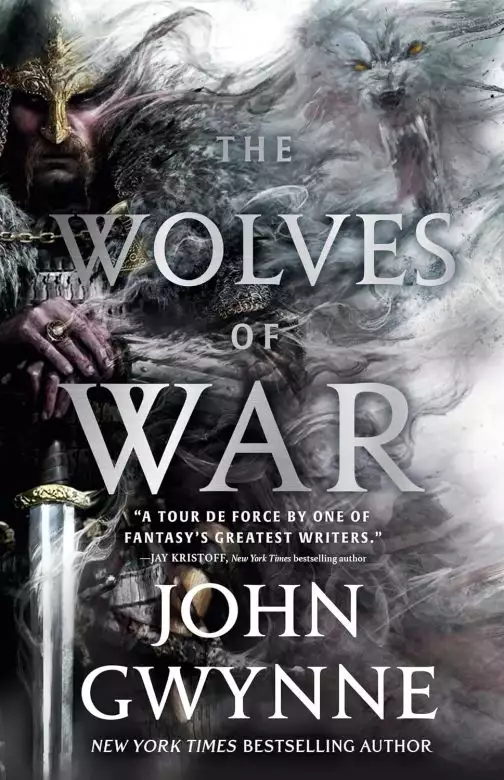
“Ha,” Ingvar barked a laugh. “That is because we are the wolves of war, and our bellies are empty.”
“A hungry wolf will wage a hard battle,” Svenald agreed. The warrior looked down at Ingvar’s war-host. “And those wolves down there, they are all hungry, for coin and for battle-fame.”
“Cattle die, kinsmen die, but one thing never fades, the fair battle-fame of a dead man’s deeds,” Ingvar breathed, reciting his father’s oft-repeated words.
“Just so, Lord,” Svenald agreed.
“And I am hungry for that fair-fame, too,” Ingvar growled.
“You have amassed a dragon’s hoard of battle-fame already, Lord,” Svenald said. “But you can always have more.” A grin split the warrior’s black moustaches. “We only wait for your word, Lord.”
Ingvar smiled at his chieftain. “Soon,” he said.
Footsteps drummed behind them, Svenald twisted with a hand reaching to the axe at his belt, then let it drop. A woman approached them, dark-haired, tattoos scrawled across her lower jaw, clothed in a dark wool tunic and a necklace of bones hanging about her neck. A curved blade like a farmer’s hand-scythe hung at a rope belt.
“What news, Vorna?” Ingvar hissed to the priestess as she drew near.
“Your wife awaits you,” the priestess said. “As does your newborn son.”
“A son,” Ingvar breathed, and without realising it, his legs were moving, Svenald following at his shoulder. The three of them passed from the palisade into a tower, two of Ingvar’s oath-sworn druzhina falling in behind them. They descended wooden stairs, torches sending their shadows stretching. Ingvar entered a corridor and heard the wail of a child. Two more of his oath-sworn druzhina stood at a door, lamellar armour gleaming, curved swords and axes at their belts.
“Lord,” one said, opening the door, and Ingvar strode through, Svenald and Vorna behind him. Svenald gave a flick of his hand and the four druzhina stopped in the corridor, one closing the door.
The stench of blood and sweat was heavy in the air. Torches burned, wicks drenched in flax oil, smoke moving sluggishly for the roof-hole. Ingvar saw servants sweeping away blood-soaked rushes on the floor.
A group of women stood around a bed singing in a tongue Ingvar did not understand. All were clothed in tunics of black or green, more servants of Mokosh, this land’s goddess of childbirth. A snapped command from Vorna and the women parted, revealing a fair-haired woman lying propped upon a bed, a child suckling at her breast. In two quick steps Ingvar was at her side, dropping to one knee, and he laid the sword in his grip upon the floor.
“My Helga,” he breathed as he wiped sweat-soaked hair from her brow. She looked up at him, blue eyes ringed with shadow, gaunt and pale, yet still proud, and she smiled.
“You have a son,” she said, her voice tinged with the echo of pain recently passed, her eyes full of elation and exhaustion.
“A son,” he echoed, and felt a joy flood him, great as any he had felt in battle or victory. He looked down at his bairn, still greedily suckling, and rested a hand upon his head, wiped blood and slime away that slicked his skin, and saw that he had tufts of fair hair. They looked like wet straw now, but Ingvar knew when it was cleaned and dried it would shine like wheat in the sun, just like his and Helga’s hair.
He reached out and took the boy in his hands, prised him loose of his mother and held him up. Father and son regarded one another, and the baby reached out a fat hand and gripped Ingvar’s drooping moustache. Ingvar laughed.
“My son, Sviatoslav,” he said, using the name he had discussed with Helga. A name taken from the people of this land that his father and uncle had conquered, a name that showed they were becoming one people now, no longer Northmen and their conquered vassals.
“Hold him,” he said, and with a wince Helga lifted herself on elbows, sat straighter and took Sviatoslav from Ingvar.
He reached down and lifted his father’s sword, held it flat before Sviatoslav.
Slowly, he drew the sword, the blade still burnished from oil in the sheepskin liner, and still sharp. Ingvar dropped the scabbard and held the sword close to Sviatoslav, just out of his short-armed reach.
“My son, look upon this sword. It is your only inheritance. Everything you come by in this life, all that you do, all that you achieve or own, it shall come to you by this blade.”
He pressed the flat of the sword against his son’s lips, a fleeting kiss, then took it away before Sviatoslav could grip it. Ingvar slid the blade back into its scabbard, laid it upon the bed beside Helga, and leaned forward, kissing Sviatoslav hard upon the forehead, making the child cry.
He shifted and kissed Helga fiercely, then stood, looked to Svenald, who held his gaze and nodded.
“To war,” Ingvar said, then turned and strode from the chamber.
The year 944 CE (two years later)
Halia ran with wolves.
One was as close as her shadow, ink-black and fierce, but she felt no fear. Instead, a wild joy flooded her, racing through her veins just as she was racing through the forest alongside the ink-dark wolf.
Other shapes flitted at the edge of her vision, wolves flowing like mist between silhouetted trees. Sharp beams of moonlight stabbed through the canopy, turning patches of snow into liquid silver.
Beside her, Ink gave a burst of speed and pulled ahead, becoming a darker shadow at the edge of her vision. She ran harder, faster, flitting across the snow-covered ground like a wraith, feeling the cold air burning in her chest, and then she saw Ink had stopped, was sniffing at the ground. She reached him, slowed to a stop, saw the wolf was examining a yellowed patch in the snow. Halia knelt and stuck a finger into it, sniffed it and smelled the sharp tang of urine.
“It is still warm. He is close,” she said to the wolf.
Yes, forest-cub, he is close, she heard Ink’s gravel-voiced answer in her head and then the wolf was moving again. She sucked in a breath to say something, thought better of it and set off after him.
They ran for a while, their path twisting between trees tall as the black-vaulted sky, the only sounds the pounding of Halia’s heart in her head, the scrape and hiss of Ink’s loping footfalls in the snow, the whispered hint of wolves on their flanks. An owl hooted high and to the left.
She heard it first, the thud of hooves, the snapping of foliage, and then she saw it. An old bull elk, white-furred, antlers gleaming white as it ran through a patch of moonlight. Steam leaked from its body in a cloud.
“Faster,” Halia shouted to Ink.
No, Ink’s growl echoed in her head, not the wolf way, and Halia dipped her head in submission. They followed the elk, keeping it in view, but not gaining. The animal was carving a way through foliage and thick banks of snow, ploughing a path for Ink and Halia to follow. Halia could hear the elk’s laboured breathing. Movement ahead and to the right and Halia saw a wolf pale as the moon loom out of the darkness, angling to cut off the elk. Moon snapped and snarled at it, and the elk veered tightly away, and then Ink and Halia were level with Moon, the she-wolf joining them, setting her pace to theirs.
They ran on.
More wolf shapes materialised out of the murk, these in front of the elk and it snorted, slowed, veered again, gave a burst of speed, crashed through a tangle of thorn and leaped, landing on a thick drift of snow. It staggered, righted itself, tried to run on and then its hooves were skidding, the elk sliding on ice, falling with a spray of snow and a deafening crack.
Halia ran through the gap in the thorns and stopped, saw that the elk was struggling to rise, legs slipping. It was stood upon a frozen river. Ink leaped onto the ice, landed with bursts of powdered snow about his paws, Moon and other wolves following. The elk stood on shaky legs, still slipping, great gouts of steam and misted breath billowing in clouds about it. Letting out a baying challenge, the elk lowered its antlers at Ink. Shapes burst from the far bank, more wolves, one leaping onto the elk’s hindquarters, teeth biting, another sliding beneath the floundering beast, teeth snapping at its underbelly. Ink leaped, jaws latching on to the elk’s throat, and in a crash of snow the elk fell, streaks of blood black in the moonlight.
Halia stood and watched as the wolf pack swarmed over the elk, saw its legs kick, its antlers shiver, and then it was still. Moon raised her head, jaws slick with blood, and looked at Halia with amber eyes.
Come, Moon said to her. Halia hesitated. Winter was near its end, and she knew that the river-ice was thinning and cracking. She had heard trappers in her village talk of it. It was not a good way to die.
Come, forest-cub, Moon said to her again, and Halia stepped out onto the river. Her feet crunched into the snow-powder that lay over the ice. As she drew near, a shape drifted up from amongst the wolves, milk-white and rising like mist from the elk’s body. Tendrils ephemeral as smoke swirled and twisted together, forming into the image of the dead elk. It hovered in the air over its body, gazing down on the wolves, then looked at Halia with pale, mournful eyes.
“They are sorry to kill you, forest-brother,” Halia said. “They respect your strength, your speed, your courage, and they would have you know that you are part of them now. That in your death you help them live.”
The misted form of the elk regarded her, dipped its head and then it was turning and moving away, blurring and disappearing.
Death is a part of life, this is the wolf way, Ink’s voice growled in her head and Halia nodded. The black wolf stepped out of the pack, padded softly to her and stood, a handspan separating them. Halia could smell his warm wolf-breath, his jaws oil-slick with blood. Ink leaned forwards and touched his jaw to Halia, smearing blood on her pale, freckled cheek. She reached up, touched fingertips to her skin that came away dark and sticky.
“You honour me,” Halia said.
Yes, Ink agreed.
The other wolves of the pack had left their kill, the elk’s body steaming in the cold air, and came to stand around her in a half-circle. Ink raised his head and howled, Moon and the rest of the pack joining him. The forest rang with their mournful, sweet-ululating music, and Halia raised her head and howled along with them. The sound filled the forest, shaking the trees.
A new noise pulled at her, distant, but growing, rising in volume, and she felt a tugging sensation on her shoulder. Something shaking her. Heard a voice saying her name, over and over. The wolves and forest around her began to fade, breaking apart like ragged clouds torn by the wind.
“Halia, Halia, wake up, my darling.”
She blinked, felt a thrumming pain down her spine, running into her legs. Opened her eyes and saw a face peering down at her. Red-haired, streaked with grey, hazel eyes, a look of worry twisting a woman’s lips and creasing her eyes.
Halia smiled at her, and the woman smiled in return, the worry in her eyes melting away.
Mumma, Halia tried to say, but only a wordless noise made its way up through her throat and out of her mouth. She tried to sit up, but only her head and her left arm moved, her body not responding, not doing as she told it.
“It’s all right, my darling,” her mother said, pulling a wool blanket from Halia and slipping an arm under her, pulling and helping Halia to rise. She hummed a wordless song.
Halia closed her eyes and drew in a deep breath.
Back to the land of flesh and pain, she thought. Was this all a dream?
The sound of wolf howls was still ringing in her ears.
Ivan checked the porridge. It was bubbling gently in a pot suspended by a chain over a blazing fire. Next to the pot flatbread and a slab of salted ham were sizzling upon an iron griddle. Root the domovoi was stood fanning the flames with her breath, blowing and humming. She paused to mumble and mutter something unintelligible, then looked up at him.
“Fire good?” she asked.
Root stood a little taller than Ivan’s knees, clothed in a fur-edged kaftan and fur-lined boots, a series of tools hanging from her belt, tufts of white hair sprouting from her head. Her skin was grey-green, eyes amber as tree sap, her nose drooping like a half-melted icicle and ears sharp and tapered.
“Yes, the fire is good, Root. My thanks,” Ivan said. “I need some honey. Are you able?”
She shuffled off towards the cupboards, muttering under her breath.
Ivan gave the porridge a stir, then went back to crushing a strip of willow bark in a bowl. He could hear his wife Vesela singing to Halia in their daughter’s bedroom, and behind him footsteps drummed and Ivan looked over his shoulder to see his son Vadik come striding into the kitchen, a wicker basket in one hand, his wavy brown hair perfectly combed, his moustache neat and trimmed. There was snow on his boots, and he huffed into his hands, cheeks red from the cold. He set down the basket, a handful of duck eggs in it, and took out a sprig of rosemary.
“Here you are, Pappa,” Vadik said, handing him the rosemary from the garden.
“My thanks,” Ivan said, then looked to the door that led from the kitchen out into the courtyard. “Don’t your brothers need help?”
“What, milking old Agata? Three is too many,” Vadik said. “Too many hands. Jarek can hold her, and Bogdan can do the milking. I would just get in the way.” A smile twitched at his moustache, and he dipped a finger into the porridge.
“Ach,” he hissed, whipping his finger out and sticking it in his mouth. “It’th hot,” he mumbled, then let out a squeal as a spoon bounced off his head.
“Vadik have to wait, like everyone else,” Root said, coming back with a clay jar of honey and stooping to pick up the spoon she had thrown.
“Ha,” Ivan chuckled. “That should teach you.” He knew it wouldn’t.
“Isn’t Root supposed to help us, not hurt us?” Vadik whispered to Ivan as he rubbed his head.
“Sometimes both are the same,” Ivan said, and Root gave a toothy grin.
Ivan stripped the needles from the rosemary and sprinkled them into a bowl. He mixed in a touch of flax oil, crushed and stirred it all and put the bowl down. Checked the porridge again, then ladled a big spoonful out of the pot and poured it into the bowl. Stirred it all again and added a drizzle of honey from Root’s clay jar. He found Halia’s wooden spoon, dipped it in and blew on it, tasted it. Smiled.
“Ivan.” He heard Vesela’s voice, knew by the tone that something was wrong.
“Watch the food,” Ivan grunted to Root as he hurried from the kitchen, glimpsing Root turning the flatbread and slab of ham. He passed through a rush-strewn hall, strode around a big table and on into Halia’s bedroom, where he saw Vesela had sat Halia up in her bed, propped and steadied with pillows.
“What is it?” Ivan said. Then he saw the blood.
A streak of red smeared across Halia’s cheek. He hurried over to his wife and daughter, held Halia steady with one hand on her shoulder and brushed his thumb across her cheek. The blood was sticky, starting to dry. He checked her face for cuts, but there were none.
“A nosebleed?” Vesela said, leaning close beside him.
“Must be.” He frowned, though he could see no blood in Halia’s nostrils. “I don’t know where this came from, my Halia,” he murmured, trying to soothe her in case the blood scared her, “but I don’t think you need worry.”
Halia looked up at him with her blue-grey eyes and smiled. That smile that lit up the room like the sun, and he could not help but grin back at her.
Vesela resumed the humming of her wordless tune as she dipped a cloth into a bowl of water and washed Halia’s face, cleaning away the blood, then patted her dry with another towel while Ivan began massaging and kneading Halia’s twisted right leg. He knew every morning it was stiff and painful. Halia grunted and winced as his thumb found a knot.
Vesela laid Halia’s clothes out on the bed and helped her take her bed-tunic off. Gave Halia the wet cloth and Halia took it in her stronger hand, washing her body with it. Then Vesela and Ivan helped her dry herself and get into her clothes; wool breeches, an undertunic, then a thick green kaftan trimmed with rabbit fur at the neck, cuffs and hem. Last, Ivan helped Halia pull on thick wool-knitted socks and her fur-lined boots.
Vesela stepped close to Halia, cupped her face in her hand and kissed one of her cheeks hard.
“All ready,” Vesela said, smiling at her daughter.
Ivan took Halia’s hand and she slid off the bed, staggered a little as her twisted right leg took her weight. She reached for her knotted stick of alder wood and took it in her left hand, which was better than her withered right hand, then sucked in a deep breath and let out a noise that both Vesela and Ivan knew meant I am ready.
Halia walked in a swaying gait from her room using her stick, Vesela and Ivan behind her, hovering close. Root stuck her head from the kitchen.
“Ready?” the domovoi asked, and Halia nodded.
“Good,” Root said.
Ivan saw that the table in the hall was ready for them, plates and bowls set out, wooden cups and jugs of water and sweet-tasting kvass, as well as Halia’s bowl of steaming porridge. Root began banging on a brass bell with one of the tools at her belt. Vadik pulled
We hope you are enjoying the book so far. To continue reading...
Copyright © 2026 All Rights Reserved

 Please log in to recommend or discuss...
