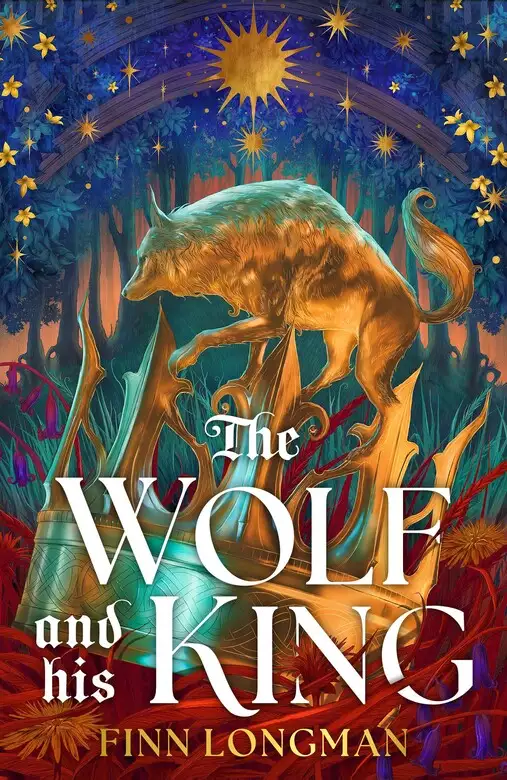
Madeline Miller meets Angela Carter in this spellbinding queer retelling of the 12th - century tale of Bisclavret the werewolf -- unmissable for fans of Uprooted by Naomi Novik, Swordcrossed by Freya Marske, and The Bear and the Nightingale by Katherine Arden.
A noble knight hiding the beast inside. A lonely king isolated by his courtiers. Between them an impossible gulf surmountable only by the twists and turns of relentless destiny in this spellbinding retelling of Marie de France’s classic 12th-century tale of romance and adventure.
The wolf-sickness strikes always without warning, stealing Bisclavret’s body and confusing his mind. Since boyhood he hasn’t dared leave his isolated holdings—not to beg the return of his father’s lost estate, not to seek brotherhood among the court, not even to win the knighthood he yearns for. But when a new king ascends, Bisclavret must deliver his kiss of fealty or answer for the failure.
Half an exile himself, the young king is intrigued by this uneasy, rough-hewn nobleman. Bisclavret seems a perfect knight: bold, strong, and merciful. But he keeps his secrets close, and the king’s longings are not for counsel alone. As his fascination grows, the barriers between them multiply, until the king battles desperation and grief. Then Bisclavret vanishes beyond reach, just as the greatest threats to the kingdom converge. Only duty to his people stands between the king and ruin—duty, and the steady loyalty of the strangest wolf . . .
Release date:
January 27, 2026
Publisher:
Erewhon Books
Print pages:
352
* BingeBooks earns revenue from qualifying purchases as an Amazon Associate as well as from other retail partners.
He’s not even a man, these days – not always, not in the ways that matter. The wolf comes often enough to rob him of a future, but not so often as to rob him of his name. Yet. It tugs at the frayed edges of his mind, pulling loose the threads, and one day, he’s sure, the gnawing insanity of his animal skin will win. He’ll lose himself, become fully beast: this he knows the way he knows the ache of change when it settles into his bones.
Part of him fears it. Part of him welcomes it. It would hurt less, he thinks sometimes, to lose everything than to bloody his fingers trying to hold onto something already shattering.
For now, he knows himself. Knows when the fragile wonders that are his fingers warp into claws. Knows when his spine shatters, his neck breaks, and his body remakes itself into something unholy. He’s grown to recognise the signs – the swelling soreness of his joints, the bite of his teeth against his lips, the taste of his own blood like salt in his mouth – but he still slips out of his skin suddenly enough to be caught off guard and slowly enough to hurt.
It has always been this way.
Bisclavret is used to it.
He lives his life in exile. Quarantine, almost, keeping the wolf-sickness away from the markets and the towns and most of all the court, where once his father performed great deeds as baron and knight of the king. So his mother told him, anyway, when he was a child and there was still hope of a cure. Not forever, she promised, would they live here on her meagre estate in the shadow of the hills and on the edge of the woods, as far from the salt of the sea as any could be in a land shaken and pummelled by waves. One day, he would receive his father’s sword and the gift of his lands, and all would be restored: he to knighthood, she to joy, the wolf to memory and nightmares and half-forgotten tears.
But now she is dead, and the sickness has not left him, the possession not yet undone.
Once, when he was young, there was a priest who saw the damnation that thrust itself into his skin, but did not flee. Nor did he try to exorcise him with rituals and candles, scourge and invective and pain. Instead, he took the bruised, childish hands of the boy in his own and prayed, earnest and terrified. And after a few weeks in his own body, the boy thought, perhaps, that it had worked.
But the wolf came back. It always comes back.
The same priest warned him not to speak of it, as though he needed warning. ‘If they know what you are,’ he said – clutching his prayer beads, white-knuckled, his mercy only just outweighing his fear – ‘they will never let you be anything else.’
He is not sure, in truth, whether he is anything else.
Just a wolf-sick boy, exiled and unwanted.
Bisclavret cannot remember a time before the plunging agony of transformation, but as a child it came infrequently, once a month at most. He’d have weeks to forget how it feels to wake with blood under his nails and fogged memories of how the night was spent and a growing fear: don’t let me have hurt anyone. Now, though, now he loses himself a day each week, sometimes more; he’s afraid to keep too close a count of it, for fear he’ll find himself calculating how many more years he’ll have with a voice before he’s robbed of it entirely.
So, no, he’s not a man. Just enough-man, enough-human, to know what he’s missing. Enough to remember his mother’s tales of adventure and feel a hollow grief for something that never was. Enough to know that the secrets written into his skeleton have shaped him into something that can never see the light.
Enough to long for knighthood: a glittering, unattainable dream.
Once, as a child, he saw the knights passing by, the king in their midst and his son at his side and laughter in the air. They hardly seemed like men themselves – they were some new creature, shimmering silver skin like fish scales, as Other as himself, but entirely unlike him. Their eyes were bright; their joy, their brotherhood, was an ache to witness.
Childhood is a distant memory now. And the fair beardless youth amongst those knights, seeking the first thrills of chivalry, is long grown into a man. A man and half an exile himself – even here, Bisclavret has heard tell of the king sending his son and heir to foreign courts to learn better the violence of ruling, the art of war, fearing the quiet prince might be more naturally inclined to the monastery than the battlefield. If he has yet returned, word of it has not reached this place.
But even if the prince is ill-suited to war, he is better suited to the crown than a wolf-man to knighthood.
Bisclavret cannot fathom why the Almighty formed him in this body; he wonders, sometimes, if his nature is a test and a trial, the Adversary at work to torment his mother like Job. If so, she did not live long enough to receive her reward on earth, for she died believing him possessed and his future bleak. Perhaps she was right. It is not for him to pretend to be something blessed. It would be presumptuous – blasphemous, even – for such a creature to shrive himself in the chapel and let them paint the cross on his forehead before raising him to sword and horse and brotherhood.
And even if it were not a sin and a lie, the risk is too great. One day he may lose his mind along with his body, and then what? Would he kill, or only maul? Without human reason to restrain his actions, would he reveal himself to be the monster he’s always feared, secretly, that he is?
No. Bisclavret knows his place, and he is not a knight. He will never be a knight.
But he will dream of them, all the same.
‘He’ll be crowned in a week, and there’ll be a hunt to celebrate.’
His cousin. Resplendent in court garb, all bright colour over gleaming mail, the finest armour his lord can bestow upon him. When, as children, they played at knighthood together, it was not to a landless life of service to another lord that either aspired – but his cousin is a younger son, an inconvenience, sent here to this estate as a companion to his infirm kinsman and only later to court. By then there was no money to equip him, but he’s found a lord, and a part to play, which is more than can be said of Bisclavret.
His cousin is still travel-stained from his long journey, but his eyes gleam with possibilities. Two days’ hard riding to bring word: the king is dead, the prince recalled from distant courts, the kingdom altered. An accident, a terrible shock, of course, but amidst the mourning many perceive the jewel of opportunity. The young prince – now king – has been gone long enough that none at court may yet claim his favour, and it is a rich fruit to be plucked.
‘I cannot see what this has to do with me,’ says Bisclavret, folding his arms. He has lost weight this summer. The wolf takes it from him, punishing him for keeping it from hunting the way it craves.
‘You owe him oaths,’ his cousin reminds him. ‘Your mother’s land is yours. You are a noble, however pitiful your estates. You will be expected at the coronation to swear your fealty.’
Bisclavret’s heart sinks. He inherited his land some four years past, and ought by rights to have sworn to the old king, but the man was cantankerous and disinterested in the doings of minor gentry, so long as they held back from poaching in his forests and parks. His cousin is right, though: he will be expected at the coronation. Three days’ journey, at the least, if he doesn’t want to torment his horse the way his cousin has done these past two days; a night or several in the king’s hall; the same journey in return.
Too much entirely for a man with a wolf in his skin.
‘It’s not possible,’ he tells his cousin. ‘I will have to send my apologies. Meet him when next he takes a circuit. Tell him I am infirm, or injured, or—’
‘But this is your chance,’ his cousin interjects. ‘Did your mother not always plan to present you at court and reclaim your inheritance? The new king will be seeking loyal barons. No doubt he will be more than ready to restore your land, in exchange for your gratitude and good favour …’
‘A nice idea,’ says Bisclavret drily. ‘You have forgotten the wolf.’
‘I have forgotten nothing,’ says his cousin. He was all of twelve summers old when he learned the true nature of Bisclavret’s infirmity and has kept faith with him in the years since, when most would have turned their back. ‘But you can’t mean to spend the rest of your life here. Your father was a knight. A baron. His place should have been yours.’
And if his father had waited just a month or two longer to die in the old king’s service, it would have been. As it was, he died without sons, Bisclavret still in his mother’s womb, and his land reverted to the crown.
‘Then perhaps the king will grant me lands on his next circuit, but I cannot travel that long. The wolf—’
‘Surely you can manage a week,’ says his cousin, but he must read the answer in Bisclavret’s expression, because concern crosses his face for the first time. ‘Does it truly come so often, now?’
Bisclavret looks away. He has done his best to create the impression of the wolf as an infrequent visitor – an occasional lapse, not a constant haunting. All men, after all, have moments of weakness. But weekly … weekly starts to look like a habit.
‘Sometimes,’ he says. ‘Especially in the winter. I think the cold …’
His cousin doesn’t care for technicalities. ‘You can transform on the road. There will be no one to see you. Once at court, if you slip away, I can make some excuse for you, and they’ll be none the wiser. No one will be surprised by a little eccentricity, in any case, after so long in exile.’
Nobody expects you to be more than a rustic fool, he means; it’s funny how he intends this as encouragement. As though the people of the court will overlook Bisclavret’s appearance, too: the way the wolf leaves him lean and hungry, burns a sharpness into his bones that no amount of hearty food can fill out; his hair, always overlong; his skin, disfigured by small scars, souvenirs of another life. Now and again, he runs his fingers over the marks and tries to remember how they got there, but a wolf’s memories map uneasily onto a man’s body. How can he remember hurting his hand, when hours ago he didn’t have hands at all?
And his clothes – he only needs to glance at his cousin to know that his own clothes are hopelessly old-fashioned, the cheap blue and brown dyes faded with age. Fine clothes would be quickly ruined by being shrugged from a changing body and abandoned somewhere out among the trees, but he cannot appear before the king looking like he works his own fields.
‘You assume I choose the time and place of my changing,’ he tells his cousin. ‘I do not. The wolf comes when it wills, and this is too great a risk. You will take my apologies to the court.’ And he will never regain his inheritance, and he will never be a knight, and he will pretend to forget the youthful games he played, sparring with his cousin as though he could ever be anything other than this: a monster poorly disguised in human skin.
‘Bisclavret,’ says his cousin sharply. ‘Do you intend to do nothing but waste away here? How long will you hide yourself from the world?’
How long? He has never been granted the reprieve of an end-date for his condition. It is a fact of him, more certain than the shape of his teeth or the rhythm of his heart, they that are as changeable as all his mutable flesh. There will never come a time when it is safe for him to step out of his seclusion.
His cousin again reads the answer in his face, and for a moment his frustration is tinged with grief, as though Bisclavret’s concerns are tragic rather than rational. ‘Your mother would have wanted you to seek your birthright,’ he says. ‘Your inheritance is yours to claim.’
‘My mother kept me here and died in exile rather than risk the danger you are suggesting,’ Bisclavret points out. ‘I cannot be my father. I wouldn’t know how to begin.’
‘I would help you,’ says his cousin, and now he is almost begging. ‘I would be your man, if you would will it.’
So he thinks to exchange his lord for Bisclavret. That explains his pleading; to serve his own family would be an easier yoke than service to another man in exchange for his arms. But he is asking for the impossible.
‘I cannot make this journey. I cannot sleep in the king’s hall. Imagine if the change—’
‘I would help you,’ says his cousin again. ‘Find you a place to sleep – the stables, if you insist, somewhere secluded. And you will swear your oaths to the king and speak to him of your father and he will restore you, and then you will have your own land, enough of it to roam in your wolfing, in place of this patch of fields. Wouldn’t that be a fair exchange?’
He makes it sound tempting. Tempting, and dangerous, and just enough like their childish dreams of glory to burrow deep into his heart and tug on the buried, secret desires he hid away once he grew too old to play at knighthood and too wolf-sick to pretend humanity. But his father’s lands – the lands that were promised to him, a home where he could live safely rather than in exile …
Wouldn’t that be worth it? A few days of struggle, for the years of safety that might follow? Perhaps, if he is careful, the wolf might be kept at bay long enough to make it possible.
‘I cannot stay for the hunt,’ he warns his cousin. ‘I’ll have to leave after the coronation. The risk increases with every day I spend at the castle.’
A smile casts its light on his cousin’s face. ‘So you will come.’
‘I will come,’ he says, heavily. ‘And swear my oaths, and see what results of it. But if the king grants me nothing then let that be the end. I will not beg him.’
‘You think it so likely that you’ll fail to impress him?’
Bisclavret remembers the king as a boy, scarcely more than a child, fair-haired and wondering as he rode out amongst his father’s knights. He can’t imagine that head bearing a crown, that mouth speaking oaths. He can’t imagine how it will feel to kneel before him, to swear fealty, to kiss him.
‘A king with good judgment would see the truth of me,’ he says finally. ‘And will know what to do with that truth.’
His cousin reaches out and tucks a strand of Bisclavret’s hair behind his ear. ‘He will see you as your father’s son,’ he says, and it is the kindest thing anybody has said to him in longer than he cares to acknowledge. ‘But first we must find you some better clothes, or he will see you as a peasant. Come. There’s no time to be wasted.’
The feast has hardly begun and already you are weary of it. It has been a long day of oaths and promises, the new weight of your father’s crown heavy on your brow. You suppose you’ll grow accustomed to it, just as you’ll grow used to being at the centre of festivities, the object of everybody’s eye. For now it remains strange, unfamiliar after three years as an unwanted prince at another’s table, and the castle feels less like the home of your childhood and more like a gaol of cold stone closing around you.
A month ago it was summer, and your father was alive. Then a fall from his horse, a festered wound, and he was gone; the messenger sent to fetch you said little more than that, and didn’t need to. You thought you had longer. But now the trees have dropped their leaves and the winter is fast approaching, the many hearths of the castle unable to chase the chill from the air or beat back the encroaching blackness.
And you are king, and this feast is in your honour. If only you wanted it.
Your mood is at odds with the festivities, your father’s knights and retainers deep in their cups, every loyal man from across the kingdom dressed in his finery and seeking joy and good company. You received their oaths today, and their kisses, and it should warm your heart to know that they love you, but they loved your father too, and do not know you, and only owe you their swords.
The noise of the hall drowns the senses. Half-shouted conversations obscure each other, a mess of sound by the time they reach you; voices compete with the minstrels for volume. You squash the futile urge to flee. They have scarcely let you outside the castle walls since your return, and you ache with the need to walk down to the lake and see if it still reflects the stars of the clear autumn night in its inky depths, the way it did before you were sent away. To let the darkness dance your feet to somewhere you hardly know; to follow the tracks of the deer deep into the forest; to remember the land you were kept from.
Instead you sit here, on this dais, away from the mass of faces you half recall. They have left space on either side of you for the wife you don’t have and the favoured ones you wouldn’t know to invite to your side. A little way down the table sit your barons and advisors, deep in conversation with each other and ignoring you; at the other end sit the ladies of the household. One is the daughter of your father’s most favoured knight, lately deceased; she will remain under your protection until she marries, halfway to a sister or a niece. She is accompanied by a kinswoman of hers, you think, and two maids, but while she offers you a fleeting smile when she catches your gaze, it cannot diminish the space between you and make this seat a less lonely one.
They might have thought to choose company for you, you think resentfully; they must have known you had nobody to summon to your side. You haven’t so much as a squire to serve you at table. Your only true friend in the castle is the scribe you brought back with you from your exile, and he would never be permitted to sit beside you, if he were invited to a feast like this at all. Even your knights are strangers these days, though you see among them the faces of those you knew as a youth. It will take time to earn their companionship again, whatever oaths they’ve sworn.
‘Sire?’ Someone wants your attention. You thought you’d done your duty, the rituals of the day over; you’d resent the petition, except that it interrupts your loneliness. ‘Sire, I beg a moment of your time on behalf of my cousin.’
You look up. The voice belongs to a knight you recognise but don’t know well, though you could hardly be said to know any of them well, now. He’s a lesser knight, sworn to one of your men, arrayed in his livery; you can’t remember where he hails from, but you have a vague sense that it’s somewhere quaint and rustic, and that he has rather more brothers than any man hopes to have in the line of inheritance ahead of him.
He is also, to your surprise, spattered with mud, his once-bright clothes soiled by bad weather and a hard ride. It’s unlike him to appear dishevelled, nor were you aware that he had any cousins with whom you might concern yourself.
‘Your cousin?’ you say, half-engaged despite your exhaustion.
‘He would have been here this afternoon, sire, to swear to you as was proper, but the elements turned against us and our horses were lamed some thirty miles from here.’
And by the looks of him they’d been travelling some time before that happened. Most likely he’s one of these very minor nobles with scarcely enough land to raise his taxes – a coastal backwater, perhaps, or something out in the hills to the west. His absence this afternoon would have been noted by your seneschal and the record-keepers, but you hadn’t marked it.
‘I daresay I can find it in me not to see disloyalty in his absence,’ you say, dredging up a smile, and the knight returns it, nervously. ‘Bring him forward, then. A feast is as good a place as any to take a man’s oath.’
No doubt your seneschal would feel differently. But the knight looks relieved. He turns and gestures, and a man begins moving across the hall towards you. He has a loping stride, easy as a huntsman over rough ground and just as unsuited to a feasting-hall; he covers the distance in moments, and then he is standing before you.
He’s near enough your own age, give or take a year or two – slightly younger than his cousin, you’d guess, and even more rustic in his dress. He has no armour and no surcoat: he’s clad in red wool over a blue undertunic, his sleeves cropped and practical, and he wears no hood or cap, so that his damp hair falls unfashionably loose and long past his shoulders. But he has a rough-hewn beauty, unpolished, all cheekbones and sharp eyes and eyebrows like sword-slashes.
He bows his head. ‘Sire,’ he says, taking your hand and kissing it. ‘I must humbly beg your forbearance for my absence at the oath-taking. It was not disrespect that kept me, but poor weather and a difficult road.’ His voice is hoarse, low – strained, perhaps, by the ravages of his journey. The cold weather has flushed pink his cheeks and nose, and there is something unsophisticated yet lovely about it, juxtaposed as it is with the coal-black of his eyes and his dark hair.
‘Indeed, it’s clear you’ve had no easy journey,’ you remark, raking your eyes over his muddied clothes; whichever servant took his cloak did a poor job of brushing the dirt from his chausses and boots before they let him into the hall. ‘What is your name?’
The young man glances up and meets your eyes. ‘Bisclavret,’ he says.
Bisclavret.
You mouth the name to yourself, tasting it, trying to place it. You can’t; you don’t think you’ve ever heard it before. No chance, then, that this man is a long-forgotten childhood playmate, here to rekindle an acquaintance. A relief, in truth, for after years away you have enough difficulty matching names to faces without attempting to recall the friendship of another age.
But you would know more of this man – understand him better before you take his oath. ‘Where is it you have travelled from, Bisclavret?’ you ask, taking no small thrill from the shape of the name on your tongue as you voice it.
He names a place you have never been, and adds, ‘Some way to the west, before the mountains proper, with woodland on one side.’ It is the description one gives when expecting no familiarity with an estate; it must be very small, for you never to have heard of it. ‘The land was my mother’s dower, and passed to me now four years ago.’
So his mother is dead. ‘And what befell your father?’
‘He was killed in your father’s service a little more than a quarter-century ago, a month before my birth.’ He hesitates, glancing sideways at his cousin for help, but the knight only nods encouragement. Bisclavret continues: ‘He was a baron of the old king, and when he died without issue, his lands reverted to the crown. I … I did not inherit. Sire,’ he adds, a little hastily.
For a wild moment, you’re struck by the absurd desire to ask him to call you by your name. Nobody has done so since you returned from your exile, as though the syllables have been forgotten in your absence and you are nothing to them now but your crown.
But you refrain. ‘You have been as much an exile as I have, then, and for far longer. Your mother didn’t think to bring you to court, and ask for the return of your inheritance?’ Your father might have granted it, if he liked the old baron enough; he was not an especially loving man, but he could be generous to those who pleased him.
Now he does falter, looking to his cousin again. The knight steps in: ‘Motherhood suited my mother’s sister ill, and she was often unwell. I was fostered on her estate for some years in my youth, to give company to Bisclavret and ease the burden on her. She would not have felt able to come to court. It is, as we have found, no easy journey to make.’
And it is the cousin who has prompted him to make it, you suspect, for Bisclavret looks as uneasy here as you feel, his discomfort greater than can be attributed to his wet clothes. But those must be unpleasant enough.
‘Come,’ you say, and gesture to the bench beside you, close as it is to the warmth of the hearth. ‘Sit by me, and tell me of your father, and I will take your oath when you are dry and fed as any of the king’s men should be. Both of you,’ you add hastily. ‘You have both suffered on your travels, and have need of the fire.’
The kn. . .
We hope you are enjoying the book so far. To continue reading...

 Please log in to recommend or discuss...
