
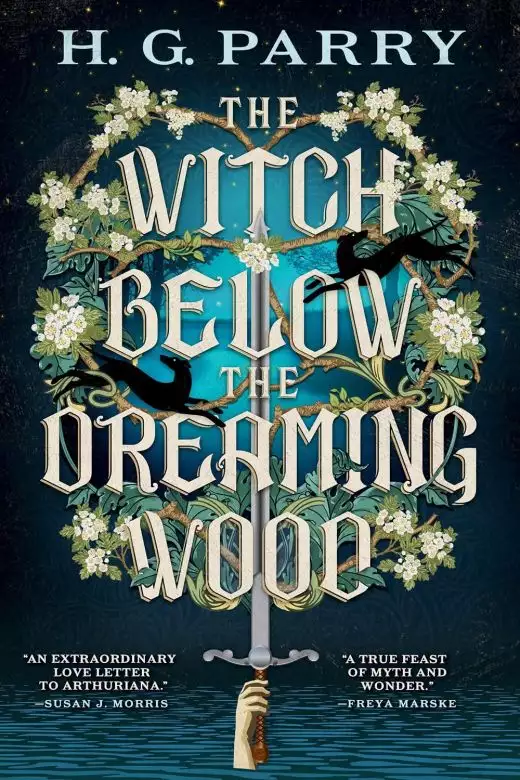
The Witch Below the Dreaming Wood
- eBook
- Paperback
- Audiobook
- Book info
- Sample
- Media
- Author updates
- Lists
Synopsis
From the author of The Magician's Daughter comes a historical fantasy where dreams come to life and Arthurian legends are reborn, perfect for fans of The Everlasting and The Once and Future King.
Wales, 1941. As war rages across the globe and bombs fall from the sky, people all over the world begin to dream of King Arthur. The dreams spread like a fantastical plague, flooding people's sleep night after night. Whispers arise of wonders and unexplained sights—dragons in the London Underground, and strange lights over Stonehenge. Self-proclaimed prophets claim they are miracles, heralding Arthur's return at the time of Britain's greatest need.
Elaine Ambrose has never dreamed of Arthur, and she doesn't believe in miracles. A librarian at the British Museum, she wants only to protect the museum's collection from the London Blitz, and is frustrated to be sent instead to catalogue a reclusive professor's private library on the coast of North Wales. But all is not as it seems. Soon Ellie must confront what she's tried to ignore: she dreams not of Arthur, but of Nimue—the Lady of the Lake. And her dreams promise not salvation, but a return to the darkness of the last days of Camelot.
Release date: July 21, 2026
Publisher: Orbit
Print pages: 448
* BingeBooks earns revenue from qualifying purchases as an Amazon Associate as well as from other retail partners.
Reader buzz
 Please log in to recommend or discuss...
Author updates
The Witch Below the Dreaming Wood
H.G. Parry
“Remember,” I would hear her whisper to little Mordred, “you are Arthur’s doom.”
I didn’t need to see Mordred to picture him, pale and golden haired, looking up with wide clear eyes. Utterly guileless, and yet with a twitch about his mouth as though he might break into a smile at any moment.
A kiss and a rustle of skirts, and she had moved to Lancelot.
“And you, my knight,” she said, “are Guinevere’s.”
Lance was ten years older than me—as long as I could remember, he had always been more of a man than a boy. Guinevere was lucky, I thought, in a confused way, not quite sure why. But if doom had to come, I thought I would like mine to come with Lance’s grey-green eyes and dark hair and rapidly-firming jawline; I would like, too, for it to have his soft, kindly manner and fragile, easily bruised heart.
And then, at last, it was my turn. I felt the bed give and turned, smiling, to see my mother’s face above mine. She smiled back at me, and my heart opened like a flower starved of sunlight. Her hand smoothed back my hair, and her lips dropped a kiss on my forehead.
“And you, my darling Nimue,” said my mother, Morgan le Fay, the Lady of the Lake. “You are Merlin’s.”
I wanted to be anything she asked of me. We all did.
In those days, the stories about Arthur were still being made as well as told. Tales already abounded of how a young boy had pulled a sword from a stone, how he had united the Britons and seen off the invading Saxons and banished the monsters and giants to the wilds, how he wielded a sword and scabbard gifted to him by the Lady of the Lake. How he had founded the kingdom of Camelot, and said it was to be a new kind of kingdom, a kingdom governed by the rules of chivalry, whose knights were sworn above all else to serve the poor and the weak and the helpless. How, strangest of all, he actually meant it. But they were still tales about a living man, a warrior and king just out of the first flush of youth, who was having new adventures every day. Camelot was many days’ journey from the Lake, but it was a real place, where my mother had been and all three of us children would one day go.
There were some stories, though, that hadn’t happened yet. I didn’t understand then how my mother knew them—they were at once too vague and too specific for prophecy, and besides, prophecy had never been one of my mother’s gifts. But she knew them, one about each of us under the Lake, and she would tell them to us when the mood was upon her. The story of how Lancelot became Arthur’s greatest knight, only to betray him with his queen and break the Round Table forever. The story of how Mordred, Arthur’s son, killed him and brought about the end of Camelot.
The story she told about me was really a story about Merlin, and how the greatest wizard in the world met his doom at the hand of an enchantress. It didn’t seem to know very much about me at all.
One day, the stories said, when Merlin was very old, a woman came to the court of Camelot. She has different names in different versions, but the version my mother had heard named her Nimue. Some say she was the Lady of the Lake, like my mother, but they say this of most enchantresses. All the stories agree that she was very beautiful, and brimming with dangerous and alluring magic. When Merlin saw her for the first time, he fell under her spell. He was determined to have her for his own. In return for her attentions, she made him promise to teach her all he knew.
Because he was a great wizard, Merlin knew that the woman would be his doom, and that if he followed her away from Camelot he would never return. He told Arthur as much. Arthur urged him, since he knew this to be true, to turn away from his final adventure. But Merlin knew that this couldn’t be, and when the enchantress called Nimue left Camelot, he went away with her over the seas.
Some say she grew weary of him and his relentless pursuit of her virtue. Others say that she was afraid of him, because he was said to be the son of the devil; or perhaps that she had simply learned all she could from him. She lured him into the woods, and she sealed him in a rock, or a cave, or a hill, or in some versions a tree. He was never seen again. And so Arthur lost his closest friend and most loyal advisor. From that day on, little by little, things began to go wrong in Camelot.
“But Arthur is still at Camelot now, and Merlin too,” I protested, the first time I was told this story. I was perhaps four years old, and hadn’t learned yet not to question my mother. “I haven’t done anything to them.”
“Not yet,” my mother said. “But you will, one way or another. It’s how the story goes.”
This is where that story begins, and where it ends.
It wasn’t what she had been expecting.
The letter had warned her that the house was old and in need of repair, that it was on a windy and isolated part of the Welsh coast, that most of the staff had gone and the land left to run wild in their absence. The drive from the tiny train station had taken them miles along a winding narrow road, through vast swathes of green hills and tree-covered cliffs with only the occasional old farmhouse or grey stone wall to show that people lived anywhere nearby. She had prepared for her heart to sink as the old car rounded the crest of the hill that the driver had promised would give her the first glimpse of their destination.
The house was certainly isolated. It was perched on the edge of a steep cliff, high above sharp rocks and crashing seas. The land around it was wild and windswept: hilly fields divided by overgrown hedges, a dark patch of woodland stretching across the slope behind the house. But the stone mansion itself looked comfortable, well-worn rather than derelict. The windows were edged in bright white, and the gravel path leading to the front door had been meticulously cleared. Two storeys high, with a turret at one corner, it had the look of a country house merged with a castle, as though anything from a farmer to a knight could be lurking inside. The sun was finally beginning to set, a little after nine o’clock, and its light touched the grey ocean with gold.
“There it is,” the driver said. “Camlan House.”
He hadn’t been as expected either. Two years into the war, most of the men she saw were either noticeably grey haired or obviously unfit for active duty. The man who had come to pick her up at the station looked younger than she was, no more than early twenties, with the thin, wiry build of an athlete and the restless energy of the students who used to come to the British Museum. He had introduced himself as Wilder, presumably a surname, and he had taken her single carpet bag and hoisted it into the back of the car, so she guessed he was actually a chauffeur of some kind. He had scarcely spoken since, and neither had she. She had lived in London since she was a student herself, and she knew embarrassingly little about how country houses were run, much less how to talk to those who ran them. Her strongest impressions came from reading Rebecca just before the war, and they weren’t encouraging.
“It’s a very nice house,” she said, politely. “How many are living there, apart from Professor Emory?”
“To be honest, I’m not even sure I’d say Professor Emory lives there.” His accent was similarly out of place, more northern England than Wales. “I’ve been at Camlan a few months now, and I’ve never even met him.”
That was unexpected too, and uncomfortable. “I thought I would be meeting Professor Emory at the house. My supervisor at the British Museum said he was expecting me.”
“He’s due back soon. I think he has a townhouse in Liverpool, and he travels a lot. He knows you’re coming, don’t worry. Mrs. Leaf has all the instructions on how to look after you.”
“Is she the housekeeper?”
“She is.” His voice was absent, as though he were concentrating hard on the winding road—which, she supposed, made sense if he had come here only recently. “She’s also the rest of the household staff, at the moment. Everyone else left last year.”
The war, presumably. She wondered why Wilder hadn’t been called up too, and reminded herself firmly that it was none of her business. She was now far from the war herself, after all.
“What about you?” she asked. “What is it, exactly, you’ve been doing a few months now?”
The phrasing was meant as a joke, but she was awkward at jokes at the best of times, and her determination not to ask about his presence in the country gave the question more of an edge than she intended. Fortunately, he didn’t seem to notice.
“I’m the outside-the-house-keeper. Groundsman, gardener, groom—chauffeur, at the moment.”
“Groom? Are there horses there?”
“Only three now. Rhiannon, Pwyll, and Pryderi.” She heard the affection in his voice, as though he was cupping each name in his hands and letting it go again. “They’re why I got this job. My father’s a groom at a big house in Chester. I can do general maintenance as well, though. If your ceiling is leaking or your door isn’t closing, come find me and I’ll look at it.”
“Aren’t ceilings and doors inside the house?”
“I’ll make sure to wipe my boots first.”
Ellie smiled, and hesitated. “Why is it called Camlan House?” she asked. “I suppose it doesn’t have anything to do with King Arthur and the Battle of Camlann?”
“Arthur?” His voice didn’t change, but his eyes flickered to the side mirror. “Is that why they sent you here?”
“No,” she said quickly. She should have known better than to mention Arthur, these days. “It was only a question.”
“I did wonder, you know. It’s a funny time to be sending a librarian out here in the middle of nowhere. And everyone says the Arthur dreams are getting stronger—”
“I was sent here to catalogue Professor Emory’s library,” she said, firmly. An unwelcome chill had gone down her spine. “I’m not interested in King Arthur. I’m certainly not interested in anyone’s dreams.”
The driver clearly sensed the reprimand this time. His shoulders stiffened, and his voice slipped into a more formal register. “I’m sorry,” he said. “It wasn’t my place to ask. I don’t know the origin of the name, I’m afraid. Mrs. Leaf might.”
She felt a stab of guilt at her tone, which had been in response to a sensitive subject and certainly not meant to put anyone in their place. Before she could say anything, or even work out what it was she could possibly say, the car turned with a crunch of gravel into the driveway of Camlan House.
The driver certainly wasn’t alone in wanting to talk about the Arthur dreams. For months now, in the midst of war, it seemed all anyone wanted to speak about.
It was difficult to say when the dreams had begun. They had been a whisper at first, lost amidst the far louder concerns of the Battle of Britain and the Blitz. The first Ellie could remember hearing of them was a morning the previous November. The all-clear had gone hours before; she had come downstairs for breakfast, heavy-eyed and yawning after their broken night. Her friend Martha was already at the table reading the paper.
“Look at this,” she’d said, turning the page around.
There, nestled alongside the usual bulletins of battles lost and countries occupied, was an article claiming that thousands across the world had reported strange dreams. None of the dreams were exactly the same—some dreamed of Excalibur and the Round Table, others of giants and questing beasts, some dreamed of the rise of Camelot and some of its fall. But all the dreams were of Arthur, flooding people’s sleep night after night—as though, the paper said, something was whispering stories from beyond.
“It’s nonsense,” Ellie said. Something inside her stirred, uncomfortable, a prey animal sensing danger. “A coincidence.”
“It isn’t,” Martha said, taking the paper back. “I’ve had those dreams myself.”
Ellie stared at her. Martha was five years older than her, a tough, plain-speaking woman with a job at a munitions factory and a wicked sense of humour. She was the last person anyone would accuse of nonsense.
“I have,” Martha added, in response to Ellie’s face. She looked a little embarrassed, but held firm. “Every night for the past week, I’ve dreamed of Arthur and Guinevere and Lancelot. I thought I was going mad, until I read this. You haven’t had any?”
“No.” Ellie didn’t need to think twice. She’d hardly been getting enough sleep to dream since the start of the bombings, and when she had, her dreams had usually been full of burning buildings. “Nothing. Are you sure you aren’t just…?”
“Aren’t what?” Martha shook her head before Ellie could answer. “I’m not imagining them. They’re not just dreams. I’m not saying I can explain it, but… Oh, you’ll understand when you have one yourself.” She swallowed the last of her weak tea with customary briskness, and stood. “I’ve got to go to work. Have the last of my porridge, if you like.”
She wasn’t sure what to say. Martha didn’t look disturbed by her own words—if anything, there was a soft wonder underlying them, a fragile joy that Ellie hadn’t seen in anyone for a long time. Still, that was disturbing in itself. The idea that dreams were spreading like a fantastical plague should be disturbing. Anyone who felt otherwise clearly wasn’t quite themselves.
But perhaps nobody was quite themselves. As explosions wracked the city night after night, Ellie began to hear others discussing the dreams: defiantly made-up women sharing details as they waited in line at the shops, tired mothers whispering their stories to children in the public air raid shelters, haggard old men in Home Guard uniforms exchanging them as they might news from the front. Whispers began to arise of wonders—a dragon glimpsed in the London Underground, a strange light over Stonehenge. Self-proclaimed prophets on the streets insisted they were miracles, heralding Arthur’s return at the time of Britain’s greatest need.
Ellie had never dreamed of Arthur, and she didn’t believe in miracles. But the idea that the world, already so precarious, was taking on another new and strange shape filled her with unaccountable dread. It was as though the incendiaries had cracked open the earth and allowed something old and primal to spill through.
It wasn’t why she had been sent to Camlan House, though. She had been sent, she suspected, because on the night of May 10 the British Museum Library had been bombed.
It had been the worst night London had seen since the start of the war, the climax to eight months of relentless attack. Hundreds of planes had screamed overhead, hour after hour, each one bringing earth-shaking explosions and fire and screams. Ellie had huddled in the basement of her boarding house alongside the landlady and the five other women boarding there, as dust shook from the ceiling and the concussions grew louder and louder. It felt like the end of the world.
More than fourteen hundred people were killed outright that night. The fires blazed over an area greater than that of the Great Fire of London. The House of Commons was destroyed; St. Paul’s Cathedral shattered. And when the all-clear sounded and Ellie stumbled up above ground, flames were rising from the direction of the British Museum.
She ran towards it, heart pounding, stumbling in her slippers, praying for the best. The roof had collapsed, and fire tore through the building, devouring stone and wood and, devastatingly, paper. All morning, Ellie fought alongside the firefighters and some of her colleagues to douse the flames, choking on ash, grime coating her skin and hair. Once, a frenzy of sorts had overtaken her and she had tried to fight her way into the building, desperate to save what she could, tearing at the rubble with heat-blistered hands until stronger hands had dragged her back. By the time the flames died, two hundred and fifty thousand volumes had turned to ash. Her books. She and her colleagues had fought through eight long months of bombs falling from the sky by focusing on protecting their charges, getting what they could to safety while keeping the library in operation to the best of their abilities. The smell of burnt paper tore open a wound she had been trying not to look at, and the pain of it was unbearable.
Perhaps her superior had seen that, or perhaps he had heard of her attempts to run into the flames. Perhaps it was simply that she was a woman, and a junior worker, and he was old-fashioned about such things. Perhaps it was surprising that she had been allowed to stay as long as she had. For whatever reason, as they made plans to relocate still more books to libraries in safer areas the following week, Mr. Weatherall called her to his makeshift office and told her that she was to go to Wales.
“To the National Library?” she asked, startled. The National Library of Wales in Aberystwyth had taken in books from all over the country since the war broke out, including tens of thousands of books from the British Museum Library. It made sense that they would be asking for more librarians. “I would rather stay here, truly. We’re doing important work.”
“We are,” he agreed, wearily. He was an old man, and the long nights of horrors had aged him further. “But there’s always work to be done elsewhere. And no, not to the library. This request comes from a private estate: a Camlan House, owned by a Professor John Emory.”
“Camlan,” she repeated. That flare of unease, a flash of knights fighting amidst the mud. According to legend, she remembered from her university studies, the Battle of Camlann was where Arthur had fallen. The day Camelot had ended, and the Round Table had been broken forever. A coincidence, of course, but still.
“He has a substantial private library that he has a mind to donate to the museum, and we need someone to catalogue it. He specifically requested we send someone with experience in medieval codexes and Welsh and Irish folklore. You specialised in both at university, did you not?”
Her heart, always heavy these days, sank like a stone. She fought to keep her voice reasonable. “Still, surely there are more useful assignments for me in London?”
“That’s why you’ve been here until now. This request actually came in March, but we couldn’t spare you. It’s different now, with so many books either destroyed or going elsewhere.”
“Where is this house?”
“The coast of North Wales, some thirty miles from Caernarfon. You should be a long way from any bombing.”
“I don’t want to be a long way from any bombing!” she protested. “I’m not an evacuee, Mr. Weatherall.”
“You’re an archivist,” he said. “There will be books at the professor’s house. I fail to see the problem.”
“The problem,” she said evenly, “is that London is my home. This is my job. And if the museum is destroyed and I’m safe miles away on the coast of North Wales, I will never forgive myself.”
If she’d hoped to break through to him with her bluntness, it failed. He didn’t even look up from the papers on his desk. “Yes you will,” he said. “You’ll tell yourself you had to go where we sent you. That is your job—what’s more, it’s your duty.”
The word silenced her, as he intended. Everyone had to do their duty. Bombs were falling from the sky, soldiers were dying thousands of miles from their homes, and the war had spread to almost every corner of the world. She could hardly refuse to go where she was sent, even though those same orders felt like desertion.
He must have seen her surrender, because his voice softened. “If it’s any consolation,” he said, “they’re saying the worst of the Blitz is over. But I doubt anywhere is particularly safe these days.”
As Wilder had promised, Mrs. Leaf was waiting to greet them when the car pulled up at Camlan House. She was an upright, formidable figure, perhaps in her mid-fifties, with impeccable brown hair and a stern face set above a starched collar. Her features were handsome and her eyes were soft and dark, but nobody would dare notice.
She stood proudly in front of the house as Ellie stepped out of the car, as though she had a retinue of servants and not an empty gravel drive. Her voice, unlike Wilder’s, had the proper Welsh lilt. “Welcome to Camlan, Miss Ambrose. I’m Mrs. Leaf, the housekeeper. I hope you had a pleasant journey?”
“Very nice, thank you,” she said, politely and untruthfully. The journey had taken all day in multiple trains packed with men in uniform, with several delays and detours due to damage to the tracks, but she would have died rather than complain to the severe-looking woman in front of her. “It was good of Mr. Wilder to meet me at the station.”
“It was neither good nor bad of him, I assure you. It’s his job to drive you anywhere you care to go.”
Perhaps it was the unfamiliar accent, or the curiously impassive face, but Ellie found herself unsure how to take that comment. She couldn’t help but feel that she had done something wrong, in a way she hadn’t since her first weeks working in the museum archives. Perhaps she’d been too haughty with Wilder; perhaps she hadn’t been haughty enough with Mrs. Leaf. Perhaps she should have greeted either or both of them in Welsh, as she’d been rehearsing in her head the night before, though she wasn’t at all sure of the pronunciation and they hadn’t done so to her. She also, under the scrutiny of those dark eyes, couldn’t help but be aware that she had been travelling all day, her skirt was rumpled and her dark curls, always unruly at best, were escaping their pins.
“Miss Ambrose was asking about the name of the house,” Wilder said. “Whether it had anything to do with King Arthur.”
“I believe Camlan refers to the stream that runs through the woods behind the house,” Mrs. Leaf said. “The word translates to something like ‘crooked bank.’ I don’t think there are any Arthurian connections with the house.”
This time, there was no doubt she had been reprimanded. “Of course not.” She wished she didn’t blush so easily. “It was only a passing thought.”
“Arthur is on the minds of many people these days, it seems. Wilder, after you’ve taken Miss Ambrose’s bags to the door, I wonder if you’d take a look at the stables? That stallion’s trying to kick the place down again.”
“I can carry my own bag,” she said quickly. “There’s just the one.” Quite apart from not wanting to make extra work, a stallion kicking down the stables sounded serious.
“Just as you like. I’ll show you to your room.”
“A pleasure to meet you, Miss Ambrose,” Wilder said, with a nod that was somewhere between guarded and friendly. Her inadvertent snub in the car still evidently stung. “Welcome to Camlan House.”
By this time, she knew better than to expect derelict old rooms and cobwebs inside the house, but she was still pleasantly startled by the light, bright entrance hall. Its panelled walls glowed a warm cream in the late-afternoon sun, the heavy door muffled the wind from the sea, and its worn Edwardian furniture invited guests to sit down and make themselves at home.
Not that Mrs. Leaf offered any chance of that. Ellie paused once, to admire the great iron chandelier suspended from the high ceiling, and when she lowered her head she found she had to hurry to catch up with the housekeeper.
Upstairs, the house splintered into a confusing labyrinth of corridors. Without Mrs. Leaf, Ellie would quickly have been turned around; as it was, she found herself trying to memorise the turns, as though she was being kidnapped. Most of the rooms they passed were shut up, or their half-open doors revealed only sheets draped over the outlines of furniture. On the second floor they passed a small sitting room, but its windows were already blacked out for the night, heavy curtains pulled to the floor and fastened with a deft hand. It made her remember the sheer number of windows she had seen from outside the house, every one of which would need to be covered according to blackout regulations so that no chink of light could be seen through them.
“We black out only a few rooms at night,” Mrs. Leaf said, as though reading her mind, “and I’m afraid I must ask that you confine yourself to them after dark, or at least not bring a light into the others. I hope this won’t be an inconvenience.”
“No, of course not.” It occurred to her that Mrs. Leaf’s stiffness might actually be embarrassment at the state of the house, left neglected with only her and Wilder to care for it. “I think it’s a very sensible plan. Is the library nearby?”
“It’s on the ground floor.” Mrs. Leaf was starting up yet another flight of stairs. Ellie gritted her teeth, fumbled for a more comfortable grip on her suitcase, and hoisted it high. “I can show you tomorrow, after breakfast. There’s a hot bath waiting for you in your room, and supper can be brought to you there. I’m sure you’re tired after such a long and inconvenient journey.”
She really would have preferred to see the library at once, but she didn’t like to insist on it. The sun was sinking rapidly; perhaps the library didn’t have blackout curtains in place.
“That sounds lovely,” she said, breathlessly, and once again untruthfully.
Her room was at the top of the tower she had seen from the road. She wondered, huffing and puffing her heavy bag up the last precarious staircase, whether Mrs. Leaf had put her as far out of the way as she could. When the door opened, however, she found she didn’t care.
“Oh, it’s wonderful,” she exclaimed. This time, she meant it entirely.
It was not an overly large room, but it was easily three times the size of her tiny quarters in London, and it was bright and airy. An assortment of books stood along a shelf, their spines too worn for the titles to be easily visible. The wide windows overlooked the sea, and the white walls, sea views, and oak furniture gave it a nautical air. This was aided by the large brass telescope that pointed out to the horizon, an armchair at its side. With the steep drop of the cliffs below, it might have been a ship about to rise into the air or drift over the waves, leaving the world behind forever.
“The bath is through that door there,” Mrs. Leaf said. “There are matches and extra candles in the drawers, should you need them—I’m afraid we don’t have electricity at Camlan. I’ll bring you your supper and put up the blackout, then I’ll leave you to get some rest.”
Ellie pulled her attention back to the housekeeper quickly. “Thank you. May I ask—where do you and Mr. Wilder sleep? If I need to ask you anything—”
“Wilder doesn’t live in the main house. He has the groundsman’s cottage near the stables. My rooms are in the servants’ wing, close to the kitchens. But there’s no need for you to come down there. That’s what the bell is for.” Ellie must have looked blank, because Mrs. Leaf walked to the head of the bed, where a coiled rope hung from the ceiling. “Here, madam.” Her patience was ever so slightly exaggerated. “If you pull it, a bell rings downstairs, and it will summon me.”
“Of course.” She had heard of ringing for servants, but it seemed absurd in this day and age, especially when she and Mrs. Leaf were the only ones in the house. She knew better than to say so. “Thank you.”
While Mrs. Leaf was in the bathroom arranging the towels, Ellie went over to the bookshelf to inspect the row of books. An anthology of Welsh mythology, for children; a volume of Keats; three Agatha Christies; a few authors she’d never heard of. The largest was a cracked Victorian edition of Sir Thomas Malory’s Le Morte d’Arthur. Her fingers brushed the spine, tracing Arthur’s name, then pushed it back quickly. She took one of the Poirots instead.
The old tin bath was full to the brim and piping hot, despite the lack of plumbing—she couldn’t imagine how Mrs. Leaf had filled it on her own. The heat relaxed the long day’s journey from her bones, along with some of the worry and confusion she’d carried for months. She couldn’t remember the last time she’d had a bath all to herself, not shared with a floor full of other young women. More importantly, the skies were quiet. By the time she pulled herself from the water, she was yawning deeply.
The dream came almost before she closed her eyes.
N ow that I know how many people there are in the world, I can see how it might have been lonely growing up under the Lake. We lived in the ruins of what must have been a vast civilisation, long since sunk beneath the waves. We went to the surface rarely, and always under my mother’s guidance; even then, the nearest villages were many miles away, and in my entire childhood I saw them only a handful of times. But back then, I never thought of it. My whole world was the drowned city, with its crumbling chambers and flooded corridors; it was peopled with my mother and Mordred and Lancelot, and that was enough.
I spent many hours alone in the great library tower, reading or practising my magic, and I loved every one of them. If
We hope you are enjoying the book so far. To continue reading...
