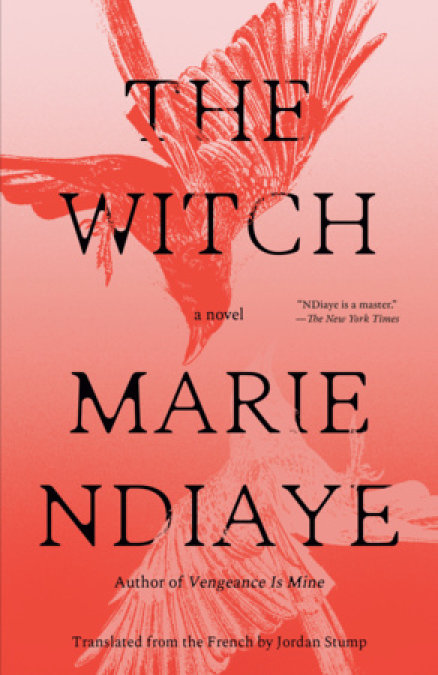
In a small, sleepy town, a mediocre witch, in a mediocre marriage, tries to pass on her gifts to her twin daughters, who, it becomes immediately apparent, have skills far beyond her own.
"The Witch is classic NDiaye. Taut, spellbinding and strange, it unfolds with the disturbed logic of a fever dream." —The New York Times
"The Witch is Marie NDiaye at her most dazzling. In this simple, startlingly powerful novel, NDiaye lays out her central themes: familial secrets, power, shame, and liberation. NDiaye is one of the greats—her novels are mesmerizing, wholly singular, completely unforgettable." —Katie Kitamura, author of Audition
Lucie comes from a long line of witches, with powers passed down from mother to daughter. Many of them have hidden or repressed their gifts to appease disgusted or fearful men. But against the wishes of her controlling husband, Lucie initiates her twins into their family’s peculiar womanhood when they reach the age of twelve. In a few short months, Maud and Lise are crying rich crimson tears, their powers quickly becoming more potent than their mother’s, opening them to liberation and euphoria beyond what Lucie and her foremothers ever considered.
Equal parts dreamlike and disquieting, The Witch tells a tale as old as time, with a dark twist: Without looking back, children fly the nest, laying bare the tenuous threads of family that have long threatened to snap. With simmering tension and increasing panic, NDiaye’s latest novel in English captures the terror and precarity of motherhood and marriage, and the uncertainty of slowly realizing that your progeny are more dangerous—to the world and to your heart—and freer than you ever could have dreamed.
Release date:
April 7, 2026
Publisher:
Vintage
Print pages:
224
* BingeBooks earns revenue from qualifying purchases as an Amazon Associate as well as from other retail partners.
When my daughters turned twelve I initiated them into the mysterious powers. Mysterious not so much in that they didn’t know those powers existed, or in that I’d kept them secret (I hid nothing from my daughters, since we were of the same sex), but rather in that, having grown up dimly and apathetically aware of that reality, they no more understood the need to care about it or suddenly somehow master it than they saw the interest in learning to cook the dishes I served them, the product of a domain just as remote and unenticing. Nonetheless, they never thought of rebelling against the tedious instruction involved. Not once, some sunny afternoon, did they try to invent a pretext to get out of it. I liked to think that this docility in my undocile daughters, my unruly, impulsive twins, was born of a recognition that in spite of everything they had a sacred obligation to uphold.
We gathered in a spot well away from their father’s eye, down in the basement. There, in that big, cold, low-ceilinged cinder-block room, which was my husband’s pride and joy for its very uselessness (a few old paint cans in one corner, nothing more), I set out to transmit the indispensable but imperfect abilities with which women of my family line have been endowed since time immemorial. In summer, the neighbor children’s shouts and laughs came to us from their nearby lawn; the sunlight that slanted through the basement window and fell onto the cement where we sat seemed to be trying to distract Maud and Lise from a dutiful concentration, the point of which they couldn’t quite fathom, but they refused to give up, their brows obstinately furrowed, their little faces, similarly diligent and intent, raised toward mine with a touching desire to pierce the enigma, a confident patience—certain as they were, from their earliest childhood on, that their turn to possess my gifts would come, certain and indifferent. When a session ended and I wiped the blood from my cheeks, drained, they sometimes went to the barred window to shout to the neighbor children: Yeah, yeah, we’re coming! and then off they ran, identical and brown in their shorts and striped rugby shirts, after each giving me a perfunctory, sweetly condescending kiss on my sweaty brow. I knew they’d reveal nothing I’d just taught them to their playmates. My daughters considered the secret of their powers strictly private, as well as fundamentally uninteresting. In another time, they would have felt slightly ashamed of it. But—practical, serene, resolute, intensely relaxed, grasping, asking a great deal of life with the most perfect innocence—they had next to no modesty or discretion, were rarely embarrassed by anything. In that those clever little barbarians, my daughters, amazed me.
In winter, the basement was dark and frigid, a dull gray glow struggling through the frosted glass, but it was still with the same doggedness, without even a word of complaint about the material conditions of their training (whereas in any other situation they protested savagely the moment their comfort seemed in danger of being imperceptibly harmed) that they launched into the labors involved in assimilating our particular power. I didn’t have to say much. Their task was to observe me and, with all their being, with the whole of those little bodies born of mine, to internalize the arduous process of divination. Sitting cross-legged, they propped their chins on their clenched fists and stared at me almost unblinking, which sometimes made me uncomfortable, whereupon I gave them a smile, tossed out a joke, earning no response but a fresh rush of seriousness and a dour impatience that expressed the little value my daughters placed on any sort of humor, which they vaguely considered superfluous.
They learned quickly, both at the same speed. After eleven months the first tears of blood dripped down their cheeks on the same day, and—as I loudly enthused to conceal my emotion at this immutable proof that Maud and Lise had gained the power to see the future and the past, the latest in a whole parade of variously talented ancestresses, the oldest and perhaps the most gifted to date being my own mother—my daughters, as if already bored with it, calmly wiped their cheeks with a tissue and sighed in gladness that they’d finally come to the end of the lessons.
“No offense, Mama, but really, it’s all just so lame,” said Maud, and that was their only comment upon joining the ageless procession of occult-powered women. I found myself wondering if they really believed in it all. Their way of cleaning their faces seemed so cool, so final, so relieved, as if, the ceremony at an end, they could now never again subject their practical minds, eager for tangible, productive sorts of knowledge, to such idiotic exercises.
“You know, the gift can be a useful thing to have,” I told them, in hopes of appealing to their taste for efficacy. But I said nothing more. My own talent was slight, apparently just strong enough to keep the gift going, to pass it along. So I couldn’t name one time when it had come in handy for me. My abilities were in all honesty laughable, they allowed me to see trivialities, nothing more. I had to work hard to set my process for divination or retrospection in motion, but however important the subject I could only glimpse insignificant details that revealed nothing at all: the color of an outfit, the look of the sky, a steaming coffee cup in the hand of the person fixed by my clairvoyant gaze . . . What, then, was I supposed to convince my dubious daughters of? Their new acquisition meant nothing to them, I could tell, and they welcomed it with contrived goodwill, simply to make me happy.
“Promise me one thing,” I went on. “If you ever have daughters, do with them as I’ve done with you for the past year.”
But they only laughed, shrugging their sharp little shoulders, then darkly muttering that there was no point waiting for them to get married. I thought them so fierce, so resolute, so solidly asexual in the slightly grimy jeans hanging loose around their slim hips that once again I let the matter drop, embarrassed to have let myself slip into sentimentality before that hard, gruff little pair.
Still, it vexed me to think that the power might be passed on no further. Their grandmother had grudgingly taught it to me, even though she so hated her own far mightier power that she never used it. She wouldn’t talk about it, probably did her best not to believe in it, considered it just one more in a hodgepodge of superstitions handed down by her illiterate mother. But when the time came, trying to forget for a few months that she had to project disbelief in the power’s very existence, and also motivated by a sense of duty weightier than her personal convictions, she taught me what I now know, in bits and pieces to be sure, with a palpable distaste that made me squirm in my chair, but tirelessly, until she saw me several times spill abundant tears of blood. Perhaps her lack of faith was responsible for my limited abilities. In my daughters’ case, I could see they would never feel obliged to obey any law whose violation entailed no serious consequences for their lifestyle, and even that they would soon forget passing the gift on was a law at all. How could I blame them? The force of their feral, sensual energy defied any notion of disappointment or rancor.
They gave me a hurried kiss on their way out of the basement, the faintly sweet scent of the blood lingering on their cheeks, and it occurred to me that when their father kissed them on coming home from work that evening he would immediately realize my lessons had borne fruit. He wouldn’t say anything about it to me. He would stick to the discretion, tinged with disgust and contempt, that he’d always shown my powers the few times I couldn’t avoid using them in his presence. He must surely have guessed what sort of exercise my daughters and I were regularly engaging in downstairs, and although he’d long known this day would come, it still might have nettled him. Maybe, I told myself, he’d been hoping, absurdly, that I would forget, would neglect to initiate Maud and Lise, or that they would prove so unreceptive to the discipline he knew the process entailed that I would give up on the idea. How, I wondered with a tingle of apprehension, would he react when he got a whiff of his daughters’ cheeks that evening? I feared he might conceive the same irrepressible aversion for Maud and Lise as he felt for me, an aversion his overworked, clouded mind didn’t see, but which I saw all too well, and which he didn’t always manage to hold in.
It wasn’t the girls I was worried about, convinced as I was that no change in the nuances of his amorphous displays of affection would ever affect their stubborn, greedy vitality, focused on promises and hopes well beyond the two of us, their parents, caring nothing for the modest goals we’d so laboriously attained. No, none of that would ever touch them, not, at least, coming from their minimally interesting, irascible, overstressed father. My fear, as I climbed the basement stairs to the kitchen, was simply that a little more revulsion and resentment in the overstuffed baggage of my husband’s feelings might turn the quietly disharmonious atmosphere of the house overtly oppressive.
“Oh hello, Isabelle,” I said at the top of the steps.
The basement stairs opened straight into the kitchen, so Isabelle saw me come in with the harried look that the exercise of my paltry gift inevitably left on my face. As always, she’d made herself perfectly at home in our house, though she was scarcely more than a neighbor. She’d brought along her four- or five-year-old son, who had a vaguely American first name. Looking out the window, I spied him in the yard with Maud and Lise.
“So what did you see?” Isabelle immediately asked.
We hope you are enjoying the book so far. To continue reading...

 Please log in to recommend or discuss...
