
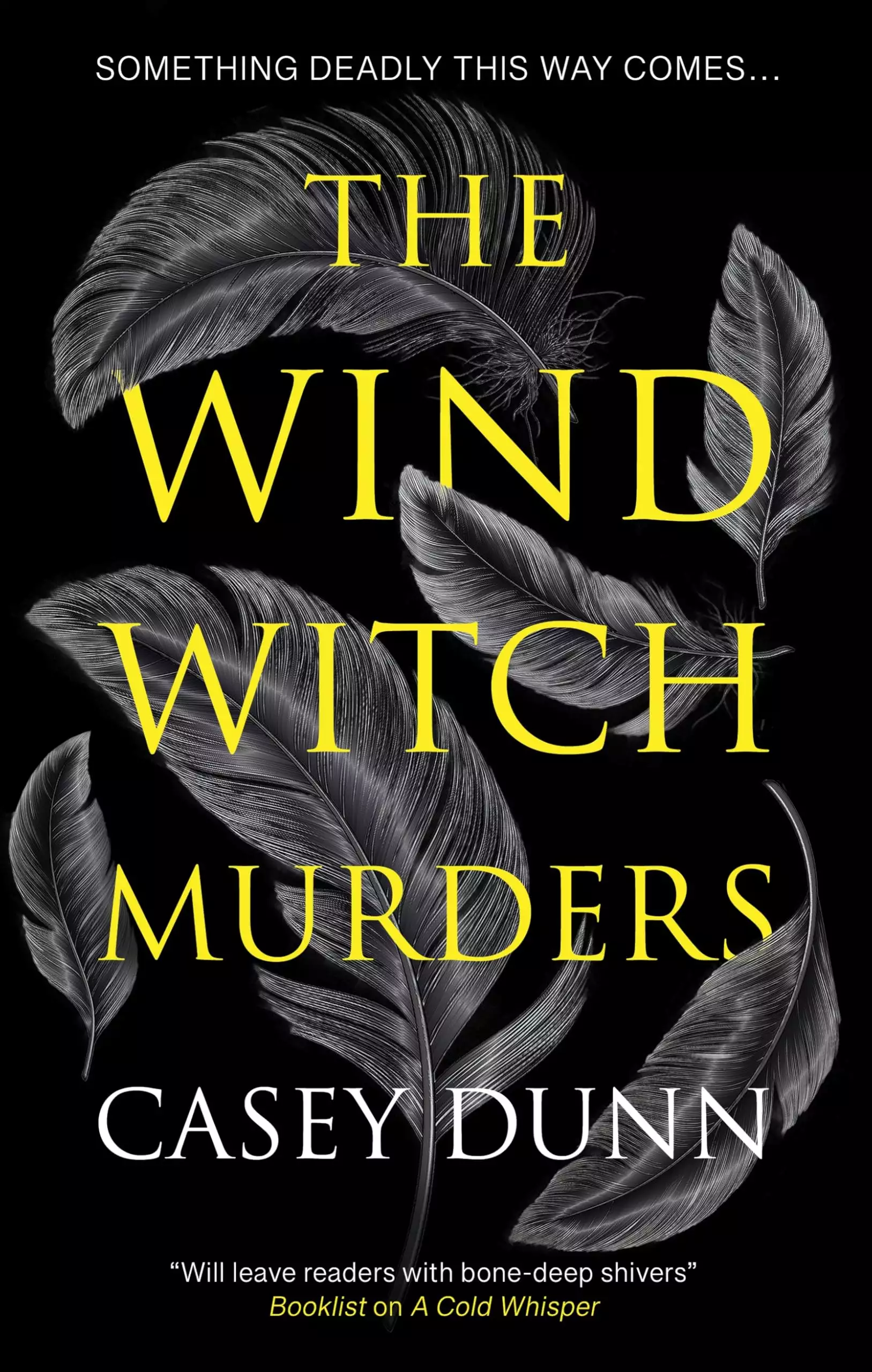
The Wind Witch Murders
- eBook
- Hardcover
- Book info
- Sample
- Media
- Author updates
- Lists
Synopsis
A haunting Southern Gothic mystery where dark magic meets deadly secrets, and a daughter must uncover the truth about her mother before it's too late.
Arkansas, 1999. Eighteen-year-old Raven Moore has spent her entire life trying to outrun her mother's dark reputation. Twelve years ago, two bodies were found burned in a field at the base of the Hill, and Raven's mother, Deanne—the woman they called the Wind Witch—was convicted of their murders.
Three days ago, Deanne died in an asylum, without ever speaking a word in her own defense.
Then, at the funeral, a stranger appears with a red feather in his hand. He knows things about Raven's mother that no one in Silverfield will speak aloud. Things about the Hill People—a community rumored to practice witchcraft who vanished the day Deanne was locked away.
Things about the wind, and blood, and the gift that runs in Raven's veins...whether she believes in it or not.
Raised by her fiercely religious grandmother to fear everything her mother represented, Raven's life has been built on secrets and doubt. But when the past reaches out to claim her, she must choose: remain in the world that has always feared her, or step into the legacy her mother left behind.
Because the wind remembers what everyone else has forgotten. And some murders were never what they seemed...
A captivatingly dark, unsettling novel of secrets, lies, superstition, and murder, for fans of Tana French and Rebecca James.
Release date: January 6, 2026
Publisher: Severn House
Print pages: 300
* BingeBooks earns revenue from qualifying purchases as an Amazon Associate as well as from other retail partners.
Reader buzz
 Please log in to recommend or discuss...
Author updates
The Wind Witch Murders
Casey Dunn
ONE
Arkansas, 1999
Momma believed in the wind. Said that when it howled in a pitch that made the hair on your neck stand up and your heart beat a touch faster, it was pushing you toward the path you were meant to walk. Truth be told, I think she got that part backward. A meant-to-be path shouldn’t lead to a grave. Then again, to be fair, all paths do.
The end of Momma’s path is a rectangle hole dug in the earth and a plain wood coffin. Standing above it, I wonder at what point a mother’s path and a daughter’s path first begin to split. If maybe ours went two ways sooner than most. And if she had been afforded a little more time, those roads would’ve ever found their way back together.
Would I wish for that, given the chance? I’d like to think clarity comes in moments like these, but in the matter of Momma, my mind is still as muddy as the bottom of her grave.
My grandmother says Momma never intended to name me Raven. The way she tells it, when I was born with a mess of coal-black hair and eyes a shade darker, my mother could say no other name. All that baby hair fell out a few months later and was replaced with fuzz the color of a new penny, and my eyes have since turned gray as smoke.
I ain’t ever seen red feathers or gray eyes on a raven, but Momma was known to say that sometimes a past life clings on to its new body when it’s brought unfinished business along for the ride, which is why a person’s colors change so much those first few years of life. I just thank the good Lord in heaven that the woman didn’t go and name me Crow or Onyx or Midnight. Really and truly, I should count my blessings. It’d be less work than counting superstitions around here.
On the other side of my momma’s grave, the preacher cracks a Bible and raises his hand. As if summoning a squall, a straight-line wind comes out of the east and rips the pastel carnations right off Momma’s coffin lid before hurling them toward the barrel-shaped public trash can forty feet from where we stand. I do my best to convince myself that the moment belongs purely to weather and physics and is certainly not my dead mother expressing an opinion from beyond the grave.
It’s a losing fight.
“We couldn’t afford any better, Momma,” I mumble, just in case she’s listening. Then I lift my eyes to their corners and peer at my grandmother, rigid under her starched dress. “And you know how Grandma is.”
When we’d stopped by the Silverfield corner store to pick up flowers, I had beelined to a plastic pot of calla lilies, Momma’s favorite. It’s one of the few benign facts about her that I keep tucked in the early childhood pocket of my memory. Grandma had swatted my hand away from them and snatched up a bundle of carnations instead. She’d said there was no reason to waste what we got left on something that’s already gone, especially when whatever we bought was going to turn brown anyhow. She’d already spent hard-earned money on the new shoes presently rubbing blisters on my heels. Plus, calla lilies look like lady parts, she’d muttered as she’d plucked money from her tired bra, the fold of bills made damp and dark with sweat. And that was the end of that.
The preacher snaps the Bible shut, then drones the opening words of a prayer. Everyone bows their heads and closes their eyes. My eyes remain blasphemously open, staring out across the field of the dead. What sense does it make to fill this pretty stretch of ground with bones beneath stubby grass? Especially Momma’s. Another body hidden deep in the earth that neither the town, which petitioned that her grave be dug twice as deep, nor Momma’s last wishes, which she’d allegedly written on a napkin and given to a nurse, claim to want.
napkin note had said.
Between the choice of flowers, the traditional grave, and the Bible verses being read aloud over her dead body, it’s a wonder Momma isn’t knocking on her coffin lid, brought back to life by the sheer indignation of it all.
I guess murderers can’t be choosers.
A man steps out of a patch of trees at the center of the cemetery, his form peeling out of the shade like a shadow come to life. The preacher prattles on, but my stare hooks on the man, who gains the clarity of shape and color as he nears. His shiny shoes catch the high-noon light, and his gleaming toes are pointing straight for me.
Every hair on my scalp leans in his direction. Aside from Grandma, the preacher, and myself, only this ill-tempered weather and the sheriff have come today to pay their graveside respects. I would’ve sworn Ruby Jane Richard had been standing at the top of the hill in a white dress when we’d first arrived, but my eyes must’ve been playing tricks. The most terrifying senior girl at Silverfield High School has never worn white a day in her life, and she certainly isn’t here for me.
Grandma had minced no words when she’d declared Momma’s funeral a private affair. Her lady friends from church all know better than to think they’re an exception, and Momma hasn’t known a friendly face in Silverfield since she was locked away. The Hill People who had once claimed my momma and her alleged powers as their own had left her to rot in the asylum without so much as a single public call for her release or testament to her innocence in the last twelve years, which all but solidified for the more civilized townsfolk that she was undoubtedly guilty. Grandma would point out each time we visited the institution that Momma was alone. How we’d never have to wait for another visitor to leave before going back. How her room was sterile of any sign that someone else cared. How if the Hill People had snuck in, they’d have left stains of their telltale dirt behind on the floor, no matter how hard the janitors could scrub.
This man is dressed too sharp and nice to have come off The Hill, or at least as far as my imagination can conjure. I’ve never encountered a Hill person that I can remember—only heard about them. From what I have gathered, their way of life can be unceremoniously summed up with one word: dirt. They prefer to sleep in it, pee in it, make witching symbols with sticks in it by the light of the moon, fling a handful of it into every storm, bleed every bird they can catch in a pool of mud, then make a tea out of that blood-soaked earth on the first day of spring for their pregnant women to drink. That is, if you believe everything people say about them down to the letter.
They’re also long since gone.
Twelve years ago, my momma took the blame for two bodies found where the trees give way to a big open field on the south side of The Hill. Twenty-four hours later, according to Grandma, every uniform in the county went up that hill with guns and dogs and bulldozers and took everything from the Hill People. If there’s truth to it, I had always figured it was a decent reason none of them came to visit Momma or demand she be set free. But nobody ever asks me. They just tell.
My attention moves up from the fancy man’s shoes to the long red feather spinning in his fingers at his thigh. He is a walking contradiction. An argument with two feet. I am sure I’ve never met him. Never even seen him. And I am equally sure his pale, smooth hands have never been stained with earth, can’t imagine him sleeping curled like an infant on the ground. But if he’s come to a funeral for Deanne Moore with a feather in his hand, he knows my momma. Knows her well.
Finally, the preacher quits making excuses to God on Momma’s behalf. I shut my eyes and wait a respectable beat before I reopen them. Not even a full second has passed, but inside that speck of time, the lanky, pale, peculiar man has reached the head of Momma’s casket, and every inch of Grandma has gone remarkably stiffer. Anger has taken to the loose folds of her face like a cheap taxidermist, tucking them between her teeth, gathering them in a pucker at the center of her lips.
“I’m sorry for your loss,” the man says. His angular chin juts in Grandma’s direction, but his bright gray eyes are fast on me.
“I lost my girl a long time ago,” Grandma responds.
“You made sure of that.”
“I wasn’t talking to you.” He keeps his stare on my face and presses the feather to the coffin lid with a single finger. Wind screams through our small group, pushing hard enough to force a ripple in Grandma’s starched dress. That feather doesn’t scoot a damn inch.
Grandma folds her arms. “I think you best be on your way.”
“I’ve seen all I came to see.” His gaze doesn’t waver off my face, and that feather stays just as committed to where he’s set it on the lid. He backs three steps up before turning on his heel, then he walks away. Curiosity produces her claws and scurries through me like a cat up a tree. I can’t stop watching after him, every inch of my skin raw and stinging as if my interest in his presence has already left marks. I can’t help thinking he didn’t come here for my momma or grandma. That he came for me. And the notion feels like a truth and a sin in equal parts.
The man veers off to the right. Wherever he’d come from through the thicket of trees at the center of the graveyard isn’t where he’s going back to. I am reminded of what Momma was known to say about spiritual journeys: you shouldn’t ever go back out the way you came in, or you didn’t actually go anywhere at all. And Momma was a loon. I bite down hard on my lip as the thought passes through me and spreads its empty dark.
“Who is that, Grandma?” I whisper.
“The only thing you need to know about that man is that he is all that went wrong with your momma,” she replies. Then, in silence, we watch him fade back into a shadow on the lawn.
The moment Grandma looks away, his form stops mid-stride. I don’t know what strikes me more—that his shape is already something I find familiar, or that, even with his back turned and from a distance, he seems to have a sense of when Grandma’s attention has left him. In the sweat-slick inners of my new shoes, my feet itch with the want to follow him.
A gust of air drops out of the sky like a missile. Part of Momma’s last words to me, which she’d scrawled with a silver crayon on a napkin and handed to me three days before she died, blow through me now: You’re not
safe here anymore.
With you dead and gone, the whole town is safer, Momma, I answer her in my mind. It’s a sentiment everyone in Silverfield seems to agree upon, yet I can’t make myself say it out loud. I steal a glimpse of her coffin, then look back to the spot where the man had been, but he’s gone.
Up the hill, a boy from school lurks among a cluster of tombstones, his gaze cast down to where we stand. It’s Acer Ackerman. He and I share two similarities: we are both seniors at Silverfield High School, and we both carry unearned reputations—mine for being a witch’s daughter, and his for being a good, God-fearing young man. He may have led the baseball team to a championship title and won first place at the high school state meet for cross country last year, but he’ll shove a shrimpy kid in a locker just as fast as he’ll force his hands up a girl’s shirt. He puts on a good show whenever a member of the congregation is present to bear witness, I’ll give him that. But I’m not sure he needs to try that hard. Any accusation made against him seems to be forgiven each time he steps up to the plate with a bat in his gloved hands, a twinkle in his blue eyes, and an all-American dimple in his left cheek.
The first symbolic shovelful of dirt drops from the blade at the end of the shovel in the sheriff’s hands and clatters down onto Momma’s coffin, making me jump. I knock into Grandma, and without so much as throwing a glance at me, she snatches my hand, then begins towing me toward the car.
“No sense in lingering,” she says. “We need to spend a good bit of time at the church the next few days to set up for the spring festival. That’s the perfect place for you to be. Let the Lord and His people keep you and guide you,” she finishes with a curt nod like she’s out to convince us both.
I peek over my shoulder up the hill, where Acer is still standing, his stare on me as cold and sharp as a knife.
I was wrong before, Momma. With you dead and gone, everyone in this town is safer except me. Chapter Two
Grandma stares through the windshield at the cemetery’s exit, which looms ahead. I want to ask her to wait. To turn around. To go back to the grave. Even just for a moment.
As if sensing my thoughts, she accelerates beneath the metal archway and turns onto the main road without so much as glancing for traffic before merging. I brace myself against the door, but my eyes hold steady on the side mirror, where I watch the reflection of a tractor backfilling earth over my mother until it slides from view. It is strange to reckon with the truth that I am from her, but I have never been sure that I know her, and now I never will.
I only know that she met my father right out of high school and that he could allegedly charm the pants off a stone statue, according to my grandma. Disturbing though that may be, it still seems a less formidable task than turning my momma against my grandma and into another rabble-rouser that lived on The Hill, where they made snake oil out of birds’ blood and sent Momma to town to sell it as tonics and cures to weak-minded, desperate women in town by day, and spent their nights wrecking the steel mill until their dabbling in devil worshipping imbued her with power no one would’ve believed had they not seen it with their own eyes.
But that’s what happened.
What people have come to call the Wind Witch Murders occurred on a Tuesday in August. Our northwest corner of Arkansas hadn’t seen rain in more than a month. I was six years old, and the only soon-to-be kindergartner who would see a seventh birthday during the coming school year, my mother at last conceding to Grandma’s definition of an education once it became a provision of our ability to move back in with her after my father died when his car ran off the road in a storm on a trip out of state.
“You’ll have to go to regular school during the week. She’ll take you to church on Sundays and Wednesdays, too. But it’s not so bad. And we’ll go to the woods every weekend. Just you and me,” my mother had whispered in my ear that morning as she stood beside me, making tiny braids in my red hair. “You’re old enough now for me to teach you the real things you need to know.”
I’d peered in the mirror at the reflection of her oversized patchwork satchel where it sat by the door, slouched open at the top. One side bore a worn oval spot where it had brushed the curve of her hip like a contented child as she’d carried it up and down her gathering trails. When I’d looked back up to find her reflection, I’d caught her crying silent tears.
Even then, small as I was, I had a sense of knowing that unsaid things were swelling inside my mother, so big they threatened her very seams, and that while she could feel the pain, she could not find the words. Perhaps she somehow knew that once she had no more hair of mine left to braid, once she walked out the door of Grandma’s house that morning, she would never come back.
Some nights when I can’t sleep, I still lie awake and watch the memory of her leaving on my bedroom ceiling like a silent movie screen, and I wonder if there was any way she could have known that I’d lose all my other memories of her and my father that day, too? How she would leave me with no pictures of our past or her voice for my future? That come sunset, I would, for all intents and purposes, be an orphan?
Five hours after my mother left Grandma’s house, I’d been sitting cross-legged on the kitchen floor shelling peas into a bowl, the bare skin on my thighs sticking to the floor in an adhesive of sweat. Grandma had been standing in front of a box fan that she’d propped up on the narrow laminate counter, wet spots creeping out from beneath the armpits of her white blouse. She’d opened every door and window in search of a breeze, but the air outside had
been just as still and hot.
“Don’t God care enough about Arkansas to even spit on us?” she’d grumbled, then mopped the back of her neck with a dish-rag before bowing her head to pray for what must’ve been the tenth time that day.
I can remember that last quiet moment with uncomfortable clarity. The sensation of being baked. The whir of the fan blades. The scents of baby powder and damp cotton. The itch of perspiration escaping my scalp and sliding down my neck. I’d scrunched my face and swatted at the tickle. Before my hand had made it back to the bowl of peas, a wind had picked up in a sudden swell, as if God himself had drawn a breath so deep every living creature had no choice but to lean. A gust of air had swept through the kitchen and slapped the back of the shotgun house with an open hand. The back door, which had been propped with a broom handle, had slammed shut, and the short lace curtains that dressed the top of every open windowpane had taken violent flight. A shock of rain had fallen for three deafening seconds, pouring in a uniform burst like the rat-a-tat-tat of a thousand sticks against a snare drum. Then the wind had returned in a howl down our street, windchimes clanging in a violent symphony, dogs answering Mother Nature from every backyard.
I’d turned to smile at Grandma, sure that God had heard her prayers and had brought relief right to her doorstep, and that maybe she’d finally be happy about something. But she had been clutching at the loose skin on her chest, eyes hunting a view through the top of every window. I’d followed her stare out the back. The sky above had become muddy, a swirl of something between orange and green, and thick as stew. Storm sirens had joined nature’s hellish chorus until its rhythmic bleats were swallowed by a screaming wind. Then the murk had opened, and within a blink, the yard had turned white beneath an assault of hail.
“Get to the cellar,” Grandma had ordered.
“What about Momma?”
“If this storm’s a work of the devil, she’ll be out dancing in the rain. If it ain’t, she’s still covered in my prayers, whether she wants them or not,” Grandma had said in haste, then she’d practically shoved me down the plank stairs
to the cellar below.
Those nineteen minutes we spent beneath the house felt like an entire day, a year, a lifetime. When at last we’d climbed back up those stairs, I’d thought the wailing and screaming and sirens would be over. But they had just begun.
Folks who’d watched the storm from their front porches instead of hiding in their basements had caught sight of a towering fire whirl at the southern edge of town. Volunteer firefighters had chased the smoke and discovered flames rolling across an open field of drought-thirsty, hip-high grass at the base of The Hill. Near a patch of blackened trees, a ramshackle hut erected from pallets and scrap plywood had been reduced to a pile of char and ash. Lying naked and unconscious a stone’s throw down The Hill from the shed’s smoldering stoop was my mother.
Those first responders had initially treated her with care. Even though she’d once been a member of the Hill People, she’d come home. Repented. She was still Ethel Moore’s daughter, after all, whose prayers for others were answered so often and so vividly, people began speaking their wants into her ears like she was a payphone with a line straight to God. Grandma wasn’t someone whose faith you’d want to lose for nothing.
The firefighters had covered her with one of their own coats before checking her vitals. Upon closer inspection, they’d discovered the smudges on her forehead and chest weren’t signs of injury but symbols finger-painted on her skin with blood. In her patchwork satchel, they’d found sage, matches, baling twine, hydrogen peroxide, a dagger, and a bottle of ferrocyanide. Then, from beneath the smoking door to the old shack, they’d spied the blackened fingertips of a human hand, and in an instant, the fact that she wasn’t burned to a similar crisp went from miraculous protection to damning suspicion. Instead of administering further care to my mother, they’d tied her wrists together for their own safety, busted down the door to the sight of two dead boys, and phoned the sheriff.
In the days after the storm, some people had speculated that the tornado had swept up my mother yet had no choice but to toss her back when neither God nor the devil would take her. By week’s end, half the town was convinced that she could bewitch the wind to do her bidding and had conjured a breath inside her
own dead lungs to live again. Other people urged her to speak up for herself, to give people the peace and answers and names for these young bodies burned and mangled beyond recognition.
God forgives, they’d said. But people don’t. Folks in town don’t even call her by her name anymore. Used to be, they’d at least refer to her as Ethel’s girl. But after the fire, Momma’s name from her time on The Hill rode out of those woods and became a fixture here like a bur on a sock that won’t come loose no matter how many times you wash. And in the town it had a murderous ring to it.
The Wind Witch.
At the time of my mother’s death three days ago, she hadn’t spoken a word since I’d watched her face in the mirror that morning she’d told me she’d teach me everything I ever needed to know. At least not to me or Grandma or anyone willing to admit it. Adding insult to injury, I can’t remember a moment of my life prior to that final conversation we had while she braided my hair, and either no one is entirely sure how she died or they’re just sure I’d be better off not knowing. I just wish they’d have considered the inevitability of rumors.
Only in the last year of her life had Momma made any effort to communicate with me at all, albeit in as unceremonious a way as you can get. Her first words arrived on my eighteenth birthday, which she snuck to me on a paper napkin when Grandma wasn’t looking. For the first eleven years of her incarceration, my birthday was one of the only two days a year Grandma would drive me the forty-five minutes out of town to see her. The other day was my momma’s birthday, exactly six months after mine. This past year, for no reason that I can figure, we’d gone four times. Three months apart to the day. Whenever I’ve asked Grandma why, she just says: Because it’s what you want. I never did have heart enough to tell her that I wasn’t so sure about that anymore.
When I was little, more time by Momma’s silent side was all I’d wanted. I’d begged and bargained, thrown all holy fits that had earned me afternoons spent locked in my room. Eventually, I’d learned it was better to keep any wishing to myself, and opted to make countdown calendars in secret, which kept track of the time between visits. Each morning, I would wake up, steal beneath my bed
before my eyes were fully open and focusing, slide the piece of paper from the slat where I kept it folded and tucked, then cross off the new day before actually beginning it. There’s a metaphor there somewhere, I’m sure. But I’d rather not look too hard for its defining edges.
I imagine my younger self would be sorely disappointed to learn that the more frequent the visitations became, the harder they were to endure and the less I wanted to go. Perhaps it was the fact that once she’d decided to finally communicate with me, her messages seemed to have little meaning and were limited to how many words she could fit with a crayon on a square paper napkin since the folks at the institution didn’t have to worry about her using either as a weapon.
The first message she wrote me on my eighteenth birthday simply said: Hello. Happy birthday. Take this out with you. Then throw it away.
A better daughter than me might’ve been overjoyed. My mother can write! It’s an answered prayer! But nothing else about her had changed, and all I could think was: You’ve been in there the whole time?
I’d left that day with that napkin stuffed in my pocket and more fury in my heart than I knew a throbbing twist of muscle could hold. I didn’t show Grandma the note, but I didn’t throw it away either. It’s still tucked between my mattress and the bedframe in a sandwich bag, along with the other three notes from the past year and the last one warning me of my safety.
Hello. Happy birthday. Take this out with you. Then throw it away.
Hello. Why are you here today? Take this out with you. Then throw it away.
Hello. Stay in her house or go far from here. Take this out with you. Then throw it away.
Hello. I don’t feel well. Stay away. Take this out with you. Then throw it away.
You’re not safe here anymore. Take this out with you. Then throw it away.
I glance at Grandma, who hasn’t made a peep since we left the cemetery. If she’s ever found the notes or noticed Momma pass them to me,
she’s never made any mention of it. But she can be curious when it comes to how she reacts to things. She’d seemed more upset by that strange man’s arrival than the fact that she was there to bury her only child. Here and now, she’s damn near strangling the steering wheel. Her veiny throat flushes with heat even though she’s turned the air conditioning on as cold and forceful as it will go, and I am sitting on my hands to keep them warm.
We pull up to our house. The questions stacking in my mind are far less tidy than the casserole dishes lining the front porch, its bare-wood surface made bone-gray from weather and time. Grandma had let it be known to anyone who would listen that we wouldn’t be entertaining visitors today, but people in this town don’t know how to cope with death if not for cooking. Busy hands make for quiet minds. Chewing food takes the place of not knowing what to say.
While we have more food on our porch than most restaurants in town, no one has left even a single flower. I don’t know why I expected that there might be at least one, maybe hoped for it, if I’m being honest. A token for today that I could let dry in the sun and press between pages, then pull out and touch when I want to remember, if ever I do. But flowers are in remembrance of the dead, and food is for the living left behind. I would doubt anyone in this town would be willing to offer a form of connection between themselves and Momma. No one except that man who left the feather. I wish I had snatched it when no one was looking, hidden it up my scratchy sleeve.
“Take these casseroles to the kitchen, will you?” Grandma asks. She opens the door for me as I collect the dishes. Once everything is inside, she latches the screen, then locks both deadbolts on the front door. She’s never locked our door during the day before. God protects this house better than a little metal bolt ever could, she likes to say. Then again, I think most of us are more comfortable believing that trouble doesn’t walk right through the front door in the middle of the day. We like to think it has to sneak in. That it needs the dark.
“We don’t need anybody’s curiosities in here,” Grandma says, catching me eyeing the lock. “Anyone who knows us and what Deanne has put us through also knows well enough to leave us alone today. And anybody else
will get the message.”
“Who was that man, Grandma? That man with the feather? Was he from The Hill?” I blurt, every inch of me itching with a new appreciation for why people busy themselves in the kitchen on days like this one.
Her breath leaves her like she’s been stuck deep in the side and it’s leaking out all the wrong places. “He was The Hill,” she says. “Without him, that land was just another rise in the earth.”
“And he knew Momma?” I whisper, my voice six years old in my ears.
“I need to lie down for a spell,” Grandma replies as if she hasn’t heard me. “Don’t let anyone in, and don’t turn on the lights. People will take any sign of life as an invitation.” Then she starts pulling the curtains together to cover the windows striping the front room of our house.
Every room in our house is white except this one. The day after the storm, Grandma painted the walls of our front room as red as the pure blood of Jesus Christ—which is exactly how she describes the shock of color at the first hint of a new visitor’s disapproval. To further her point, she’s hung a four-foot-tall brass crucifix on the back wall right above the fireplace. In the summer, humidity gathers in beads on the red paint and, once heavy enough, runs down the wall in tiny, bloody rivers. The first time I saw it happen, I dropped my cup of milk and bolted out the front door. It took Grandma nearly two hours to find me hiding in the patch of woods at the end of our road. Now, I’ve learned to keep a dry dishrag in the bucket with the fire poker so I can wipe the sweat from the walls before mold sprouts along the baseboards.
Grandma tugs the last curtain across the farthest pane of glass, shutting out the light. “That’s about all I can do. Once you get the casseroles put up, cover the windows in the rest of the house before you do anything else.”
“Yes, ma’am.”
“And, Raven, curiosity is no one’s friend,” Grandma adds, then she turns away from me and shuffles to her room, closing her bedroom door.
Through the wall, I can hear the metal frame of her high bed protest her company. I can’t help feeling a little jealous. If only I knew
how to speak up as loud and bold as those springs when the weight of her presence becomes too much to bear.
I leave a sigh and my shoes where I stand before making my way to the kitchen, where I’ve lined up the casseroles on the counter. They are all the same idea: a choice starch or canned vegetable swimming in a white cream sauce and topped with cornflakes or crumbled crackers. There’s no doubt they’ve been prayed over, too. I do my best not to think of the spittle that may have dried to their tops, crystalized like extra salt. I pick two of Grandma’s favorites and store them in the refrigerator for easy access. Then I move the rest to the deep freezer in the cellar.
Grandma hasn’t been down below the house since the nineteen minutes we spent huddled on the earthen floor all those years ago, blaming her reluctance on a poor relationship between the steep nature of the stairs and the age of her knees. I would guess the truth is more that she came out of that cellar a little different than she went in. The world we returned to that afternoon was certainly not how she’d left it.
I lost my fear of this space once I was too old to worry that a monster might be lurking in its dank, shadowed corners or behind a piece of dust-coated furniture. The smell down here has never changed—a damp, earthy scent of a permanent chill. Today, though, it reminds me of a freshly dug grave, and I race the sound of my own footsteps back up the wood plank stairs.
When I come back up, I move from window to window, shutting the world out and us in. I am not physically alone in this house, but I feel the ache of it all the same.
I tiptoe past my grandmother’s door to my room, where the last window remains uncovered. I don’t know why Grandma bothered to hang a floral valance and a red curtain in here. The glass is frosted, making it a chore to see out and damn near impossible to look in.
My twin bed is nestled deep into the close corner and is topped with one pillow and a white blanket. The floral-print bed skirt matches the valance and conceals the bed’s chipping legs and the pile of candy wrappers ever growing underneath. A high, narrow bedside table stands too tall next to the head of my bed. I’ve rolled into its corner in my sleep more times than I care to count. But every time
I move it, Grandma moves it back. A basic desk is positioned to face the foot of the bed, which is problematic when I’m doing homework at night and can look up and spy where I would much rather be.
On the opposite wall, a wooden three-drawer dresser stands next to a narrow door that leads to the world’s smallest closet. As I gently pull my door shut, I entertain the thought that maybe I’ll leave this one last curtain open for just a little while.
I turn around, feeling like I’m courting trouble, and in the backlit square of frosted glass, a face stares back at me. ...
We hope you are enjoying the book so far. To continue reading...
