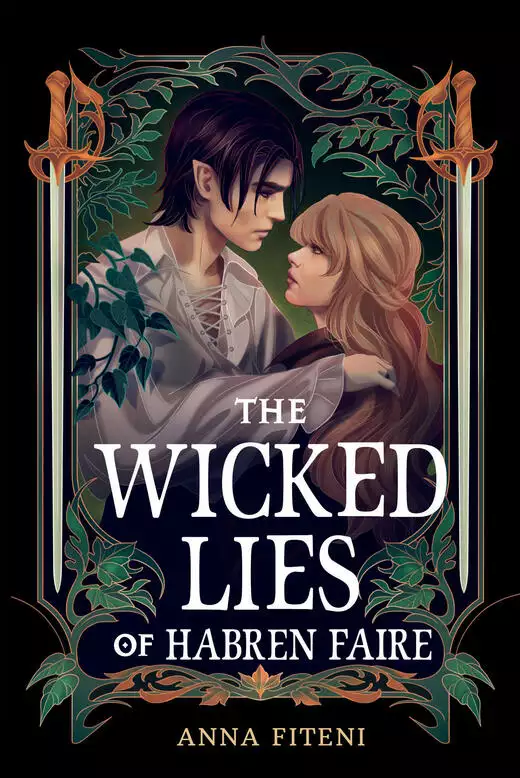
An enchanting romantasy debut about a girl who must strike a dangerous bargain with a prince of fairy in order to find her missing sister, perfect for fans of Margaret Rogerson and Lexi Ryan
For Sabrina Parry, the world of her small, Welsh mining town is cruel and practical. Her main aims in life are to hold onto her job, hold her tongue, and marry off her pretty, but sickly sister Ceridwen to a man rich enough to look after her.
When Ceridwen vanishes into the woods leaving only an iron ring behind, it’s up to Sabrina to find her by venturing into Eu Gwald—fairyland.
Sabrina quickly realizes fairyland is far more dangerous than she ever expected. So when a fae prince who considers himself a scholar of all things human offers her a dangerous deal, Sabrina is forced to accept. The prince is charming, and more interested in Sabrina than she is willing to believe. But as always with fairy bargains, there is a cost.
And if this bargain doesn’t cost Sabrina her life, it will certainly cost her heart.
Release date:
October 21, 2025
Publisher:
Little, Brown Books for Young Readers
Print pages:
272
* BingeBooks earns revenue from qualifying purchases as an Amazon Associate as well as from other retail partners.
A great many people have come to see whether my father will swing. So many that I am crushed at the back of the court, craning my neck over hats and bald heads for one glimpse of him up in the dock.
He doesn’t look back.
Father’s spine is straight as the railway tracks he was once paid shillings to lay. His cap is in his hands and his blond hair hasn’t been washed in days. We’ve traveled from our small town to Cardiff, and though it’s a grim occasion Gran insisted we dress well, but we still look shabby She’s clad in black bombazine. A mourning dress—made when her sister went missing, updated when their parents died of grief and rebirthed once more when her awful husband left without warning. I doubt she will ever wear color again.
The judge thwacks his gavel, beady eyes tracking over the chattering, shuffling crowd.
The standing room shifts its weight to a different foot. A hush washes over us like a rain shower. Only Gran’s clammy hand in mine keeps me from rushing forward.
“Hold your tongue, Sabrina,” she had said that morning. “I’ll not have you in trouble, too.”
I bite down on the urge to shout, to move, but it isn’t enough. A twitch seizes me and I shiver, though the room is hot as an oven. Gran’s hand tightens on mine, eyes trained on Dad as well. Ceridwen’s are downcast. I don’t blame her. Perhaps she doesn’t want to know what fear does to his features. We’ve never seen that before.
“David Parry, on the charge of assault, this court finds you guilty,” says the judge.
The crowd lurches forward, while Gran drags me back. Father is lost, his face eaten whole by the mob—I’ll not know what terror looks like on him, either. I’m grateful for that.
“On the charge of rioting, we find you guilty,” the judge continues. “On the charge of inciting civil unrest, we find you guilty. On the charge of destruction of property, we find you guilty. On the charge of arson, we find you guilty.”
They rattle off the list of crimes leveled against Father and the other rioters. I don’t blame Father for attacking the tollhouse. I’d have done the same. Protests against increased taxation have racked Wales for years, organized by men dressed as the biblical heroine Rebecca. It’s no surprise Father and men from all over the valley joined them these last few months, after they’d been bled dry by tolls, taxes and famine prices. It only got worse when the local mine exploded and trapped thirty men beneath the rubble. The English owners, the Branshaws, won’t waste the money to retrieve the bodies that lie entombed in coal. The coal that was more valuable than the men could ever be.
“You are sentenced to ten years’ transportation.”
I don’t imagine the groan of disappointment that echoes through the crowd. My heart drops to the floor. Two men have been sentenced to hang already today for setting fire to the Llanadwen tollhouse. The punishment does not fit the crime, but it seldom ever does. No doubt the assembly hungers for the blood of the third—of the leader. Even I expected Father to swing, but since they can’t lay any of the deaths at his door, I suppose they’ve gone for the next best thing. Transportation is a living death, but the crowd won’t get to watch.
“Thank God,” Gran says under her breath.
Ceridwen opens her mouth and her eyes roll back. The next moment she’s on the floor.
“I knew we ought not have brought her,” Gran says quietly as I pace.
Ceridwen sits at Gran’s side. Two men kneel at her feet, basking in her attention. One is a young clerk, the other a doctor from the crowd who volunteered his services. Her cheeks are in high color, and though she nods and smiles while they fuss, her eyes dart to me. She’s embarrassed, but it would be rude to dismiss them. Ceridwen can’t stand being rude.
“I wanted to see Dad,” Ceridwen says, half to Gran, half to her attendants. Her eyes are wet as she tries to keep herself upright, her bonnet slouching low over her mass of red curls. “I’m well, really.”
I can only snort. Ceridwen has not been well since our mother died last year, when they both caught the same illness and Mam went first, leaving Ceridwen lingering in a sickness that never seems to end.
“How terrible this must be for you,” the young clerk says.
No one has said anything like that to me, or to Gran. I’m too plain and Gran’s too old for men to care, but Ceridwen has a natural light that brings even the most jaded moths fluttering to her side.
I catch Gran’s eye.
She’s always watching me in moments like this—when I become little more than Ceridwen’s shadow. Gran gives me a small, sympathetic smile that I force myself to return.
“Dwi’n gwybod sut mae’n teimlo i gael dy anwybyddu,” says Gran. “Paid â’i gymryd at dy galon.”
I know how it is to be overlooked. Don’t take it to heart.
It pierces my chest, but I keep my expression blank. “All neb fy anwybyddu. Mae fy llais yn rhy uchel.” No one can overlook me. I’m far too loud.
Gran tuts at the obvious lie and crosses her arms, looking away from me.
The doctor watches us warily.
“English,” he says curtly. Welsh isn’t taught in schools; it was barred by Westminster long ago. He must be from the city, so he never had a chance to learn.
“Sorry, sir,” I reply flatly. “We were only discussing whether we’ll make our train.”
His bottom lip curls down. “Your sister is very ill and you fret over your train?”
“She’s only being practical,” Ceridwen says quickly. “This is our first time in Cardiff—first time taking a train! We’ve come a long way for our father.” She looks to the clerk with purpose, her brows pulling taut. “Sir, do you know how much longer he will be?”
The doctor straightens, encouraging the clerk to follow. “The young lady ought not to be kept waiting; go see what’s taking them so long.”
The clerk nods, near tripping over his own feet to help Ceridwen. She smiles beatifically before turning the expression on the doctor, set to dazzle him next.
“It’s heartbreaking to see the havoc consumption can wreak on even the sweetest creatures.” He pats Ceridwen’s hand.
I sit up straighter, latching on to the note of mourning in his voice. “Please, sir”—I lay on my accent thick and heavy, trying to sound far stupider than I am—“we haven’t a doctor in our village, and no medicine…” I trail off, forcing myself to sigh. “Certainly none we can afford, anyway. If you could—”
Ceridwen seizes my arm. “Sabrina! We can’t ask the nice man for such an extravagance.”
I believe her until our eyes meet. My sister can lie as well as me when she needs to.
“It’s all right, miss,” the doctor says gently to Ceridwen. “My practice isn’t far. If you wait here, I’ll return with some medicine to aid your journey home.”
He too bows and retreats. We hold our poses until he’s gone, then Ceridwen turns to face me, letting out a deeply held breath. We can be quite the team. Ceridwen has always been dazzling; not just in her beauty, but in her capacity for warmth, too. Even the rosy flush of her sickness can’t dampen that. And I know how to use her to her full potential. But the exhaustion shows once her audience is gone.
“Free medicine, another blessing to count,” Gran says, but her bloodshot, clouded eyes are dull. “And we’ll get you back to bed soon.”
“It’s only ten years,” Ceridwen agrees, ever the optimist. “Australia isn’t so bad as it used to be.”
“They have spiders as big as your hand. Bigger, even,” I tell her.
“You made that up.”
“If I wanted to make something up, I would, and it would be far more interesting than large spiders. Everyone knows. It’s in books. Just like everyone knows the sun there is burning and the work never-ending.”
Ceridwen’s nostrils flare. “Must you be so miserable?”
“I’m telling the truth.”
“For once.”
“Enough bickering.” Gran points to the empty seat beside her and stares at me expectantly.
I join them, hitching up my mass of skirts as I sit. I try to emulate Ceridwen’s elegant posture with little success.
Gran takes my hand. She squeezes once, a surprising amount of strength left in her gnarled fingers, then releases me.
“I’m sorry,” Ceridwen says after a moment of silence. “Duw, I’m so tired.”
I swallow and nod. “We all are.”
As I settle, the door to the cells opens. I lurch up, only just remembering to offer my hands to Ceridwen and Gran. Their thin, bony fingers wrap around mine as I pull them to their feet.
We hear the rattle of chains before we see him.
Father is a pile of bones with scraps of leftover meat barely clinging on, and his old suit is worn thin at the elbows and cuffs, but his hair, as blond as mine, still glows like a lantern in the gloomy corridor. His hands are unbound—just for this goodbye—and we run to him. He takes his mother in his arms first. Gran wilts into him, then it’s Ceridwen’s turn. He holds them and his words are lost to their hair.
When it’s my turn, his embrace is a rock. I rest against him, feeling for the coal miner, the laborer, the thousand things he has been beneath this new uniform—convict—and find only Dad. He once told me that I was the trunk of the family tree, Gran the branches and Ceridwen the leaves. They rustled and bent in the wind, but not me. Not him. I am the trunk and he the roots.
“Your mam is the soil around us,” he had said then, over candlelight the night before I started working at the shop. “I’ll hold you in place, Sabrina, so you can keep our girls aloft—even in a storm.”
Now, three days into sixteen, I’m to be trunk, root and earth. The only person holding our fractured family together.
In my ear, he says, “You know what you have to do.”
“Keep Ceridwen and Gran safe,” I say. Tears sting my eyes, though I will not let them fall until tonight when I find a moment alone in the pantry. “Work hard, bring money home.”
“Wages from the shop won’t be enough,” he warns me. “You can’t go down the mines; they won’t take girls no more. You’ll need to find work up the big house.”
“Dad!” There’s nothing worse than working for the spoiled aristocrats who are the very reason we are here today.
“We made a promise, didn’t we? Gran is too old to work, Ceridwen too infirm. It falls to us—to you, now.”
I swallow my fury. It tastes metallic.
His arms tighten around me, roots diving deeper. “You forgot one thing, cariad.”
I pull back slightly to meet his eyes, blinking.
His stubbled face softens as he presses a kiss to my forehead.
“You have to stay out of trouble,” he reminds me. “I know it finds you no matter what you do, but you must always be smarter than trouble, Sabrina.”
“I’m smarter than everyone.” I force a grin, but my words ring hollow.
“And don’t we know it. Go on now, my girl. Go on.”
Dad lets me go first and my arms cling to his shoulders. I cannot move them, so Dad does it for me and steps away. The police seize him, and with each step he takes away from us, the ax descends—once, twice, thrice, and our family is severed at the trunk.
The journey back to Llanadwen is disjointed and silent after the doctor returns with medicine. We stumble blindly to Cardiff Taff Vale station. By the time we haul our numb bodies onto the rumbling steam train, we’re all yet to say a word.
It’s the second time I’ve ever ridden a train; the first was this morning. I’ve longed to leave our paltry village since I first saw a map of the world at school and Mrs. Cadwalladr loaned me an encyclopedia to navigate by candlelight, and now I’ve done it. I wish it were under better circumstances, but even as we trundle back to the mines and the sheep of the valleys I cannot help but marvel at it all. At the iron beast we are piled inside, bodies pressed together and rocking with perpetual motion; at the countryside rolling by unstoppably.
“This train could take us anywhere,” I remark to Ceridwen as Gran naps on the bench opposite. “And here we are letting it drag us back to Llanadwen.”
Ceridwen doesn’t look up from her threadbare gloves. “Where else would we go?”
“I already told you. Anywhere.”
Her shoulders shake as if she is laughing, or crying, or both. I cannot tell with Ceridwen these days. The last year has been brutal on us all, but Ceridwen has receded into herself so deep that, even as she sits next to me, I’m not sure if she’s really here. She stares out the window—at the gray clouds gathering ahead and the fat blobs of rain that strike the pane.
“Anywhere is a rather big place,” she says.
The world in maps and encyclopedias can be held in two hands, and yet I still can’t quite grasp it. Not that it matters, not really, when the world passes me by on this train, and I am back in Llanadwen before it even knew I was gone.
No one comes to call on our two-up, two-down terraced house, though it sits squat on the edge of the village. We’re an eyesore now. It was our father who organized the riot, and though plenty of men believed in his cause and helped rally the town, the consequences have been laid at our door.
Night descends. Ceridwen is abed already and Gran dozes by the fire in the next room as I pad barefoot through the kitchen in my nightgown.
Even I think I’m daft as I pour milk into the chipped saucer; just as daft as everyone says. Silly Sabrina, the Mad Parry Girl. I’m Sabrina Parry, and I leave milk out for the fairies though I’m sixteen.
Yes, I know.
We call them the tylwyth teg here.
It means “fair family.” Dad used to tell us stories of them as if they were mad uncles from up the road, and Mam spoke like her dearest friend had been some fairy princess dancing up a mountain. Only Gran doesn’t care for the tales. She’d shush Dad when he started, saying that he’d scare us, though he never did. The teg lived among us, given life by our wagging tongues, but they never cared for their human kin or showed their faces at dinner. And yet, a part of me never stopped hoping they would.
I shoulder the back door open and twitch slightly, sloshing milk over my nightgown sleeve, and curse. That’ll sour to a sad little smell overnight.
The stone of my measly garden is cold against the soles of my feet, and wind whistles down the hill—out of the woods and over our stunted wall to dance with my white nightgown. I shiver and leave the saucer in the same place it has always been, just beside the door. Some mornings I find it empty; more often it’s unchanged.
I don’t think it’s fairies, I promise. I really don’t, but something does crawl out of the trees at night and drink the milk, and I hardly think it’s the neighbors’ boy or the pampered kitten from the big house—do you?
I wrap my arms around myself, staring at the sheets we pegged up yesterday. They’ve been rained on and left flapping like flags of surrender. Beyond them lie the woods.
They’re distant and dark, a vast wall. Stars shine above the tree peaks, brighter there than here, and when the wind that has whipped through the boughs comes to call at my door, it smells like faraway and clean and nowhere at all.
Two forests border my town. One keeps us away from the Branshaws, who live up at the big house and own the town, the mines and the farms and just about everything a person can. The other forest belongs to no one, no matter how hard people like the Branshaws try to claim it, to box it in with railroads and dig it up with mines. People can hunt free and play among the trees, but no one does; the forest has a habit of swallowing people whole and rarely does it spit them back out. No one returns from the woods unless the trees choose to give them up, and there are certainly no corpses to be found.
I’ll give you three guesses as to which forest looks over my house.
“Were you leaving milk for the tylwyth teg?” Ceridwen asks as I enter our room.
“You know I was.”
I retrieve our brush from the cabinet and cross over to our bed, where Ceridwen already sits, blankets bunching about her waist, and hand it to her. She tucks a lock of my hair behind my ear, and I catch a glimpse of a new ring on her finger. It is battered and rather dull, with a blue stone hammered into the center of its gray band. Bitterness coils low in my belly, even as I insist I wouldn’t want a ring like that anyway. Perhaps she has another boy in town making moon eyes at her. If so, she should marry him. Quickly.
Women alone in the world are vulnerable, and there are three of us. I’d have more luck catching fish with my bare hands than a decent husband and besides, I’m the only person in the family who can work. If Ceridwen marries, that’s one less mouth to feed. If she’s really smart about it she might even find a man who can help us. She’s sickly, not dying—it’s never put the boys off, and I certainly don’t care if she passes the disease to her husband. In an ideal world, this man would die before my sister anyway, and we could take his money.
I sit and we move until she is behind me. Ceridwen runs the bristles over my blonde curls, parting the thicket gently. It’s not as vibrant as hers, but it is my one beauty—tended to with the utmost care by my mam and, now, Ceridwen.
“They must be saving up something wonderful for you after all your years of service.” Ceridwen sighs. “I thought I heard a cyhyraeth wailing in the wood the night they came for Dad.”
I shiver at the idea of a cyhyraeth—a hag that shrieks to warn of death—lurking near our house. With our family’s luck a cyhyraeth might as well set up camp in our garden.
“Have you cried yet?” Ceridwen asks when the brush is laid aside.
“No. I don’t want to.”
“Tell me a story,” she says. “One of your fairy tales.”
My hand twitches on the blanket. Sometimes I repeat Dad’s stories like prayers, sometimes I make my own. Ceridwen enjoys both.
I roll my shoulders, turn to face her and fix her with a performer’s smile that I know doesn’t reach my eyes. “Have you heard the tale of the Lady of the Well?”
“Maybe.” She reclines against the pillows. “You tell so many tales. But I’ll hear it again; no one tells a story like you.”
I wonder if she knows why I’m picking this story, if she remembers its moral. As with everything, I’m bringing it up for a reason.
I shuffle down the bed until I’m perched at the end. I rise onto my knees, tossing my hair back like this is a stage and I’m some great actress. Perhaps I am—by Llanadwen’s standards, anyway.
“King Arthur sleeps, but his castle does not,” I begin. “Three knights gather outside his chambers, around a dimming fire, and as the embers burn low and start to die, though their eyelids grow heavy, they know they cannot sleep. They’re on guard after all, and duty remains. So they tell stories. Brave Cynon tells of a castle where a dark warden and twenty-four beautiful women live, half asleep, ever the same as time races on around them. Cynon says it was youthful folly that sent him to challenge the warden—a folly that earned him the great scar on his cheek. But while the youngest knight, Owain, listens, he does not understand.”
Ceridwen burrows deeper into the cushions, her own eyes fluttering. It’s no insult that she grows tired as I speak. It was a gift when she was sick—one I will never stop being grateful for. Sometimes I think the only reason I was given a tongue to tell these tales is to amuse my sister, or put her to sleep.
“The very next morning, when the other knights retire, Owain slips from the palace,” I continue. “He saddles his mount and rides for three days and three nights, his armor no protection from daggers of rain, until he happens upon a great black castle on a hill. Owain meets no resistance as he enters, the strangeness of which he is too young to question. He doesn’t understand that the castle has been waiting for him, waiting for his blade. The warden sits at a long table before a rotten feast, the remaining chairs vacated by long-forgotten party guests. Their shadows still dance on the walls, though there is no firelight to cast them. The old warden has little to say. Why would he? A young man has come; there’s only one thing he wants, and he will take it. The fight is ill-matched. Owain is strong—a knight to the greatest king in the realm. His sword is another limb he uses as precisely as his hand, and the warden is slow. He falls to Owain’s blade and dies without a word.”
I lean forward slightly, catching my sister’s eye. She pushes herself up, reminds me that she’s listening. Good, the next part is for her.
“That’s where the trouble begins.” I shrug, tossing a hand toward the window. “From the shadows come those twenty-four women. Each more beautiful than the last, gowned in silks of every color and heavy with jewels. Owain has not considered the truth of his prize. He’s thought only of the delight of having twenty-four pretty faces surrounding him and not the cost of protecting them, or of their happiness. One, the warden’s widow, the Lady of the Well, catches his eye. She’s the most beautiful, of course, and she issues Owain a decree.”
I sit up, back ruler-straight as I adopt a voice I perfected by imitating Lady Branshaw when she comes into town.
“‘The house and all those who reside within are yours now, sir,’ says the lady. ‘You must honor both as my lord husband once did.’ So, she marries her husband’s murderer before he can wash the. . .
We hope you are enjoying the book so far. To continue reading...

 Please log in to recommend or discuss...
