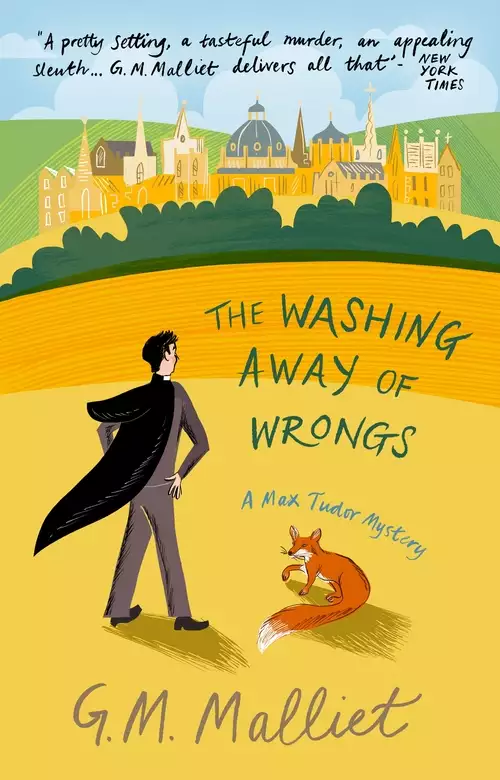
In this new mystery for Max Tudor, he is forced to revisit the past to solve a very recent case of murder...
Max Tudor thought he'd left the world of deceit when he resigned from MI5 to become an Anglican priest. Then his bishop asks him to return to his Oxford college, St Luke's, to investigate the death of its chaplain, and Max realizes there's no leaving the past behind.
At first, Max agrees with the official police verdict of death by natural causes. The Rev. Ace Graybill was as harmless a man as ever lived. It's difficult to see how he managed to cross anyone capable of murder.
And the suspects are all above reproach: the celebrated Principal, the cautious bursar, the wise librarian, and a raft of benign students and academics.
But someone in the college wanted the kindly chaplain dead... and looks can be very deceiving.
Praise for G M Malliet
'A superb novel, a wonderful read.' Louise Penny
'G M Malliet has brought the village cosy into the twenty first century... Wicked Autumn is a refreshing read for everyone who loves a really good murder.' Charles Todd
'There are certain things you want in a village mystery: a pretty setting, a tasteful murder, an appealing sleuth... Malliet delivers all that.' New York Times Book Review
'For readers who relish a traditional mystery with a satiric edge, perfect for a cozy fireside read' - The Boston Globe
From the series named "Best Mystery of the Year" by Library Journal and The Boston Globe
Publisher:
Little, Brown Book Group
Print pages:
75000
* BingeBooks earns revenue from qualifying purchases as an Amazon Associate as well as from other retail partners.
The Rev. Max Tudor was expecting only good things to happen that unseasonably warm day, with England nearing the end of a fitful summer. He and Awena would leave Nether Monkslip early in the morning, taking a leisurely drive through the countryside, headed for their weekly ‘big shop’ in Staincross Minster. The trees might just be starting to dress for autumn, but the green hedgerows – thriving from England’s recent, abundant rains – would be humming with life, and cows, sheep and horses might be grazing in the fields as he and Awena drove past in the Land Rover.
Max had come to enjoy not just the drive but the shopping itself, having developed a keen eye for the freshest fruits and vegetables at the best prices. He would stride about the shops and the market square clutching a shopping list provided by Awena, looking for the best ingredients for the coming week’s dinners. He wasn’t above a spot of haggling over price, but only when he wasn’t wearing his priest’s collar, which he felt would give him an unfair advantage at the greengrocer’s.
But the truth was, most people in Staincross Minster recognised the handsome priest, who was often in the news, both local and national. Having deliberately left worldly concerns behind for a quiet life, Max found that the noisy world sought him out, despite his best attempts at obscurity. There had even been talk of a Netflix documentary of his life, which, had he come to hear of it, would have horrified him.
Thinking that a small parish priest might be stretched for cash at the best of times, the shop owners and farmers often let Max think he had won the skirmish over the last of the summer’s leeks or cabbages. Everyone wished him well, and Max was known as a good man to have in one’s corner.
But before Awena set Max loose in the marketplace while she went to buy yarn and supplies for Goddessspell, they would have lunch with a pint and a glass of wine at The White Hart. Sometimes, they’d meet up with friends for lunch, but more often they’d find a quiet corner of the pub and catch up on each other’s doings throughout the previous week.
It was their version of ‘Date Day’ – a Monday, the only day of the week a clergyman could call his own. Mrs Hooser, their housekeeper, would mind their son Owen, and insist they take their time getting back.
Max could only wonder at his good fortune. Not long after he had taken up his position as vicar of St Edwold’s, he had recognised his growing attraction to Awena, even as it complicated his investigation into the murders that winter at Chedrow Castle. Now here they were, many seasons later, married and with a small child they both adored. Max tried to shake off the superstition that overtook him when things were going too well. It was no doubt a leftover from his MI5 days, when it had been drilled into him that there was no such thing as good luck, only good planning, and mere brief lulls in the global storms generated by forces beyond his or anyone’s control.
Max liked to spend his day off away from his parish in Nether Monkslip whenever possible. Otherwise, parishioners had a way of popping in ‘for a chat’ and once dug in by the fireplace with their cares and worries and a nice cuppa, were difficult to remove. Max loved his calling and he loved all the members of his flock (some perhaps more than others). He just found them all easier to love after a day away from them and their problems, most of which could have waited until Tuesday.
But just as he and Awena were getting ready to leave for the market that Monday morning, the vicarage phone rang, and in Max’s position, ignoring the ring was never an option.
The patrician voice at the other end of the Bakelite phone carried bad news and conveyed an intriguing problem. Even before the voice identified itself, Max recognised it as belonging to the principal of St Luke’s – Max’s undergraduate college at Oxford.
‘Had you heard, Max?’ asked Professor Sir Colin Windmill in the rich, commanding tones of a man born to wealth and leadership. ‘Our chaplain has passed away.’
‘Oh, no. Not Ace Graybill.’ Max remembered the chaplain well, although it had been years since Max had matriculated at St Luke’s College. The Reverend Dr Acerton Graybill, M.A., D.Phil., Dip. Theol. (Oxon), was legendary in his way, part of the warp and woof of the ancient college after so many years as the spiritual guide for thousands of students.
Perhaps more shoulder to cry on than guide, thought Max. Nonetheless, he had been responsible in some way for Max’s leaving MI5 to study for the priesthood – a move Max had never regretted. For one thing, he doubted he would have survived the next car bomb, which surely would have been aimed at him.
‘I’m so very sorry to hear this,’ he said to the principal. Even though Ace must have been nearing the end of his useful life, there was always hope that people as good as he would be granted a reprieve.
And Ace, in Max’s memory, had been one of the very good ones.
‘Was it his heart?’
‘Only in a manner of speaking.’ Professor Sir Colin Windmill proceeded to fill Max in on the details, as much as he knew of them. ‘And his wife telephoned me almost right away,’ he concluded.
‘Hilda?’
‘Yes, that’s right. What a memory you have. Anyway, Hilda insisted something was amiss. She continues to insist that, although the coroner was satisfied that it was not unexpected that a man of the chaplain’s age and – how shall I put it? His dietary habits – should pass on. Ace liked food and wine, perhaps more than the next man or woman. His idea of heaven – apart from the real heaven of his beliefs, I mean – was having a chat over cheese and port in the Senior Common Room, a chat that could carry on into the small hours.’
‘No post-mortem,’ said Max. It was not a question. The coroner would not order a post-mortem of such an elderly man unless the circumstances surrounding his death were indisputably suspicious.
By this point Awena had entered the room and stood quietly, waiting, one elegant dark eyebrow arched quizzically, a shopping bag slung over her shoulder. She knew from long experience that the day’s plans were being disrupted.
‘He was eighty-six and taking medication for his heart,’ the principal told him. ‘But she – Hilda, Mrs Graybill – felt something was wrong.’
‘Surely the Oxford police— ’
‘Thames Valley Police, to be precise. They won’t touch it, Max. They looked into it initially, of course, because she’d kicked up such a fuss, but since then they’ve rather given her the brush-off – politely but firmly. I can see their point, can’t you? While crime rages, the death of an elderly man, a death officially from natural causes, is hardly a priority. They say there’s no evidence pointing to anything but a dicey ticker, which Hilda admits he had. Angina in a man his age … you know.’
‘But he had seen a doctor?’
‘Of course he had.’ The principal was using the imperious voice he generally saved for the undergraduates. ‘That’s where he got the medication. But I gathered from Hilda … Well, she won’t admit it plainly now, but I did gather Ace wasn’t religious about taking his prescribed medicine, if you’ll pardon the expression. I mean, he’d forget, skip a dose. You know.’
‘Well, there you are. I—’
‘But she insisted I ring you, Max. I’m rather afraid she’s not going to let this go until “a real expert” – her words – has had a look. She’s called your bishop already, I’m afraid. I thought I’d give you fair warning.’
‘My bishop?’
‘Yes, of course, he is an old friend of her family’s, didn’t you know? She is a Wolf – you know, the famous Wolf family, always in and out of favour at Whitehall. Not to be confused with a pack of wolves, of course. I’m told they’re rather pleasant once one gets to know them. Anyway, the bishop promised her he’d send you out, apparently. She said she wanted “someone who could be trusted to be discreet and to get to the truth”. When can you get here?’
Well, that was his agenda set for him, thought Max. Once his bishop was involved, ‘no’ wasn’t really an answer. He thought it interesting how the bishop had gone from dreading the publicity engendered by Max’s murder investigations to actively sending him out on missions to solve crimes in the area – and beyond. Now it was Thames Valley. How the man thought Max’s pastoral duties were being fulfilled was anyone’s guess. Too much was already falling on the shoulders of his curate, Destiny.
Max offered a feeble protest that came out sounding rather like a bleat to his own ears, even knowing that once he’d been ‘activated’ by his bishop – exactly like some action figure in a priest’s collar, now he thought about it – there was little he could do or say that would prevent the inevitable.
Still, he gave it one last shot. ‘I can’t just show up and start asking questions about the chaplain’s death,’ he said. ‘Won’t people wonder what I’m doing there, anyway?’
‘I’ve got a solution to that, Max. I’ll appoint you as the Interim Chaplain, so you can move about the college freely and ask questions under the guise of settling in and getting to know people. It’s rather a perfect solution, since we’ll need time to find Ace’s replacement, anyway. Let’s see … You’ll need a list of names of the people who were here at the relevant time. Fortunately for our purposes, there aren’t many people around in summer vacation. The undergraduates have mostly gone home and only a few loose graduate cases hang about. The people in administrative positions – the bursar, and so forth – must, of course, be here, preparing for the next intake at Michaelmas term.’
‘I’m not sure I c—’
‘It was your bishop who suggested it. He seems rather taken with his role as spymaster.’
This Max knew from previous experience. Max’s exploits shone a positive light on a Church often perceived as irrelevant at best, mired in corruption at worst.
‘Do you suppose he’s bored?’ asked the principal. ‘I would have thought the Anglican Church would have given him lots of things to fill his time. Anyway, mustn’t disappoint him, Max. Or Hilda.
‘There’s a good chap.’
Max caught the train from Staincross Minster that very day, since he ‘wasn’t doing anything, anyway’ – the bishop’s words. Tempted as Max was to repeat what the principal had said about the bishop’s boredom levels, he knew that wisdom lay in holding his tongue. The bishop had his faults, but a touch of the glory hound in his nature was a manageable one. Probably.
And it suited Max better than being called on the ecclesiastical carpet to be chastised about his sleuthing activities, as had been the case earlier in his time at St Edwold’s.
It was a long trip under molten grey skies, for the promise of verdant, drawn-out summer days receded as the train moved east towards London. His journey required a change of trains at London Paddington so as Max waited for his connection he downed a cup of tea and a pebbly scone. He’d brought his sermon to work on en route, but as he was stuck for anything original to say about the Sermon on the Mount he felt time passed slowly. He’d also brought along a paperback thriller someone had left in the Nether Monkslip Little Free Library maintained by the Women’s Institute (rumours of censorship were rife, as the head of the WI was not a popular woman, and the library’s offerings tended towards outdated textbooks) but the story failed to hold his attention. How likely was it a shy botanist would be recruited by a government cabal and planted (so to speak), because of his special knowledge of insecticides, inside the corridors of power, meeting a gorgeous but undoubtedly treacherous woman in the process? Max spotted her as a wrong ’un before the end of the third chapter.
His mind kept turning to his memories of Ace Graybill. Max could easily call his face and form to mind. He’d also seen the occasional photo of him in the alumni magazine.
The chaplain always looked the sort of man who might have gone into comedy if he hadn’t chosen a different path, with his ready smile and lopsided, engaging features beneath a wild halo of frizzy hair. To Max’s young and jaded eyes he’d seemed ancient, although he must have been only in his sixties. He’d been of medium height with a round build and a rolling gait which suggested early arthritis or sports injuries. Recent photos showed his still-abundant hair had turned the purest white over the years.
He’d been popular with the students, attracting religious sorts, nihilists and avowed atheists alike, for he was always open to the sort of jejune debate on the meaning of existence so beloved by the young, as if they alone had invented these timeless doubts.
It had been two decades since Max had seen the chaplain in person, and age had probably taken its toll, but Max knew Ace Graybill was the sort to ignore infirmity, putting any discomfort aside in the cause of helping others. How such a man came to meet a violent end – if that was, in fact, the case – was anyone’s guess in a wicked world.
On his arrival that evening in Oxford Max bundled himself and his baggage into a black cab from the taxi rank at the station. Perhaps fifteen minutes later, having expertly and rather thrillingly dodged the weekday city traffic, a journey punctuated by the blare of car horns as the taxi sped through traffic lights, the driver deposited Max with a screech of brakes at the august gates of St Luke’s College. Max wasn’t sure if he should applaud and tip him handsomely or rebuke him for his recklessness. He was used to the quiet rhythms of tiny Nether Monkslip, with its own ancient streets and twisting alleyways, with horse riders and the occasional wayward sheep causing the greatest hazard to traffic. He realised he would have to adapt quickly. In his absence, Oxford had become a miniature London.
He stood on the pavement before St Luke’s, his small black wheelie bag at his feet, staring up and down ‘The Turl’ – never Turl Street, but ‘The Turl’. The austere beauty of the stone walls of the college had of course not changed, probably not in centuries. The golden glow of Cotswold stone seemed to have become burnished by age, as if polished to a high gloss.
Max had rarely set foot inside the massive gates of the place since his undergraduate years. When he had returned to Oxford to study for the priesthood as a mature student, following his stint in MI5, he had read theology at nearby St Barnabas House. He wondered if he would have time to visit his old haunts there, if his tutor would still be around.
And if the same sense of time standing still, awaiting his return, would hold true there as well as it was holding here.
While at St Barnabas House he had briefly visited St Luke’s as a tourist would have done, and he’d had dinner one night in hall at the invitation of his former tutor, long since retired. But all his energies had been focused on an exhausting daily regimen, training for a career he never dreamt he would aspire to.
He stepped through the raised threshold of the pedestrian gate, hoisting his bag behind. It was like being pulled through a time portal. The locked bulletin board to the right of the entryway, with its colourful notices of students’ doings; the door into the porter’s lodge to his left; the breathtaking initial view of the serene First Quad, empty of students for the moment.
He introduced himself to the porter on duty in the lodge, saying he was there at the behest of the principal. He waited, peering into the quad as a call was put through to the office.
It was impossible but St Luke’s seemed to have grown, the stones of its walls bigger, higher; its ancient leaded-glass windows more intricate and imposing, concealing rather than revealing the secrets within.
This trick of the mind was, Max imagined, opposite to the experience of people visiting a childhood home after a long absence. St Luke’s did not carry its historic weight lightly but was massive and ponderous and designed to intimidate the brash young things that swarmed in and out of its medieval gates each year. Unlike in olden days, when places at the college were reserved as a matter of course for gentry – and for males only – Oxford now strived to lure the brightest stars from every firmament.
The empty First Quad looked like a film set for an Inspector Morse or Inspector Lewis caper, the velvety grass and surrounding stones waiting expectantly for actors John Thaw or Kevin Whately to arrive and survey the murdered corpse, found either stabbed in its rooms or flung from the rooftop or poisoned at High Table. Soon Dr Hobson would come with her medical bag and, after swapping a few quips with the policemen standing about and having flirted madly with Lewis, she would pronounce the estimated time of death within a four-hour range. She would always couch this estimate in language that left as much wiggle room as possible. Max knew from experience this was still the best a pathologist could do at first glance.
From there the detectives would swing into action, asking witnesses to quit messing about and tell them what they really knew about the deceased, and who would want to harm him or her, and why.
Which pretty much described his own mission.
The series had made the Oxford colleges seem timeless, but most certainly the city of Oxford had changed, as he had just had time to notice on the chaotic drive in from the station. The main streets where the tourists flocked looked to be an ever-changing array of trendy coffee shops, patisseries, hotels and restaurants, jammed into spaces designed centuries before for bookshops, taverns and gentlemen’s outfitters.
The porter behind him put down the phone and told Max the principal was waiting for him. She began trying to point him on his way.
‘Thanks, I think I remember,’ he said with a smile.
Max strode to the principal’s office to the right of First Quad and sprinted up the narrow stairs to the third floor, still carrying the bag that held his overnight essentials. He was optimistically planning to stay only a day or two. After all, he had obligations awaiting him at home.
And in his heart, he thought the chaplain’s wife, as well as the principal, were probably just too grief-stricken to accept that the obvious explanation for the demise of the chaplain was undoubtedly the true explanation.
Max had seen it countless times in people mourning a lost one. Facing the truth was easiest for those not blinded by love.
The white-haired principal, still an unusually tall man, greeted him at the door, thanking him effusively for coming and saying, ‘I’ll be right with you, Max. I just have to think of a thoughtful sign-off that commits me to nothing and then hit “send” on an email. No rest, you know.’
Max nodded amiably. He had never been inside the principal’s private sanctum and welcomed the chance to have a look around.
The oak-panelled walls cocooned the space in a golden Tudor ambience, the deep fireplace set off by leather chairs inviting long hours of reading. The principal’s desk, however, was piled to its edges with files and books, and suggested industry rather than idle perusal of long-forgotten tomes. The sleek laptop computer was festooned with sticky notes peeping from its sides.
The beautiful old rooms,. . .
We hope you are enjoying the book so far. To continue reading...

 Please log in to recommend or discuss...
