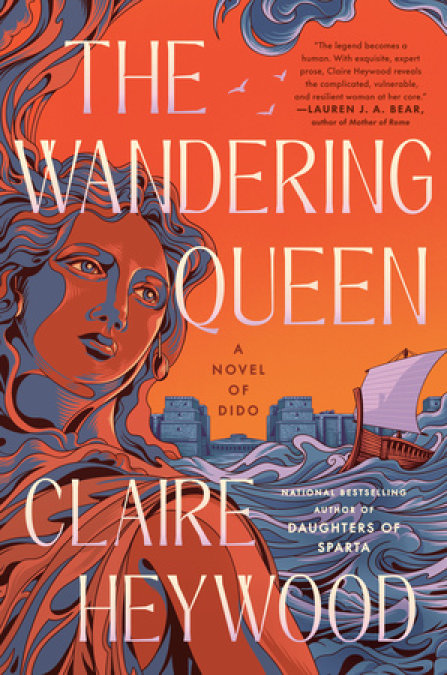
An epic and fiercely imaginative retelling of the story of queen Dido, the legendary founder of Carthage, from the author of the national bestseller Daughters of Sparta
When the King of Tyre dies, he decrees that the rule of the kingdom will pass equally to both his children: Elissa, his clever and strong-willed daughter, and Pygmalion, her young half-brother. But Elissa, not yet skilled in the machinations of court, quickly finds herself sidelined by a band of powerful merchants in favor of her more malleable brother.
Forced out of her palace home, Elissa resolves to forge her own path. Both triumph and heartbreak await in the life that she builds, transforming herself from a sheltered princess into a strong and formidable leader. When she leads her followers on an epic journey in search of a new home in a faraway land, she earns herself a name that will echo through millennia: Dido, the wanderer.
Then one day, a mysterious stranger, Aeneas, arrives at the city gates, fleeing the Trojan War. As Dido and Aeneas are increasingly drawn to each other, Dido is forced to make an impossible choice between power and love.
Release date:
February 10, 2026
Publisher:
Dutton
Print pages:
336
* BingeBooks earns revenue from qualifying purchases as an Amazon Associate as well as from other retail partners.
Elissa rolled the dice sticks between her palms. She liked the crackle they made, that woody clatter she could produce with just a glide of her hand.
"Are you going to roll, Little Jackal?"
Her father's voice was impatient, but she could see the smile in his lips. She warmed at the sound of her new nickname. Her father had begun using it these past months, but only here. Only in the quiet, incense-filled air of his chamber. Only when it was just the two of them-as if it were their secret.
Elissa had to share so much of her father. She had to share him with the whole city. The people needed his love, his protection, his warm and wise words, just as much as she did. Every day, they came to the palace demanding these things. But he always saved a little of himself just for her. When she was younger, he had told her stories by lamplight, or picked flowers with her in the garden, or held her hand as she stepped across the rocks at the shore.
Now they played games. He enjoyed teaching her, and she enjoyed learning-for the most part.
Let it be a five, she thought, with eyelids pressed shut. She threw the sticks, and when she looked down, only two had their white bellies showing. Elissa let out a sigh and studied the board. The ivory heads of her jackal pieces stood alert, ears pricked.
"I needed a five," she muttered. "To get this piece to the end."
"And you have a two. That is the way of it. Now, what will you do?" Her father looked at her with a familiar attention. The one that made her feel pleased and annoyed at the same time. He was testing her, and all she wanted was to impress him. For Elissa, there was nothing worse than being made to feel a fool.
"Which piece would you move?" she asked tentatively.
Her father was silent, as if he hadn't heard her, his bearded chin resting on his fist. "Don't let yourself be trapped, Little Jackal," he said eventually. "You must be wily. Put yourself into the mind of your opponent. Know when to guard yourself, and when to act boldly."
The same advice he had been giving since he'd started teaching her this game. A few months ago, he might have touched one of her jackals, or at least given her a meaningful look, but now he sat still as a stone.
Elissa studied the board once more. "There are no safe moves!" she complained.
"Then you must make a dangerous one. There is no standing still."
She glanced between her white jackal heads, and finally lifted one from its hole, placing it down again two holes farther along.
Her father's face revealed nothing as he rolled the dice sticks. A four. He picked up one of his own hound-headed pieces and removed hers from the board. Elissa felt her cheeks burn and sullenly rolled the sticks. She would never win now.
"Well done, Little Jackal," her father said when he had brought his last piece inevitably home.
"I lost," Elissa grumbled, avoiding his eyes as she put the dice sticks roughly back into their box.
"But you played well." When she looked up, he was smiling. "You sharpen yourself with every game. You are so very clever, my Little Jackal."
She couldn't help beaming at that, though her brow did not fully unfold. "You always win."
"Not always."
"Usually," she insisted.
"I have played a great many more games than you. You are young yet, my daughter. Do you think I was born with the wits of a king?" He held her gaze in a curious way then, which somehow dampened the burn of her defeat. He looked as if he would say more, and she waited for it. But instead, he pushed himself up from his seat. "Kiss your brother good night before you go to bed."
The baby had already been laid down when Elissa’s clacking steps reached the chamber. She softened them, creeping toward the cradle with a penitent smile that made Barce, the nurse, chuckle.
"He is sound asleep. Don't worry yourself," she whispered, moving aside so that Elissa could look down into the cot.
Her brother was swaddled in soft wool, and perfectly still apart from the occasional wrinkle of his nose. She studied his face, trying to find something of her father's features there, but it was still too early to tell. Perhaps he would take after his mother, with her high forehead and her flat little nose. Elissa hoped not. She wanted to share something with her brother, a resemblance that would make people smile and say, "There go the children of the king." They already admired her arched nose. "A daughter of King Mattan and no mistake," they would say. And every time she would beam, holding her chin just a little higher as if to display her inheritance.
She did not remember her own mother's face, not as anything more than a warm smile framed in dark curls. She could not know which parts of her were owed to that woman; if there were any, nobody seemed to speak of them. Nobody seemed to speak of her mother at all. Her father was the anchor of her life, and her identity. He was what joined her unbreakably to that soft, dreaming face in the cradle. She liked to feel that connection, branching out from her in two directions now, instead of one.
"May I kiss him good night? Father said I should."
"Go on, then," said Barce. "But don't fuss him."
Elissa leaned down and brushed her lips against his downy forehead. "I'm here, little brother," she whispered. "I'll keep you safe. I won't let anything happen to you. Not ever."
She knew he was not her full brother, not her mother's son. But Pygmalion was the only sibling she had ever known, and she loved him fiercely.
When she straightened up, Barce was smiling. "He is lucky to have you for a sister." She put an arm around Elissa's shoulders and squeezed her. "You have ten more years of life than him. He will need you and that clever mind of yours. Even if he does not know it yet."
Elissa felt her cheeks glow from the nurse's praise.
"And especially with that fool mother of his . . ." Barce sucked her teeth, then shook her head. "Asherah, forgive me. I shouldn't say such things. Not of the queen." And yet as her tongue slid over that word, she seemed to find it distasteful.
Elissa remained quiet, enjoying the feeling of the woman's arm around her. She had spent less time with Barce since Pygmalion was born. She knew her brother had more need of a nurse than she did, but that did not stop her feeling a little abandoned.
They stood like that for a while, watching Pygmalion's sleeping face.
When Barce spoke again her words were slow, as if carefully chosen. "It is good for you, too, Elissa, to treat your brother well. To make sure that he cares for you as you care for him."
Elissa felt the nurse look down at her, but she kept her eyes on the cradle. Why shouldn't her brother care for her? Father always spoke affectionately of his sisters, recounting the mischief they had made together in their youth, before they had gone away to be married.
"He will have great power one day," her nurse continued. "Power over Tyre, and over you. Your father rules your life now. He makes decisions for you, and he keeps you safe. One day he will be gone-Melqart preserve him-and you will look to your brother instead. Do you hear me, Elissa?" The nurse moved her hand along the cradle edge, pressing it over the young fingers that were gripped there. "You'll do well to be sweet to him. A brother's love is a valuable protection, for any woman."
Elissa's face wrinkled and she tugged her hand away. She already loved her brother. She did not want to be told to do so. And she didn't like Barce's talk of a future without her father in it.
"I'm going to bed now," she said simply, turning her back on the cradle. She felt the nurse's hand brush her dress sleeve, but knew she would not follow. Barce had a more important charge now, and Elissa was too old and too clever to be lectured to as if she were a know-nothing fool.
Chapter Two
Carthage
Loss had become a part of Dido. It was a hole that filled her with its emptiness, pressing up against her insides. After so many years the feeling had joined with the rhythm of her body, like the slow sucking of air into her chest, the uncommanded beating of her heart. So natural as to feel unconscious, and yet so conscious, when remembered, as to consume her.
It had not always been that way. At first, her loss had torn and seared, howling like a beast. Then it had sat like a jagged thing within her, possible to ignore if she kept herself still enough, until an unexpected movement would send a jolt of agony and a thunderous message from her own soul: Do not let yourself forget. It was her penance, she told herself, to let the loss reside within her, even after all this time. She could not banish or forget the pain of it. Not entirely. And when she felt it receding, when its edges began to lose the last of their sharpness, she would reshape them. Just enough to know that it was still there, still pressing against her, still keeping her company. To not feel the loss at all would be a new bereavement, a fresh guilt. It would be a betrayal.
The grove was where Dido came to remember. There was a quiet to the place, away from the city. A solitude. And yet the rustling sighs that came from the leaves overhead were enough to remind her that she was not alone. There was a piece of him here. Not a body, and not even ashes. The earth was as untouched as when she had found it. But of all the places that made her kingdom, Dido knew this was where his spirit would choose to be.
"I thought I might find you here."
Dido did not like to be disturbed when she came to the grove, but she smiled to hear Iarbas's voice.
"If you'd rather be left alone, I'll go," he said, holding up his palms and taking half a step back.
"No. No, stay," she said. "The sun is getting low. I should be returning to the city anyway." Dido looked up at the blushing sky. "I hardly realized how long I'd been here."
He nodded respectfully. The black locks of his hair were braided, as usual, falling past his ears and almost touching the dark, smooth skin of his shoulders. "Shall I walk with you, then?" he asked, letting a little of his habitual smile fill his cheeks. "Even Queen Dido may need an escort when the hyenas start to roam."
She scoffed. "Cowardly creatures. A fierce stare and they go on their way."
Iarbas laughed. "A stare from you?" He pretended to shudder. "I don't blame them. Well, then, perhaps it is you who should escort me."
He put out an arm, bare apart from its tattoos, and Dido linked her own around it.
"Hyenas or not, I shall be glad of the company."
They fell into a familiar step, smoothed by years of friendship. The silhouette of the city lay ahead, a huddled crowd of roofs and towers. Dido knew every line of it.
"What is that new building there, on the east side?" Iarbas asked.
"A granary," she said. "We needed another, now that the fields are producing better."
"Producing well, I should say."
Dido smiled to hear how impressed he was.
"You know, when you first arrived, I thought you a little mad," he said.
"You have told me so. More than once." She squeezed his arm playfully.
"And you may still be mad," he carried on. "But I cannot deny what you have built here. Your husband would be proud."
Dido felt herself stiffen, and Iarbas must have felt it, too, for he fell quiet. For a while they walked in silence, their elbows suddenly jostling with each other in a way they hadn't before.
"And are you . . . happy?" Iarbas's voice was thin, hesitant. So unlike his usual rich timbre. He kept his eyes on the city ahead.
"My people are thriving," she replied.
"That's not what I asked." He stopped, and Dido had no choice but to stop with him. She unlinked herself from his arm and turned to look at him, to prove to him-or perhaps to herself-that she was not afraid to meet his gaze.
"I know what you are going to say," she said shortly. "You have said it so many times, even though you know my answer. You'll say that I should remarry. That I cannot mourn forever. That I should marry you." She thrust her hands onto her hips, ignoring his step forward. "You know why I cannot. I have made a vow, Iarbas, to my husband and to myself."
"I know," he said softly. The regret in his voice took some of the tension from her arms. "I'm sorry. Please. I should not have said anything. Come, let us go on as we were before."
She considered him for a moment, while the evening breeze whipped strands of black hair across her cheeks. She should be flattered, she knew. Iarbas was handsome, well-respected, a leader among his people. She had known him for as long as she had been in Libya, since before the first stone of her city had been laid. Over those years, she had appreciated his friendship, and-more than once-his advice. But his talk of marriage only made her feel guilty. Guilty that he had not taken another woman as his wife. He must have had opportunities. Did he hold back because of her? And guilty, too, that she might ever have entertained the idea of saying yes to him. That she might still entertain it. If not for his own happiness, she wished for her sake that he would marry someone else.
"It is forgotten," she said, forcing a smile. He smiled, too, and though she saw genuine relief cross his face, there was a shadow of sadness behind it.
We hope you are enjoying the book so far. To continue reading...

 Please log in to recommend or discuss...
