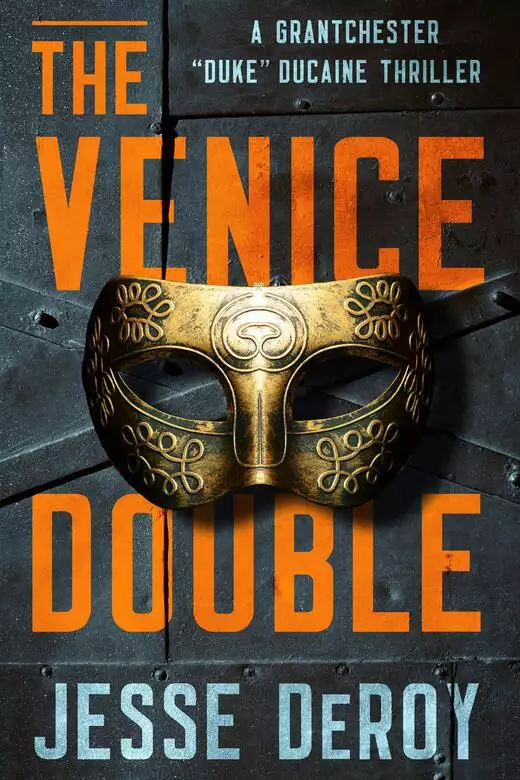
The Venice Double picks up where Safecracker left off, after Grantchester "Duke" Ducaine steps back into the thieving game to spring his dad from prison and save himself from losing his thumbs to a gambling debt. Now, a few months later, he’s trying to decide if he’d get more satisfaction from putting a bullet into the fixer who betrayed him, or his overbearing father, Knox. But when an old friend of his parents’ calls in a favor, Duke jets to Italy—along with Knox, shot caller and bookie extraordinaire Aunt Paulie, and his mentor Helen MacDonald—to pull off the exact same job they did before he was born: The Venice Double. Except instead of stealing a scrap of paper with the beginnings of La bohème written in Puccini's own hand, this time, Duke and his family have to do the heist in reverse. This would all be fine . . . if it wasn’t a rush job, if he didn’t have to dodge a rival team, deal with his father’s constant criticism, worry about his sister’s surgery, and confront the ghosts of his parents’ past. But the question hanging over Duke's head is what’s going to kill him first: the job itself or having to pull it off with his family.
Jump back into the gritty underworld of heists and international crime with this second installment in the Grantchester “Duke” Ducaine thriller series.
Release date:
January 13, 2026
Publisher:
Union Square & Co.
Print pages:
320
* BingeBooks earns revenue from qualifying purchases as an Amazon Associate as well as from other retail partners.
DAD AND I WERE IN FLORIDA trying to kill a man named Janus.
But first, we had to find him.
A little more than two years ago, I’d made a colossal mistake. As a result, I’d taken a bullet to the chest, my dad got arrested, and my sister, Ginny, got tossed off a sixth-floor balcony.
I healed up fine, but Dad drew an eight-to-twelve in federal prison, and Ginny ended up in a coma.
About four months ago, broke and desperate—I was on the verge of losing my thumbs because of a gambling problem—I’d done a job that earned me enough money to erase my debt and, more importantly, came with a Get Out of Jail Free card for my dad. Not just early release, but a full pardon. Never mind that it was my fault in the first place that he’d been sent to prison, me getting him an actual pardon was a miracle. Jesus turning water into wine. Except it was a bitter vintage; I hadn’t been able to get a miracle for my sister.
Which is why our dad and Aunt Paulie were able to convince me, as Ginny’s healthcare power of attorney, to let her go under the knife. Highly experimental surgery, uncharted territory. Her autonomic nervous system and her swallow reflex worked, which meant Ginny was able to breathe on her own, but that was about it. Two years since my screwup had gotten her hurt, and there’d been no change to her state of consciousness despite every other medical intervention I had authorized.
What was there to lose by trying an experimental operation?
Everything.
Of the eighteen patients who’d undergone the surgery before Ginny, half of them had left the operating room as cold bodies. Or as the doctor had put it, “gone with the angels,” which I thought was a weird thing for an MD with a PhD to say, but our surgeon’s spirituality didn’t seem to faze Dad or Paulie.
“Who cares,” Dad said. “And it’s not like being dead makes any of them worse off.”
“Real sentimental of you,” I’d said.
Aunt Paulie, who was a fixer, a fence, and a shot caller—if you worked on the West Coast, you paid her toll one way or another—had to have a couple of her goons break us up.
Once we were sitting down again, like reasonable adults, Paulie cut through the argument: “We’re choosing between a small chance and no chance at all.”
She was right. It wasn’t much of choice.
The surgery had been three weeks ago. Ginny had survived—“the angels were looking after her,” the doctor told us—and gone through the step-down units at the hospital. She was back in her private care facility. As expected, Ginny was still in a coma; between the swelling from the surgery and the new cocktail of drugs being pumped into her, we’d know if the procedure was successful sometime between week four and eight. Past week eight, and that would be an answer in and of itself.
Nothing I could do but wait.
And go hunting.
Two years ago, after I’d recovered from being shot, I’d gone after all the people who’d crossed us, leaving a trail of bodies behind me before finally hitting a literal dead end even though I still had two more people on my list: Janus, who’d set everything up and then betrayed me and Ginny, as well as the unnamed client who’d commissioned the Paris Job and ordered Janus to commit the betrayal.
The job I’d done four months ago, the one that saved my thumbs and sprung Dad from prison, had extra bonuses stacked on top: The first bonus was that I found and killed that client from two years ago, a Russian billionaire named Volkov. But the second bonus was that I’d gotten a lead on the double-crossing Janus.
Which was great, but the problem was that the Volkov Job was, in a lot of ways, a boondoggle. In the process of trying to extricate myself from the whole fiasco, I’d inadvertently stolen an item of supposedly incalculable value from the safe of a CIA black site in Germany, broken into the Los Angeles offices of the FBI, shot a couple of people who needed shooting, killed Volkov, sunk his yacht, and generally caused a bunch of havoc. As part of the debacle, a freelance hit squad trying to send me a message waltzed through Paulie’s office, murdered three of her men, and beat her almost to death; her right arm was still in a cast, the deep scar near her hairline was just starting to look reasonable, and the slight limp would probably never go away.
It wasn’t like the Volkov Job had been quiet and subtle; at the exact same time I’d gotten a fix on Janus, I’d essentially lit a bonfire he couldn’t ignore. The aptly named two-faced fixer was going to be looking over his shoulder. We had to be cautious in our approach, so we didn’t scare him off. Which meant a lot of sitting around, watching. It wasn’t a lot different than waiting for the doctor to come out and tell us if Ginny had made it through the surgery or not.
I checked my phone again. Nothing.
Dad said, “Relax, Captain ADD. It’s not like the more you look at that screen the more likely it is that Ginny comes out of her coma. It’s only been three weeks.”
I thought about smacking him. I decided against it. We’d been in Florida nearly a week. Waiting. So far, getting a sighting on Janus had been like chasing a whisper in the wind.
“Plenty of other people I’d be willing to kill if we don’t find Janus soon,” I muttered under my breath.
“You’re in a mood,” Dad said.
He didn’t need to add again.
“I can’t wait to get out of here.”
Thankfully, Dad didn’t respond.
Things had been hit-or-miss with the two of us. I’d taken him on an over-the-top vacation to Hawaii to celebrate his release. That had been fun, but working together now, without Ginny as a buffer, we were finding a lot of places we chafed. He’d raised me and my sister to be the greatest thieves in the world, but greatness came with a cost. As charming as Dad could be when he wanted, he was also an awful lot like one of those abusive sports dads determined to shape their kid into the next Michael Jordan or Serena Williams. Except with shooting and safecracking, what Ginny called bloody knuckles and brainteasers.
Dad and I had so far spent today the exact same way we’d spent every day the whole time we’d been in Florida: camped out at a strip mall. All the businesses on the strip had that same hollowed-out feeling of serving only the temporary needs of sun-starved tourists. Seven days in a row, the same thing: morning in the coffee shop, lunch at the sandwich shop next door, then, two doors down from that—we skipped the ice cream parlor—we moved to a rooftop bar after lunch. There was nothing to recommend any of the businesses except that they existed, and that they had a good view of the marina across the street where Paulie thought we might find our quarry.
Water, water everywhere, and not a drop of that piece of shit, Janus.
I was tired of being patient.
In the parking lot, below the bar, a man walking through took the last bite of his ice cream cone, crumpled up the piece of paper that held the cone, and dropped the paper onto the ground. I thought about taking a potshot at him. Even if he hadn’t been littering, he was wearing one of those “FBI: Female Body Inspector” T-shirts. That alone was probably enough to deserve a bullet.
A panel van pulled into the marina parking lot. Dad and I both perked up, but the driver entered the office with a package and then left empty-handed. Otherwise, it was sporadic movement: boats coming in for fuel, the occasional owner leaving or arriving, a maintenance man repairing the dock at one of the boat slips.
But no Janus.
Dad and I took slow sips of our beers, watching, waiting.
I had a 9mm pistol under my shirt and a knife in my pocket. Both weapons were functional, not fancy. Tools, not jewels. Designed with one purpose in mind. But when I finally got to Janus, I wanted to use my hands.
WE WERE EACH ON OUR THIRD BEER when I went to the bathroom. The upside of our camouflage—the waiters didn’t care how long we lingered in the slow hours of the afternoon as long as we kept telling them to keep the change—was that I always had a ready excuse to slip away from Dad for a few minutes. After I washed my hands, I gave Ginny’s care home a call. If I’d called from the table, Dad would have either rolled his eyes or made a comment about “watched pots.” I wasn’t in the mood for it. Maybe Dad had a point, but checking in on Ginny’s status was something, even if I got the same answer every time I called: no change.
The floor nurse picked up. He’d just finished a check: no change.
I was waiting for Janus. I was waiting for Ginny. No change, no change, no change. I thought I was going to explode.
I put my phone away and headed up the stairwell. I had to get back to waiting.
But when I came out to the rooftop, Dad was standing next to our table. He had his phone pinched between his ear and his shoulder. He was peeling bills off a roll. He looked shaken.
Even though I’d literally hung up from talking with Ginny’s reassuring nurse, I had a sudden lurch in my stomach.
He walked toward me, still on the phone. I mouthed Ginny’s name, but he shook his head and then motioned for me to follow him. I realized as he passed me that he wasn’t upset or scared; he wasn’t shaken, he was serious. The languid look we’d both adopted to stay under the radar while we worked surveillance had been replaced by utter focus.
“Got it,” he said. “No. On our way now… No… No… Yeah, I’ll call her.”
He stayed on the phone as we made our way downstairs and out back to where we were parked. He handed me the rental car keys, made a few more cryptic comments to the other end of the conversation, and then hung up.
“Airport,” he said. “Stop at Slurry’s along the way to ask him to hold the gear.”
“But what about—”
“Questions along the way. Phone call first.”
I took a quick look at the map on my phone to remind myself how to get to Slurry’s. Fortunately, his place was on the way to the airport. Slurry was a long-time acquaintance of my dad’s. He was a leathery old man who’d been retired from the active part of the trade for at least two decades. Despite pushing nearly ninety, however, he still dabbled in supplying material to fellow travelers. He was the one who’d sold us our pistols and my knife, all clean, all tested, all untraceable. If we were going to the airport, our choices were to either ditch the weapons or leave them somewhere safe. It made sense to ask Slurry to hold them for us.
Fortunately, we’d already planned to switch hotels. We had checked out this morning. The small amount of clothing we’d brought with us—a single carry-on each, nothing more—was already in the car.
Dad’s call must have gone to voicemail, because he said, “It’s me, give me a call,” before hanging up.
“Now are you going to tell me what the fire is? I thought we were going to stay here until the job was done.”
I didn’t want it to be done. I needed it to be done. Whatever happened with Ginny’s surgery, Janus was a box that needed to be checked. Or rather, a rectangular box that needed to be filled and put six feet under.
Dad said, “It’s been two years since the Paris Job. Janus will keep. Helen”—Helen MacDonald, my dad’s partner in crime, and my mentor slash surrogate grandmother—“called Paulie, Paulie called me. I left a message with Helen.”
“And?”
“And an old friend called in a chit. Look, it was a quick call. I don’t have all the details, but Paulie said move, so we’re moving.”
“We?”
A long, long pause.
I waited. I was getting good at waiting.
Finally, he added, “Paulie said that Helen told her, and I quote, ‘bring the kid.’”
“Gee, since y’all are asking so nice.”
“Don’t be a brat.”
“Where are we going?”
“Rome.”
“Rome?”
“Yeah. And I know. Paulie is figuring out the passport thing.”
“Who’s bankrolling?”
“Each their own,” he said. “I don’t even know if this is a paid gig for you. You’ll have to talk to Paulie about it.”
“Basically, I got voluntold to go do some job with an old buddy of yours, I may or may not be getting paid, and I’ve got to cover my own expenses.”
“Yeah, but you get to go to Italy. It could be worse.”
DAD PUT THE CALL ON SPEAKER so I could tell Paulie where she could find my passport in my apartment. Also, she wanted to know how I was covering my tickets, and I had to ask her to front me the money since I didn’t have enough space on any of my credit cards.
I’d been paid well for the Volkov Job, but that had been four months ago and I’d treated it like Monopoly money. I’d had to pay tax on it—everything about the Volkov Job had been complicated, including how I’d gotten paid—and then I’d fallen back into my old pattern of profligate spending. Cash had run like water from a broken main: After deducting Uncle Sam’s cut, paying the state of California its share, retiring my gambling debts, catching up on my delinquent rent, prepaying the next six months at my landlord’s insistence, taking my dad on the month-long high-end Hawaiian vacation, and covering the costs of our hunt for Janus, I was close to broke again. Worse. My credit cards were still cranked out.
“As my Aunt Paulie,” I said, “I’m asking you to do this for me, to front me the money, as my Aunt Paulie. As a personal matter. Not professional.”
“How are you out of money already, Duke? All right, yes. I’ll buy you a ticket, but you’re a moron,” she said. “No vig, but don’t expect a glamorous trip on my dime. Knox, take me off speaker.”
Which was fine, because I needed to focus on dealing with the traffic. Florida drivers, it turns out, are as bad as drivers everywhere else. And 80 percent of drivers everywhere think they are above average.
Dad was still on the phone when we got to Slurry’s. An unremarkable 1970s ranch house in a tract of cookie-cutter ranch houses. It was well-maintained, with a postage stamp of zoysia grass that looked recently mowed. The neighborhood was a mix of old-timers and first-time home buyers, and a few of the homes showed the signs of children: bikes dropped haphazardly on lawns, basketball hoops installed on driveways, and swing sets peekabooing from backyards.
Slurry answered the door before I had a chance to ring a second time. He offered me a beer, but I declined and then presented him with the weapons instead. He reared back like I’d pulled out a pair of rattlesnakes instead of the pistols he’d sold us, but calmed down as soon as I told him they hadn’t been used, we didn’t want a refund, and all I needed him to do was hold on to them until we were back. When I offered him five hundred bucks as a “convenience fee”—which put my “kill Janus” fund at close to zero dollars—his attitude changed from belligerence to resigned annoyance. I told him I figured it would be a couple weeks at most.
He took the money, both pistols, the extra ammunition and magazines, and the knife, and nodded in a noncommittal way, as if he didn’t much care who I killed, let alone when I got around to it.
Which suited my murderous mood fine, because when I got back to the car, Dad told me the travel arrangements, and it was all I could do not to throw a tantrum.
Now that I’d had fifteen minutes to wrap my head around leaving Janus for another time, I was almost happy to have a break and the chance to do something—anything!—that was more interesting than sitting in a strip mall and letting my butt go numb. That wasn’t what set me off.
And I wasn’t angry because I’d been voluntold to help Helen, Paulie, and Dad pull off some heist on behalf of a random old friend of my dad’s. Nor was I upset that my dad, my aunt, and the woman I thought of as a grandmother, all owed a “drop everything” favor to that same random old dude they’d worked with in the past, and this was the first I was hearing about it. I wasn’t even annoyed about the absurd itinerary: Miami west to Los Angeles—Paulie was going to meet us at the airport with our passports—and then immediately east, direct to Rome, twenty hours of travel, give or take.
Heck, I wasn’t even mad that I had to fly in economy!
What I was furious about was that I had to sit in economy while Dad and Paulie sat in business class! They were going to be drinking sparkling wine, eating seared scallops, and sleeping on their lie-flat seats. Meanwhile, I was going to spend most of the next twenty hours in the middle seat, wedged between a college student who probably smelled like stale weed, and somebody’s grandpa who wanted to talk politics.
Being a high-end, international thief was usually more glamorous than this.
I was so busy feeling sorry for myself that I almost missed it when Dad said the name.
“Wait. Did you say Nando? Nando’s the one calling in a favor?”
“Aren’t you listening? Of course this is for Nando.”
I wondered if I could ask him to hold the steering wheel while I choked him in frustration. What was it with parents explaining like 10 percent of something and then making you feel like an idiot for not magically knowing the other 90 percent of it? Whenever Dad, Paulie, and Helen talked old times, they’d tell the same stories over and over again. The Kingsford Job. The Berlin Magnet. The Gold Standard. The Broken Axle Heist. That sort of thing.
I loved hearing the old stories, particularly the ones where Mom made an appearance, but the old folks were constantly aghast that I didn’t remember some random detail about some random person that they’d never told me existed.
Except Nando wasn’t some random guy.
NANDO WAS AN INVETERATE CON MAN. Almost every word out of his mouth was a lie. He claimed, differently at different times, to be a French chemist, a British barrister, a former Navy SEAL and Vietnam War veteran, the heir to a Texas oil fortune, a one-time professional wrestler, and distantly related to Frank Sinatra, and during at least one job, he managed to pull off a convincing act as a Norwegian diplomat.
Nando liked to say that he could trace his true ancestry back nearly a thousand years, to Afonso Henriques, the first king of Portugal, and that even though everybody called him Nando, his real name was Ferdinando Marcos Ricardo De la Mora III. His name and his heritage, like everything else in his life, were probably an invention. But the reality was beside the point; Nando was fully capable of acting like royal blood coursed through his veins.
He was a terrible driver and useless with a gun, but if you put a deck of cards in his hands, he could do a rum punch shuffle or the Moscow two-step so smoothly that even a seasoned pit boss wouldn’t spot it. His hands looked ordinary, but he could tie a knot in a puff of smoke. He’d taught me and Ginny how to dip a wallet so you could strip the cash without even taking it out of a mark’s pocket, and as a teacher, he had an almost inexhaustible supply of good humor.
He was funny, profane, deeply intelligent, and intensely loyal. He was a polyglot who spoke seven languages like he was native born, and another eight or nine with near fluency, and he could slip in and out of different skins as easily as changing a shirt. He could make a mark say thank you for the privilege of getting skinned. The joke was that Nando was so charming that when the grim reaper comes looking, Nando will talk his way out of it.
He was also the ex-husband of Helen MacDonald.
I thought of Helen as my surrogate grandmother, but if she was that to me, Dad was more like her kid brother. She was about a dozen years older than him, and they started working together when my dad was in his early twenties. Dad’s dad had been a crook himself, but my paternal grandfather was more of a mechanic. Helen was the one who showed Dad how to be an artist.
They worked separately plenty and would often go off on their own for months, or even years at a time, but Dad and Helen were a natural pair. Right about the same time my mom and my dad met and fell in love, Helen and Nando connected. The two of them getting married meant that, for all intents and purposes, Nando became family.
When Helen and Dad swapped old war stories, to hear them tell it, those early years of the two of them, and then the two of them plus Nando, working together as a team, Paulie sometimes rounding out the string, with Mom along as nothing more than a tourist, well, those were the best years of their lives.
I loved hearing about that time, even if it usually took Dad a while to remember to do the perfunctory, “Best years of our lives before we had kids, okay?”
And then, two things happened when I was seven. The first is that my mom was killed by a drunk driver. The second is that only a few weeks later, Helen and Nando split up.
It’s impossible for me to separate those two things and apportion it out. Perhaps in different circumstances, him leaving wouldn’t have hurt so badly. Nando would just have been an adult I remembered with fondness. But I was devastated by my mom’s death; I have no idea how much of that made it worse that Nando was suddenly no longer a regular presence in my life.
I’d worshipped Nando with the fervor that only a young boy can muster. I know that my dad loved me—loves me—but he was intent on transforming me and Ginny into the greatest thieves who ever lived, and even with my mother’s civilizing influence, he could be a hard, hard man. Aggressive and passive-aggressive, sometimes at the same time. Controlling. Moody. He motivated me through fear, pushing, prodding, nothing I did ever good enough for him, especially not compared to Ginny.
Nando, though, was completely unreserved with me and Ginny. He was always ready to make me smile with a joke, a magic trick, a warm hand on my shoulder. If he ever got tired of having me follow him around like a puppy, I never knew it.
Him and Helen splitting up didn’t mean he was completely out of our lives. I saw him maybe a half dozen times after that, usually for a few weeks at a stretch, when he’d bring us in on a job or vice versa. Sometimes, during those “after” jobs, there was a certain tightness in the interactions between Dad, Helen, and Nando that I, even in my youth, could see, but I didn’t care. Having Nando around was like Christmas come early.
The last time I’d seen him was right around when I turned sixteen.
It was a job in Panama City. We hit a mobster for a ton of cash. It had been the full crew: Helen and Nando as a couple, me and Ginny as their nephew and niece and spoiled brat wards, and Paulie—making a rare reappearance in the field from the executive suite—and Dad as employees, secretary and body man respectively.
But what made the job even more fun for me is that when it was all done, we met back in Los Angeles to cut the take, and Nando gave me a birthday present: a completely restored 1966 MG coupe in jet black.
A grand gesture, though Nando was prone to grand gestures. He’. . .
We hope you are enjoying the book so far. To continue reading...

 Please log in to recommend or discuss...
