
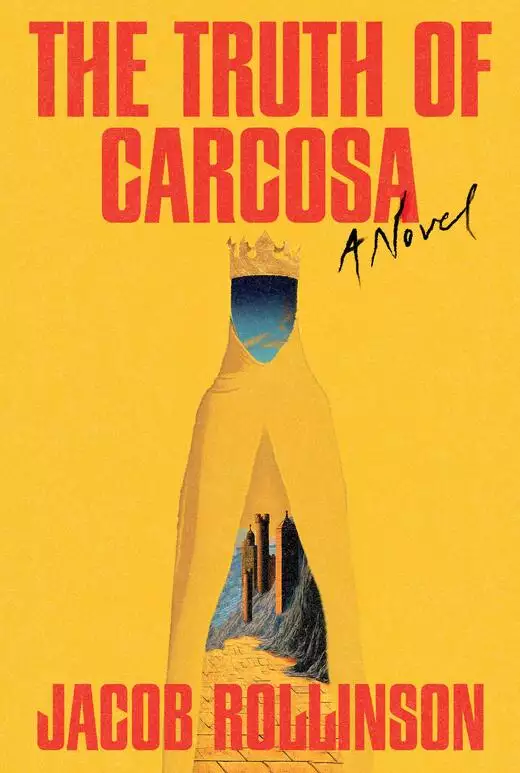
The Truth of Carcosa
- eBook
- Audiobook
- Hardcover
- Book info
- Sample
- Media
- Author updates
- Lists
Synopsis
In 1984, the renowned author, Salvatore Archimboldi accepts the help of a psychotherapist to write his new book, hoping to transform traumatic memories into literary genius. But the resulting book, The Truth of Carcosa, is more than a book—and, horrified, Archimboldi suppresses his creation and wills all traces of it, his correspondence, and any copies to be totally destroyed.
Long after Archimboldi's death, in a chaotic age of resurgent nationalism and violence, a biographer and his protégée search through Archimboldi's correspondence for clues to the location for the last copy of The Truth of Carcosa. Hot on their heels are a shadowy, all-powerful corporation, and a madman with his own, private reasons for his obsession. As these groups converge, it becomes clear that the last copy of The Truth of Carcosa might be the answer to a bewildering set of questions:
What are the strange entities that arise in the wake of the book?
Who—or what—is the Yellow King?
And what does he want with us?
Release date: January 13, 2026
Publisher: Union Square & Co.
Print pages: 320
* BingeBooks earns revenue from qualifying purchases as an Amazon Associate as well as from other retail partners.
Reader buzz
 Please log in to recommend or discuss...
Author updates
The Truth of Carcosa
Jacob Rollinson
Scottie can barely credit the stories. It’s like they’ve come from some other place, another country, where people do barbarous things. Not England. But if they’re true, he can’t deny that the Guard have only done what they’ve always threatened to do. This is the Will of the People, about which the government-in-exile blustered and promised for years, right up to the point they were escorted to Dover.
If the rumors are true.
“Can you really believe it, Mr. Sol, what they’re saying?” he asks, as Sol climbs into the cabin of the van.
Sol is in his forties with the soft, worn look of a middle manager. But his hair is unkempt, clothes disheveled, skin waxy. He’s wearing a dirty delivery driver’s jacket and jeans. He nods irritably.
Scottie is soft and unkempt in a different way, like somebody who’s only just woken up. He’s younger, with a soft beard and clothes that suggest time spent outdoors. He shrugs.
“I can’t believe it.”
Indeed, as they navigate the quiet roads toward the city, it’s possible to pretend that all is well, that they’re driving for pleasure in the England that was. New green leaves glisten with fallen rain. Stupefied pigeons rise late from the asphalt.
But smoke rises from the town, and on the slip road into the city a dozen cars are lined up with their doors hanging open. The verge is stained with dark patches, and somewhere over the rise a fire still smolders.
Sol slows to a crawl, wary, but the scene is deserted and the makeshift turnpike at the head of the line has been hauled to the side of the road. The route ahead is clear.
In the city, posters on the walls mark the stages of the occupation: Old advertisements are overlaid with flyers calling for allegiance to the Hasturian Guard, for racial unity, for the King, for the defense of England and the death of cannibals; emergency dispersal orders cover these; then handwritten curfew notices, signed “HG.” Across the railway bridge, all bills have been ripped down and graffiti, neatly lettered in housepaint, begs for martial law.
“It’s like a bad dream,” Scottie murmurs. Sol says nothing. They pass barricades and burned-out houses: familiar roads made strange. Empty medical tents and stained brickwork.
“That was the Berryman.” Scottie points at the charred remains of a pub. “I can’t believe it… I can’t believe it…”
Sol bristles. He seems to carry a burden of discomfort, some pain that sensitizes him to the irritants of the world: the uncomfortable seat, the sticky gears, Scottie’s moaning.
“I can’t believe it…”
“You’d better start believing it,” Sol finally says.
“But it’s so… terrible.”
“You’ve been listening to the radio. They said what they wanted to do.”
Again, true. But—
“But I…”
Scottie’s eyes are wide. His voice falters. Sol realizes he’s made a mistake. Up until this morning, Scottie was confident and practical about the situation they faced. It’s clear now that he simply hadn’t processed it. “I’m sorry,” Sol says, but it’s too late. Some barrier has broken in Scottie: The world has become very real to him.
“This is serious,” he whispers, as if to himself. “This is dangerous! Maybe we should go back!”
“Scottie, I’m sorry. Take a breath. Remember the plan. We’re here to find your friend. What’s his name again?”
“Louis.”
“Louis is going to help us, right?”
“Yeah.”
“We’re going to find him. Just like we meant to do before all this happened.”
“But everything’s changed!”
“Our plan hasn’t changed.”
“He could be dead.”
“We don’t know that.”
“How are we meant to find him? This place is a war zone.”
Just then they round the corner to the city center and reach a bus shelter plastered with paper: handwritten notes, photographs, printed posters. Sol pulls up beside it and scans the posters. The word “Missing,” repeated over and over. Missing people, messages, instructions. Have you seen? I lost you in… Sweetheart, meet me at…
Waiting for you.
“What’s Louis’s full name?” he asks.
“Louis Barrow.”
“What does he look like?”
“He’s a white guy. He looks a bit like me.”
“Like you, how? Scottie?”
But Scottie is looking across the square at the facade of City Hall.
A ladder. A pot of paint. A list of names painted in large white letters across the brickwork. At the top of the list is the word “COLLABORATORS”; an elderly man in a wrist brace is finishing the name “LOUIS BARROW.”
The square is a surreal tableau. A single white Jeep with a UN insignia is pulled up beside the municipal fountain. Two soldiers in blue helmets stand guard beside a makeshift office: a generator, strip-lights, photocopier and filing cabinet, a litter of papers, tousled by the wind.
Two senior citizens are working under the supervision of a woman in a Kevlar jacket. Sol waits in the van while Scottie walks, hands-up, past the blue helmets. He points at the writing on the wall and pronounces the name in a trembling voice. One of the bureaucrats, an elderly librarian with a bandaged face, nods. She roots around in the filing cabinet and hands him a photocopied note. The note contains the address of a house in the city. Below is something else:
To the Relevant Authority,
Cannibal House
They know more than they tell.
These vermin change their skin with “E”-injections. (“E” for embryo)
They cannot stop the KING!
Louis Barrow, Trusted Citizen
“What does it mean?” Scottie asks. The librarian only shakes her head. She has a broken jaw.
“Denuncia,” says the woman in the Kevlar jacket. She might be from Spain or Latin America. “The Hasturian Guard go one house, another house, another house… They follow these little nota from trusted citizens like this. Collaborators.”
“And the people in the house?”
The librarian draws a line across her throat.
“Why?”
“Read the nota.”
“It doesn’t make any sense.”
“No. None of this does.”
Radios crackle. A blue helmet taps Scottie on the shoulder and tells him to vamos before the curfew.
“What curfew? Who’s in charge here? Who are you?”
The woman points at her lanyard, which bears the UN insignia.
“Forensic fact finder,” she says. “I’m not in charge. And I go soon, too.”
“Then who’s in charge?”
“In this city, now? Nobody knows.” She sighs, turning back to the volunteers sifting through the papers. “They take a big risk to do this,” she says, pointing at the list on the wall. “They want to tell the truth, what happened here and who did it. I can’t tell them not to do it. And it helps my work. But after I go, they stay. What then?”
Paintbrush in hand, an elderly man starts climbing the ladder again.
“If you can leave, go,” the fact finder says. “Find refuge.”
Back in the van, Scottie hands the note to Sol.
Sol reads, wincing.
“Why would Louis do this?” Scottie asks.
Sol shakes his head. “I don’t know. He was your friend.”
“He wouldn’t do this.”
“Do you know the people in the note?”
“There are no names. Just the address.”
“Do you know the address?”
Scottie reads it again. His eyes widen. Slowly, he nods.
“From long ago,” he murmurs.
“Then we should go there.”
Night has fallen by the time they reach the house. It’s in a terraced suburb, the front gardens heaped with garbage bags, streets strewn with broken glass. There are remains of barricades, constructed from trash cans and shopping carts. Some cars have been torched, some broken into. Electric light is sporadic.
The house has been burned out. Scorch marks rise from vacant windows. Scottie stares at it. He seems to have collected himself.
“I knew this place a long time ago. Louis knew it, too. I never knew the people who moved in since. I don’t see why Louis should have known them.”
“Was your friend ever… into the Hasturian Guard?”
“No way. He wasn’t like that. He didn’t believe that England for the English shit.”
“But he was close to The Truth of Carcosa.”
“What do you mean?”
“People get compromised. It’s a tangled web, believe me.”
“Not Louis. He was on our side. He was my friend. He agreed to help us.”
“Would you prefer me to go inside?”
“No. I need to do this.”
Sol pulls a pair of bright yellow rubber gloves out of his jacket pocket and hands them to Scottie.
“If you find anything—if you find the files we wanted…”
Scottie nods.
“Wear gloves,” he recites. It’s a much-repeated warning. “Don’t read anything.”
Scottie follows the old route into the back of the property: over the fence onto the grounds of Hourglass Lodge hospice, across the hospice’s wide green space and through the hedgerow. He jumps the final, low fence, pushes through thick yew growth, and emerges in a back garden. The moonlight is strong, and the garden looks well tended. Scottie steps up the garden path and pauses. He’s in a familiar place that’s changed in ways he doesn’t yet understand; he should be cautious.
Some conservatory windows are smashed. Some are blackened and warped. Some have melted, running like sugar syrup to the ground. Scottie steps into the conservatory and pulls a flashlight out of his jacket pocket. Turns it on. Narrow beam. He starts to search. He has no specific hope of finding signs of Louis, nor the files Louis agreed to bring them weeks before. But he feels a responsibility, having known Louis, to bear witness to what he’s done.
He shines the light over charred carpet, still soggy from the fire hoses. He finds furniture: the shell of a chair, springs and skeletal armrests; the charred remains of a table; a puddle that was a television set. Drifts of ash. Leaves, blown in from outside. Here, beside a door, intact but ajar, his beam illuminates a discarded spray can. The room beyond is a downstairs bathroom. It has escaped the fire, but the bathtub is full of clothes and graffiti on the wall reads ACCESSION UNSTOPPABLE.
Scottie retreats from the bathroom. He shines the flashlight up the stairwell. The walls are black with soot, but a trail of discarded objects marks a path to the bedrooms. Things thrown from upstairs: a coat hanger, photo frame, picture book. Scottie climbs. The stairs complain with every upward step. The flashlight beam dances ahead of him, illuminating scorch marks and voids. On the landing he finds three doorways. Two doors were open at the time of the fire, and the interiors beyond are black. The third door was closed. Scottie heaves it open. The wallpaper inside is a bright, warm yellow, with a pattern of fairies or sprites—little smiling people with nutshell hats and dragonfly wings. Big smiles and wide eyes.
Scottie follows his flashlight beam into the room.
Inside, beside an empty cot, is a pile of empty food cans and ballpoint pens. Some squatter has been here. Before the fire, perhaps; but after the original inhabitants were removed.
These vermin change their skin with “E”-injections.
It can only have been Louis. After removing the family, Louis occupied their house. Here, he ate canned potatoes and fruit salad, and wrote until his pens ran dry. In this house, and no other: for old time’s sake, perhaps.
Cannibal house. That’s not what they used to call it. Scottie can’t remember what they used to call it.
There’s no sign of whatever Louis was writing. Scottie shines his flashlight under the cot. The plastic eyes of a stuffed rabbit stare back in alarm.
A few minutes later he trudges back downstairs. His hands are empty except for the flashlight, which is flickering now. His hands are shaking.
He stands in the center of the living room, still unable to fathom the enormity of what his friend has done. He can see it, but he can’t comprehend it. He can’t square it with the fact that just a few weeks ago, Louis was communicating normally. He’d agreed to help out, to deliver the files Judy and Mr. Sol were so adamant they needed. He was on their side.
Cannibal house.
Did Louis believe what he wrote about these people? And if not, what did he expect to happen to them, once the militia accepted the rumor? He, too, must have heard the broadcasts.
Scottie’s flashlight beam returns to the ruin of the couch, and stops there. There’s something about it he hadn’t noticed before. Synthetic fabric has melted over the springs, creating a topography of ridges and rills where water from the fire hoses has pooled. Except in one spot, where the water has drained out of a low basin—lower, indeed, than other flooded parts of the miniature landscape. This spot should be completely underwater.
He pushes his flashlight into the lowest dip in the material. There’s a small nick where water has drained out. He prods at the nick, and the ruined fabric falls away, revealing a yawning hole beneath. Unwilling to use his hands, Scottie kicks around the tear, exposing a deep hole in the living room floor. The flashlight beam meets water a few feet down—flooded crawl space—with flotsam jiggling in the ripples. A piece of charcoal. A dead rat, sleek and perfect. A plastic folder, sealed with parcel tape.
Scottie kneels down. He feels the cold soak through his trousers. With the flashlight between his teeth and one hand on the crumbling lip, he reaches out for the folder. He doesn’t grasp it instantly. He must pat it, stroke it with his fingertips, before it spins on the water and drifts within reach.
There’s a handwritten label on the folder. It lists two numbered items.
By an Expert of Sound Mind
Concerned with Preventing Calamity
Louis Barrow,
of the formerly of the Archive for Literary Investment
In fact, I am quite sane.
You will excuse the above abrupt preface. The thing is, I know how writings such as these are typically received. So let me be clear—no, this Special Report is not busywork for an unquiet mind. Nor some last-ditch effort to save my position. This work should be read as a serious and lucid message to those who are capable of waking to the danger, or the opportunity.
I Am Quite Sane.
Yet I might admit to feeling lonely. Not that my loneliness is pathological, nor even tremendously uncommon. In fact, until very recently I’ve cleaved to the belief that loneliness is a linguistic fact.
I refer of course to the theory that while signs—everyday words such as pencil, razor, videotape—are communicable, the realities to which they point are essentially unknowable unless they can be reached by our personal sensoria. And so that which is truly our own, our most powerful and vivid experiences, since they cannot be touched, also cannot be communicated.
I call these incommunicable signs portents. Portents are the lonely baggage of the self: our predawn fears, our intimate shames, the sad pearls of personal joy to which we cling when all else disintegrates around us. Fragments of memory and fantasy that linger after we wake up, put the book down, leave the movie theater. What our bodies know, and cannot say.
Let me illustrate.
When I open the door to the cold room at the Archive for Literary Investment, I know logically that I’m entering a climate-controlled depository of literary manuscripts and correspondence from 1971 to 2010. But I feel as though I’m entering something far stranger.
The door is heavy. It opens only after you swipe your access card on a reader, which produces an optimistic series of chimes: diddly-DEE! After which you hear the clunky magnetic lock disengage, and you pull the handle.
Heavy. You pull it open and it hisses as air currents exchange, and from inside you hear the air conditioning unit re-engage: click, thunk, whir.
You leave the warm office for the cold hum of the archive room. You smell the faintest acid odor of paper bleach and cardboard adhesive. Behind you, the door closes: the seals of frame and door near one another, rubber lips closing in, and the airflow sharpens, like a tiny inhalation: like a question, cut off.
The archive cold room contains sixteen rows, accessible by a single corridor. Therefore, as the door closes behind you, your view is of a single path, with a wall on the right and sixteen aisles on the left. At the far end is the fire exit, alarmed, never used, with a bold red stripe across its belly, declaring CAUTION.
The sixteen rows terminate in wall shelves. So if you walk into any row to locate your target text, and turn back to the main corridor, you need only turn right, and you’ll find the office door, waiting to return you to the warmth and chatter of that communal space.
But what’s this? Beside the handle you’re gripping, your attention is arrested by a bold red stripe. CAUTION. This isn’t the office door, but the fire exit. Instead of turning right at the corridor, you have—inconceivably—turned left.
This happens more than once. As you’re leaving, some cockeyed instinct guides you left when you ought to turn right. Sometimes you catch yourself, mid-turn. Sometimes you stand before the fire exit, hand on the alarmed handle, CAUTION traced in negative on your eyelids, knowing—convinced—that on the other side of that barrier you’ll find the office, with its fluorescent glow, keyboards tapping, the funk of old woolen clothes. You need only pull the handle and you will rediscover it.
This is what your body tells you. How does it get it so wrong?
Perhaps the sensory overload in the cold room baffles your instincts, overriding the internal compass and confusing short-term memory. But perhaps the repeated decision to turn left when you should turn right is itself significant. Perhaps your consciousness is responding to the presence of another form of geometry, something present within the cold room but alien to planet Earth—from some other system, perhaps, with a fundamentally different cartography and calendar.
This feeling of mine, this hint of other worlds—this I call a portent. As such, I cannot expect you, dear reader, to comprehend it. You may read all the words in this special report, and feel convinced that you’ve sounded their ken; but according to the theories that (until recently) delimited my perceptions, you cannot hope to grasp the true meaning of the portents within. We remain within our sense envelopes, scraping against our own internal surfaces, imagining what the outside world looks like.
This is what I mean, when I say loneliness is a linguistic fact.
The question of True Communication, as we might call the piercing of this envelope, is for poets and fanatics. They call it transcendence, or Accession, or nature, and they yearn for it with fruitless devotion. Grown-ups know True Communication to be impossible and leave it at that. Salvatore Archimboldi said it best when he called its pursuit the “last resort of heartbroken tyrants.”
Which makes it particularly awkward to explain what I must.
In short, I have become convinced in recent months that we hold within this archive artifacts and fragments of wondrous, terrifying power. Simultaneously, I’ve felt the erosion of my envelope. I’ve become alive to certain portents hanging in the firmament of my own personal cosmos, like chinks in a previously airtight mechanism. I’ve come to apprehend that it isn’t just my cosmos anymore.
Fearfully and full of doubt I type these words, and I leave to you the question of their veracity and moral valence, upon reading the rest of my report:
True Communication is possible.
We need not be lonely anymore.
The Yellow King is coming.
Sol sits in the darkness of the van’s cabin. The engine is off, yet his hands grip the steering wheel. His left arm is rigid, but a careful observer might see him moving his right shoulder and elbow in tiny circular motions. He isn’t stretching or exercising his arm. In fact, with each small movement, the fabric of his sleeve is scraping oh-so-lightly over his skin. And the permanent expression of discomfort on his face ripples with something like relief, something like pain. A careful observer might guess that Sol is teasing an itch he dare not scratch.
Scottie hammers his palm on the window and Sol jumps like a startled cat. Collecting himself, he gets halfway to unlocking the door before Scottie presses the folder against the pane. Sol catches sight of the label and freezes.
“It was in the house!” Scottie explains excitedly. “Louis left it there!”
Sol is paralyzed with fear and indignation. Scottie, his hands bare, is holding the files just inches from Sol’s face. This, after all the warnings he’s been given. Both Judy and Sol have spent hours trying to explain how dangerous the files might be. Sol’s hands form fists. He can’t speak. When it finally comes, his voice is a furious whisper.
“Why aren’t you wearing gloves?”
Scottie, blinking: “Come on, unlock the door! We need to get out of here.”
“Put it in the back, Scottie.” Scottie looks confused. Sol gestures vehemently. “In the back.”
Scottie, surprised and hurt, does as he’s told. Sol lowers his fists onto the steering wheel. He opens his hands, with some effort, rubs his palms together, and wipes away the stress tears flowing down his cheeks. A near miss, perhaps. Or maybe nothing. He’s still here, his nerves still vibrating with sensation. The likelihood that it could all have been taken from him, just a moment ago—it’s difficult to calculate. Archimboldi’s The Truth of Carcosa has filled his world with invisible land mines, and it’s exhausting, trying to calculate where they might be. He can’t do this alone. He needs to trust the people he’s with.
“Why did you lock me out of my own van?” Scottie asks, once they’re on their way out of the neighborhood.
“Why didn’t you listen? I told you to wear gloves. I told you to be careful.”
“I was careful, Mr. Sol.”
Sol clears his throat. Winces. His forehead is beaded with sweat.
“The folder. Is it what we asked for? The files from the ALI?”
“One of them is.”
“The actual manuscript?”
“No. Something else, an archive thing, like a list of letters. And there’s something Louis wrote, too. A diary, I think. He calls it a report.”
Relief and disappointment flicker briefly over Sol’s face.
“Okay,” he says. “It’s a start.”
They drive out of the suburb on a circuitous route. Mostly they see nobody. Once, passing a cul-de-sac, a cluster of wavering flashlights turns their way and a single shot rings out before Sol accelerates away. They reach a stretch of unlit highway, then quickly turn onto a service road. They pass through a quarry and onto a gravel trail that climbs into woodland. The headlights pick out young leaves, startlingly green in the blackness. They leave the gravel road and follow a pair of rutted tire tracks deeper into the woods. The van lurches from side to side as Sol struggles with the steering wheel.
Sol, who’s been thinking hard, breaks the silence.
“How much did you read?” he asks.
“What? What makes you think I read anything? You warned me, didn’t you? Keep your distance, don’t read it, wear gloves…”
“And you didn’t wear the gloves.” Scottie says nothing, but the look on his face confirms Sol’s suspicion. “Look, I shouldn’t have expected you to understand, because you haven’t seen what I’ve seen. I know today’s been a shock to you. But I thought you pulled yourself together pretty well.”
“Ha. We’ll see.”
“What do you mean?”
“I don’t feel anything, Mr. Sol.”
“It’s the shock,” Sol says. This isn’t an uninformed opinion. Until a year ago, Sol took a professional interest in psychological responses to trauma. He could list the symptoms, if he chose.
“I think I should feel sad, but I don’t.”
“You feel numb.”
“Not even. All I can think is how lucky I am that it was them and not me. How clever I am to live where I do. And my lucky parents, in their gated community… I didn’t even realize how relieved I felt to speak to them this morning. And Judy’s safe…”
Sol nods. Scottie looks down at Sol’s hand, then blushes and looks away. Sol tries to hide the hand behind the steering wheel. Difficult while driving.
“What is it?” he asks.
“I’m sorry, I didn’t think. Talking about how my people are safe when I don’t know about yours. Have you spoken to your wife yet?”
“Who, Dulcie? Why would I speak to her?” Scottie points, and Sol realizes he’s wearing his wedding ring. “Oh. She’s not my wife. We’re divorced. I kept the ring in my go-bag because… well, it’s gold, you know? I don’t know why I put it on that finger.”
“Have you heard from Dulcie?”
“No. We’re divorced. I’m sure she’s fine. I hope so.”
Silence.
“Is there anyone else you need to talk to? To make sure they’re okay?”
“I don’t want to talk about it right now, Scottie.”
They drive. They’re moving slowly now between close walls of undergrowth. Wind whistles through the gaps at the top of the windows, carrying the damp scent of leaf mold.
“I did read some of Louis’s diary,” Scottie finally says.
Sol nods. Long recovered from his earlier indignation, he’s already considered the eventualities, weighed up the consequences. If Scottie read this diary and nothing bad happened, then the diary should be safe to read.
“I think you should read the whole thing,” he says.
“I’m sorry I lied to you. I’m sorry I didn’t take this seriously.”
“You couldn’t know. Not without seeing it. Even two weeks ago this whole thing could have been a fantasy, before the Hasturian Guard started…”
“Doing what they promised to do.”
“… but the plan doesn’t change. We came to find information and we found it. You should read the diary. Read the other thing. Make up your own mind. Otherwise you’ll just be taking our word for it.”
“I never thought you were lying.”
“It’s okay.”
“It’s just that lots of people come to our community with things they’re running from. Lots of people have, um, non-mainstream ideas. We don’t say they’re crazy. We don’t believe in that. But we have to be careful.”
“I understand.”
“Take me to the bonfire spot. I’ll read them there.”
They drive to a fork in the track, and choose the right-hand path. The trees here are older. Limbs emerge in the bright headlights and fall behind into the darkness. Eventually they reach a clearing and Sol pulls up.
Scottie climbs out into the cool air. He retrieves the package from the back of the van. As he steps back through the fumes and headlights, he hears Sol call to him.
“Once you’ve read it, you’ll come to us, first, right? Me or Judy. No one else.”
Scottie nods, and watches the red lights diminish down the lane.
At one end of the clearing, in a sheltered spot between covered stacks of firewood, campfire embers glow. Scottie carries the package over to the campfire and lays it down carefully on the sandy ground. He pulls a camp chair and storm lantern from beneath a tarpaulin and feeds the embers until the fire returns to life. Then once again he unpeels the tape around the plastic folder and pulls out the document labeled THE TRUTH OF CARCOSA: A SPECIAL REPORT.
It comprises perhaps a hundred pages of laser-printed sheets, smudged and stained, as though examined and thought over for long hours under difficult circumstances.
Scottie clears a space on the ground before him and lays the manuscript down. He takes the pages he’s already read and places them face down to the left of the unread pages. Now he has two piles. As he reads, the pile on the right will shrink, and the pile on the left will grow. And however much he feels like his world might explode, like unimaginable calamities might be unveiled with every page overturned, the steady growth of one pile and diminution of the other is all he can predict will happen.
We at the Archive for Literary Investment have been victims of our own success. We are a relatively well-endowed archive with a diverse list of authors in our catalog. We have four manuscripts by Cecilia Burton. We have the fascinating correspondence between Jag Caruthers and his constellation of lovers that would form the basis of his Dog Running Dog trilogy. But these minor treasures are chronically overlooked. When people think of the ALI, they think of the Archimboldi Deposit.
The Archimboldi Deposit is the ALI’s Big Deal. It’s only become more of a big deal since that infamous will reading, following which the executors of the Archimboldi estate set about destroying any notebooks, manuscripts, or correspondence that fell into the scope of their attention. “Destroy with fire,” the author’s explicit, debatably lucid instructions. For years the legal drones of Giovanni, Metti & Metti, LLC have followed these instructions to a tee.
The ALI keeps the arsonists at bay, of course. Its own deposit was endowed in 1993—before Archimboldi’s deathbed crisis—and agreed upon in bulletproof contractese. Our legal department is muscular, well trained, and frequently exercised. You should see them, bounding over the green in pursuit of their prey.
We hope you are enjoying the book so far. To continue reading...
