"Moran’s debut is a slow-burn romance in a historical fantasy setting, with modern political bite.” —Library Journal (starred)
Perfect for readers of Naomi Novik and Katherine Arden, The Trial of Magdalena Overmorrow is a sweeping enemies-to-lovers debut with both historical depth and fantastical allure.
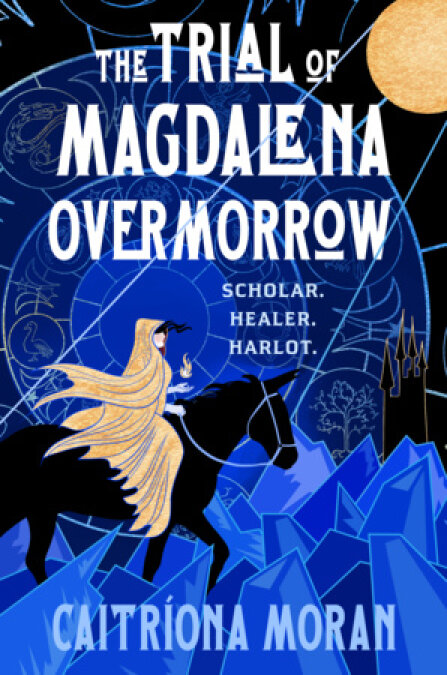
Scholar. Healer. Harlot.
In her house, the villainy is her.
Magdalena Overmorrow has been called a scholar, a healer, a harlot. She carves out some measure of freedom for the women of Astoleyn, risking capture and death by caring for them and performing forbidden abortions. When she’s betrayed by a close confidante, she faces banishment to the realm’s desolate northernmost city as an accused witch. There, she must await her trial and possible doom under the watchful aegis of the Lord Proctor of Cair Gramora, a man so pious and humorless it is rumored that he has never once laughed in his life.
When she arrives, though, Magda is surprised to find that the Lord Proctor isn’t the grizzled old priest she expected but a man barely older than she is. As cold and mysterious and beautiful as the mountains at the cair’s northern border, he holds her life in his hands. One word from him could send her to the stake or worse, but she can’t help her fascination with a man and fellow scholar who is more than he appears to be, and the dangerous secrets he is clearly keeping. As her trial draws closer and the intrigue of the isolated cair threatens them both, she and the Lord Proctor must form an uneasy alliance that could either save her life or lead her to martyrdom and ruin.
Release date:
November 10, 2026
Publisher:
G.P. Putnam's Sons
Print pages:
480
* BingeBooks earns revenue from qualifying purchases as an Amazon Associate as well as from other retail partners.
It is the harvest season: a time of reflection and repentance, of setting one’s affairs in order before the unforgiving slog of winter, of purging one’s house of any villainy that has plagued it during the hot, slack summer. But this year, more than any other, there is nothing to be done for Magdalena Overmorrow. In her house, the villainy is her.
“Total rot,” Magda says. “How can you take those books out? Who am I without my books?” She rolls over on her stomach, the coverlet wrinkling beneath her, and reaches into the trunk to run her fingers along one of the spines, a book of Moscar good spells she hasn’t even been able to read yet. It arrived from the printer only yesterday, wrapped in cloth scented with lemon verbena. “A husk. An illiterate.”
“A prisoner,” Jula says without looking up, “which is what you are. And a lucky one at that. If I hadn’t intervened, you would still be in the Hosselheim, picking worms out of your bread. You don’t have room for the books and you need to bring more clothes.” She heaves up a dress, forest green brocade with black and silver stitching, heavy as chainmail. “How about this one? It’s double lined. Unless you want to freeze to death in the north.”
Magda doesn’t want to freeze to death in the north. She doesn’t want to go to the north at all. The mornings in Astoleyn now are bluebell bright and the evenings the color of honey, amber and long and languid, scented with hyssop and foxglove and the tang of sweat. But in the northern province ice has already formed along the shoreline; the animals have begun to move, and the wolves have grown lean. By the time Magda arrives, it will be almost winter, and night will fall before candle hour prayers. At least that is what she has read.
But Jula is right: she could easily be languishing in the Hosselheim’s lowest dungeon, watching green frost bloom on the walls. She casts her eyes over at the opened letter on her desk, the broken seal of the High Chancellor. The order remanding her into custody in the country’s most northern stronghold until her trial, making her a ward of the realm until the Birch Court summons her to answer for the charges against her: apostasy and black magic. After which time, if she is found guilty, she will be burned upon the stake until death, and may the gods take her soul into their mercy, and so on, and so on.
In these circumstances, she’ll take her chances in the north. She would rather go by ice than by fire.
“That dress is fine,” she says. “All the dresses are fine. If I’m going to be a prisoner, it doesn’t matter what I wear, does it? I could wear buckram, and heap ashes on my head, and go weeping and wailing through the streets, and it wouldn’t make a difference to my keeper. I assume the High Chancellor didn’t pick him for his chivalry.”
“It would make a difference to you,” says Jula. “You would itch.” She tosses a bundle of stockings into Magda’s lap. “Fold these. You can say what you will about the Lord Proctor but I doubt it would please him to have you going around barelegged in Gramora.”
The Lord Proctor. Just the title makes Magda prickle. No one she knows has ever met him. For that matter, no one she knows has been to Cair Gramora, the northern stronghold where she will be held, though some have heard of it from a friend of a friend, or saw it once from the sea when they crossed the Mayzar Strait. But at least they have seen it. Her future jailer is an impenetrable mystery. In the north, they call him the Incorruptible. He comes from nothing and no one, has no name and no family, and cannot be bribed. A rumor, unsubstantiated but convincing, has circulated the university that he received the post of Lord Proctor at the outrageously young age of thirty-four because he had never once laughed in his life. He was picked for the task of minding her, she presumes, more for his ability to slowly strangle the life out of her with his dull odium than to keep her from fleeing the country before her trial. They make quick work of the rest of the packing. Magda places the last of the stockings—good Esriti silk, dove gray—on the top and Jula shuts the lid. As soon as the lock clicks, they stare at it in silence. The finality sinks in.
“Are you staying the night?” Magda asks. She means to be breezy, but the question comes out as weak as a kitten’s mew. She might as well have begged.
“Of course,” Jula says, employing her lawyer’s briskness. She stands and dusts off her skirts. “I have to go to court this afternoon, but I will return tonight for dinner, and I will take the Willow Road to Wirlwick tomorrow morning. You have letters for me?”
Magda fetches a pile of letters from her desk, all sealed with the black hawthorn of the Overmorrow name. “Please remind the headmistress that it serves all of our best interests at this moment for her to be circumspect.”
“Or as circumspect as Selina can be, the old battle-axe,” Jula says with a snort.
“Just…impress upon her the importance of her maintaining her position while I am incapacitated. In the event that I don’t return from Gramora, the future of the school will be in her hands, and she will help neither me nor our cause by getting herself removed from her post by the High Chancellor’s men.”
Mistress Selina is two decades older than Magda, one of Rena’s proteges from her early days at the university. She was a member of the first class of Helena Scholars, the first group of girls permitted to matriculate into the University of Kalabrax. In those days, the male scholars, and some of their instructors, would pelt the girls with stones and clods of dried dung, and townspeople would follow at a distance, calling them whores and waving sticks at them like they were a pack of stray dogs and not women dressed in scholar’s black. Selina, it is said, knocked down a man who followed her from the city chapel after her prayers, demanding that she suck his prick. Since no man would be able to show his face in the tavern again after taking a girl to the justice of the peace for beating him, the matter was dropped and the man slunk home with his tail between his legs. This was in no small part why Magda hired her to run Wirlwick; being the headmistress of the first girls’ grammar school in the kingdom required the sort of woman who might fight a yeoman in the street. But Magda shudders to imagine what will happen if Selina does the same to one of the High Chancellor’s men who comes to perform a surprise inspection and gloats over Magda’s fall.
“Don’t talk like that,” Jula says sharply, and Magda starts. “You will come back from Gramora. No matter what nonsense Selina gets herself into in the meantime.”
“You don’t know that,” Magda says. It is an old argument between them, older, in fact, than Magda’s current predicament, when it became relevant to their lives. Women had died in custody before, or been deformed or repeatedly raped. There were accidents. Reforming the custodial system, which had sputtered on for hundreds of years for lack of any better ideas, had long been one of Jula’s pet projects; when they were girls, she and Magda had snuck into an inquiry into the death of Sibella the Sweetling, the traitorous mistress of the king’s castellan, who left her keeper’s castle so broken she was deemed unfit for trial. They would have had to carry her into the courtroom in a chair. And just two weeks later, she bled into her insides and died. Perhaps, Jula had suggested to the Birch Court years ago, some kind of stringent house arrest would be preferable for those who had been accused but not convicted of crimes, especially women. But now Jula could do nothing without tainting her efforts with favoritism for her closest friend. Magda, for her part, had always sworn she would rather just plead guilty and accept the sentence rather than be shipped off to a remote castle to be tormented by whatever man could pay enough in bribes to get her in chains. But that was before she saw the inside of the Hosselheim. Before the prospect of the fire.
At any rate, Magda doesn’t want to exhume the argument now. Not when she has so little time left. She contents herself with the idea that Jula will destroy any man who hurts her, and that any man who isn’t a fool knows that.
Jula tucks the letters into the pocket of her dress. “I will be Mistress Selina’s good conscience. I’ve known her many years, and though she can be brash, she is not a stupid woman. Between the two of us, we will keep the school running. You shouldn’t worry while you’re away. Think about how you can make a strong case for your defense.”
Magda snorts. “I’m not sure there’s much I can do on that front from Gramora. The bulk of that thankless task falls on you.”
“And am I some ignoramus?” Jula demands. “Some clodpoll? Would you rather have someone else mounting your defense?”
Finally, Magda breaks: she laughs. “You are the cleverest woman in the entire kingdom, and the only lawspeaker worth a damn on the Birch Court. I am the realm’s luckiest criminal.” It pierces her, the way Jula is trying to buck her up, to keep her from despair. It was despair, after all, that had done Rena in.
She follows Jula down the stairs and out into the Redbud Cloisters courtyard. Even though the bread hour bells just rang, the cobbles are already awash in yellow sun and hot beneath Magda’s shoes. Remember this, she tells herself, when you’re in the cold heart of the north.
“I’ll have a bed made up for you,” she says to Jula, which means she will make up the bed herself. She let almost all of her household go last week, the laundress and the cook and the serving girls and the chambermaids, with a month’s pay and a recommendation; Jula would ensure they all found placements. In the interim, she and Jula had been living like students, eating bread and the last of the season’s plums and falling asleep at odd hours on top of their blankets. Carine, Magda’s lady’s maid since she moved into Redbud Cloisters almost a decade ago, had left the day before, cursing the High Chancellor so loudly that one of the guardsmen had come in from the front gate to investigate how a raving drunk had snuck through the manor’s defenses.
One of the only remaining staff, Humphrey the groom, meets them at the stables. He passes Jula the reins of her horse, and sketches a bow to both of them.
“I believe in the justice of the gods,” he declares loudly, though it isn’t clear to whom. “The innocent will thrive, and the guilty will fall down on their knees and be punished.” He taps his chest, over his heart. “You will be vindicated, mistress, and restored. Of this I have no doubt.” Magda meets Jula’s eyes. If she were an innocent woman, Humphrey’s words might comfort her. But though she believes she has committed no crime, she is certainly guilty in the eyes of the law, and probably in the eyes of men as well. No one has taught her the proper prayers for a sinner who doesn’t want to be forgiven.
—— While Jula goes to court—though her closest companion is soon to be delivered into the wilds of the savage north, her docket is full and the law does not rest—Magda walks the cloister gardens and soaks in the almost obscene lushness of her little plot in late summer: the heavy-headed phlox, the clouds of love-in-a-mist and coneflower erupting around pots of apple mint, the spiky orbs of globe thistle, and of course the redbud trees that give the house its name. When she was in the Hosselheim, shut away from the light, she thought often of this garden, and the nigh-unspeakable things she would do to sit in it again. And now she is here, and soon to leave again. She tries to envision the plants of the north, but can picture only bare branches black against a white sky, withered husks half-buried in snow. Brown, dried, dying things. She knows she shouldn’t think this way, that even in Astoleyn there are snowdrops and hellebore that bloom in the cold, and surely it will be educational for her to see northern plants and study northern healing. She must stop wallowing.
In recent months, she has taken to grinding her teeth, asleep and awake; she has dreams in which her teeth crumble like old limestone and fall out, and wakes with headaches in the pith of her skull. She must ration out her moments of kind and expansive thinking, or else explode; that’s why the foreign plants she may never see get short shrift.
They will cuff her on the way north, cutting her off from her magic. It is routine; even if they sent her up with a legion of armed guards, she could, if the men grew sloppy, call up a wind and sweep them all off their horses into the sea. Or she could trace a sign over their cooking pot and put them all to sleep around the campfire, and disappear into the night. Magda has never been cuffed before; only the most evil and untrustworthy magicians deserve to have their magic taken from them, sliced away cruelly and precisely like sinews under a surgeon’s knife. A man she knew from university, a ne’er-do-well and a drunk, once told her that he was cuffed in the court of King Oraffio of Moscaria. He said he accidentally killed the king’s prized pointer, but Magda has her doubts. Even the Moscars wouldn’t cuff a man over a dead dog. If they didn’t tell me they’d done it, he said, I wouldn’t have known at all. Didn’t feel a thing.
At the time, she didn’t think to ask him how his sentence ended. How the cuffs were taken off, and if there was a way around them, a backdoor. She didn’t think she would ever need to know. She was no intemperate drunkard stumbling from tavern to tavern accidentally killing animals (or, she suspects, men). She should have known, really; even then she thought there was a not-insignificant possibility she might fall afoul of the law. Her work was already trending that way. But why would she ask, when she was clearly too clever to get caught?
She wonders if the Lord Proctor will let her go outside at all, or if he will treat his mandate as her jailer with deadly seriousness. Until he takes the cuffs off, his control over her will be absolute, and only marginally less so after. Unease sloshes around inside her chest. Again she remembers the women sent off to await trial under the watchful eye of supposedly pious men who never emerged, or emerged so broken and bloody they never saw trial. There’s no reason she can’t be one more.
When Jula returns in the evening, they make supper: brown bread, some cheese, a couple of early, barely ripe apples from the orchard. They eat quietly, with only a candle; even though the sun has set, the late summer air lingers in Redbud Cloister’s upper rooms, heedless of the open windows: too warm for a fire. Jula tells her about work she is doing on behalf of the Weavers Guild; one of their middlemen is extorting them, holding their ships in port and threatening the crew, mostly Moscars, with beatings if they protest. The crewmen know well that they will find no sympathy in Winnley Far, Idylemore’s most southern port and the city most ravaged by the Moscar wars, if they were to petition for release, so they stay aboard the ship in harbor and don’t try to haul anchor and flee. The Weavers Guild then pays the bribe to let the ship go. As is often the way with bribes, the sum has only increased since the mischief began.
“I’ve sent the harbormaster a formal notice,” Jula explains, “with my seal and my name. That ought to be enough to frighten him, at least for now. He doesn’t want kingsmen breathing down his neck, or the Birch Court.” She doesn’t need to say, because Magda already knows, that if she sends a notice with her seal and her name, the guild will owe her a favor.
“Aren’t you worried you might be seen as a stooge of the guild?” Magda asks as she pours out the last of the wine.
“On the contrary, I think I will be seen as a scourge of extortionists. It’s one thing to grease a palm here or there to get out of excise taxes or to pretend you’re not at home when the almoner comes to collect his tithe—if we stopped all corruption in Idylemore at once, the realm would fall to pieces in a day. But it does us no good to allow one harbormaster to enrich himself by threatening poor men who don’t want to get their heads bashed in by thugs. It’s been twenty-five years since the war. We must be better than this.” Jula drinks from her goblet and then adds, “And at this point in time, it behooves me to have as many people in my debt as possible.” Then, with nothing else to do, they prepare for bed.
Magda can’t argue with her, even if she wanted to. She knows the responsibility of keeping her alive is a burden Jula carries willingly, though she wouldn’t call it a burden. But there is something unspoken between them. Something unsettled. Jula lies beside her, her breathing even but too loud for sleep. Magda considers trying harder to feign being asleep herself, but knows it’s pointless; she could just as soon trick a mirror out of showing her reflection as lie to Jula.
When they were girls, both under Rena’s care, they used to wonder if they were sisters. Everyone laughed at them, but they didn’t see why it was so ridiculous; if Rena’s bay mare and Selina’s buckskin could have the same sire, why couldn’t they be sisters? And they have the same eyes. They used to sit across from each other for hours, describing their eyes to one another. Your eyes are darker than a black chestnut table, Jula would say. Your eyes are darker than a black nanny goat, Magda would answer. They would go on like this (a loaf of Gevan pumpernickel, a tabby cat but not a black one, gingerbread when the baker has fallen asleep and let it overbake but not burn) until they couldn’t think of a single other dark thing. When Rena finally gave them a mirror case to keep in the room they shared, and they held it in front of them at arm’s length so they could each fit one eye in the tiny circle, they realized they had been right all along.
“Whatever you want to say to me, you should just say it,” Magda says quietly. She waits, staring ahead into the blackness for so long that she thinks perhaps she was mistaken and Jula really is asleep. Then she feels a hand gently touch the end of her braid.
“This man,” Jula begins. “The Lord Proctor. I don’t think he’s a bad man, but I don’t know him. Once you are in the north, in his lands, among his people, you must do what you need to do to keep him happy.”
Magda flips over in bed, yanking her braid out of Jula’s hand.
“I didn’t mean it like that,” Jula says immediately, as if she can see the frown on Magda’s face in the dark room.
“Then how on heaven and earth did you mean it?” Magda says. “What would you advise me to do, present myself to him in a secluded corner as soon as is decent upon arrival and go down on my knees?”
“Magda.” Jula’s voice cuts through Magda’s rant: calm as still water. “Of course I don’t mean that. What I mean is you can be charming, sweet, when you want to be. Don’t give him an excuse to be cruel to you. To mistreat you.”
“I’m not entirely sure I have a say in that.” Magda strains to see the familiar outline of Jula’s nose, a flash of the red silk scarf she always wears to bed over her hair, but there is only darkness. She resists the urge to pluck her braid from where it has settled along her shoulders and set it back in Jula’s hand.
“You know how to make people like you,” Jula says, “to win them to your side in spite of themselves. Use that gift to make yourself pleasant.”
Magda is seized with the urge to argue, to be unpleasant for the sake of being unpleasant, just to prove a point, but Jula is right, as Jula is always right. The single best way for Magda to get through the next indefinite stretch of her precarious life is to be as sweet as a spring lamb to this gnarled old bastard, to flatter him, to make him believe that she thinks he’s more clever and more powerful and more pious than any man alive. Adulation of that sort intoxicates men faster and more soundly than the strongest spiced wine. She has seen it before, has lived it. After Rena’s death, when she was mourning and bereft of the only home she had never known, enraged at Rena for leaving her like that and missing her so fiercely she thought she could weep blood, the High Chancellor’s men had been circling her, waiting for her to fall. To sink. She and Jula had had no allies, no one willing to stand beside them and give them advice, or comfort. Jula had thrown herself into completing her degree so she could receive a place in the lower carrels and represent their interests in the courts; Magda had gone to parties, and charmed their debt holders into forgiveness.
“Perhaps my pleasing ways will not be pleasing to him,” she says. There is a high, untuned string of worry in her voice. “After all, the man has never laughed.”
Though she can’t see Jula’s face, she knows she is rolling her eyes to the heavens, asking the gods for patience. “You know as well as I do that that’s rot. You shouldn’t slander him so, just because of a little tiff.”
“A tiff!” Magda exclaims, loud in the dark bedroom. “A tiff! The man wrote an entire pamphlet refuting my treatise on Szaltzan Paradox. An entire pamphlet.”
“You said yourself he raised a few good points and sharpened your thinking.”
Did she? If she did, she doesn’t remember. What she does remember is the Lord Proctor of Cair Gramora being an arrogant ass, his condescension coloring his words, even his words of praise, with derision. Mistress Overmorrow’s reputation precedes her, he had written in the opening of his monograph. Snide bastard. Was it her fault she was only known for her trysts and not for her scholarship? She could not help it that she was exceedingly good at both.
“Mags,” Jula says quietly, and Magda realizes she hasn’t spoken in several minutes. Her mind has galloped ahead of her, lost in the darkness of the room. She wonders if she can relearn, at this point in her life, how to bear humiliation with grace again—not that she was particularly good at it the first time around. It is not beyond the realm of possibility that the Lord Proctor will use his time as her guardian to grind her down, to demean and humble her, and she will be forced to speak pleasantly to him, to play along, as Jula suggests. Her life could depend on it.
“Ben has promised a pardon,” Jula says. “And I intend to make him keep that promise. But it will come to nothing if aggravate the Lord Proctor enough that he sends you back to the Hosselheim in disgrace. He wants to be seen as magnanimous, but not as a fool. He won’t pardon you if you give him a reason not to.”
Another reason Magda is the realm’s luckiest criminal: Jula’s cousin is the crown prince of Idylemore, and he owes her a favor.
“I will endeavor to behave myself, for your sake if not my own,” Magda says. “If I had your patience, I could make a better go of it.”
“I don’t care how you do it,” Jula says. They lie silently for so long that Magda finally feels night begin to fall behind her eyelids as well as in front of them. Then Jula adds, softly, “Just survive. Leave the rest to me.”
—— They are lingering over a cheerless breakfast the next morning (the last of the bread and plums, both past their prime) when the gates of Redbud Cloisters grind open.
Jula jumps up. “They’re here.”
As she runs to the window, Magda hears the sound of carriage wheels, a horse snorting, the guards of Redbud Cloisters running to greet the newcomers. The guards! Had she remembered to make provision for their pay while she was gone? She had dismissed the rest of her staff but if she left Redbud Cloisters undefended for an indefinite amount of time, she would find it stripped to the stone when she came back. If she came back.
“Jula,” she says, “did I—”
“Look at this,” Jula says. She wrinkles her nose. “Oh, bah.”
Magda joins her at the window and sees the object of her ire: a small, rattling cart, flanked by rows of the High Chancellor’s guards. Well. At least they weren’t going to make her walk.
“Better than them dragging me to Gramora by my hair,” Magda says.
“They are trying to humiliate you,” Jula answers. “Parading you through the capital in a cart like a common criminal.”
“Oh well, they’re going to have to try harder than that.” Magda gives Jula a wide smile that she almost feels. “We both know I’ve humiliated myself worse on more than one occasion. I almost feel offended they didn’t affix a cage on top.”
Jula turns from the window, and the look in her eyes, a tenderness that just skirts the edge of pity, tempered at the last minute by a pinch of exasperation, makes Magda’s chest molten.
“Magda—”
“Besides, I am a common criminal. You would do well to remember that once I’m gone.” “You are accused, nothing more,” Jula corrects. “And you would do well to remember that. If you let everyone start calling you the Dark Witch of the South or the Devil’s Concubine because it makes you laugh, it will come out at your trial and will look like guilt.”
“I suppose it’s too much to expect the Birch Court to have a sense of humor.” Magda sighs. “All right. I suppose I ought to get this over with.”
Two extremely dubious-looking men in unwashed tunics of the Fourthgate Guardhouse dismount from the front seat of the wagon. Magda feels rather than sees Jula stiffen beside her, and when the men approach Jula asks them, in the voice she uses in the courtroom, to produce their writ. They grumble and shift and one of them, who has a crude stigma of a goat on his neck, spits on the ground, but does eventually pull from his pocket the official writ, signed by the High Chancellor, ordering them to take Magda into custody.
Jula studies the writ with a frown. Then she taps the page with a finger and sighs. “I was hoping they would forget this bit,” she says. Magda follows her finger and sees a line instructing her guards to cuff her. “Sometimes the scribe will reuse the same language from one writ to the next, and not all prisoners need to be cuffed.”
“No doubt the High Chancellor had this sent to him in triplicate for approval before he signed,” Magda says. She squints into the morning sun, strong already, which has just crested the outer wall of Redbud Cloisters and begun spilling into the courtyard. It would be too much, she thinks, to expect the mercy of not being cuffed. No small mercy, that; she will instead have to content herself with something smaller, a crumb of kindness. The warm yellow yolk of the sun, on a day when it could have rained.
“We haven’t got all day,” Goatman says, gesturing to the cart. This is it, then: the end. No speeches, no pageantry. Just two roughs heaving her over their shoulders and into a cart like a chicken going to market day. Goatman’s comrade, whose face is bespeckled with liver spots, plucks a cuff from his pocket.
“All right then,” Liver Spots says shortly. He clasps one cuff over her wrist, and then the other. They are slender things, and the work is fine; Magda can barely see the inscriptions, even though she is looking for them. The final element is a thin silver chain that runs between the two circlets, so she can’t stretch her arms more than a foot apart. The cuffs were inscribed by one of the master forgers at the king’s smith hundreds of years ago, one of only ten pairs in the kingdom, and kept in the archives of the Yew Court. If she were not in such dire straits, she would admire them, their beauty, their deceiving delicacy. She can feel in her forearms that the chain wouldn’t even dent under a blacksmith’s hammer.
She turns to Jula, and for the first time in her life feels totally separate from her, excised from the land of the upright and la
We hope you are enjoying the book so far. To continue reading...

 Please log in to recommend or discuss...
