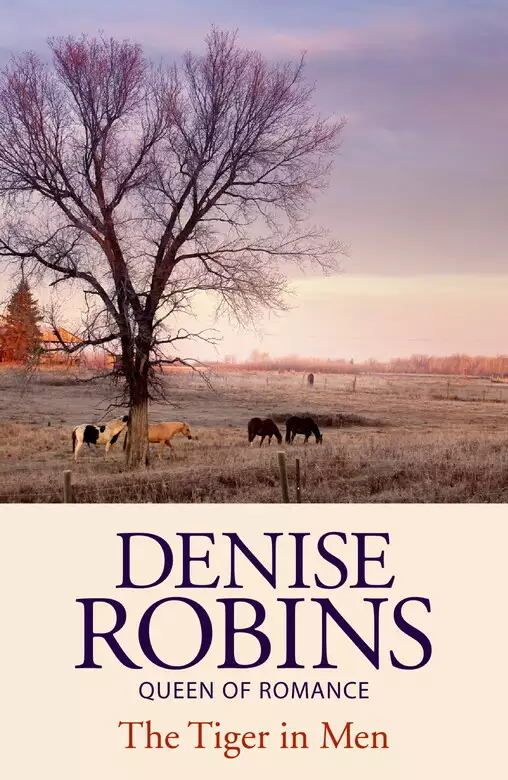
It was a wild and passionate night—a night that drives beautiful Fenella to marry a stranger, and begin the most hair-raising adventure of her life. Moments before, Fenella finds her blond fiancé Max with another woman, and in a blind fury she rides with the stranger through the Canadian wilderness to the magistrate's office—to become Mrs. Gail O'Shean. Then they part forever, or so she thinks. Try as she might, Fenella cannot forget Gail's handsome face and beautiful eyes. Max wants her back desperately. But suddenly, in a rush of kidnapping, bandits, and sheriff posses, Fenella is involved in a breathtaking intrigue. Three men want her, but only one loves her. Will she discover him before it's too late?
Release date:
March 27, 2014
Publisher:
Hodder & Stoughton
Print pages:
192
* BingeBooks earns revenue from qualifying purchases as an Amazon Associate as well as from other retail partners.
Fenella stood on the porch of her bungalow, looked out at the night, and thought it was one of the loveliest she had ever seen.
It was March, and out here, twenty miles south of Edmonton, Alberta, March meant the end of the long, cold winter, and the breaking through of the spring.
To the lonely ranchers spring signifies the renewal of hope. The growing of young green things, the shooting of the tender wheat, the bursting into blossom of the trees in the vast forests, and the thawing of the ice on the rivers. The end of hardships and the beginning of soft, lovely days, when the dead grass comes to life, and the poplars and the birches show their green, and the great white, wild geese fly across the lakes to seek their nesting-grounds.
To Fenella Shaw, this was a very particular spring. A season of rapture for her, unlike any other in her life.
It was the first spring she had known out here in the Saskatchewan Valley, for she had only come from England at the end of the autumn last year to take possession of this cattle ranch which had been her father’s legacy.
Tonight she looked with tender, speculative eyes across the fertile acres and grazing-fields which belonged to her, and away to the distant mountain peaks which were still glittering white with snow in the March moonlight.
There had been a time when she had first come out to Canada when she had felt she could never grow used to the strange, hard life which she had to lead. So different from the civilised existence of England in a London flat, and of the first twenty years of her life spent with a mother who thought of nothing but playing bridge and educating her daughter to attract a husband of means.
During those twenty years Fenella had not been unhappy, although always conscious that she was in a milieu foreign to her nature. She had missed her father. He and her mother had separated while she was still a babe. Dick Shaw had never cared for a conventional existence, nor for the frivolities which meant the breath of life to his pleasure-loving Irish wife.
Finally he had bought himself a ranch in Canada and remained there. It had flourished, and he duly sent home the necessary money to support his wife and child, but never returned to them.
Mrs. Shaw’s death of septic pneumonia left Fenella alone in the world except for this father whom she had never known and with whom she immediately communicated. After her mother’s funeral, he cabled for her to join him in Alberta.
Fenella had sailed away from England without many regrets. She had always wanted to lead an open-air life. She preferred horses and dogs and the country to the London which her poor mother had adored. She had come through the last two years of this “social round” without losing her heart to any of the men who lost theirs for Fenella. Fenella, who was slim and lovely, full of an unconscious grace and the charm of smoke-grey eyes bequeathed to her by Ireland, dark brows and lashes, and hair the colour of wheat with the sun on it.
But she had more than that haunting beauty. There was a flame in Fenella, an iron will, a spirit which had never been in her mother, and that love of adventure which had, perhaps, led her father to seek his fortune and make his way in the wilds of Canada. Mrs. Shaw had always complained of Fenella’s determination which, when she was a small child, had shown itself. They had often clashed. A queer, rebellious little thing Fenella had been, never really understood by her mother. There was still something of the rebel in the straight glance of fearless eyes, the strong moulding of her wide mouth, and the doggedness of a young pointed chin.
Being left alone in the world had no terrors for Fenella. But once she landed in Canada, she grew conscious of acute homesickness and the sudden wish to be back in London with the mother whose love was at worst the only one Fenella had ever known. After all, she was only just twenty-one, and what did she know about life in Canada on a cattle ranch and this father whom she could not even remember? She was homesick and a little afraid when she arrived at Edmonton. And still more afraid when her father’s manager met her, only to tell her that she would never know that father, and that he must for ever remain to her a stranger and a name. Dick Shaw had been killed in an accident, hunting beaver up the Hudson, a day before Fenella landed, and his funeral was Fenella’s only welcome from him.
She was terribly lonely for weeks after that. Financially she found herself well off. Everything had been left to her. She was not unlucky to become the owner of a handsome bungalow and a flourishing ranch. But there seemed little suitable companionship for one of her years and upbringing. Except for the Indian women who were servants, there was nobody within miles. And then only the rough-and-ready Canadian wives of neighboring ranchers.
Of necessity, she was thrown more than a little upon the company of her father’s manager, Max Geering. Of German and English origin, Geering was a big, fair, handsome man of a powerful, athletic build, with sleepy, long-lidded eyes, and a Teutonic passion for music, outside his work. Fenella’s father appeared to have placed infinite trust in him, and he seemed, indeed, a capable and efficient manager. Fenella was told all round that she could leave her business in his hands with utmost confidence. She also heard that Max had an eye for female beauty, and was something of a heart-breaker in the district. Such a reputation would arouse any woman’s interest, and it was not long before the girl, Fenella, looked at and spoke to her manager with feminine curiosity as well as business instinct.
Max could be charming. Max made himself more than charming to his employer’s daughter, now mistress of the Bar-None Ranch. Not only was she lovely, but she was lonely, and his own bungalow was but half a mile across the grazing-fields. He could come up in the long winter evenings, and play to her on the tinny old piano, from which his fingers managed to extract the utmost possible harmony. And he could sing, too. Little heart-breaking songs by Schumann and Schubert. In German, very appealingly, Max delivered these ballads.
There was nobody to advise Fenella. Nobody but the big blond Max to amuse her and drive away the depression of that first interminable winter when the snow seemed to fall without ceasing, and one couldn’t get outside the door for days on end and the nights were cold, dark and terrifying; long silences broken only by the hungry cry of wolves from the surrounding forests.
Fenella had ample protection in her Indian servants. Tomasso, the Chippewayan who had been Mr. Shaw’s devoted servant, would have died for “Little White Lady,” as he called Fenella. And there were others ready to die for her. She had gained an immense popularity on the ranch. She had shown such spirit in learning to ride a horse, to shoot, to fish, and to endure physical hardship stoically like other women in the vicinity.
But it was not enough for her to have faithful followers or devoted slaves. Her heart, lonely and hungry as any girl’s for human affection, cried for something more. And that something was supplied by Max.
Then in the New Year down at the saloon there had been a dance. Fenella in a pretty evening dress brought out from London, and Max, one of the only men to possess a dinner jacket, danced together the whole evening and made a handsome, devoted enough couple to cause all the tongues for miles round to wag freely for days afterwards. So it was not a matter for amazement when, at the end of January, it was announced that Fenella and Max were getting married.
Now the great day had come. Tomorrow was Max’s and Fenella’s wedding day. After tomorrow, Max would not need to come up here just to look through the accounts and talk business. He would move from his bungalow to hers, and stay here with her always. They would never be parted again. It was a delirious thought to Fenella, because she was very much in love with Max. And it was the first time in her life she had been in love and had known the intoxication of being adored in return.
There wasn’t another man in the world like Max. So fair, so handsome, so clever. A man of education and culture, as well as one who could manage a cattle ranch and make money for her as he was doing. They would run the ranch together now. She would never sell it, as once she had thought of doing. Neither would she go back to England unless it was with Max, to introduce him to a few distant cousins, and friends at home.
Her heart was here now. Her life and love were here in this grand open country with its rolling, fertile plains and blue mountains, its great broad, shining rivers, and the fine spruce forests which lay so black and dense and mysterious under the big clear stars.
Tenderly and passionately, Fenella thought of her lover and of tomorrow. It would not be the sort of wedding which poor Mum would have liked, she reflected; in a nice conventional church wearing a nice conventional wedding dress with veil and orange blossoms, and the rest of it. No smart crowd would gather at a reception to see her cut the cake. There would be no going away or honeymoon in the accepted sense of the word. She and Max had decided that they would wait until the summer, and then take a few weeks up in the mountains. But just now with the advancing of spring, and all the new cattle being born, it was advisable for Max to stay and superintend. They were to have the ceremony in the tiny chapel down the hill. Old Parson Jenkins came up from Edmonton on his sledge, driven by a pack of dogs, to perform Sunday service there when the weather permitted. Only a few people would be present. The boys on the ranch and some of the neighbours and traders. No “reception”. Just a few drinks, then she and Max would steal up here to her bungalow, and here they would start the glory of their new existence together.
Tonight, a little wistfully, Fenella thought of the dead father she had never known, and wondered what he would have thought of her marriage to his manager. Wondered what he had really thought of Max as a man. Would he have liked to see his daughter become Mrs. Geering? Certainly her mother wouldn’t have liked it. She had always wanted Fenella to marry well, and she would not have considered the manager of a cattle ranch a suitable husband. But Fenella thought him suitable. Fenella was only happy now when she was with Max. What a lover he was! Skilful enough, in fact, to make her wonder just how many other women he had held in his arms. He had had “affairs”, but he said that he had never really loved any girl but his Fenella.
This afternoon when she had seen him, and they had made the final arrangements for their marriage, he had kissed her mouth and her throat in that way which set her heart beating so madly, and he had whispered:
“One more night … and you’ll belong to me. What heaven, my liebling, for us both.”
She loved that German word of endearment which he used for her. She loved the way his sleepy blue eyes half closed when he looked at her, and the caress of his music-making hands, which he had kept quite fine and sensitive in spite of all the rough work he did on the ranch.
She had wanted to see him this evening, but he had told her that he would not come up to the bungalow tonight. He wished to make all the books up to date and leave everything in apple-pie order for the assistant manager to take over, in order that they might have a week of peace from tomorrow, and not allow the affairs of the ranch to trouble them any more than was necessary.
Fenella, wrapped from head to foot in soft brown beaver furs, roused herself from dreaming and, putting two slender fingers in her mouth, whistled like a boy for Tomasso to come with her sledge and her fine team of Eskimo dogs which Max had collected for her last winter. They were swift-running little dogs, and when the snow and ice were on the ground the Indian method of travelling was the surest and speediest. But after the big thaw, when the roads were dry, there was an old Ford motor-car which could take Fenella into the towns when she wanted to go.
Tomasso came round with the sledge, and Talooka, Fenella’s Indian maid, came out to wrap her young mistress in fur rugs, for the March nights were freezing cold. Fenella smiled at Talooka. A lovely Indian child of seventeen, slim as a reed, with a skin like polished bronze, and glossy plaits, black as a raven’s wing, swinging to her knees.
“Good night, Talooka, and don’t wait up for me,” said Fenella.
The Indian girl kissed Fenella’s hand and withdrew into the bungalow in silence. Fenella looked at the young Indian holding the dogs in check. He had an unusually sullen expression. He was Talooka’s lover. Fenella had an idea that they had quarrelled. Bu. . .
We hope you are enjoying the book so far. To continue reading...

 Please log in to recommend or discuss...
