
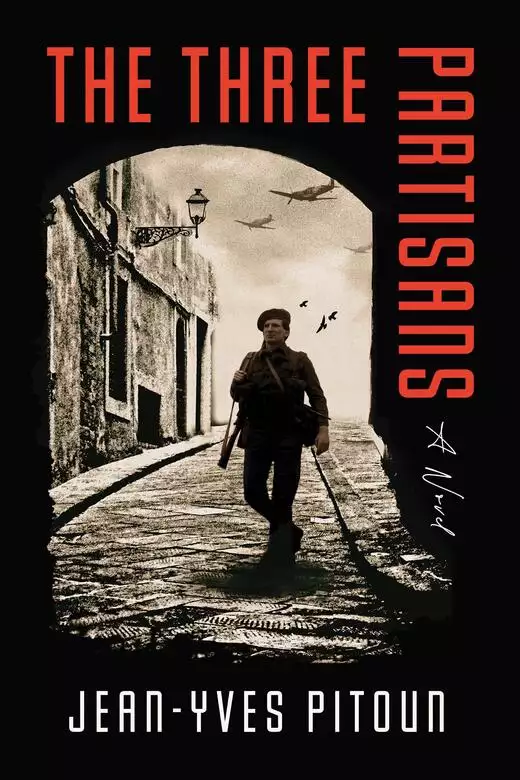
The Three Partisans
- eBook
- Paperback
- Book info
- Sample
- Media
- Author updates
- Lists
Synopsis
Based on the true stories the author grew up hearing about his father’s time fighting with the Resistance during WWII, this sweeping historical drama combines adventure, romance, and espionage to tell the story of extraordinary perseverance in the face of overwhelming odds.
This is the gripping saga of three World War II freedom fighters: Robert, an Algerian Jew, who runs away from home to join the army in Algiers; Mike, a cocky American pilot who enlisted in the Royal Air Force at the outset of the war; and Janine, a passionate and determined Frenchwoman leading missions to smuggle Allied airmen over the Pyrenees, out of France, and to safety. When fate forces the trio together, an easy friendship forms, one that soon blossoms into a fragile love triangle. With dangers mounting and SS operatives closing in, one of them is captured and must be rescued at all costs.
The story brings to life the significant cruelty of the occupation, and how the war brought out the ugliest aspects of human nature in some, but the gifts of courage, self-sacrifice, and grit in others. Filled with action-packed battle scenes, daring escapes, and a colorful cast of characters, this saga evokes the bravery and compassion that fueled the Resistance and helped win the war.
Release date: September 2, 2025
Publisher: Union Square & Co.
Print pages: 480
* BingeBooks earns revenue from qualifying purchases as an Amazon Associate as well as from other retail partners.
Reader buzz
 Please log in to recommend or discuss...
Author updates
The Three Partisans
Jean-Yves Pitoun
Glancing wearily at the empty fireplace, she scrubbed her shoulders and paced the farmhouse’s main room. It was bare save for a seed company calendar on the wall opened to October 1942 and featuring a picture of the fall harvest. She rubbed her hands and stretched her back muscles the way she used to do in warm-up exercises before ballet. How she had loved dancing. She caught her reflection in the grayed mirror above the dresser and saw, for a fleeting moment, her past self.
No time for such frivolous distraction today. She snorted at the memory and turned away from the mirror. She did not think of herself as beautiful, but she was, with dark, liquid, hazel eyes that sparkled with intelligence, yet today were filled with worry. Peering into the hallway, she glanced at the young American airman sitting on the floor, staring straight ahead. A nineteen-year-old bombardier with the US Air Force, his B-17 had been shot down over Normandy. Or so he said. Freddy Griffith was his name; he was the only survivor out of a crew of ten.
Feeling her gaze, Griffith raised his callow face from the Farmer’s Almanac he was reading and glanced around. “Do you live here?” he asked and immediately raised his hand in apology. “I know I shouldn’t ask. They told us at briefings. If we’re rescued not to ask names or where we are…”
Janine breathed in the farm smells of cured meat and cold ashes and shook her head. “No, I don’t live here.”
“Right. You don’t look like a farmer’s wife,” Griffith said with a grin.
This almost made Janine smile. She was a dentist and practiced with her father in Toulouse, one of the largest towns in southwest France.
“You’re the first person I met who speaks English,” Griffith said. “I want to thank you. I know you’re all taking big risks to help me.”
The US Air Force briefed him well, Janine thought. Yes, this was risky, very risky. She had been smuggling shot-down allied airmen to Spain and the British base of Gibraltar for over two years and had seen many resistance organizations decimated by Vichy France’s police and by German intelligence.
The previous night had been typically wearing. Janine had taken the omnibus from Toulouse, changed trains twice, and slept poorly. Her papers had been thoroughly checked as she crossed into German occupied France and she was now in the heart of Brittany, dreading the decision she might have to make. Something was not right about Griffith. His identification papers said he was born in Del Rio, Texas, and that he had trained at a base in England, but when he was put in the presence of an American pilot who came from the same base, the man claimed he had never seen Griffith before.
The pilot attested that Griffith spoke with a definite Texas twang. And MI9, the British Directorate of Military Intelligence in charge of escape and evasion, had confirmed that Griffith, a navigator from the 8th AAF bomb group based in Polebrook, had indeed been shot down on September 21 over Cherbourg.
Still, when Griffith was asked about his life in England, his responses were vague. When asked for the names of the pubs outside the base, he responded that he was a member of the Mormon Church and believed in abstinence. Also, he didn’t know that “lorry” was the term the English used for truck. Perhaps he was just not curious. Some people were like that. They go to foreign places, avoid interactions with the locals, and just stick to what they know.
Janine knew that the German Luftwaffe trained agents to pose as allied aviators. They were provided with the identification papers of captured allied airmen who had been ordered to strip down before being shot on the spot. Then a Luftwaffe agent of similar height would put on his clothes, down to the socks and skivvies, and roam the countryside until picked up by the Résistance. For the job, they recruited young Germans who had grown up in the United States and returned to Germany during the Depression, when Hitler was calling for all true Aryans to return to the motherland.
She glanced again at the young aviator flipping through the Farmer’s Almanac. Still a teenager, he looked awkward in his French civilian coat, too tight around his shoulders. This Griffith had gone through a harrowing experience, Janine thought. His plane had been shot down and his crewmates were dead. He had been cooped up in attics and cellars all over Brittany for weeks. He was obviously in shock and entitled to memory lapses. Of course he is an American airman! Janine made up her mind. If everything about Griffith checked out, she would take him to the Spanish border herself.
The war years had been hard on Janine. She had been devastated by the loss of her husband, a pilot in the French Air Force, who was killed in June 1940, a few days before the birth of their daughter, now two years old. She was heartbroken but determined to find a way to help the allied cause. Her chance came when she learned that a pilot from her husband’s outfit was helping rescue stranded British airmen. She got in touch with him and began to organize smuggling runs across the Pyrenees. When that pilot was caught and executed, Janine took the full measure of what a dangerous undertaking this was, but the airmen kept coming and they had to be helped. Janine rebuilt the network, but constant worrying was now an integral part of her life.
The sound of footsteps made her turn and Loïc Briant walked in. In his late twenties, with a broad rugged face and short-cropped hair, he wore blue overalls pushed into rubber boots under a fisherman’s coat. They had worked together for months, and she felt safe in his presence. Very safe, and Janine felt bursts of absurd love for him at times—they trusted each other with their lives but she was a doctor from the city, he was a farmer, and the distance remained. Loïc’s father had been killed in the trenches in 1916. His mother had died, and his brother was a prisoner of war in Germany. He lived alone and ran the family farm all by himself and did it well. Loïc was a rarity, a Protestant in a Catholic community. At the outset of the war, he had responded to the deacon of his church’s call to help a group of German Jews and Spanish Republicans escape a French detainment camp before the Vichy government turned them over to the Nazis. Protestants in France had a history of resistance born from centuries of Catholic persecution. Fighting the oppressor came readily to them.
Loïc nodded to Griffith, then ambled to the window to stand beside Janine. He kept his left hand in his coat pocket. Janine knew his arm was shriveled by polio and that Loïc was ashamed of it. The polio had kept him away from the army, but also from finding a wife.
“What did he say?” Janine asked.
“Agfa,” Loïc replied.
A shadow crossed Janine’s face. “Are you sure?”
“Of course I am sure. I made him say it three times.” Loïc’s eyes twitched shut periodically, a nervous tic betraying more irritation than anxiety. “They’re waiting by the bridge. I’ll take care of it.”
“Have you ever?”
Loïc shrugged off grimly at whatever was going on inside him. “First time for everything.”
Janine stared at the rain outside. When she joined the Résistance she had been forewarned that one day she might have to do the unspeakable and not expect others to do the dirty work for her. “No, I’ll handle it,” she said.
Loïc glanced at Griffith and whispered, “I can’t let you do this. Let’s talk outside.”
“No. Go get the horse ready.”
“This is wrong.”
Janine clenched her teeth, pushing away a feeling of foreboding. “It’s the way it has to be.”
Loïc shook his head like the stubborn ox he was. She was the leader of the line and he had always respected her decisions, but he could not uphold this one. And now he was angry. “I can do this better than you,” he insisted.
“It’s my responsibility,” she said.
Loïc’s face darkened as he walked to the door. “I’ll hitch up the cart,” he announced, louder than necessary.
“We’ll need coats. It’s still raining,” Janine said.
“I keep them in the barn.”
Janine waited for the door to close, then she turned to Griffith. “All right, young man, let’s go.”
Griffith closed the almanac and looked up eagerly. “Where are we headin’?”
“South. How’s your Spanish?”
“Rusty,” cheered Griffith with a big smile. “Oh, jeezus! That’s great! I can’t wait to get back. Everybody’s been real nice, but I’m startin’ to go nuts. Hell, at the last place they wouldn’t even let me look out the windows. Oh boy, that’s good. Thanks a bunch.”
Janine had learned British English in school, but now with the arrival of American airmen, she felt she had to learn the language all over again. Nuts? Thanks a bunch?
They hurried across the muddy yard and into the barn. Loïc pointed at oilskins hanging on pegs amid hats and rubber aprons. They put them on, pulling the hoods over their heads, and moved toward a horse-drawn cart. Loïc adjusted the harness and then stuffed tufts of hay into the horse’s ears.
“What’s he doin’?” Griffith asked.
Janine shook her head. She had no idea. Loïc caught the exchange and glanced at the dark sky. “Thunder… Boom, boom,” he explained, and pointed at the horse’s head. “Cheval, scared crazy.”
Griffith understood that, smiled, and helped Janine climb into the cart where she huddled on the backbench. Griffith sat beside Loïc, who slapped the reins over the horse’s back. They wheeled across the yard and onto the road. The animal broke into a gentle trot. It was raining hard, and Janine shivered in her oilskin.
While she had known that Griffith’s papers issued at Fort Bragg, North Carolina, were authentic, she had needed to be certain about the photograph on those documents. So she had asked for one final verification: a chemist working for the underground had developed a method to test photographic paper and determine if a picture was printed on Ilford paper made in England, Kodak paper made in America, or Agfa paper made in Germany.
Agfa, Loïc had said. “Griffith” was a German spy.
Janine had never killed anyone. She had never so much as slapped someone’s face. She remembered Résistance fighters talking about executing spies—it’s easier to hate people if you only see the back of their heads. “Take a deep breath and do what needs to be done,” they had said. Janine stared at Griffith’s nape. This was a nineteen-year-old kid. She feared him and felt sorry for him, but she could not hate him. As the moment approached her terror grew. She considered all the reasons why she should not do this—they had made a mistake, there had to be another way. Maybe they could lock him up somewhere. But this boy, whoever he was, had met many helpers in the last few weeks. If she let him go, they would be arrested and tortured. A few would talk. Twenty or thirty men and women would die or be deported because of this.
They crossed a narrow bridge onto the road, which snaked into a grove. This was the place. This was where it had to be done. Suddenly, she knew she could not kill this man. Do the unthinkable! she was told. The absurdity of it all infused her with unexpected strength. Janine pulled a 6.35-millimeter revolver from under her oilskin but felt suddenly compelled by the need for one last test.
“Wurdest du in Bremen ausgebildet?” Were you trained in Bremen? she asked casually in German.
“Wie?” Griffith responded automatically. A terrifying instant later he swung around, saw the gun, and lunged for it. He was well trained. Janine fought back furiously but his powerful arms pinned her to the wagon’s bench as he grabbed her gun.
Two shots rang out.
The German’s body sagged into Janine’s arms. She pushed back and watched in horror as it rolled onto the floorboards. Loïc had fired point-blank into his head. Thanks to the straw the horse had not reared, but the detonations had frightened a flock of birds that was now screeching and soaring into the sky. Loïc stopped the cart and put down his revolver.
They were both stunned. Blood was everywhere. They watched the body shake violently as life emptied out of it.
“Oh, God,” Janine whispered.
A whistle rang out and two men walked out of the woods. Breton farmers, one middle-aged, one young. Father and son probably.
“The hole is already dug,” the father said.
They slid a burlap bag over the German’s head and carried him away. Hard rain pouring, dirty pink water streaming down the floorboards. Loïc scooped a handful of straw and cleaned the blood off the bench, then he stepped ahead and removed the plugs from the horse’s ears.
Janine hauled herself to the cart’s front bench. Her face was drenched, she was trembling. Loïc climbed back aboard and with more straw, wiped the blood off her oilskin. He thought about taking her in his arms to try to comfort her. He was just about to but could not find the right way. Janine sat there, staring straight ahead, and the moment passed.
Loïc clucked his tongue, and the horse resumed his trot. Turning back, Janine caught a glimpse of the two farmers working deep in the undergrowth. She knew they would undress the body before dropping it into the grave. Civilian shoes and clothing, especially in large sizes, were scarce and expensive on the black market. Those would be cleaned and used again, hopefully on a real allied airman next time.
“I had to make sure they were right about the photographic paper,” Janine said, giving in to an overwhelming need to justify her actions.
“Your stubbornness almost got us killed,” Loïc said.
“He was my responsibility,” she replied, not giving an inch.
They rode in silence. Loïc fumed to himself. He should have stood up to her. Killing was a man’s job. He had slaughtered pigs, sheep, and cows all his life. True, killing a man was different. Gruesome. Horrible, but his job, nonetheless. He shuddered, then felt Janine’s hand on his arm.
“Thank you, Loïc,” she murmured.
He was still angry but grateful for her touch.
Janine held his arm tighter and breathed in his musky smell. Hay laced with sweat. She wanted to embrace him. She wanted to bury her face in his shoulder. She wanted his powerful arms wrapped around her body. She did nothing.
“You can cry, it’s all right, you know,” Loïc said.
“I never cry.”
Loïc’s nervous tic flashed again as his eyes twitched shut a few times. “Well, I do. No shame in that.”
Janine looked down at her hands and forced herself to stop trembling.
“Push it away,” Loïc said. “What just happened.”
Janine nodded, determined to do so and failing miserably. “Get going. I don’t want to miss my train.”
“You’re picking up airmen in Limoges?”
Janine nodded. “Griffith was supposed to be part of that convoy.”
Loïc clucked his tongue again and the horse picked up the pace.
Janine closed her eyes: a deep breath and do what needs to be done. She had not been able to.
ROBERT LEVY HATED THE PLACE where he was born. A knotted feeling weighed on his chest every time he came home to Kherrata, a small town perched high up in the Atlas Mountains of Eastern Algeria. The local population consisted of six thousand Muslims, three hundred Europeans, and about two hundred Jews, Robert’s family counted among the latter. Snow had come early that year, and a dirty white layer covered the hills. Their street, the main thoroughfare, was one of the few paved roads in town. It was Shabbat, so the Jewish-owned stores were closed, and the street was empty.
Robert worked as a mechanic in a car repair shop in Sétif, twenty miles away. He visited home rarely but tried to return for religious holidays. A few days was all he could take before his mother’s disapproval and “greater plans for her oldest son” started to take their toll. He always wore his suit for the occasion. Lean, almost six feet tall, with a tanned face and dark curly hair, he displayed an ever-present smile that added to his air of self-confidence.
When his parents’ friends, the Zeitouns, appeared in the middle of the afternoon for coffee, Robert got more than an inkling of what else his mother wanted. He joined his father, mother, sister, and three brothers: all sitting at the big dining room table facing Joseph Zeitoun, his wife, their daughter Arlette, and her two young brothers.
Robert’s father was in his early fifties but looked older. A rubber seal, hiding a dead eye, blackened the right lens on his glasses, a memento of World War I. Under this severe exterior, Robert knew there was a gentle soul who fretted constantly about the war and the future of his children. He wore his gray suit with the rosette of the Légion d’honneur adorning the lapel of his jacket. For his heroism during the Great War, he had been awarded the highest French decoration a soldier could receive.
La mouquère, the maid, served everyone, muttering under her breath, “Je n’aime pas les Zeitouns, c’est tout.” I don’t like the Zeitouns, that’s all. Of course she didn’t. Joseph Zeitoun owned a clothing factory. They were so rich as to be detestable in her view.
La mouquère had a soft spot for Robert; she thought he was the best-looking in the family. Yet she knew he was also the unhappiest. For the past three years he had lived with an ear glued to the radio, fiddling with the dials to get the latest news from the war. There was mostly bad news, with Adolf Hitler’s armies occupying Western Europe, part of the Soviet Union, and North Africa.
But lately there had been a glimmer of hope, extraordinary news censured by the Vichy government, but known to all. In June, the Free French in Libya had confronted Rommel’s German forces at Bir Hakeim and inflicted heavy casualties on the German panzer and Italian Ariete tank divisions. The term “Free French” was replaced with “Fighting French” by Winston Churchill himself. With this opening in mind, Robert was determined to join the fight.
In the typical fashion of North African Jews, Joseph Zeitoun was talking about everything but the reason for the visit. Robert’s father had bought and renovated a two-story building up the street. It had a shop on the ground floor and an apartment upstairs. “Wouldn’t this be a wonderful opportunity,” he murmured, “for the Zeitoun and Levy families to go into the retail business?”
In 1940 the pro-Nazi Vichy government had passed the loi Carré, an anti-Semitic law that took away the French nationality from North African Jews and forbade them from working in the French administration. Tens of thousands of Jewish civil servants lost their jobs and since then, all government positions were now closed to Jews. The older Levy had decided that his son should go into business.
That was not all he had decided. Robert looked across the room at the Zeitouns’ daughter Arlette, a pretty, young woman with dark hair and almond eyes Robert had known all his life. She caught Robert’s gaze and returned a friendly glance.
As a first-born son in a Sephardic Jewish family, Robert was expected to be the guardian of tradition. But rebellion was in every fiber of his body. He spoke French and fluent Arabic, but when at ten years old he was told that in addition to French school, he had to attend Hebrew school, he ran away. The entire community was in an uproar until his father found him a week later hiding out with Arab shepherds up in the mountains. His mother had beat the living hell out of him and the rabbi managed to cram enough Hebrew into his stubborn head to get him bar mitzvahed.
Now, except on the high holidays, Robert never stepped foot in a synagogue. He forgot his Hebrew and replaced it with the English he learned listening to American blues, jazz, and BBC news bulletins. English would be his key to the outside world, his gateway to freedom.
Across the table, Arlette whispered to her mother, who exchanged a few words with her husband before muttering a reluctant “oui.” Arlette winked at Robert, who stood up and followed her. Once out of the room, she took Robert’s arm, and they stepped outside. A Renault Monaquatre sedan was parked in front of the house. A beautiful automobile with charcoal fuel tanks on the roof, it was Arlette’s father’s car, and an extraordinary luxury in such a place.
Arlette led Robert to a granite bench on the sidewalk. “You’ve got to get us out of this,” she said. “If you don’t come up with a bright idea today, you’ll end up with a wife.”
“You don’t want to get married?”
“Not to you.”
His face flooded with relief, he looked at her with smiling eyes. He didn’t want to marry her, but he liked her.
“What they’re discussing in there is for you to become a shopkeeper and for us to be married before Tu B’Shevat,” Arlette continued. “And that’s in less than four months. They hope I’ll have a calming influence on you. They also expect me to be pregnant by summer. A couple of children and he’ll settle down. You know how they think.”
“I certainly do,” Robert said.
“They want to resolve this today and announce our engagement next week. Once they do that, it’s sealed. Then it’ll be a question of honor. I don’t want to be an abandoned bride.”
“They should crawl out of the Middle Ages.”
“You go tell them that.”
“They’ll be furious and will make your life miserable.”
Arlette nodded emphatically. “Yes, but you’d do that too.”
Robert smiled grimly. She was right.
Next to them on the sidewalk, a bicycle was tied to a rack with a heavy chain. Arlette followed his gaze to the hamstrung vehicle. “Your father padlocked your bicycle.”
“I can pick that lock,” Robert said. He dug into his pocket and pulled out a fat roll of bills tied with a rubber band. “I’m going to Algiers.”
“Where did you get all that money?” Arlette asked.
“My job at the repair shop.”
“We both know that’s a lie. You sold hashish again!”
Robert shifted nervously under Arlette’s disapproving look. “How do you expect me to get out of here?” he asked.
Arlette sighed and stood up. “Fine! You explain that to our families.”
“It’d be easier if I just left.”
“Easier for you but not for me,” Arlette said, pulling Robert toward the house. “Do you know how angry my father’s going to be? Well, make sure he’s angry at you.”
Robert waved a gallant hand toward the door and followed Arlette. Entering the dining room Robert flashed a huge smile. He opened his arms and marched up to Arlette’s father. “Mr. Zeitoun, Arlette and I have been talking and there is something I need to tell you, but first I have to kiss you.”
Arlette’s father glanced at his wife for approval and stood.
“God has answered my prayers,” Robert’s mother whispered as she watched Robert and Joseph Zeitoun kiss on the cheeks several times.
“Mr. Zeitoun, I’m honored. You’re willing to give me what is most precious to you—your daughter, the apple of your eye. She’s beautiful and much brighter than I am. Mr. Zeitoun, she deserves better. I can’t marry her. That would be a crime. And she doesn’t want to marry me either, she thinks I’m a bum.”
“She’ll do what I tell her to do,” Joseph Zeitoun said.
Robert’s mother held her forehead and cried. “My son, you want me in my grave?”
“Mother, there is a war and I want to join.”
“To get yourself killed!” his father barked. “You are not twenty-one yet. I decide what you do.”
“In America, boys under sixteen are lying about their age to enlist in the armed forces,” Robert said, turning to his father. “Dad, you and I have talked about this. You know we have to fight.”
“In what army? You aren’t even French! Look at me,” he said, flipping his hand by his dead eye. “You saw how they treated me. I was awarded the Légion d’honneur yet now the Vichy government’s anti-Semitic laws decide I am no longer French.”
“It’s the Vichy government, Dad. They’re traitors.”
“They hate Jews!”
“That’s why we must fight them.”
“And you’re going to fight them,” Charles Levy asked, raising his chin, “all by yourself?”
“The Free French are in Libya, the British in Egypt. The war is coming to us. Dad, you taught me that there are two kinds of Jews, the ones who whine and the ones who fight. You were in the trenches for four years. It’s my turn to fight.”
“Come here,” Charles Levy said, standing up and taking Robert in his arms. “It’s different this time.”
“Yes, it’s different! It’s worse. All we hear about is Jews rounded up and shipped away.” Robert kissed his father. “I’ll be fine. Like you, Dad.” With welled-up eyes he turned around and walked out.
“You’re letting him go?” Robert’s mother yelled as the room exploded into turmoil.
Robert’s father raised his arms to calm everyone. “At his age, I didn’t want to get married either. My father, God bless his soul, put some sense into me.”
This was news to Robert’s mother, but she quickly refocused on the crisis at hand. “Robert, come back inside!” Turning to her husband, she wailed, “He’s not coming back.”
Robert’s father sat down, put his lips together, and let out a disparaging pfuu. He spread his hands and looked at Joseph Zeitoun. “I was a heartache to my father. My son is a heartache to me.”
Outside, a car engine whined, coughed, and came to life.
“Is that my car?” Arlette’s father asked, patting his pockets. Now the roar of the Renault Monaquatre’s eight cylinders filled the room. “He took my keys!” Joseph Zeitoun said as he rushed out of the room.
The Renault was already moving. Joseph Zeitoun ran after his car but was forced to give up. Charles Levy didn’t even try. He shook his head, looking sadly after his son. The children were jumping up and down in excitement. The women were crying. It was all so upsetting.
Shifting gears, Robert spotted their maid in the rearview mirror waving happily. “Kan allah fi eawnik, Robert!” May God be with you, Robert! she shouted.
LIEUTENANT MIKE O’KEEFE OF THE British Royal Air Force Eagle Fighter Squadron felt relaxed as his plane soared over the thin layer of clouds covering western France. His unit was escorting bombers back from a raid over Germany and soon they would return to base.
A Chicago native, Mike was part of the early wave of idealistic young Americans who had enlisted in the RAF while the United States was sitting on the sidelines. The isolationists in Congress refused to help Britain. Mike was one of the top pilots in his unit, with eleven kills and tallies drawn on the side of his aircraft to prove it.
The pulsing throb of German radar drumming in his headset cut short his high spirits. Bam, bam, bam! Suddenly, all around him the sky filled with puffs of black smoke hanging in the air like paint splashes. Babablam! His Spitfire shook as the whole cockpit shattered and the top of his instrument panel shredded into pieces.
Whuuu! Mike fought back overwhelming panic—breathe, breathe, breathe! He checked the formation of bombers a thousand feet above and focused on what was left of his instruments.
The crisp English voice of Peterson, his wingman, came over the intercom. “O’Keefe, I think you’re hit.”
“I’m all right,” Mike answered.
Mike reduced speed to lose altitude. He tapped the gauge dials. The engine coolant indicator was edgy—not good. He cleared his throat to steady his voice. “Left coolant line’s shot. Right one’s holding.”
“Excellent,” Peterson said.
Mike felt intensely cold suddenly. He looked up and spotted a gaping hole in the panel above him. Then he looked down—there was another hole in the floor. Shrapnel had speared the underbelly of the aircraft and blasted through the cockpit between his legs. Mike pulled his knees up and shook his feet. His pants were soaked with blood.
“Damn!” He pulled off his glove with his teeth, unzipped his flight suit, and searched for his cock.
“You all right?” Peterson asked.
Mike pulled up his hand. His fingers were covered with blood. He wiped it off on his pants. “Krauts almost blew my nuts off.”
“I know young ladies who’d be all torn up about that,” Peterson said.
Well, yeah—Mike pulled up the talisman he wore around his neck and kissed it. A gorgeous dark-haired nurse had given it to him. It was one of her black stockings tied up with a stick of lipstick and a lock of her pubic hair—his good luck charm. He hoped to God that the thing worked—don’t let me down now, sweetie!
“Bailing out, old chap?” Peterson said.
“No POW camp for me. I’ll be fine.”
Mike checked the instruments, trying to steady the wire of fear jumping inside him. The aircraft’s lifelines shut down one by one.
“Coast’s still miles ahead,” Peterson said.
“Engine’s holding well,” Mike lied. “Give me some room.”
Mike glanced at Peterson’s plane moving away—good-bye, friend. His Spitfire’s engine could explode at any moment, and he had made sure his squadron mate would stay at a safe distance. He now squinted at the shimmering surface of the North Sea ahead. That water was home—almost. The condition of his aircraft made him an easy kill. He scrutinized the sky, searching for enemy fighters who often
We hope you are enjoying the book so far. To continue reading...
