** New from Mollie Walton, twice finalist for the Romantic Novelist Association's 'The Romantic Saga Award' **
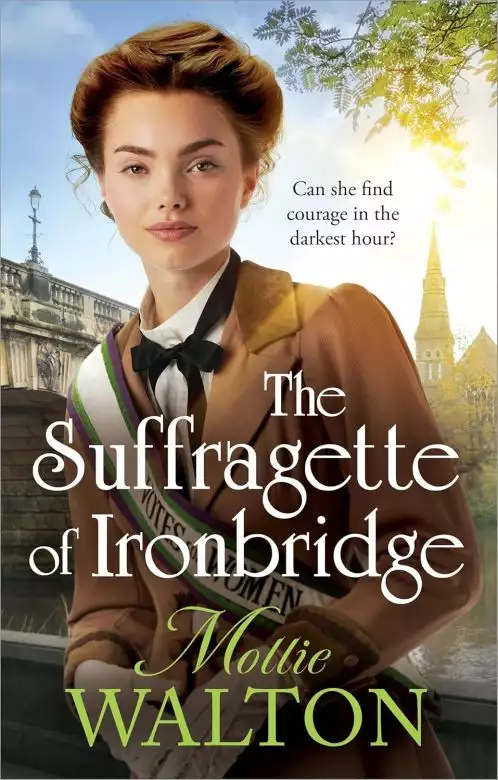
Ironbridge, 1911: Childhood sweethearts Jo and Alfie Woodvine marry and life couldn't be happier in Ironbridge. But when their baby son, Harry, is born, Jo starts to feel trapped and alone, held back by motherhood. But when she meets a group of women in the local suffragette movement, she finally finds her place again - and a purpose.
But then, in 1914, news comes that war has broken out in Europe and they receive the devastating news that her husband Alfie is to be sent to the front to fight. With Jo is left at home looking after their young toddler, and the suffrage movement on hold, Jo soon feels isolated again, until a group of Belgian refugees arrive.
Jo and her friends rally around to find homes for the new arrivals, and many others, displaced by the war. But as the war worsens, tragedy strikes the heart of the village - can Jo find the courage to keep on helping others, even in the very darkness of wartime?
A heartbreaking and powerful WW1 saga, perfect for fans of Maggie Hope and Anne Bennett. Praise for The Ironbridge Saga:
'A compelling blend of real history, rich period detail, and a gritty, authentic story brimming with love, loss, intrigue, hope, and bitter revenge' Lancashire Evening Post
'A Journey. Compelling. Addictive.' Val Wood
'Walton has created a brilliantly alive, vivid and breathing world in Ironbridge' Louisa Treger
'Evocative, dramatic and hugely compelling . . . I loved it' Miranda Dickinson
'Feisty female characters, an atmospheric setting and a spell-binding storyline make this a phenomenal read' Cathy Bramley
'Such great characters who will stay with me for a long time' Beth Miller
'The attention to period detail and beautiful writing drew me right in and kept me reading' Lynne Francis
'Vivid, page-turning drama' Pippa Beecheno
'A powerful sense of place and period, compelling characters and a pacy plot had me racing to the end' Gill Paul
'A story that is vivid, twisting and pacy, with characters that absolutely leap off the page' Iona Grey
'Beautiful and poignant' Tania Crosse
Release date:
April 9, 2026
Publisher:
Headline
Print pages:
400
* BingeBooks earns revenue from qualifying purchases as an Amazon Associate as well as from other retail partners.
When she was six years old, Jo Darlington secretly watched from the darkened hallway outside her parents’ room as her mother held a pillow over the face of Jo’s father and ended his short brutal life. He’d been lying on their bed in a drunken stupor after he’d beaten his wife in the kitchen. Mrs Darlington never knew that her little girl had seen her murder him. When the morning came, men in black coats and hats arrived at the house and Jo sat on the stairs eavesdropping on them talking with her mother. She didn’t understand what they were saying in their gruff, grown-up voices but it was something to do with the word ‘misadventure’. Her mother didn’t get arrested and didn’t go to prison. Nobody mentioned the pillow and people talked about how much Bob Darlington had had to drink that night, as he could barely walk home across the iron bridge and vomited over the side into the fast-flowing River Severn beneath, a witness had said. A doctor mentioned something about his liver and everyone said he’d lived a bad life. Jo watched her mother talk to Jo’s Aunt Stella and all the neighbours and friends and never shed a tear. Jo wondered if she’d dreamt the whole thing. But deep down she knew she hadn’t. She knew her mother – after years of beatings at the broad fists of her husband – had killed him in his bed. Jo carried the knowledge of it around in her belly like a stone and never told a soul. All she knew for sure was that it was a lot more peaceful at home without her father. And her mother looked peaceful too. Until she got sick.
Two years after her father’s death, her mother was by this time bed-bound and her skin turned yellow. The doctors couldn’t help her. She was looked after by Aunt Stella, who had a job as a nurse in the town, so was good at it. Jo stayed with her aunt’s three daughters, to keep out of the way. Jo’s cousins were all girls, all whiny and troublesome. Jo didn’t like them much, or their father, Jo’s uncle by marriage, who made his children call him ‘sir’. Jo wasn’t allowed to call him Uncle Ned and had to call him Mr Andrews instead. One day, when Mr Andrews came back from factory work, he told Jo, ‘Your mother’s dead. Go on home now.’ Men in black coats came to the house again and Aunt Stella was there. She came down the stairs and hugged Jo tightly. Jo hadn’t cried yet, just like her mother hadn’t cried for her father. Jo hadn’t cried for him either. She never found it easy to show her feelings to others. But now, what she mostly felt was fear.
Jo said to her Aunt Stella, ‘I dunna wanna live in this empty house alone. There are ghosts at night and now there’ll be one more.’
‘Oh, child,’ said her Aunt Stella, and a single tear rolled down her aunt’s cheek. Jo wished she could cry. But the tears just wouldn’t come. ‘Dunna fret. You’re to live with us now, little Jo.’
Jo was smaller than the average, she supposed. In every other way she felt completely average (apart from the fact that her mother had killed her father, but then nobody knew that but her). She had brown hair which she described to herself as being the colour of a rat or, if she were being charitable with herself, perhaps a mouse. They were both vermin, however you looked at it. Aunt Stella helped her pack a few clothes and knick-knacks and that was all she was allowed to bring from her old home to her new one. When she was taken in by Aunt Stella, the first thing her aunt did was cut all of Jo’s hair off to a bob just below her ears, because it was so knotty from the months of neglect when Jo was without her mother or aunt, while Aunt Stella had been nursing her mother half the time and the other half with her patients. The only adult more present in her life at that time had been Mr Andrews, who would rather skin an elephant than brush his niece-by-marriage’s hair. Once Jo’s hair was chopped off, she felt peculiar, the back of her neck suddenly cold and her head lighter than air. She felt like a new person and, she supposed, she was a new person now, in a new life. Everything she’d known before, every comfort of her childhood and her home, was gone, never to return.
And that was how, in the space of two years, Jo Darlington gratefully lost her father and sorrowfully lost her mother, and thus became an orphan at the age of eight and went to live with her aunt, uncle and three troublesome cousins.
Aunt Stella lived in a different neighbourhood and thus Jo started at a new school, the one on Church Hill in Ironbridge, the first day falling on a cloudy and cool spring morning. The night before she had had nightmares about looming dark things in the room she shared with her cousins. The three of them were all cuddled up together in a double bed, while Jo was on a narrow horsehair mattress on the floor in their room, beside a wooden doll’s house whose dark windows seemed to watch Jo as she shuffled to get comfortable, unsuccessfully. The four walls of their bedroom were covered in pictures cut out of magazines pasted to the wallpaper, a curious collection of angels and cherubs, little girls in posh outfits and stars of the stage in the latest fashion. Jo’s cousins fell asleep in seconds in their warm, soft bed, while Jo lay awake for ages, thinking of how her childhood bedroom had no doll’s house and only one doll, which she realised she’d forgotten and left under the bed there. Her aunt had told her all the things left in the house were sold, to pay for her mother’s funeral, or burnt, because the other items there were ‘no good’. Jo scolded herself for forgetting to bring her doll with her; how could she be so careless with her own baby doll? Perhaps it had been burnt up, a ghastly thought. She believed herself then to be a bad mother to her forsaken dolly, to also be ‘no good’.
She tried to sleep that night but ended up staring at the faces on the walls that soon turned ghoulish in her shattered mind. Jo kept waking up clutching at her face as if she couldn’t breathe, so by the morning she was exhausted. She was given a piece of bread with a smear of jam and half a cup of condensed milk by Mr Andrews (his good wife delayed upstairs fashioning elaborate plaits in her eldest girl’s hair), who complained when he was forced to mind his own children and ‘the extra’, as he called Jo. He gruffly went off to work, saying they’d made him late. Once the eldest had come downstairs, Jo was left with her three troublesome cousins. They were Sarah, seven, Sally, six, and Celia, five. It sorely vexed Jo that their three names sounded like they started with the same letter and yet Celia’s didn’t. Jo found it insupportable that her clever Aunt Stella had made such a careless mistake. It meant every time Jo found herself looking at Celia, she drew out an S shape on her palm as if to correct the error. Aunt Stella really was the cleverest person Jo knew, being the town nurse, a kind of unofficial one. Aunt Stella told Jo that she’d never had any proper training but nobody liked the young town doctor, a Mr Hale – especially the women – and so most of them called on Aunt Stella when they needed medical help, particularly if it involved ‘lady parts’, as Aunt Stella said in an undertone with a furtive look.
‘What are lady parts?’ asked Jo, but she never learnt the answer, as Aunt Stella hurried them out to school as she was late to see her first patient.
‘Get a shift on,’ said Aunt Stella, not unkindly. ‘You’re the eldest wench of the house now and all your cousins will do as you say. Get yourselves to school, my beauts, and mind your cousin, little Jo.’
Then her three cousins whooped and hollered at her half the way to school, calling her ‘little Jo’, quite decidedly meant unkindly. Jo shouted at them to shut their gobs and they did, momentarily, then whispered about her behind her back as she strode ahead. She couldn’t pretend to herself that she was not desperately jealous of them, not only because they still had both a mother and a father (although she’d be quite happy if the grumpy Mr Andrews didn’t come home from work one day, perhaps killed in a ghastly accident at the blast furnace at Blesser’s Hill where he worked). But Jo was also extremely envious of their dark hair, almost black, just like their mother’s, and how long their raven hair was and how pretty the hairstyles their loving mother had crafted for them were. Despite liking the lightness of her own new hairdo, Jo knew she looked like a boy compared to her pretty cousins, and a very little boy at that, as the eldest, Sarah, was two years younger and yet taller than her. She heard her cousin Sarah tell the others that Jo was little because she was an orphan and never got fed properly because her parents had been ‘drunken degenerates’. Jo didn’t know what the second word meant but it didn’t sound good.
‘Hush with your chinwagging,’ Jo said.
‘Yes, little Jo,’ replied Sarah, with a fake smile. Troublesome, Jo thought, and not for the first time. She tried to tell herself that her cousins’ hair was boring and traditional, while her new haircut was daring.
She had persuaded herself to be quite delighted with it, until she got to school that first day and the first thing that was said to her when she joined the queue of girls outside, opposite the queue of boys, was one girl shouting: ‘Wrong line, boy-hair!’ And then a significant portion of the rest of them all began to chant ‘Boy-hair! Boy-hair!’ at her, even though some of the girls had quite short hair too – though not as short as hers, it had to be said. Even her cousins joined in, which felt particularly treacherous. Then, one of the boys stepped out of the queue and shouted everyone down.
‘Shut your cakeholes!’ he cried.
And everyone did. The boy didn’t even look at Jo but she stared at him that whole time they waited in the insolent silence of a chastised mob. He had yellow hair and was dressed neatly in his shorts, long socks, waistcoat and jacket. Despite his neat appearance, his hands looked filthy and he picked dirt out of his nails.
Then, at long last, the queues began to move and in they went. Jo had never liked school much and had often succeeded in getting out of it for days on end when Mama was alive, under the pretence of some sort of ill-defined snuffle or helping out around the house, but they both knew it was just her mother being soft. Louise Darlington had been a kind and well-meaning person but was easily swayed by any point of view, always assuming that every other person living had a better argument than she did and, weighing up all the possibilities, she was most likely wrong about everything. Jo knew her letters and could do sums, so she knew she wasn’t an idiot and thus couldn’t see why she needed to learn anything else at school, about what lay beyond the China Sea or why lightning occurred and other mysteries. She was poor and thus destined for a ‘life of toil’, as Mama called it (her mother had taken in laundry and needlework and worked too hard). What good was such fancy knowledge when you were toiling?
However, once inside her new classroom, with the schoolmaster, Mr Woodvine, at the front, and everyone seated according to boys on one side and girls on the other, Jo listened to everything Mr Woodvine told them. He had a kind face, a kind smile, even kind hands, the way he held them before himself and gesticulated expressively during every speech he made about the interesting things of the world. That first day Jo learned about the bears of Canada, which awakened in her a sense of wonder she’d never felt before.
At playtime, they all trooped outside, the boys to the lower playground and the girls to the upper, the playground on a steep terraced slope. Jo’s cousins ran off and played with their friends, who whispered about Jo and pointed at her. Jo stood by the low wall marking the top boundary of the school and pretended to be interested in a snail climbing up it. Before long, the pretence wasn’t real and she did become fascinated by the snail and wondered how it would feel to move so slowly, as if through water, just like she had played in the shallows of the river downstream with her mother on sunny days when she was younger, the weight of the water pressing against her shins as she edged forward. Then, a tap on her shoulder made her look round and there was the kind face of Mr Woodvine looking down at her. He was tall, with brown hair shot through with streaks of grey.
‘Did you know that snails and slugs are also called gastropods?’
Jo shook her head, not really understanding what Mr Woodvine was talking about, something about peas in a pod, but just happy to be spoken to. Nobody really talked to her at her new home, except for Aunt Stella, who was rarely there. Her cousins looked at Jo as if she were a creature, not a person, and though she was used to it, she also knew you could never really get used to such a thing in your life. You could never get used to loneliness.
‘You might imagine that there is a dearth of interesting wildlife in Shropshire, but you’d be wrong,’ Mr Woodvine went on. ‘If one has a keen observant eye, there are animals everywhere one might look. Look up into the sky and you’ll see a plethora of birds and insects winging past you. Turn over a leaf or lift a rock and you’ll find more, scurrying away. And there, over there behind the town, you see?’
The school was up a hill and when you stood in the playground you could see across the town of grey boxes of houses and shops of Ironbridge nestled in the valley, fringed on each side by thick swathes of deeply green trees.
‘Within those copses of trees you’ll find all manner of wildlife, from rabbits to foxes to badgers and more.’
Jo worried about those trees, as they looked dark and brooding that day, the sky overcast. She asked Mr Woodvine, ‘Do those forests have bears in them, like in Canada?’
‘No bears, little Jo,’ said Mr Woodvine, and smiled at her.
And then he left her, striding away to break up a fight between two boys in the lower part of the playground. She watched him go and felt bereft. She looked out for the blond boy from earlier who had saved her from the cruel chanting. She saw him playing at soldiers with his many friends, running around shooting at an invisible enemy. The blond boy was leading them all in the chase, and led them again in a breakout of cheering when they had beaten their foe. Jo wondered why he had been so kind to her, a stranger, a girl with hair like a boy. Or maybe he wasn’t being kind and was somehow responsible for keeping law and order in the school. But why? Why that boy?
She watched as Mr Woodvine suddenly went over to the blond boy and took him aside, away from the other boys, and had a quiet word with him. He wasn’t telling the boy off, Jo could tell. She watched as the boy ran his fingers through his blond hair, looking puffed, with pink cheeks from his recent soldiering exertions. He nodded at Mr Woodvine, then peered around the schoolmaster’s back and pointed at Jo, straight at her. She felt glued to the spot. What was she being accused of? Then, Mr Woodvine nodded too and patted the boy on the shoulder and the boy ran off as the bell rang for the end of playtime. This vignette remained a mystery that Jo pondered until the end of the school day, when they were all dismissed and she was about to leave with her cousins, the three of them running ahead so they didn’t have to be seen with her. And the blond boy came up beside her and tapped her on the shoulder, just as Mr Woodvine had.
Jo turned and gazed at the boy in wonder.
‘My dad said you’re the same age as me and you might need a friend, being so alone in the world as you are.’
‘Your . . . dad?’ said Jo, confused as to why this boy’s father might know anything at all about her, let alone her deepest shame, that of being a blighted orphan.
‘Mr Woodvine, the schoolmaster. He’s my dad.’
‘Oh!’ she replied.
This was news indeed. And now it all made sense, how he shouted at the others and they listened to him with begrudging respect. How he led his platoon of boys in their war games in the playground. And why Mr Woodvine had taken him aside to have a word with him. She imagined that the child of a teacher might’ve taken some stick for that particular parentage, but instead it seemed to lend the blond boy a position of esteem in the school hierarchy.
‘Sorry, I didna mean to draw attention to . . . well, you being alone. Sorry if that hurt your feelings.’
‘It didna,’ she said, amazed that anyone was talking to her so kindly, let alone a boy (who, in her experience from her last school, were usually cruel and mucky things who despised girls mostly, especially one that was not conventionally pretty, like herself).
‘Good,’ he said, and nodded. ‘I’d walk you home for a bit of company but I live here.’
‘You live in the school?’ Jo imagined him and Mr Woodvine, and whoever else was in their family, sleeping all squished up together in a tight cwtch in the stationery cupboard at the back of the classroom.
The boy laughed and it was infectious. Jo actually smiled, the first time she’d done that in weeks, months even.
‘Nay, nay! We live in the cottage there, beside the school, see? My parents have a garden behind it where we grow all sorts of fruit and veg. You should see it. I’m gonna be a gardener one day. Dad wants me to be a teacher like him, but I’d rather die than be cooped up in a classroom all day, wouldna you?’
She nodded ferociously. She agreed with everything he said, whatever it was.
‘I’ll be a gardener in a big fancy garden next to a big fancy house, you’ll see.’
‘I believe you,’ she said, reverently.
‘Anyway, must get off or we’ll miss our tea. See you tomorrow. Tara-a-bit.’
He turned to go, then stopped and added, ‘Oh, and I’m Alfie, by the way. Alfie Woodvine, of course.’
And off he went, with a skip and a hop, back through the school archway for boys. She heard his booted steps recede as he went around the school, then saw the blond top of his head above the school wall as he ran up to the cottage beside the school, his head bobbing out of sight.
She stood absolutely still for a minute, her feet unwilling to move from the spot where he’d stood just moments before.
‘And I’m Jo,’ she said quietly, to herself alone.
Jo
April 1902 to December 1911
Alfie Woodvine became her champion. As Alfie’s dad was the schoolmaster, nobody gave her any open trouble after that, nothing that Mr Woodvine could see, at any rate. He protected her in a particular manner, as she’d lost her parents, just as his kindly soul protected all orphans in a particular manner, but with Jo being Alfie’s favourite, he seemed to keep a special eye out for the Darlington girl, to the chagrin of the other girls. Outside of school, the girls, including Jo’s cousins, either ignored her obviously, turning their heads dramatically away when she was nearby, or openly bullied her with taunts. There were rumours in town about her parents that never left her throughout her school years.
Walking to and from school became a trial. She noticed that grown-ups often commented on gangs of boys ranging around as trouble. Yet Jo was rarely bothered by boys. It was coteries of girls that gave her the tight sensation of fear in her chest when she heard a group coming up behind her as she walked quickly, alone, always alone. She never understood what it was that girls pinpointed about her that made them hone in on her so accurately. But they did.
‘Drunk,’ one would say, and giggle.
‘Drunk, drunk, drunk!’ another would chime in.
Mostly she would walk faster to try to evade them. Sometimes they’d wander off after that, tired of the pursuit. Other times, they wouldn’t. Instead, they’d speed up and surround her, forcing her to stop.
‘Yer father was a proper bezzler, drunk every day of his life!’ a girl would crow.
‘He drunk himself to death,’ another would add, jabbing Jo in the chest.
‘And yer mother!’
Some days Jo would shove her way free and other days she’d stand her ground.
‘That’s old news,’ she’d say, her voice riven with contempt. ‘Keep up.’
But whether she answered or not, whether she was clever or not, whether she was angry or pleading or silent, nothing worked.
‘They say yer mother was yellow as marsh marigolds when she went! What a sight!’
‘You’re a disgrace. Everyone says so. My mother says the Darlingtons are as bad as crow carrion pecked on the road.’
One time Jo shouted, ‘Nobody gives a stuff what you or yer mother think! Everybody knows yer mother did it under a hedge with the ironmonger!’
But however witty or defiant Jo was, it never earnt her enough kudos for the bullying to stop. She could tell some of her classmates did have a grudging respect for her, but they showed it by giving her a wide berth, or a solemn nod when she passed. Nothing akin to friendship. The others simply hated her with a ferocity that Jo never understood.
Why did they care so much? Why was it Jo’s disgrace to carry, that her father was a bezzler, a heavy drinker who’d drunk himself to death, and her mother had too? Why didn’t it elicit pity from them, instead of scorn? She never found the answer but wondered sometimes if some people on this earth made themselves feel better about their own mean and mediocre lives by stamping down others, forcing others down further, to elevate their rotten selves. But the worst of it was that only Jo knew the terrible truth about her parents was a thousand times worse.
And so, she turned to Alfie, who never teased her, or turned his head away, or ignored her. He’d bring extra food for her from his parents’ garden and talked with her of many disparate things, of the geography of Shropshire and the wars in southern Africa and how to be a goalkeeper at football and the mysteries of prime numbers. He was good at everything and yet people weren’t hateful towards him and no one called him a swot, mostly because his dad was such a fair man and Alfie himself was a good sport and fun to be with. Everyone liked Alfie Woodvine.
But for Jo, it was quite different. She loved Alfie from the top of her head to the soles of her feet. . .
We hope you are enjoying the book so far. To continue reading...

 Please log in to recommend or discuss...
