They came from nowhere, and now they are everywhere.
A few months after her mother dies, the novelist Naomi Alderman sets up a wildlife camera in the back garden of her parents’ home. It captures the first image of a strange new animal. Low to the ground, about the size of a badger, flat face, long, trunk-like nose. Suddenly these “mimmoths” are as common as foxes or dogs. And no one knows where they’ve come from.
As Alderman negotiates the territory of grief – a place with its own logic and rhythms – the mimmoths spread. From the UK east and west, to the United States, to Russia, to India. They seem harmless, but oddly intelligent. They cannot be captured, they will not take food from humans, they have their own purposes.
Alderman cannot shake the feeling that she has a particular connection to the creatures. Or is she just succumbing to ‘mimmoth psychosis’? As the impact of the mimmoths increases, she is pulled into the cross currents of conspiracy theories and global power struggles. Have her deeply personal forms of mourning lent recent events a surreal air, or is our reality changing drastically and irrevocably?
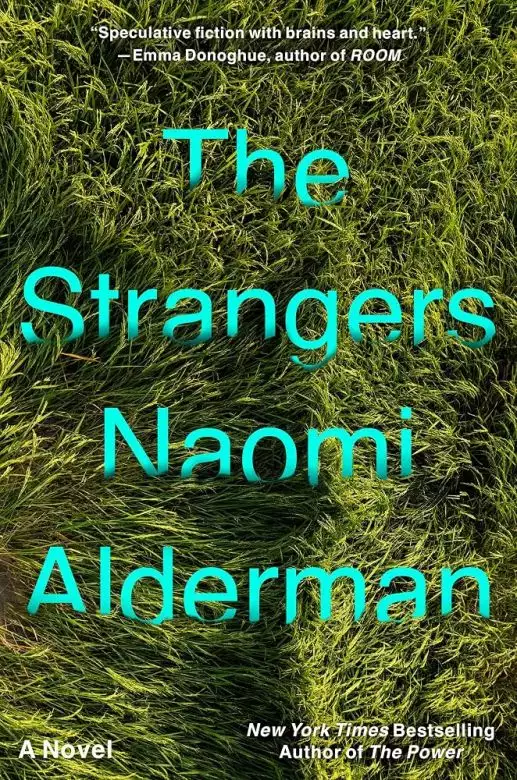
From the award-winning author of the international bestseller, The Power, The Strangers is a thrillingly original and devastatingly moving novel that blurs the lines between fiction and reality, inviting us to reconsider what it means to be human. It’s like nothing you’ll have read before.
Release date:
September 8, 2026
Publisher:
Little, Brown and Company
Print pages:
304
* BingeBooks earns revenue from qualifying purchases as an Amazon Associate as well as from other retail partners.
By chance, it was the cameras I’d put up in my dead mother’s garden that captured the first image of the new animal.
It is a strange photograph. We had set up outdoor cameras to take pictures of the foxes that visited the garden by night. Dad needed something to be occupied with. Mum had loved the garden and he loved the foxes. We strapped two cuboid low-light cameras to the trunks of three apple trees. In the morning, the cameras transmitted their photographs wirelessly to dad’s phone and he sent them on to me.
It was good to have something to look forward to, at least a starting clue for the puzzle of the new day. We had photos of fox cubs playing, of squirrels racing along the fence, of pigeons beating their wings. Sometimes we got a comical photo of dad staring at the camera in puzzlement wondering whether he’d done it right, his body lopsided with the swollen knee that already needed replacing. And, of course, we got The Image.
In The Image, a large fox is at bay. Its tail is up, its mouth is open. The time is 10.48 p.m. but the infrared camera makes it look a gloomy twilight. The fox on the lawn is baring its teeth at a shape in front of the holly bush, a creature covered in soft fur – brown and cream and black and grey. The creature’s head is down in the long grass, the face cannot be seen. Its tail is pointing towards the sky in the shape we now know as ‘fanned’ – the fur bristled out. The fox looks angry or possibly afraid, it must have made some sound. The creature in the grass seems barely to have noticed that it is being challenged.
It was the start of summer. Incipient thunderstorms rumbled all day, making the air hot with static, but never became the longed-for downpour.
Dad and I both looked at the photograph. On my phone screen, I turned it this way and that, zoomed in to try to see the face more clearly.
Dad said: ‘Your mother would have known what that was.’
We said maybe it was a badger, or a strange large cat.
It didn’t look like either of those things. However we examined The Image, it looked like an animal we’d never seen before.
I showed The Image to a couple of friends who know about animals.
Weird angle, they said. Long exposure. It probably is just another fox, or one of those creepy pedigree dogs. It must have moved while the camera was taking the picture.
The photographs from the garden changed after that, though. In the past, the foxes had played and hunted in mum’s garden. They’d crouched and leapt in the long grass which dad hadn’t found the heart to cut since mum died. Once, we’d downloaded the photographs in the morning to find one of a triumphant fox, tail erect, carrying a soft baby rabbit in its mouth. Dad and I were both distressed and fascinated. This, the picture seemed to say, is the world as it really is: foxes hunt, baby rabbits die, their bodies droop in a bloodied muzzle. But now the foxes skulked in one dark corner of the garden. The photographs showed them staring at something in the long grass, baring their teeth.
‘Put that photo on the internet,’ said dad, ‘the first one we got. Maybe someone will know what it is. We might need to make a report to the authorities. Could be a lynx.’
So I put The Image on to the internet.
At first, there was nothing. Online friends saying the kinds of things we’d already said to each other. Perhaps it’s a stoat. A weasel. Two weasels wrapped around each other. An otter. A beaver. A beaver carrying a branch. A beaver carrying a rattan mat. Are there any reports of escaped capybaras near you?
And then underneath my post was a message from someone called KeithL1982 directing a third person to look at The Image.
‘Hey, isn’t this what you said you saw on the estate?’
And a reply: ‘Duck me, yes that’s it!’
Within a few hours there was another message: someone on Orkney had seen two of them, chasing each other through a field of unmown hay.
Someone in Ipswich had seen one on a verge at twilight.
A teenager coming home from a party in the Wirral had seen one walking along the middle of a quiet suburban road just after sunrise. She’d had a clear view, the creature had been almost nonchalant. It had a flat face, long proboscis, it was low to the ground like a badger.
They had come from nowhere and now they were everywhere.
At first it was a story on the evening news about ‘what people are saying’. People are saying there’s a new animal in the United Kingdom. People are saying they have seen it at dusk or just before dawn. People are sharing this photograph which some are calling The Image.
Our photograph flashed up on the screen. The fox baring its teeth. The face not quite visible.
A thousand people called in to the television show that night. From all parts of the United Kingdom. They’d seen it on Shetland, scurrying along the edge of a road while the sheep looked on in blank amazement. But then, sheep looked in blank amazement at, for example, other sheep. One had ambled through the car park of a Co-op in Sunderland at 4 a.m., turning its strange, flat face with the proboscis towards a man dashing to the station for the first train of the morning. Everyone when they’d seen them had thought they were something else, they must have been mistaken – too big for a cat, maybe an injured dog, could be a weird badger – the light hadn’t been good, and it was no kind of animal anyone recognized.
On a Reddit thread called The Image, people began to pool information about them. They were herbivores – no, someone had seen one eating a rat, holding it down with a clawed furry foot and munching thoughtfully and contentedly as a cow. They were only seen at dawn and dusk – no one could be found who’d spotted one in broad daylight. They were covered in fur, that was certain. The fur was graduated – darker around the face, lighter at the back of the body. Except someone had seen one which was particoloured, musk brown on one side, mid-grey on the other. But could they be believed? There was so much rumour. The creatures’ faces everyone agreed were very flat apart from the nose, their eyes faced forward, their snouts were narrow and tube-like, curious and soft. They looked like a child’s drawing of a pet. They looked like an animal that came from here. No one knew what they were.
About ten days later, during one of those exhausting heatwaves that now come every summer, one of the animals was found as roadkill. It had been struck by a car which had taken a corner too sharply at 3 a.m. and, mounting the kerb, had swiped a garden hedge. The creature had been foraging in the bushes for snails, perhaps. For insects. For earthworms. For whatever the hell it was they ate. Now, they said, now we will find out about it.
The creature, when examined, fitted easily into a taxonomy of temperate-climate wildlife. It was a mammal, going by the nipples, womb and ovaries. Its fur was thick, soft and waterproof. Its eyes were perhaps a little unusual, with a secondary inner eyelid whose purpose could not be determined. Its four feet were padded and it had three toes on each foot, each one with a long, sharp claw. Each could be moved independently with a wide range of motion, more like three thumbs than three fingers. Its face in repose looked – like a dog’s – as though it were gently smiling. Its eyes were in the front of its head; its mobile snout had an interesting, moist inner cavity which looked as though it might be extremely sensitive to both smell and touch, a little more like an elephant’s trunk than a dog’s nose. When the photographs and illustrations were published in the papers and online, people called it a baby elephant, a mini mammoth. A mimmoth. Even after the scientists established that it could not possibly be more related to elephants than – say – we are, the name stuck.
No one at that point noted that this was the first roadkill and that the mimmoth had not run out under a car. This mimmoth had died because of the motorist’s bad driving, and not due to its own bad judgement.
Where had the mimmoths come from? This question was unanswerable. They certainly seemed to have come from the United Kingdom. At least, up to this point they had not been spotted anywhere else in the world. French tabloid media reported on them as ‘l’hystérie anglaise’, the English hysteria, with the implication that we had simply made them up or been taken in by some massive hoax. There were plenty of people in the UK who continued to say they were a hoax long after events had moved on quite significantly. The people who were talking about them talked about them, but many didn’t really care at all.
If the mimmoths had been in the United Kingdom – and in these numbers – all along, why had they only recently been seen? Were they a new, sudden mutation? But mutations don’t happen that way. And what species were they mutated from? One common theory around this time was that they had escaped from some laboratory which had been genetically altering animals. Or that some rogue person with an unlicensed version of the gene-editing technology CRISPR had been manufacturing them. Though to what end was, again, uncertain. They did not seem to do anything particularly threatening or even interesting. They stayed out of the way of humans as far as they were able. Like urban foxes they emerged between dusk and dawn. Unlike urban foxes they ate rats and pigeons, which seemed broadly a good thing, and they did not go rooting through anyone’s bins leaving a trail of chicken bones strewn across the road. A wildlife charity suggested that the mimmoths could be destroying habitats and that more research was urgently needed, but the charity did not suggest which habitats or what animals might be at risk. Farmers had not complained of them ruining crops, they were not damaging the foundations of buildings, there was no evidence they spread disease.
Looking back, in those early days it was easy to believe that the mimmoths were a story that would somehow simply go away or turn out to have been a silly mistake.
It was in those few weeks just after The Image that a burrow thought to be that of a mimmoth colony was discovered. It was found during scans for forgotten pipes or electricity mains before building work could begin on waste ground next to a supermarket in Staffordshire. There was a flurry of media excitement at the idea that we might see the young of the mimmoths – people love baby animals, they sell papers and generate clicks. The interest faded sharply when it was clear that this burrow had no living mimmoths in it. The entire burrow extended for around 150 feet, roughly the same size as a large rabbit warren. There were droppings, neatly contained in several podded-off areas at the rim of the burrow and half-buried along with a type of fungus which was rapidly eating through them to create clean new soil. Environmental scientists commented on this sanitary arrangement, saying we would do well to copy it ourselves, but no one was really interested in what environmental scientists said about toilet fungus.
The construction of the burrow was intriguing. It had been dug out by the mimmoths’ sharp claws and each wall was smoothed by their shiny, padded feet. In certain places there were chambers with walls made of chewed-up paper and leaves, apparently spat out and delicately plastered down with their long tongues. The suggestion was that they stuck the paper in place with a special kind of saliva. There were inner and outer chambers clearly designated for different purposes – none as obvious as the outer ring of droppings receptacles. Several chambers were almost perfect cubes with a raised squared-off area in the centre. Some had channels or grooves cut into them. One was dotted all over with large and small stones in what looked like a decorative pattern, although perhaps it was merely a heat sink. Most intriguingly of all, one very big chamber was stepped, sinking deeply into the earth and ending with a circular area of around six feet in diameter.
My father showed me the photograph of this chamber in the newspaper.
‘Look at that,’ he said, ‘just look at that! It’s a theatre.’
He wasn’t the only person saying this, although of course it was mostly a joke.
‘Your mother would have loved this,’ he said.
I wasn’t sure. She might have loved it. She might have turned the page in the newspaper with a mixture of fear and disapproval. It was too strange to be easily reckoned with or categorized.
Scientists on the television said that many species of animals have complex living quarters. They showed the moulds that have been taken of abandoned termite burrows, the chambers that regulate gas flow and temperature, the way that they are oriented north–south. The interesting question, they said, is why this one is empty.
There were many theories about this too. This burrow was rather close to a river and perhaps the mimmoths had realized that their living quarters would become too damp in time. The entrance was near also to a footpath and, given that no other burrows had been found, perhaps they simply stayed far from human beings. A humorist in a broadsheet newspaper wrote a funny weekend column pointing out that the land under which this burrow had been built was also scheduled for redevelopment. Within six months it would be dug up and filled with concrete to become an underground car park. But of course there was no way the mimmoths could have known that. Unless they’d somehow had access to the plans or begun to understand human speech! Hah!
And where were the other burrows? Not one had been found with living mimmoths in it, even though a tabloid had offered a payment of £50,000 for any information that led them to one. On their YouTube channel, the editor of the tabloid newspaper demonstrated how they could use a miniaturized colonoscopy camera to watch the mimmoths living and playing, without disturbing them in the least. He made a lot of remarks about how – no matter how small it was – he wouldn’t like this camera up his own backside. Then he had to apologize and give a donation of £5,000 to a colon cancer charity along with a prominent video on the tabloid’s website talking about the importance of colon screening for the over-fifties.
I was familiar with these flexible colonoscopy cameras; they had been a regular feature of my mother’s life since she was about fifty years old, when she’d first had a diverticular abscess which burst, leaking pus and faeces into her abdominal cavity, a peritonitis which nearly killed her. After that, she’d had a colostomy for more than a year, followed by a reversal which also formed an abscess which also nearly killed her. The investigation of her guts had been the rhythm of my years since I left college. My mother hated the invasive cameras and the gas inflation of the bowel, feeling them every time as enemy attacks which left her stomach sore and her guts bleeding and aching for weeks. Later in her life, after her brain had been worn away by multiple strokes, she wondered aloud why they couldn’t do it with ultrasound. But by this point I was already so traumatized by the ultrasound images of my own many failed pregnancies that I could only imagine the grainy black-and-white pictures as part of a personal and malicious horror film, and I did not know what response to make. It was impossible for any mention of a colonoscopy camera not to start off this chain of ideas in my mind.
There was no need for medical equipment for me to see the mimmoths playing, anyway. In the evenings, now, my father and I sometimes sat in silence looking out through the dining-room windows and the thin-paned glass door to my mother’s garden.
Several mimmoths visited regularly. We thought we recognized three of them by their body size and markings but we could not be certain. They seemed to come less often if we cut the grass so we left it long. The foxes gave them a wide berth and continued with their foxy business. They did not provoke a fight, and the mimmoths did not seem interested in provoking one either. If a fox came too near to a mimmoth, the creature would bend its stubby legs and leap high into the air, much higher than one might have thought possible, showing its pointed teeth and snarling. The fox would draw its head back and cringe, evidently as startled as we were.
And occasionally, just as the last light was dwindling from the sky, the mimmoths began to dance.
My father and I called it ‘dancing’ between ourselves with a sense of vague embarrassment, almost a joke. Online we found a few other people who had seen it and some of them called it ‘mating ritual behaviour’, although we never saw any mating happening before or after. No one had a decent video of it. We tried a couple of times but the long grass got in the way. All we could do was sit at the dining-room table, look through the window and watch.
When the dancing happened an odd number of mimmoths – three most commonly, sometimes one, and twice there were five – pounded the grass with their feet. They raced towards the centre of the circle they’d made. Stepped to the left. Stepped to the right in an orderly and hypnotic rhythm. The whole thing lasted no more than four or five minutes altogether. If there were more than one, then at points they intertwined their trunks and danced in a circle together, taking little hops and skips. The intertwined trunk was strong enough to lift each of them off the ground in turn. They made a hissing sound as they were raised up which, after a time, struck me as obvious.
‘They’re laughing,’ I said, ‘laughing with pleasure when they get lifted.’
My father put his hand on mine, the skin quite cool and pale with age, the knuckles bony and large. His eyes were damp. He was thinking of my mother. She’d loved dancing, had taken me to different ballets at Sadler’s We. . .
We hope you are enjoying the book so far. To continue reading...

 Please log in to recommend or discuss...
