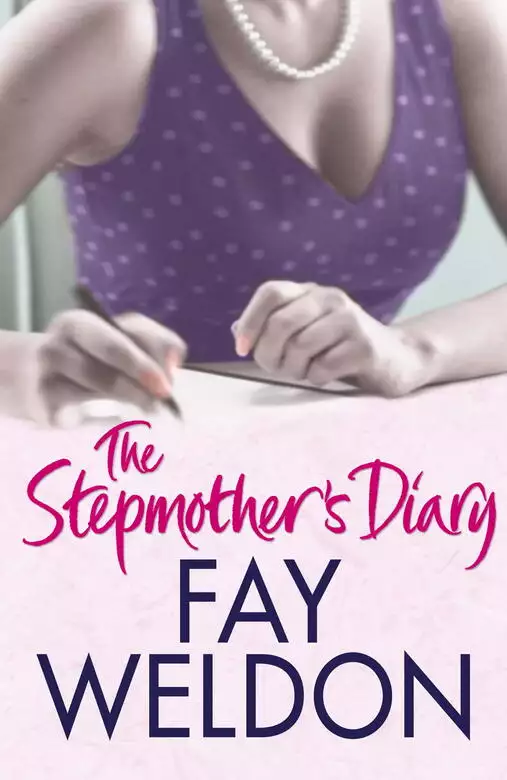
I read my daughter's diaries the other day. Let me share with you. You may think you know pretty much what's going on in your own family. Believe me, you do not.' Sappho was so happy when she married Gavin. She was in love and it seemed that at last everything was falling into place. But she hadn't considered his daughter, Isobel. She is a delightful, charming girl who spends her school holidays caring for the elderly and is the apple of Gavin's eye. Now cast in the role of Wicked Stepmother, Sappho tries all she can to befriend Isobel and find her place in the new family. It's not easy, but no one had promised it would be. Sappho perseveres. But she has a history, and the history works against her. When it becomes clear that, contrary to popular belief, it is Isobel who steals Gavin's love and attention, and Sappho who must fight for his affection, Sappho is at a loss. How can she win her husband back? With warmth, wit and her unique insights into the workings of the female mind, Fay Weldon has written a brilliant, unsettling new novel about family life today.
Release date:
May 15, 2012
Publisher:
Quercus Publishing
Print pages:
336
* BingeBooks earns revenue from qualifying purchases as an Amazon Associate as well as from other retail partners.
I read my daughter’s diaries the other day. Let me share with you. You may think you know pretty much what’s going on in your own family. Believe me, you do not. You think truly dreadful things only happen in other countries, other cultures, far away: but they also happen in your own back yard, to the nicest people, and at the hands of others who believe that they too are perfectly sane and nice, the kind who sort the household waste and try to save Africa.
Gwen, grandmother of my daughter Sappho’s stepchildren, turns out to be nothing but a two-faced, greedy bitch. And she had recently been awarded an OBE for services to charity. Mind you, the money had been as good as stolen, and from Sappho.
And to Isobel, my pretty granddaughter, currently doing her A-levels, who spends her Saturdays clearing old people’s gardens, and in whose sweet mouth butter would not melt, I was on the verge of saying, ‘I think you are evil. Not just ordinary evil, but actually satanic.’ I did not say it because I did not want to be cursed. Isobel does not projectile-vomit nor does her head turn right around on its neck, as with the child in The Exorcist, but she might as well. You can see that I am pretty angry with her at the moment.
Isobel is not actually my granddaughter; she is my daughter Sappho’s stepdaughter. There is a difference. There is no blood connection. I would not want you to think evil ran in the genes. These modern, all-inclusive families of ours, created by the passing sexual interest of a couple in each other, be they hetero or homo, can give birth to chaos. Splits happen: children pack their bags and have no choice but to follow the possessor of half their genes, leaving the other half behind. A week with this parent, a weekend with the other - if they love us so much, think the young, why don’t they get the fuck back together? Save us all this?
And as a result of modern times here is my daughter Sappho, Isobel’s stepmother, on my doorstep at ten in the morning, pregnant, distraite, and suffering.
Usually once I open the door to Sappho she goes on in ahead of me bringing with her a gust of good cheer, energy, and red-cheeked dark prettiness, which has been hers since she burst from the womb. On that occasion she didn’t even leave me time to get to the delivery room. It is not in her nature to hang about. But today she just stood hesitantly on the step and thrust a heavy Waitrose bag towards me. She was five months pregnant, and she should not have been lugging heavy stuff about.
‘I’m not going to stay,’ she said. ‘These are my diaries. I want you to hide them. Please don’t read them.’
‘Good heavens,’ I said. ‘Surely there are enough places at home to hide things?’
Home for Sappho and her husband Gavin, and his children Isobel and Arthur, was our beloved Apple Lee, a rambling, six bedroomed farmhouse of considerable age and uncertain value, located as it was just off the carbon-soaked Archway roundabout where ‘no one’ wanted to buy. Only its Grade II listing had kept developers at bay. All around was squalor and random urban development, waiting for decades for a chop which never came. Although the house had been recently and rashly renovated to the glossiest of standards (Sappho had become unexpectedly and wonderfully rich) it was already cluttered, since none of the family put anything away if they could help it. Only Laura the perfect secretary did, and these days she was kept to her quarters.
I had lived in Apple Lee for thirty years and here Sappho had been born, and her father before her, and here I had been widowed young, and assiduously pursued lovers and career. I am a psychoanalyst and work from home. I still thought of Apple Lee as mine, and myself as temporarily absent, and half regretted and half not, that I had put the property in her name so that she, not I, would have to cope with garden, stairs, draughts, rumoured ghosts, Heritage building regs, the ancient apple tree which needed treatment for blight and canker, the protected soprano pipistrelle bats in the garage which was once the stable block, the neighbours with their man-eating dogs and feral children, the street litter of fast food cartons and used syringes.
I prefer to live in a comfortable, centrally-heated, ground-floor retirement flat in Hampstead, and my few clients (Freud has fallen out of favour in recent years) certainly prefer to see me here rather than at Apple Lee.
I had not reckoned on Gavin and the children moving in with Sappho. Of course, it was on the cards that she would marry: though she always said she had no intention of doing so. That she would abandon the world and sanity for love had simply not occurred to me.
‘Not Apple Lee; it isn’t safe any more,’ said Sappho. ‘Isobel might find them and use them against me. Fucking little tart. ’That was quite shocking.
In the four years since her marriage Sappho’s loyalty to her new family — though none of them was her flesh and blood - was extreme. But perhaps now she was finally pregnant, and Stubb-Palmer blood (Sappho’s) was to mingle with Garner blood (Gavin’s) in the new child, her reactions would become less civilised and more Darwinian. She might even try to nudge the rival’s children out of the nest. The selfish gene would assert itself: she would begin to act more like a wicked stepmother and less like an angel trying to outdo her predecessor in care and concern for the young she had inherited. We would see. This morning she certainly looked a little wild-eyed and paranoiac. I hoped she was okay - it is nice when one’s theories are vindicated but one does not want one’s flesh and blood to suffer for them. Better to be proved wrong. ‘Fucking little tart’ from Sappho was out of order, and distressing; she swore occasionally but mostly at inanimate objects. ‘Fucking computer’, ‘fucking printer!’ perhaps, but not this.
‘I have to be on my own for a while,’ she said now. ‘I have things to work out.’
‘You and Greta Garbo,’ I began, but stopped. There was indeed something really the matter. She was not wearing her usual too-high heels or the silks and suedes she tended to favour: she was wearing a woolly hat with red and blue stripes and was wrapped in an old nylon navy parka, and her shoes might as well as be Gavin’s as hers. So much pregnancy can do for you when it comes to fashion, I know, but she was not at all her normal self. She had the stunned look you see on faces on TV when people watch their homes being burned, or stand among the bodies of the dead, unsure whether they’re in a dream or it’s real. She was wearing a backpack. I recognised it as Arthur’s, the one he took to go potholing, as was the hat.
‘You shouldn’t be wearing a backpack,’ I said. ‘They’re bad for the spine. What are you trying to do? Lose the baby?’
‘You would say something like that,’ she said, forlornly. ‘It’s projection. You mean you want me to lose the baby.’
I was taken aback.
‘Why would you think I wanted you to do that? Of course I don’t.’
‘Because you hate Gavin,’ she said, bleakly. ‘And it’s Gavin’s baby.’
Well, who else’s would it be? Infidelity, between them, was just not on the cards.
‘You’re so full of hormones,’ I said, ‘you’re not going to know who you hate or what you want.’
I wished she hadn’t married Gavin but I didn’t hate him. Nor, did I imagine for one moment, did she. I had seen and heard too many patients vent their rage about their spouses, how they despised them, loathed them, wished them dead - only to observe them perfectly calm and affectionate again at the next session, good sex having intervened as like as not. Gavin and Sappho had had some almighty row, which they did anyway every month or so. It was always when she was pre-menstrual, a fact she hated me to point out, and so I did try not to. Now that she was pregnant, I felt allowed to mention it. But I clearly shouldn’t have.
She glared at me, as if she were seven once again, and turned to go, in such apparent dudgeon I tried to grab hold of her, which is not in my nature - I tend to reserve physical contact with anyone for actual sexual activity. I am too often construed as a rather reserved and remote mother, but I love Sappho very much.
The trouble is that too much awareness of the fragility of the child’s erotic development can make one err on the side of caution. So many case histories offer tales of phobias and neuroses - a shoe fetish, say, or a savage Electra complex - triggered in childhood by some random action by the mother, some misinterpretation by the child of what is going on. The knowledge itself can mean one tiptoes through their lives when one should be clumping noisily about. Now, seeing she was unhappy, mother love overcame reserve and took me by surprise, and I reached out for her. And Sappho just pushed me away and said,
‘I’m going away for a bit. Just don’t try and run me to ground, okay?’
And she was gone and I was dreadfully hurt.
And I went inside and tried to make sense of it. Why did she think I hated Gavin? I was always perfectly polite to him. I daresay I tended to disparage him in the ‘Oh, men!’ kind of way women of my generation do disparage men, but he was Sappho’s choice - inasmuch as women do have a choice when their hormones are running and their expectations are sailing - and I had gritted my teeth and tried not to let her see I was appalled.
And in fact these days I get on rather well with Gavin. He was fascinated by birds and small wildlife, having been brought up on the Yorkshire moors, not far from where Ted Hughes the poet spent his childhood. My deceased husband Rob had been a friend of Hughes, and shared the love of small furry creatures, and some of it had rubbed off on me, so at least I had something to talk to Gavin about, if only rodents, crows and eagles. I am not so hot on the classical stage, which is his other enthusiasm, tending to go to the theatre only if Sappho has written the play. And that, since she married Gavin, come to think of it, and he moved into Apple Lee with the children, simply hadn’t happened. Once she had a writing career, now she does not. She has a family, and a job, and obligations. Is this what marriage does? Yes. Partnership is worse. Always peering over the shoulder to see if another is fancied more? Never!
Barnaby declares he wants to live under the same roof as me. Let him come down for a toasted sandwich and a snuggling session in bed - he has problems - but anything more? Heaven forfend.
And ‘fucking little tart’? Isobel was usually as good as gold. Girls can suddenly ‘turn’ when they reach the menarche, I know, and change from little darlings into Winehouse monsters almost overnight, embracing squalor and rough sex in a fit of enantiadromia, that Jekyll–Hyde, Saul-on-the-road-to-Damascus process so loved by Jung, but surely not our Isobel. Mind you, she was a stepchild. Stepchildren tend to have ‘issues’ in adolescence.
‘Any woman who takes on a man with a daughter takes on trouble,’ I’d said to Sappho, when she first broke it to me that she was going to marry Gavin. ‘I hope you’re aware of that.’
‘That’s not necessarily true,’ she said. ‘You just want it to be.’ She could not bear for me to be proved right, I knew, any more than I could bear it when my mother was proved right when I married Rob. But that had been a long time ago.
‘These days fathers have profound and lasting relationships with their daughters,’ I warned her. ‘Often it stops only just short of actual sexual involvement. The face on the pillow is liable to change, but a daughter is for ever.’
The daughter remains to share memories, places, laughter and keep past and youth alive, I said. ‘Wives may come and go, but daughters stay, to love and be loved and try and drive out any new woman in the marital bed.’
‘It will be different for me,’ was all she said. ‘Their mother is dead, poor things. Why should they not love me, if I make myself lovable? I will do everything I can to make up for their loss. It’s not in my nature to be a wicked stepmother.’
She simply did not, would not, get it. She resists me: I don’t blame her. It is not much fun being the child of a widowed, sexually active psychoanalyst. But the archetype has changed, whether Sappho cares to admit it or not. Wicked stepdaughters are more common now than wicked stepmothers ever were. Poor ousted Hansel and Gretel no longer roam the forest hand in hand: rather it is awash with lonely, weeping, second wives shivering in the cold and rain, tripping over tree roots, grabbed at by thistles and thorns which can pierce the heart. Hansel and Gretel stay home in the warm.
The doorbell rings again. Perhaps it is Sappho back to make her peace? In theory I can open my door by pressing a series of keys but it never happens. I thank God this is a ground-floor flat and there are no stairs and that I no longer live at Apple Lee, where the stair carpet in my time was worn and dangerous. I am in my sixties; I have a mildly arthritic knee. I open the front door to Gavin.
Behind him pass the citizens of Hampstead, to and fro as they do all day outside my window, with their smart clothes and cotton bags from the organic stores, and nowadays not a plastic bag in sight. I am up near the underground station, opposite the coffee shop. The customers have clear civic consciences, and God knows what they get up to in their hypoallergenic beds at night. Gavin is looking just fine, handsome and only moderately distraught, which is not unusual. He doesn’t come in.
‘Is Sappho here, Emily?’ he asks. I shake my head.
‘No,’ I say. Well, it is the truth. I don’t want to get involved.
‘You haven’t seen her?’
‘No,’ I say, crossing my fingers. Freud saw this as an unconscious gesture of seduction, but I do it consciously, to acknowledge and excuse a lie.
Gavin runs his hand through his hair, which I see has suddenly begun to thin. And he had such a fine head of hair once. It was part of his charm, with his intelligent eagle looks and saintly manner: all that brown curly hair, all that vigour! Gavin is nineteen years older than Sappho, and only ten years younger than me. When he is seventy and she is fifty-one, she will feel it. When she gets to my age, he will be eighty-five. I wouldn’t want a man of eighty-five. (Barnaby is sixty-seven and that is quite old enough. Barnaby lives upstairs and will be down for a toasted cheese sandwich any minute now.) And now Sappho is pregnant, and not easily able to get out of this relationship. A lot of the young these days have a kind of first disposable marriage before moving on to what they describe as the real one. This has not happened, alas, to Sappho. I want a grandchild, true, and a bird in the hand is worth two in the bush, but the girl has managed to complicate her life no end, and wilfully, not just by shacking up with but actually marrying the man.
‘Any idea where she might be?’ he asks, as if casually, but it isn’t. Something’s up.
‘No,’ I say. ‘Didn’t she tell anyone where she was going? She usually does, in case she’s needed.’
‘You know what she’s like,’ he says. ‘She writes an email and then presses delete instead of send.’
‘Doesn’t Laura know?’ Laura is their secretary and in the interests of efficiency tracks everyone’s movements, even plays back their phone calls in order to make sure dates and times are put into the Garner Times Diary, and everyone is where they are supposed to be in the right clothes and on time. It is not embossed - one of Gavin’s few economies. Once it was the Sappho Stubb-Palmer Economist Diary, her name embossed in gold.
‘Laura is temporarily out of the office,’ says Gavin. I wait, but he declines to elaborate.
‘Have you tried Sappho’s mobile?’ I ask. Gavin all but shudders. He manages email, but despises mobiles and all things digital. He is a dinosaur, and I am afraid one day he will simply topple over into hot primeval sand and crush my poor Sappho, who is a rosy, delicate flamingo.
‘It’s switched off, naturally.’ He is hostile towards her. What has she done?
‘There’s an open day at Isobel’s school tomorrow,’ he continues. ‘I just need to remind her.’ But it doesn’t ring true to me.
Now Sappho is pregnant things will have hotted up. Competition for the father will become overt. From ‘fucking little tart’ I imagine the row is most likely over Isobel.
I tell Gavin I’ll get in touch as soon as I know anything. I suggest he checks out the college where she teaches once a week, but he says there’s no reply from her office. And then he asks if by any chance she left a carrier bag with some papers, and I think: oh, that’s it. For some reason he’s after Sappho’s diaries.
‘No,’ I say. ‘Why?’
‘There are just some papers there I need.’ He is on his way to a weekend conference in the Faroe Islands.
‘Ah,’ I say, ‘the red-necked phalarope!’ He is pleased at my ornithological knowledge, and darts me one of his charming smiles, and I hope that whatever has happened between Gavin and Sappho is not too bad, and all will yet be well.
Gavin goes. I offer him a drink but I’m glad he doesn’t take up the offer. I do not want to keep up the deceit, and besides, he might catch a glimpse of the Waitrose bag.
These diaries, which Sappho doesn’t want the ‘fucking little tart’ to get hold of, and which now Gavin is searching for, are safely with me. Of course I meant to read them. I am a mother, and have my daughter’s best interests at heart. In a Waitrose bag, too, and therefore homely yet aspirational. A Tesco’s bag would somehow have diminished the contents.
Was it my duty as a mother to read them, or not to read them? I had read her diaries when she was a child until she found out I was doing it. She said nothing but began to write them as letters to me, and then we both got bored and stopped. Or perhaps she just had too much homework, being at an academic all-girls school. Did she mean me to read them while saying she didn’t? Yes, I decided. Of course.
Otherwise she would have handed them to one of her friends. I made myself a cup of coffee.
I take my mildly painful joints back to my desk, where I somehow fit. The Waitrose bag sits there and defies me to open it. I am putting it off. Do I really want to open it? Isn’t it bad enough remembering what you choose to remember, let alone facing your daughter’s memories of a mutual life?
I go back to considering the plight of the modern child in the current climate of multiple serial partnerships. The one-life, one-spouse model is outmoded. The child of the much-married or serial-partnered must live with a mere half of the provider of their genes, and as like as not the wrong half. The bed where they were conceived vibrates to the cris de jouissance of new partners, and it a rare house built to modern building specifications where the walls are thick enough to muffle animal cries of human congress. The primal scene, which Freud felt to be so important to the unconscious sexual development of the child - the first awareness of the parents’ sexual entwining - is not necessarily between the joint creators of the personality, the self, as nature intended, but is tainted by the intrusion of a stranger. In Isobel’s case, by my daughter, Sappho. The more the father loves the newcomer, the more the child hates.
Isobel’s real mother is Isolde Garner, ten years deceased, invalid and martyr of perfect memory but still very much alive, I fear, in the Garner household. Sappho and Gavin sleep with a painting of Isolde above their bed. It’s a rather gloomy composition by a fashionable but not very good artist, in patterns of greys, as if all the life had been drained out of the subject, as indeed when it was painted it was soon to be. The only light allowed is around the head, in the form of what amounts to a halo. A depressing piece.
I said once, when Sappho was having trouble conceiving the grandchild I so wanted, that perhaps the painting of an ex-wife above the bed was not a particularly good fertility omen.
‘I tried to get rid of it,’ she said shortly. ‘But Isobel had hysterics. Gavin would be more than happy to see it go, but Isobel sees it as a disloyalty.’
‘Why can’t she have it in her room?’ I asked.
‘It would upset her colour scheme,’ said Sappho. ‘The greys are too blue. She’s very artistic.’
‘Or Arthur’s room?’
‘Even I wouldn’t wish that on Isolde,’ said Sappho. ‘Arthur’s room is all dirty socks and plates of old baked beans.’ For all her money she is hopeless at running a house.
The doorbell goes again. I open it to Barnaby, my lover. I like to describe him like this, of course, and he technically is, but Viagra would help. He is more of a cuddler than a lover. Barnaby has the flat above mine: he is a Jungian who specialises in dream analysis and dream therapy. We are in and out of each other’s homes all the time, and quarrel all the time. I think, bluntly, that Jungian therapy sucks: he thinks the same of Freud. Sometimes I suggest we get married, knowing that this is the best wa. . .
We hope you are enjoying the book so far. To continue reading...

 Please log in to recommend or discuss...
