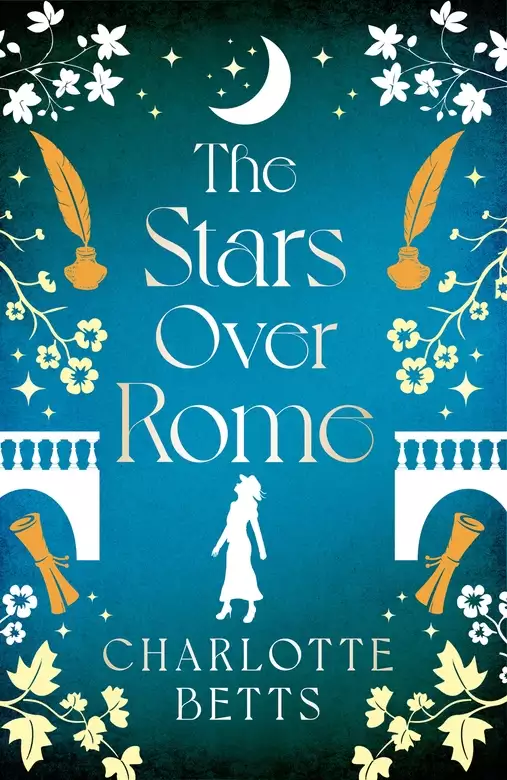
In a world where women are often overlooked, can Gabriella defy expectations and carve out a place for herself in a rapidly changing society?
Rome, 1913
To her mother's dismay, Gabriella Hazelwood has no interest in marriage or a quiet domestic life - not when she has big dreams of becoming a journalist. But when she meets Marco Santorelli, a handsome newspaper heir who believes in her ambitions as much as she does, Gabriella begins to wonder if she can have both a husband and a career.
Under the magical stars of Rome, their connection deepens, and a sweeping love story begins . . . until the shadow of war casts a dark cloud over Europe.
When Marco is called to the front, and his family's newspaper teeters on the brink of collapse, Gabriella steps in to help, only to face fierce resistance from those who believe a woman has no place in the newsroom. As she fights to prove herself, tradition and progress collide, loyalties are tested, and the devastating consequences of war jeopardises all that she holds close to her heart. Why do readers love Charlotte Betts?
'Lush, romantic and full of intrigue' Tracy Rees, Richard & Judy bestselling author
'A deeply romantic novel whose vivid characters will linger in your mind' Margaret Kaine
'Romantic, poignant and gripping . . . a fabulous holiday read' Deborah Swift
'A stunning and captivating read . . . full of drama, love, loss and life' Book Literati
'Lingers in the heart long after the final page is turned . . . a must read for anyone who wants to be absorbed as well as utterly enchanted' Carol McGrath
'A compelling story, beautifully written and brought alive with rich historical detail' Liz Harris
Release date:
September 9, 2025
Publisher:
Little, Brown Book Group
Print pages:
400
* BingeBooks earns revenue from qualifying purchases as an Amazon Associate as well as from other retail partners.
The first time I met Marco Santorelli, I hadn’t yet plucked up courage to tell my mother I wanted a career, not a husband. The summer I spent in Rome, however, changed everything.
It was grey and drizzly when Mamma and I left London. Several days later we arrived at Roma Termini Station. It was suffocatingly hot and my linen travelling suit was creased and reeked of cigar smoke. When I opened the carriage door, my ears were assaulted by a cacophony of noise: the hiss of steam, shrieking train whistles and the echoes of a thousand voices. Mamma and I descended on to the platform and into the milling crowd.
Fabrizio, my eldest cousin, was waiting amongst the throng. It had been four years since I’d last seen him and, now twenty-six years old, he’d filled out and looked prosperous in his business suit. He ran towards us and lifted me up with a whoop of delight, knocking my hat over one eye. ‘It’s been too long little Gabriella,’ he said. He beamed at me. ‘And not so little now. You have become a beautiful lady.’
That wasn’t quite true. I was too tall and angular to ever be that, since I took after my British father, but I did have Mamma’s expressive brown eyes and glossy dark hair.
Fabrizio set me down with a smacking kiss on my cheek, while Mamma eyed us with a matchmaker’s gleam in her eye.
‘Forgive me, dear Aunt Rosabella,’ he said. ‘How was your journey?’ There was a mock-mournful expression on his face. ‘No, don’t tell me. It was never-ending, too hot and all you want is to lie down in a darkened room with a cool drink.’
‘Dear Fabrizio,’ said Mamma, embracing him.
‘The family is waiting to see you,’ he said.
I straightened my hat and picked up my suitcase. My Roman adventure was about to begin.
We were given a rapturous welcome when we arrived at Uncle Vittorio’s home on the east bank of the Tiber before being ushered off to wash our hands before dinner. Later that evening, I leaned back from the dining table with a satisfied sigh, happy to be back in my aunt and uncle’s comfortably shabby house, which I would call home until mid-September. The faded wallpaper, smothered in pink cabbage roses, was hung with family photographs. A crucifix held pride of place above a sideboard cluttered with Capodimonte figurines, a Murano vase of lilies and a brass tray of multicoloured coffee cups with gold rims. The French doors were open, their lace curtains stirring in the breeze. The sun was setting and the indigo sky was streaked with orange like a painting by JMW Turner.
Uncle Vittorio, his silver hair slicked back with Brilliantine, sat at the head of the table opposite Aunt Serafina. My cousins Fabrizio, Giovanni, Matteo and Clemente were placed along the sides with Mamma and myself. Conversation was always loud and exuberant in the Castellini household, and I smiled to see how Mamma blossomed in the midst of her brother’s family. At home, she was a model of British decorum, only showing her warm Italian nature to Father and me behind closed doors. While here, she was pure Italian. Her hands took on a life of their own, illustrating her conversation with gestures, and her face was somehow more mobile when she spoke.
Aunt Serafina pushed a platter of saltimbocca towards me. It was fragrant with red wine and sage. ‘Eat, eat!’ she urged. ‘You are too thin, Gabriella.’ Her own figure was comfortably plump, her eyes almost disappearing behind the apples of her cheeks when she laughed, which was often.
‘I couldn’t manage another morsel,’ I said.
‘So, what’s happening in Britain these days?’ asked Uncle Vittorio. ‘If what I read in the newspapers is true, it sounds a troubled place.’
‘The newspapers are full of stories about the government and the trade unions at loggerheads,’ I said. ‘Then there’s tremendous unease over the war in the Balkans, and the Germans are manufacturing battleships so fast that everyone is concerned they’re a growing threat to the supremacy of the British navy.’
‘I heard a suffragette martyred herself by running into the path of the King’s horse,’ said Aunt Serafina. ‘How foolish!’
‘I don’t condone the rising violence of militant suffragettes,’ I said, ‘but I do sympathise with their demand that women be allowed to vote.’
Uncle Vittorio huffed. ‘Votes for women? What nonsense!’
Although I felt passionately about votes for women, I didn’t want to argue with my uncle when I was his guest. I turned to Fabrizio. ‘Last time I was here, you’d finished your military service and were at university. You must be a fully fledged architect by now?’
‘I work in Papà’s practice, with Giovanni hard upon my heels a year behind me. Papà is determined Vittorio Castellini and Sons will be at the forefront of the architectural world.’ Fabrizio refilled my wine glass. ‘And you, Gabriella? What will you do next?’
‘It’s time she stopped scribbling all those stories and put away her books,’ said Mamma. ‘I must find her a husband before it’s too late.’
‘Twenty-one is still young enough,’ said Aunt Seraphina, ‘but don’t leave it too much longer.’
‘I want to be a journalist,’ I said. Mamma drew in her breath sharply. I made a point of not looking at her. I hated it when she clasped at her heart as if I’d mortally wounded her.
Matteo, my youngest cousin, sniggered. ‘A journalist! That’s a man’s job.’
‘Why?’ I said. ‘A pen isn’t too heavy for me to lift.’
‘You might have to go to places that are dangerous for women. Besides,’ he looked at me warily when I glared at him, ‘what man wants to read anything written by a woman?’
‘I was at Sapienza University with a student whose father owns a news periodical called Il Nuovo Romano,’ said Fabrizio. ‘Perhaps you’d like to meet him, Gabriella?’ He sent Mamma a mischievous glance. ‘It must be about time he settled down, Aunt Rosabella. He’s already the managing editor, and he’ll inherit his father’s business one day.’
‘He’s a nice boy,’ said Aunt Serafina.
Mamma nodded decisively. ‘Gabriella should meet him,’ she said. ‘He will tell her journalism is unsuitable for a woman and …’ Her voice trailed away.
‘I’ll write him a note,’ said Fabrizio.
Mama and I both smiled, but for quite different reasons.
It was good to be back in the warmth of the Italian sunshine. Over the following days I sat in the courtyard, half-listening to the ebb and flow of Mamma and Aunt Serafina’s gossipy conversation while I wrote up my travel notes in my best handwriting.
One morning, Fabrizio and I left Mamma and Aunt Serafina poring over the family photograph album and set off together along the cobbled streets.
‘You’ll like Antico Caffè Greco,’ said Fabrizio. ‘It’s a popular meeting place for musicians, philosophers, intellectuals. Byron and Keats once frequented it.’
I was nervous about talking to Fabrizio’s friend, and hoped he wouldn’t try to dissuade me from my ambition. I’d read Uncle Vittorio’s copies of Il Nuovo Romano from cover to cover and prepared several travelogues, in Italian, in case I was asked to provide samples of my work.
Leading the way through the crowd at the foot of the Spanish Steps, Fabrizio ushered me inside Antico Caffè Greco. He removed his straw boater and hung it on a coat rack. We sat on chairs upholstered in scarlet velvet, and I studied the paintings in gilded frames that adorned the damask-clad walls.
We were watching the entrance and sipping excellent coffee when a young man pushed open the door. Tall for an Italian, he wore a cream linen suit. He paused in the doorway before lifting a hand to greet Fabrizio.
At a nearby table two ladies nudged and whispered to each other as he slung his boater on to the coat hook beside Fabrizio’s and strode towards us with leonine grace.
‘Forgive me for keeping you waiting,’ he said.
His deep and mellifluous voice sent a tremor down my back. Suddenly, the room felt awfully hot.
‘Gabriella,’ said Fabrizio, ‘may I present Marco Santorelli? Marco, this is my cousin, Signorina Gabriella Hazelwood.’
‘How do you do, Signor Santorelli?’ I said. His chin was firm and he had an imposingly aquiline nose, fit for a Roman emperor. I held out my hand, and his warm smile dispelled any severity in his expression.
‘I’m delighted to meet you, Signorina Hazelwood.’
When the skin of his palm touched mine, the hubbub of the café faded away and a shockwave coursed up my arm. The back of my neck prickled as I became transfixed by his gaze. His dark brown irises were flecked with amber, like tiny glints of sunshine.
Fabrizio coughed.
I blinked, unsure how long I’d remained spellbound. Hastily, I let go of Marco’s hand.
‘Surely we’ve met before, Signorina Hazelwood?’ he said.
‘We must have,’ I stammered. ‘At least, I feel I know you.’ I looked at Fabrizio. ‘Perhaps we met when I came to stay with you last time?’
‘I don’t believe so,’ he said.
‘How strange.’ Marco frowned. He sat down and crossed his long legs before catching the eye of a passing waiter and ordering coffee.
Fabrizio gave me a quizzical look. I returned a bland smile but, inside, I was trembling. Something momentous had happened but I didn’t know what it was.
‘So, Signorina Hazelwood,’ said Marco, ‘Fabrizio tells me you’re a fiercely intelligent bluestocking.’
‘I’m not sure about that,’ I said. ‘I do have a thirst for knowledge, and a desire to see more of the world. I read widely, and grew up bilingual in English and Italian. My father taught me Latin and my German governess spoke to me in her native tongue and taught me French.’
‘And you have aspirations to be a journalist?’
‘I keep a journal and write short stories, but I intend to write travelogues and features.’
‘Then you will, of course, need to be in a position to travel.’ His gaze rested on my face like a caress. ‘It’s impossible for an attractive unmarried woman to travel alone.’
I tried to ignore the flush that warmed my cheeks. ‘Perhaps I might look for a position as a governess to a diplomatic family. Then I’d be able to accompany them abroad.’
Fabrizio laughed. ‘I can only imagine what Aunt Rosabella would say about that.’
‘I will not sit in my parents’ drawing room knitting tea cosies for the rest of my life, Fabrizio,’ I said.
‘A tea cosy?’ asked Marco, his expression perplexed.
‘A useless item that spinsters are obliged to make, in order to appear as if they are doing something useful to justify their existence.’ There was more than a touch of acerbity in my tone.
Marco’s lips twitched. ‘You might send some of your work to a local newspaper.’
‘I will, when I return to London,’ I said. ‘I’ll take a course in typewriting, too, since that may offer wider opportunities for employment in a publishing house.’
‘You’re clearly a determined young lady, but I doubt it will be easy for you to find employment. You need good connections and, even then, your writing would have to be of a high standard.’
‘As it happens,’ I said, delving into my handbag, ‘I have some travelogues here. On our journey to Rome, my mother and I stopped in Paris, Basel, Milan and Florence.’
‘Give them to me, but I warn you I’ll be absolutely honest about your ability.’
‘I wouldn’t expect anything else.’ I handed him an envelope.
‘Are you staying in Rome for long?’
‘Until the middle of September.’
‘Excellent!’ he said. He turned to glance at a waiter carrying a tray of cakes on his shoulder. ‘I’ll look at your travelogues later, but first, shall we order some of those delicious cakes? I recommend the Sacher Torte.’
The following day I sat in the courtyard with Mama and Aunt Serafina in the dappled shade of the pomegranate tree. Mamma fanned her face with her napkin. ‘The last time I was here was the summer after little Elena breathed her last,’ she said.
‘Your precious girl will be sitting at the feet of the blessèd Virgin, along with all your other little ones,’ murmured Aunt Serafina, crossing herself.
For much of my childhood, Mamma had been recovering from the loss of a baby or anticipating the birth of another that never survived beyond a few weeks. Sometimes I wondered how it would have been had my siblings lived and our home been as full of noise and laughter as my cousins’.
Filomena, the maid, came to announce that Signor Santorelli had come to call.
Hastily, I smoothed my hair, hoping my nose wasn’t too shiny from the heat.
Aunt Serafina gave Mamma a knowing look.
A moment later Marco entered the courtyard through the French doors. ‘It’s good to see you again, Signora Castellini. I hope I haven’t called at an inconvenient time?’
‘Not at all,’ said Aunt Serafina. ‘You’ve met my niece, and this is her mother, Signora Hazelwood.’
Marco shook their hands and then mine. I was prepared for the same unnerving sensation I’d experienced before and was slightly disappointed when it didn’t occur. Nevertheless, my pulse skipped. I told myself it was because I was anxious to discover what he thought of my articles.
Mamma studied Marco for a moment and then smiled. ‘Gabriella told us your father owns Santorelli Publishing.’
‘My husband subscribes to Il Nuovo Romano,’ said Aunt Serafina. ‘He says the articles are very well-written.’
‘Unlike some presses,’ said Marco, ‘we aim to appeal to the more intellectualreader. I’m happy Signor Castellini approves.’
I suppressed a snort of laughter at Marco’s blatant flattery.
He glanced at me, eyes alight with amusement. ‘Signorina Hazelwood, I’ve read your travelogues.’
‘Did you find them of interest?’ I crossed my fingers and held my breath.
‘They’re charming.’ He opened his portfolio and extracted the envelope containing my articles. ‘My father liked your attention to detail when describing the art, architecture and ambience of the cities. The tone of your work, however, is slightly humorous, and he thought this wouldn’t suit Il Nuovo Romano. I offered my opinion that they might make a pleasant contrast to some of our weightier news features.’
‘I’m delighted you liked them.’
‘I do, but your writing needs to be more concise.’
‘Then I’ll learn from your helpful comments,’ I said.
Filomena brought us lemonade and a plate of almond biscuits.
Marco sipped his drink. ‘Signora Hazelwood, with your permission, I’d like to invite your daughter to visit the Santorelli Publishing offices to meet my father. That might assist her in deciding if she still wishes to embark upon a career as a journalist.’
‘I have reservations about Gabriella’s ambitions, Signor Santorelli,’ said Mamma, ‘but it would be useful for her to discover what such work entails. I’m not sure she appreciates the difficulties.’ She turned to me. ‘Would you like to meet Signor Santorelli’s father, Gabriella?’
‘Very much,’ I said, barely able to conceal my excitement.
‘Then I will chaperone you.’
‘Mamma!’ I protested. How could I possibly attend a business meeting with my mother in tow?
‘This is Italy,’ she said, in a tone that brooked no argument. ‘Young ladies do not have the same freedom here as you sometimes find in London.’
Marco turned his palms to the sky. ‘My father would be delighted to meet you, Signora Hazelwood.’
We agreed that Mamma and I would meet Marco at the Trevi Fountain two days later and walk together to the Santorelli Publishing offices near the train station.
Marco stood up. ‘Thank you for your hospitality, Signora Castellini.’ He turned to Mamma. ‘I shall look forward to seeing you very soon. And you, too, Signorina Hazelwood.’
‘It’s kind of you to help me,’ I said.
‘Believe me, it’s no trouble at all.’ He looked directly at me with a half-smile.
Filomena ushered Marco away. But as he went through the French doors, our gaze locked for a split second, and I experienced again that peculiar feeling of recognition. I shivered slightly, though the courtyard was hot.
‘Well!’ said Mamma. ‘I wish your father had been here to meet that young man.’
For the first time I could remember, Mamma’s attempts at matchmaking didn’t irritate me.
Two days later, the July sun bore down on our shoulders as Mamma and I walked towards the Trevi Fountain. Nervous anticipation for our forthcoming meeting had made it impossible to eat any breakfast. I wore a white blouse with my linen suit, now cleaned and pressed, and I’d removed the tulle roses from my straw hat and replaced them with a ribbon that matched my tan shoes and bag. I hoped I looked suitably business-like for an aspiring journalist.
Mamma, as elegantly dressed as always, walked beside me and exclaimed in delight when we passed places she’d known in her younger years.
‘I have fond memories of the Trevi Fountain,’ she said. ‘I brought your father here soon after we became engaged. We followed the tradition of throwing coins backwards into the fountain, as an offering to the gods to ensure we’d return to Rome again.’
‘It must have been painful though, for you to leave your family behind when you married Father?’
‘Yes, but I never doubted he was the right man for me. We fell in love on my visit to London in 1888, the year after my mamma died, but Papà refused to consider Theo as an eligible suitor. He said I’d be miserable if I lived somewhere without sunshine. I said Theo was all the sunshine I needed, but Papà wouldn’t listen. I wept all the way back to Rome.’
‘What changed Grandfather’s mind?’
‘A month after we returned to Rome, Theo presented himself at our front door carrying an enormous bouquet.’ Her face lit up at the memory. ‘He’d persuaded the museum director he needed to come to Rome to evaluate some statuary for sale. Of course, I was never allowed to be alone with your father, but he came to see me every day during that visit.’
Mamma and I arrived at the Trevi Fountain. Visitors crowded around to watch the water gush from the vast statue of Oceanus guiding his shell-shaped chariot through a triumphal arch. The sparkling turquoise pool was a deliciously refreshing sight and sound in the heat of a Roman summer.
I glimpsed Marco’s lean figure weaving purposefully towards us through the sightseers and my heart somersaulted.
‘He’s handsome,’ said Mamma. ‘I can see why you’re taken with him.’
‘Mamma!’ I protested. My cheeks were still flushed when Marco reached us. His smile was so warm when he looked at me that I became even more flustered.
‘Do you see the two sea-horses pulling Oceanus’s chariot?’ he said. ‘One is wild and the other docile, representing both the turbulent and calm moods of the sea. The water comes from a Roman viaduct that supplied Emperor Augustus’s baths.’
‘The ancient Romans still have such a presence here,’ I said.
‘Everywhere you look. Shall we go?’
Mamma and I walked at a brisk pace to keep up with him, and we soon arrived in the Piazza Esedra. We then turned into a street that bordered the Basilica of Stara Maria degli Angeli. Marco told us that Michelangelo had been the architect of a section of the basilica, which was built within the ruins of the ancient Roman baths.
‘Do you think the Romans ever wondered about how far their influence would reach into the future?’ I said.
‘Their empire was so powerful, I doubt they imagined it would ever wane,’ said Marco.
We passed the station and turned into a narrow road flanked by buildings with peeling facades. Several horse-drawn wagons, parked outside the open doors of warehouses, were being loaded or unloaded by workmen. I wondered if I’d over-romanticised the idea of working for a magazine.
Mamma looked at me, her eyebrows raised.
Marco intercepted her glance. ‘This part of town isn’t smart,’ he said, ‘but it’s a convenient and affordable location.’
‘Do you live nearby?’ asked Mamma.
‘My family lives in one of the streets behind the Spanish Steps.’
She nodded her head in satisfaction. ‘An elegant part of town.’
Marco led us to a building with green shutters and stopped before a once-grand entrance. Barred windows at pavement level presumably afforded light to a basement below, and a plaque on the wall was engraved with the words Santorelli Publishing.
Marco opened the door.
I straightened my back and stepped over the threshold.
Inside the hallway, our footsteps clipped across the stone floor. Mamma and I followed Marco up a staircase to the landing above.
‘Come in to the editorial department,’ he said.
The long space was poorly lit since the shutters were half closed in an unsuccessful attempt to keep out the summer heat. A pall of cigarette smoke curled over the rows of desks where a dozen men scribbled in notebooks, leafed through piles of paperwork or rattled away at typewriters.
‘This is where the sub-editors and reporters write their copy before it goes to the appropriate editor,’ said Marco. ‘Would you like some coffee?’
‘Thank you,’ said Mamma.
Marco asked a young man at a nearby desk to fetch coffee from an adjacent café.
It was impossible not to find the dingy room depressing, but it gave me a little thrill of excitement to know that, from this unprepossessing space, stories of political scandal, high-profile court cases and criminal acts were brought to life.
Several faces turned to watch when Marco led us between the desks. He stopped to exchange a few words with a grey-haired man. ‘This is our senior reporter Salvatore Palumbo,’ he said. ‘I learned much of what I know of gathering news from this man.’
Salvatore stubbed out his cigarette in a saucer overflowing with butts and gave us a world-weary smile. ‘Marco stuck to my side for years like an irritating burr, but he’s turned out to be a good-enough newspaper man.’ He leaned towards me and whispered, ‘I have to say that because he’s my boss now.’ He winked at Marco, picked up his pen with ink-stained fingers and turned his attention to his notebook again.
Clearly dismissed, we walked on. At the end of the editorial department was a door with the words Managing Editor painted in gold on the glass.
‘This is my office,’ said Marco.
The room was furnished with a mahogany desk, filing cabinets and bookcases. There was a painting of the Colosseum over the fireplace and a Turkish rug on the floor.
‘This is more comfortable,’ said Mamma.
‘Do sit down,’ said Marco. ‘My father made me work my way up from copy-boy in my school holidays to junior reporter when I was at university. After I graduated, I was sent to work with the typesetters for a while, and then shadowed Salvatore before working with the sub-editors.’
‘What is a sub-editor’s role?’ I asked.
‘They work on different types of news – features, politics, international news and so on.’
‘I see. You don’t have any female employees here?’
‘Only to do the cleaning.’ Marco shrugged apologetically. ‘Even if you managed to secure a position as a journalist at a periodical or newspaper, I’m not sure a lady would find it congenial to work in an editorial department.’
‘It wouldn’t be suitable at all,’ said Mamma.
Privately, I couldn’t help but agree. ‘I want to be self-supporting,’ I said.
‘A freelance journalist’s income is unlikely to make you rich, Signorina Hazelwood,’ said Marco, ‘but living at home with your family, you might submit your work to various publications. You could remain independent that way, rather than working as an employee for one publication.’
‘Self-supporting or not, you must remain at home, Gabriella,’ said Mamma. ‘Until, of course, you marry.’
The young reporter Marco had spoken to earlier carried in a tray of coffee cups.
‘Thank you, Guido,’ said Marco.
We sipped our espresso and the bitter brew braced me for the coming meeting with Marco’s father.
We returned to the editorial department, and Marco knocked on a door with the words Chief Editor sign-written on it.
Two men were in the room. A middle-aged man of distinguished appearance sat behind a leather-topped desk, and his visitor, powerfully built with black hair, lounged on a chair opposite him.
‘Oh, I beg your pardon,’ said Marco. ‘I didn’t know you had a visitor.’
‘Come in, come in!’ said the man behind the desk. He bore a strong resemblance to Marco, although Signor Santorelli senior’s hair was flecked with silver. ‘Signor Lionetti is leaving.’
Lionetti unfolded himself from the chair, brushed a speck of fluff from the sleeve of his immaculately tailored suit and smiled.
‘Forgive us, ladies,’ he said. ‘Our meeting overran. You know how it is when two newspapermen get together. I have the pleasure of being the owner of Roma Oggi, a relatively new and vibrant news magazine. We had so much to discuss, didn’t we, Pietro?’
‘Indeed. Marco, will you show Signor Lionetti out?’
I thought Marco’s father was a little abrupt with Signor Lionetti, but perhaps social niceties were different in Italy.
Lionetti shook Signor Santorelli’s hand. ‘Until next time, then, Pietro,’ he said.
‘Please come with me,’ said Marco, ushering Lionetti from the room.
‘You must be Signora and Signorina Hazelwood,’ said Signor Santorelli. He stood up and offered his hand to Mamma and then to me. Father and son had the same almond-shaped eyes and straight black brows.
‘It’s kind of you to see us,’ I said.
‘I’m always happy to meet my son’s friends.’ He pulled chairs forward for us. ‘I understand you’re interested in a career in journalism, Signorina Hazelwood?’
‘As a child I was always scribbling a story,’ I said, ‘but now I’d like to write travelogues and features.’
Marco. . .
We hope you are enjoying the book so far. To continue reading...

 Please log in to recommend or discuss...
