
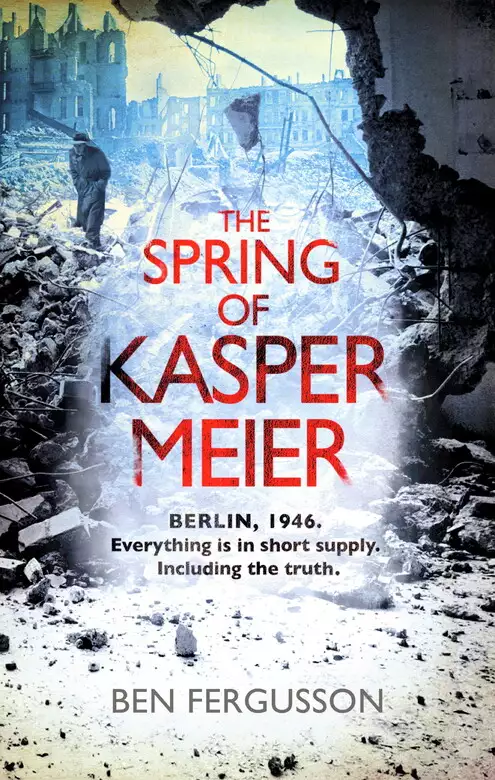
The Spring of Kasper Meier
- eBook
- Audiobook
- Book info
- Sample
- Media
- Author updates
- Lists
Synopsis
The war is over, but Berlin is a desolate sea of rubble. There is a shortage of everything: Food, clothing, tobacco. The local population is scrabbling to get by. Kasper Meier is one of these Germans, and his solution is to trade on the black market to feed himself and his elderly father. He can find anything that people need, for the right price. Even other people
When a young woman, Eva, arrives at Kasper's door seeking the whereabouts of a British pilot, he feels a reluctant sympathy for her but won't interfere in military affairs. But Eva is prepared for this. Kasper has secrets, she knows them, and she'll use them to get what she wants. As the threats against him mount, Kasper is drawn into a world of intrigue he could never have anticipated. Why is Eva so insistent that he find the pilot? Who is the shadowy Frau Beckmann and what is her hold over Eva?
Under constant surveillance, Kasper navigates the dangerous streets and secrets of a city still reeling from the horrors of war and defeat. As a net of deceit, lies, and betrayal falls around him, Kasper begins to understand that the seemingly random killings of members of the occupying forces are connected to his own situation. He must work out who is behind Eva's demands, and why—while at the same time trying to save himself, his father, and Eva.
Release date: July 3, 2014
Publisher: Little, Brown Book Group
Print pages: 400
* BingeBooks earns revenue from qualifying purchases as an Amazon Associate as well as from other retail partners.
Reader buzz
 Please log in to recommend or discuss...
Author updates
The Spring of Kasper Meier
Ben Fergusson
Sergei Ignatov sat in the middle of the group of singing soldiers, the only one not to have taken off his green padded jacket. As they sang, the other men, who were all ten years his senior, would jostle him, ruffle his hair and invite him to stand up and sing. He would laugh shyly and knock away their hands in a friendly, bear-like gesture.
Sergei was watching Frau Leibnitz at the bar. They had been coming here for three weeks and he had hoped each time to ask her to share a cigarette with him, but every time he tried to strike up a conversation he choked on the words and miserably took his drinks back to his table of roaring comrades.
In his bed, early that morning, he had thought about Frau Leibnitz and masturbated quietly under his woollen blanket. He would make love to her gently, his face buried in the soft curls of her brown hair. It would be different from his first time, jeered on by his friends, their hands slapping his back and their cheers as he came into the crying girl. It would be just him and Frau Leibnitz and they would both be completely naked. He had never seen a woman completely naked before; at least not one that was alive.
‘I’m going back,’ said Sergei. His friends, who were now trying to climb onto the table to dance, didn’t hear him. Some schnapps spilled from one of their glasses and wet his leg. He said again, ‘I’m going back now,’ and he stood up and moved across the bar towards the door. As he opened it, he turned towards Frau Leibnitz, but she didn’t notice the teenage boy at the door; she was staring ahead, her fingertips hovering above the stained tablecloth spread across the bar.
The snow was gone, but Sergei could still feel winter in the wind that whipped down the street, flicking up dirt from the ruins opposite. Only four buildings in Frau Leibnitz’s street were still standing; in the daytime the rest became a citadel of towering brick walls, thin, burnt, streaked with rain, atop rolling hills of grey stone and dust. But in the meagre light from a half-moon and a few bright stars in an otherwise cloudy sky, the piles of debris rose and fell beside him like the silhouettes of distant mountains.
He walked down towards Schönhauser Allee and soon he could hear his footsteps louder than the Slavic voices coming from the bar behind him and for a second he imagined he was back in Kazan, walking back to his parents’ house from the school. Sergei sniffed, shrugged his shoulders and spat onto the floor. He decided that he would bring Frau Leibnitz some sort of gift the following day; some tinned meat perhaps, or maybe something more romantic – some soap or stockings.
He heard a sound – the scrape of a shoe – and put his hand on his gun. He looked down, then back towards the bar and then up the main street, but he saw nothing. He heard the noise again and, turning, he noticed a woman standing in the doorway of a partially collapsed building. Her skin was so pale, and the street so dark, that her head floated dismembered in the black until she stepped out into the street. And then he saw that she was pretty in her way, but thin, and her black hair was cut strangely short, like a boy’s. She said something in German that he didn’t understand, but he understood what she was proposing. He looked back at the bar and then at the woman. She smiled. He took out some cigarettes and showed them to her. She nodded and gestured that he follow her through the doorway. He walked gingerly forward.
The inside of the building was completely black except for a little grey light coming from the entrance into the courtyard behind it, framing an empty, formless space. The smell of burnt wood and mould hung heavy in the still air.
‘Hello,’ he said in Russian. His voice echoed up the stairwell. He stumbled over the broken brick and plaster on the floor and reached out in the darkness for her. ‘Hello?’ he said.
There was a white flash, then a crack – Sergei was lying on his back on the rubble. He tried to speak, but he had no air in his lungs and he became aware that the heat on his face was his own blood. He heard the woman’s knees cracking as she bent down. She put her fingers on the jugular vein in his throat, his pulse beating up against her fingertips in heavy waves, and then he felt the gun pressed onto his forehead again, the tip levering forward until he felt the cold circle flush to his skin.
In April 1946 Windscheidstraße was still littered with a few strips of intact apartment blocks. The plaster on their frontages was cracked and peppered with scars from bullets and shrapnel, and the glass was often missing from the doors. But there were doors – large handsome wooden doors that rattled and shook as they shut. And beyond the doors the smooth wooden banister snaked up to the apartments in the front of the building, the top matt where the paint or polish had not been renewed for seven years. On the stairs the worn lino was still on the treads, though one now heard the ubiquitous sound of dust crunching underfoot, impossible to get rid of.
Past the staircase, through the back door to the central courtyard, the ground was now ploughed up and planted with vegetables. But it was still surrounded by the apartments to the side and at the back, streaked grey from the dust and ash that had mixed with the rain and the snow and dribbled down the high painted walls, reaching up sheer to the rectangle of sky above.
At Windscheidstraße 53 Frau Sauer was sweeping the courtyard with the thinning brush of an old broom. She regularly came out of her ground-floor apartment, habitually flicking at the cracked concrete pathway. She was in fact just showing herself to the other residents and to any visitors, keeping a territorial eye on the small patch of potatoes growing in her corner of the courtyard garden. She looked up every now and again to see if anyone was watching her, but her only regular attendant was Herr Meier, whose white hand floated behind his kitchen window, five floors up, his face just out of sight.
At that moment Kasper Meier’s hands were engaged in splitting the tobacco from one black market cigarette into four thin ones, using the cigarette paper for two and newspaper for the second pair. This had turned the fingertips and nails of his right hand permanently black and left a grey smudge on his bottom lip, where his hand rested when he was thinking. He took pleasure from the tobacco itself and the fact that the act of smoking was wholly selfish, but more consciously there was pleasure in the tradable value of the cigarettes on the black market; so as Kasper took a first drag he felt as if he was smoking money itself.
The chairs were positioned by his kitchen window and overlooked the courtyard. When he had taken the top-floor apartment at the back of the courtyard in 1939 the other residents of Windscheidstraße 53 thought that he was charmingly confident about the swift success of the war believing as he did that Berlin was immune to attack. When the first raids began in 1940 and he refused to leave the apartment while the sirens screamed, they thought he was being stubborn and shrugged their shoulders. ‘Poor old Herr Meier,’ they said, ‘even if the Tommies miss him he’ll never escape a fire.’ When the bombing began in earnest in 1943, and he still refused to come down to the bomb shelter in the cellar, the other residents stopped talking to him and told their children to avoid him.
Kasper’s only intention in staying in his apartment was to spend as little time with his neighbours as possible, and so this outcome was an unexpected gift. The idea of being blown up, choked to death, or burnt alive, seemed a far more preferable end to him compared to being buried alive in a cellar with the other residents of Windscheidstraße 53, until they gossiped themselves out of air.
And having survived the bombings and the occupation, losing only one windowpane to the butt of a British soldier’s gun searching the apartment for illegal goods and the temporary use of the little finger on his left hand to the winter that was finally dying away, his position and the animosity of his neighbours suited him perfectly; he was able to sit undisturbed at his window and see anyone approaching his apartment, knowing that they had five floors of stairs to get up, giving him plenty of time to assess the situation and hide cigarettes, money, scraps of information or himself. And if the stranger had asked someone they bumped into on the way for some information about Herr Meier, he knew they would roll their eyes and say something like, ‘Don’t waste your time,’ or ‘I’m glad to know absolutely nothing about that old coot.’
If they said anything, they would resort to gossip, telling the visitor that he was once a very important Nazi, a very important Communist or a Russian, British, American or French spy. The favourite rumour would be told to the visitor conspiratorially, by Frau Sauer or Frau Schwarz, leaning on their brooms and saying quietly, ‘His blind eye? I shouldn’t say – it’s none of my business – but… well if you must know, he used to peep through keyholes in his last apartment block. Eventually one of them stuck a skewer through while he was looking.’ In her retelling, Frau Schwarz often said that the woman was a prostitute and that she had heated up the skewer over the stove, so that it was red-hot when she jammed it, sizzling, into the jelly of his eye.
Kasper Meier took a second drag on his thin cigarette and the jumpy ball of his seeing eye fixed on a new visitor waiting in the courtyard – a woman who appeared to have come straight from clearing rubble. She was young, dressed in boots, grey men’s trousers tied up high on her waist with a length of thin rope, a khaki shirt with cotton epaulettes, and a headscarf from under which half a fringe of blonde hair had escaped. She looked first at the door to the side building and then to Kasper’s side of the courtyard before turning her head up to the window, shading her eyes. Spotting Kasper there, she threw her hand into the air and waved at him. He took another, slow drag on his cigarette.
He heard her running up the stairs, but didn’t move from his seat. The hinges of the door to the apartment had warped, perhaps from the winter’s arctic freeze, or perhaps from the five times it had been kicked in. Whatever the reason, the door now required a careful lifting and pushing movement to get it open. When unexpected guests first arrived they tended to struggle with it for a few minutes, calling through the gap, while Kasper finished off his cigarette. This visitor, however, knocked and cried, ‘Hello,’ and started immediately to push at the door. Kasper raised his eyebrows and continued to smoke. Instead of the usual intermittent shoving and calling, however, the woman paused for a few seconds, then rammed the door open in a series of rapid bangs that Kasper assumed she’d made by shoulder-barging it and she appeared, a little flushed, but smiling, at the doorway to his kitchen having kicked the door closed again. ‘Your door’s broken.’
‘Evidently,’ said Kasper.
‘Herr Meier?’ she said.
‘Yes.’
‘Eva Hirsch. Nice to meet you.’ She offered up her hand and Kasper waved his cigarette in the air as a reason not to shake it. She was younger than he had first thought – perhaps twenty. She was thin, but not starving, her bare, grubby forearms protruding long and straight from the rolled up sleeves of her baggy shirt.
She pulled off her headscarf and boisterously ran her fingers through her hair, creating a small haze of fine white dust. Some twisting strands of blonde were stuck around her ears and forehead with sweat and dirt; the rest had become a curling mess beneath the cloth, vaguely parted on one side and tumbling down almost to her shoulders. She flattened it a little with a few rough pulls and the early spring sun created a pale white halo from its frizzy ends.
‘Well,’ she said. Kasper watched her taking in the room, the sooty walls, the sour smell of old ersatz coffee and rancid milk, the cock-eyed shelf containing his rations: a small brick of black bread, two small potatoes, an open shoe-polish tin with three cigarettes and a package of greasy paper, bound with string, containing maybe butter or perhaps a little fatty meat if he had some connections; she would assume he did. And she would wonder what was under the old rug, pushed up against the kitchen wall, covering piles of stacked up items.
‘This is all very nice. Look you’ve even got some drink,’ she said. She pointed to a brandy bottle by the leg of his chair with an inch of spirit left in the bottom.
Kasper said nothing. Eva smiled in a supportive way that he recognised from other younger women – and, though she might pity him, he wasn’t unhappy with the way he looked. When combined with a stony expression, he invited a certain distance that he enjoyed; that he needed. And pity, the rare moments when it was forthcoming, could be just as useful as fear.
The fear could be engendered by his height – the frightening length of his limbs, which were accentuated by a dark-blue, crumpled suit that hung loose on his bony frame, but was not long enough to cover his wrists or ankles. A height that also gave itself away, in that moment, in the arm that hung down by his side, the hand almost touching the floor. And perhaps there was also something alarming about the unsettling thickness of his straight, white hair, that despite brushing and trimming, stuck up in heavy tufts, yellowing slightly at the fringe, where the smoke from his cigarette curled up after staining the parts of his fingers that weren’t already blackened.
The pity didn’t come from his age – it was indeterminable, people would guess anywhere between forty-five and fifty-five, perhaps even sixty. In Berlin, a face full of lines carved out by dirt, fear and exhaustion didn’t tell you anything about someone’s age anymore. There was only pity when they noticed his right eye, which was milky white and immobile. What had once been a shining black pupil, surrounded by a bright green iris, was now a faded blue stain beneath a smooth misty layer, like cooked egg white. And however grave or sure his expression, the eye always seemed desperate to shed its husk, to see again.
‘Can I sit down?’ said Eva. ‘Gosh, I’m sweating like a pig,’ she said, pulling at the armpits of her shirt. ‘Very ladylike, isn’t it? Not much opportunity to be a lady these days, is there?’
‘What do you want?’ said Kasper.
Eva looked about her, then lifted a pile of newspapers off a crate by the cold iron stove and dropped them onto the floor. She sat down and took two full-sized cigarettes from the breast pocket of her shirt, fanned them out in one hand and reached out to take the thin ember that remained in his.
‘May I?’ she said. He hesitated for a moment, but then held out his hand and she took the tiny dog-end from him, lit one cigarette from it, then the second. She passed one back to him, tossing the ember onto the floor and putting it out with her boot. He looked at the cigarette he had been given then took a long drag on it with his healthy eye shut, positioning his head so that the blind, white eye continued to stare at her. He blew out the smoke slowly, opened his eye again and said, ‘I hope to God you’re not here to sell anything.’
‘Oh no,’ said Eva, ‘nothing like that. I’m looking for somebody.’ She crossed her legs, so that she was sitting on top of the crate like a Buddha, and rested the elbow of her smoking hand on her knee. A stream of little cuts and bruises, pink, grey, blue and yellow, tumbled down her forearms to her hands where the skin around her fingernails was red and bitten, the nail beds dirty, a thumbnail black. ‘I heard that you were good at finding people,’ she said.
‘You heard wrong.’
‘It was a very reliable source.’
‘Huh,’ said Kasper, flicking ash onto the windowsill, ‘there’s no such thing as a reliable source in Berlin.’
‘He’s a pilot.’
‘They’re the least reliable.’
‘No, the person we’re looking for is a pilot.’
‘Then you’ve definitely come to the wrong place. I don’t do military.’
‘Can’t really avoid military in Berlin,’ she said.
‘You just have to try very hard. Who’s we?’
‘Sorry?’
‘You said “we’re looking”.’
‘Gosh, you are good,’ she said and briefly nibbled at her cuticle. ‘It’s for a friend of mine. But she can’t come. It’s complicated.’
‘It’s always complicated and it’s always a friend.’
‘It really is a friend,’ she said. ‘It’s terribly boring and straightforward, I’m afraid. She’s pregnant. They had a thing and now she’s having a baby and she wants him to know. She liked him and she thinks he’ll take her out of Berlin; take him with her. I know it’s ridiculous, but…’
Kasper laughed, at first lightly to himself and then out loud. He took his legs off the chair opposite him and balanced his elbow on his knee and his chin on his hand. ‘That really is a very sweet story, but I don’t normally take on teenage romance cases. I would suggest your “friend” cruises the same bars and hangout spots that she picked up her Tommy, Yank or Ivan in and waits it out. I’m sure he’ll come sniffing around sometime soon and she can entrap him to her heart’s content.’
Eva took a long drag on her cigarette and flicked the ash onto the floor. She looked up at him; her eyes were strange, clear and dark blue – almost purple. He couldn’t tell if they were too large for her face or beautiful in their queer magnitude. Despite her slight frame, she seemed rugged, robust somehow – perhaps a physical strength from working the rubble, perhaps something more ephemeral. It made him think of birds, of sparrows. Maybe she is in her twenties, Kasper thought, refusing to look away before she did. She had a confident, adult charm about her. But then the skin of her neck was so smooth and so thin, where the light outdoor-worker’s tan faded in his peripheral vision, just beneath the collar of her shirt; where her blue veins appeared as soft aquarelle lines. And then there was her incessant childlike fidgeting and those compulsive fingers – rubbing her eyes, teasing out strands of hair and twisting them into curls, worrying her hairline and the end of her cigarette. A girl that war had made adult.
‘They said you’d be difficult.’
‘I hate to disappoint,’ he said, leaning back in his seat.
‘We would obviously make it worth your while.’ She took a cigarette case out of her pocket and placed it on the windowsill beside him. It was plated silver, perhaps Russian, with an embossed picture of a bare-breasted woman holding the head of a horse. ‘We have a good black market connection. Cigarettes. Or if you want something else. Something special.’
‘I have plenty of good black market connection, Fräulein Hirsch. I am a good black market connection,’ Kasper said and pushed the ugly trinket back towards her. ‘As I said, I don’t think I can help you. And you’ll be hard pushed to find anyone who’s going to gladly go poking around in military matters, especially to solve a lover’s tiff.’
Eva looked at the window, one pane of which had been replaced with a piece of rotting wooden board, and then stared out into the sky above the building – it was bright grey, as it had been throughout February and March. What was that uncomfortable confidence, Kasper thought? And he suddenly concluded that he was being robbed. He jumped off his chair and stumbled quickly to the door, but when he looked out, the corridor was empty. ‘What do you really want?’ he said, turning back to her. ‘What are you doing here?’
‘Like I said, I need this information.’ She smiled. ‘But I thought that would probably be your answer.’ Yes she was young and her face almost glowing with youth in the white light, but Kasper could see the lines around her eyes already taking root, carved out by the dust and a year of chipping mortar off brick through a roasting summer and a freezing winter. And her hands were already ten years older than the rest of her body and if he had shaken them, he knew he would have found them to be dry and cracked and powerful like a man’s. He wondered if she really was just an over-confident young girl who had come about a pregnant friend. He tried to sound comforting. ‘I’m sorry,’ he said.
She nodded and stared down at the end of her cigarette.
‘Look,’ Kasper said, ‘maybe I could give you a couple of names – someone else that could help. Or I could point you in the right direction.’
She looked up at him, shocked. ‘You don’t need to placate me,’ she said. ‘You shouldn’t.’ She seemed suddenly confused and her neck and cheeks flushed red. ‘No, you have to do it. You see…’ She stumbled on her words again, but then stared forcefully down at the floor and said. ‘This contact that I got your name from. He’s called…’ She paused. ‘Herr Neustadt. Heinrich Neustadt.’ Kasper had learnt to meet any proffered name with a completely blank expression – even a name that caused his gut to contract and a squirt of acid to shoot into his empty stomach. She looked up at him now, warily – not lifting her head. ‘So, how do you know each other?’ she said quietly.
‘I know a lot of people.’
Kasper returned to his chair, feigning nonchalance, and put his forgotten cigarette back between his lips.
She seemed to have regained control of her discomfort and said, ‘I was chatting with your landlady and I described him to her. She said she’d seen him here.’
‘He visited me once, needing something found. Not that it’s any of your business.’
‘Well, she wasn’t sure exactly – she says she takes little interest in your life – apparently she’s not your biggest fan. But she’s seen him here at any rate. She could testify to it.’
He felt his anger stinging around the collar of his shirt, in an absence of breath, in an aching pain at the base of his head. And yet he remained impassive. He flicked his cigarette and let his knuckles brush the floorboards beside his chair in a slow, gentle back and forth. ‘What are you getting at, Fräulein…?’
‘Hirsch.’
‘I thought you weren’t one to beat around the bush and yet you seem to have flogged this one almost to death.’
He bit the flesh of his lip. She sighed.
‘I need someone’s help and no one will help me. I’ve got ways of paying for it, but still no one wants to take it on and you’re my last hope. What I’m saying is that I’ll make you a deal. You help me and I’ll pay you – simple as that. It’s no big issue for you. And if the payment isn’t enough of an incentive I promise not to… Well, you know – report you and Herr Neustadt.’
Kasper clucked his tongue and scratched the side of his nose. ‘Blackmail is a very ugly business, Fräulein Hirsch.’
‘So is buggery.’
Kasper looked out of the window, into the courtyard, where Frau Langer was slopping dirty water down the only working drain. ‘I don’t really see how you would expect to prove your claim.’
‘Letters.’
‘Letters? You think I would send incriminating letters to this friend of yours?’
‘Well you sent this,’ she said, fishing a note out of her pocket and reading from it, ‘“Dear Herr Neustadt, I hope this finds you well. We can meet as planned at 4.40 p.m. in Sybelstraße on Monday the 15th. Yours sincerely, Herr Meier.”’
‘It’s hardly Sodom and Gomorrah.’
‘And then I have his reply, which he gave me to pass on, but failed to seal properly. It says, “My dear Kasper, Monday 15th would be perfect. When we are apart I long to see you. All my love, Heinrich Neustadt.”’
‘That sounds very out of character.’
‘Nevertheless he signed it. And,’ she said removing another note from her coat pocket, ‘I could also say that I had a testimony from another resident, who saw the door to your apartment ajar, walked in, and, unnoticed of course, witnessed you two, you know, at it. Well, it seems rather cut and dried. And I get the impression that with a little fishing around… I mean, that it wouldn’t take much.’
‘What did you offer him to get him to write that?’
Fräulein Hirsch shrugged. ‘Honour isn’t what it was, Herr Meier.’
Kasper sucked the last out of his cigarette and put it out on the black spot on the leg of his chair that grew and flaked malignantly with every application. ‘And what do you think is going to stop me just shooting you now? Or having you shot? Who’s going to miss one more little rubble slut?’ He regretted using the word the moment it had left his mouth, but it didn’t shock her. She threw her cigarette into the small sink that was hung from the wall with wire and hopped off the crate.
‘It’s a risk, but as I said this is important – it really is,’ she said seriously. She tucked the letters back into her top pocket and pulled out a little card. She dropped it onto the windowsill. ‘And like most people in Berlin nowadays, I don’t really have anything to lose. Luckily you do.’
He stared down at the white dog-eared rectangle. ‘Why me?’ he said, ashamed that he sounded so pathetic.
‘It wasn’t you particularly. It’s just hard to find anyone in Berlin who’s doing anything bad enough for anyone to care about. Luckily everyone still hates queers, so I’m afraid it was just the luck of the draw.’
‘Well fortune’s always shone on my side.’
‘I’m sorry,’ she said. ‘The card has an address of a bar on it. Meet me there on Tuesday at eight once you’ve had some time to think it over.’ She turned to leave, but paused in the doorway. ‘Look,’ she said, nodding towards the cigarette case on the windowsill. ‘You can keep that for your trouble.’ He turned away from her, staring down at his hand resting in his lap. The girl took in a breath, as if to say something, but remained silent. Kasper looked up. She was holding on to the kitchen doorframe, staring down the apartment’s dark corridor, her mouth half open. She turned to Kasper, scrutinised his face, then walked back to the passageway. He heard floorboards cracking and the flap of a curtain. She bit her lip, then suddenly fled, frowning, dragging the door shut as she went.
‘Shit,’ said Kasper to himself and went to the kitchen door. The corridor was dark and empty. The floorboards creaked again and a heavy curtain in front of a doorway parted. An old man, with a white beard and bare feet, dressed in loose trousers, a cream shirt that may have once been white and an unbuttoned waistcoat, tottered out of the room and leant his hand against the wall.
‘Herr Meier,’ he said in mock surprise, his voice weak and husky, scraped bare with another cold.
‘What did I tell you about coming out of your room? What have I told you time and time again?’
‘There’s no one here.’
‘There was someone here and she just saw you.’
‘I don’t know what you’re talking about.’
‘You’re lying.’
The old man crossed his arms. ‘I needed to use the lavatory.’
Kasper shook his head. ‘Papa, we agreed. If someone thinks we’re related we’ll lose your room. We could have a family of East Prussians in here by tomorrow if this woman decides to report you. Ten of the buggers.’
The old man sighed and shrugged. ‘She looked harmless enough to me,’ he said.
‘More harmless than she thinks she is,’ said Kasper.
‘And anyway, she doesn’t know we’re related.’
Kasper looked up at him as if he was looking into a dusky, unflattering mirror. Kasper was his father’s image in height, form, posture; in the crazed white hair and the large lobes of his ears. Though deeper, the wrinkles on his forehead, around his eyes, around his mouth were copied line for line, but with a broader brush. Kasper’s father had once been a tall, sanguine Victorian, with a broad stockiness that Kasper had never achieved. But he had shrunk over the last ten years, their wartime frames now alike. He still kept his beard trim with a blunt razor and brushed his hair every morning, and managed to retain an air of his once colossal, cheerful dignity. But Kasper didn’t see this; he couldn’t quite see past what had gone, what once had been. He was the one personal tragedy left that Kasper was unable to ignore and it made him miserable.
‘Did she bring anything?’
‘A cigarette,’ said Kasper, walking back into his room, to his chair and looking out of the window. The old man appeared at the door. ‘You shouldn’t be trying to make it down to that lavatory the whole time,’ said Kasper. ‘Call me – when I haven’t got company – and I’ll empty anything that needs emptying.’
‘I’m trying to retain some sense of dignity. And I can get out of bed if I want.’
‘You’re sick.’
‘I’m always sick. I’m bored.’
Kasper turned and stared at him. ‘Well there’s nothing more exciting to do in the kitchen.’
The old man shook his head. ‘What did I do to deserve you?’ he said and disappeared. Kasper heard the door opening again and the steps creaking as he made his way downstairs to the working toilet two flights below. He coughed heavily as he went, heaving up all the catarrh that he had saved up while there was a visitor in the next-door room.
Kasper watched the dark stain of water in the courtyard drying around the drain. Now Fräulein Hirsch had two secrets to tell – she had him and she . . .
We hope you are enjoying the book so far. To continue reading...
