On 10 August 1944, with Germany on the verge of a crushing and humiliating defeat, Heinrich Himmler, the second most powerful Nazi and head of the notorious SS, holds a clandestine meeting in Strasbourg, with a handful of elite industrialists and bankers.
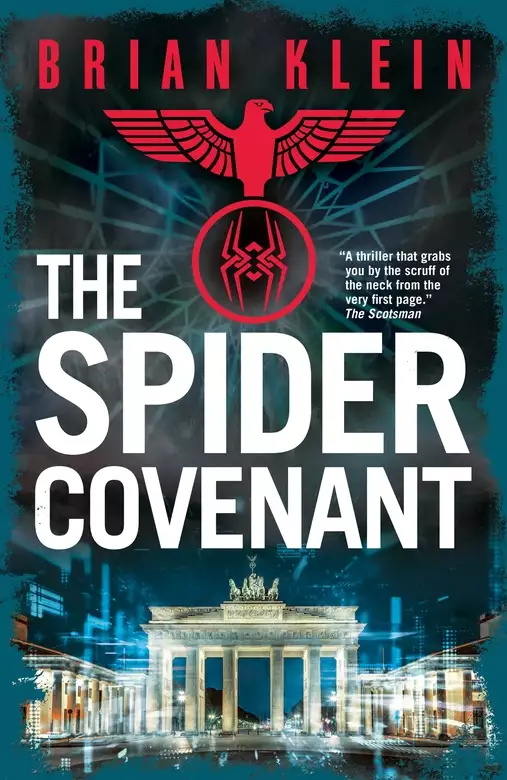
A covert organisation is born, codenamed 'Die Spinne' - The Spider. The network is tasked with helping senior SS officers to escape the clutches of advancing allied forces. New identities are created, bankrolled by illicit funds, allowing these notorious criminals to begin new lives in Europe and South America. Many of them land key roles in the worlds of politics, banking, and industry. Decades later they're able to pass on a privileged and influential birth right to their descendants.
In November 2024, a few weeks before the annual UN COP Climate Conference due to be held in Argentina, a stolen USB stick containing the coded names of prominent politicians - neo-Nazis who are members of the Spider Network - falls into the hands of Chief Inspector Nicolas Vargas of the Buenos Aires Police Department and Troy Hembury, the Head of Internal Security at the White House. The pair join forces to try and expose a dark political conspiracy, which threatens to rock the very fabric of world stability.
Employing a level of AI technology years ahead of anything currently known, the Spider network controls a secret facility based in Strasbourg capable of creating undetectable deep fakes of their own extremist politicians, able to conduct live interviews on a video stream with any news outlet in the world. At a time of world disorder, with bitter wars raging across Europe and the Middle East, the leaders of 'The Spider' look to seize their opportunity of grabbing control of the levers of political power.
Release date:
March 6, 2025
Publisher:
Little, Brown Book Group
Print pages:
100000
* BingeBooks earns revenue from qualifying purchases as an Amazon Associate as well as from other retail partners.
Chief Inspector Nicolas Vargas of the Buenos Aires police department was enjoying a beer in El Alamo, the only sports bar in the city centre showing the live US basketball game his old friend, Troy Hembury, was desperate to watch. The former LAPD police lieutenant, who’d flown in on the red-eye from Washington, was a huge fan of the LA Clippers who were playing a top-of-the-table grudge match against the Boston Celtics. Hembury had travelled to Buenos Aires for a two-week break and was staying as Vargas’s house guest at his apartment in the fashionable Recoleta neighbourhood, in the north of the sprawling city.
The two men were huddled together in a small red leather circular booth, waiting for the live transmission to start. In many ways they were far closer than brothers, having forged an unbreakable relationship working on several heart-stopping cases that had generated headlines across the world. They’d also created a remarkable alliance with senior figures inside Mossad and the FBI, helping their respective governments’ intelligence agencies combat two international terrorist attacks in the Middle East.
The news-making history they’d been part of generating wasn’t important to either of them, especially Hembury. He was living on borrowed time, thanks to the grade 3 tumour buried deep inside his brain. It was being kept at bay by a drug currently undergoing clinical trials on patients like him: people who had a death sentence hanging over them and nothing to lose. But, despite all that, the former police lieutenant was a dedicated fitness freak who worked out seven days a week, making him a difficult man to age. His unlined square-shaped face, sharp jawline and six-one muscular frame looked as though they’d been built from a set of ebony Lego bricks.
Vargas was also deeply troubled but for completely different reasons. Although he was in his early fifties, he’d been a widower for almost fifteen years and had never come to terms with the tragic loss of his wife at the age of just thirty-three. However, unlike Hembury, the drug that kept him alive wasn’t synthetic; it was an unrelenting barrage of work, which filled his every waking moment and helped preserve his sanity.
Despite his mental scarring, Vargas remained a striking-looking man whose olive-skinned chiselled features were crowned by a thick mop of chestnut brown hair, slightly frosted at the sides, and his deep-set caramel eyes sat above a classic Roman nose, framed by a set of high-angled cheekbones.
Hembury was the first African American to be appointed Director of Internal Security at the White House and reported directly to the president. At sixty-three, he was ten years older than his friend and just eighteen months away from retirement. He relished the prospect, if only his body could somehow see off the brain tumour.
‘Less than two years to go, Nic. If the drugs hold up, then it’s just me, my tropical fish, and twenty-four hours a day of ESPN sports.’
Vargas’s response was laden with scepticism.
‘I’ll give you three months with your feet up and, as soon as your beloved team starts losing, you’ll be itching to come back.’
Hembury smiled and was about to reply when two servers, laden with trays, approached their corner booth, just as the game was about to start. The enormous food platters covered almost every inch of the round wooden table and heaved with a banquet of ribs, chicken wings, corn, pickles and fries. Vargas burst into laughter as his friend dived into the ribs.
‘Christ, Troy, we could feed the entire Clippers team with this feast. What happened to your healthy eating regime?’
Hembury demolished some pork ribs and wiped the barbeque sauce off his lips with a napkin.
‘Don’t worry, I’m still on it, but basketball brings out my primitive urges and …’
Hembury never got to finish his sentence as his attention was grabbed by a young man bursting into the bar like a tornado and coming to a sudden stop, his eyes darting around like a pair of manic pinballs, until they settled on Vargas. After a moment of recognition, he headed towards the detective whose right hand instinctively dropped to the Glock 17 holstered across his chest.
The stranger was in his late twenties, dark-skinned with liquorice black hair, which was badly overgrown and formed a seamless join with his dark beard that was slightly better groomed. His hazel brown eyes were panicked with fear and his body was vibrating like a cheap washing machine as he slowly peeled open his left hand, revealing a small blue USB drive.
‘Chief Inspector, you’re the Nazi hunter, right? The policeman who exposed Hitler’s grandson?’
Vargas grimaced as the stranger made the questions sound like an accolade.
‘What do you want with me?’
‘Take this drive and share it with your colleagues, it has the names … the names of Die Spinne.’
Before Vargas could respond, the man grabbed his hand, thrusting the USB drive into it, and made to leave.
‘Who are you?’
The stranger stopped for a beat and half-turned to face the chief inspector.
‘I’m known as Manuel …’
Buenos Aires, Argentina
The platters of food remained untouched. Vargas and Hembury only lasted until the first timeout of the basketball game before curiosity got the better of them. The chief inspector glanced down at the USB drive clenched in his fist. The potential secrets it contained proved an unbearable distraction to the pair who quickly lost interest in the outcome of the match. As Vargas touched his Mastercard to the wireless terminal offered by the server, Hembury looked up from his cell and took a final glance at the giant wall-mounted LED screen just as the Clippers’ captain landed a neat three-pointer. He angled his cell towards Vargas, so he could see the screen. It displayed a literal translation of the two German words spoken by the stranger. The Argentine detective’s brow knitted.
‘I’ve always hated spiders.’
* * *
The pair hardly exchanged a word on the short Uber ride back to Vargas’s apartment. As soon as they entered, Hembury grabbed a couple of Peronis from the fridge, while his friend fired up his MacBook and cleared the breakfast bar to create a makeshift workstation in the open-plan kitchen. They sat next to each other on wooden stools as Vargas inserted the mysterious drive into his laptop and, moments later, clicked on a desktop folder which revealed five files. Four were named by continent – Australia, Europe, North and South America, while the fifth was identified by the letters HH, which were capitalised.
Both men studied the screen before the Argentine glanced across at his friend, whose face wore a quizzical smile.
‘Might as well start on home turf?’
Vargas double-clicked on the file entitled South America, hoping it would open and it duly obliged, revealing a word document. Another click and two short lines of text appeared. Each one displayed two sets of symbols with a space in between. For a moment Vargas assumed they were names as Manuel had claimed but, on closer inspection, nothing made sense. The heavily encrypted text included a mix of random keyboard characters alongside several unrecognisable icons.
Hembury edged closer to the screen, focusing in on the top line.
‘This reads more like a mathematical equation than a name.’
Vargas checked through the other three files named as continents with similar results: each contained two lines of incomprehensible text.
‘They could be absolutely anything, but I’d hazard a guess we’ve got ourselves eight names that have been heavily encrypted in case the drive falls into the wrong hands.’
Hembury took a swig from his green beer bottle and nodded in agreement.
‘Well, guess what? Someone’s worst nightmare is about to come true. Let’s send this baby to our friend in Washington.’
* * *
The stellar cast of the Metropolitan Opera Company at the Lincoln Center on the Upper West Side of Manhattan were performing to a sold-out black-tie audience attending a charity event in aid of the Nelson Mandela Children’s Fund. The concert featured Tannhäuser, Wagner’s 1845 three-act classic and, sitting high up in the gods in the cheap seats, was the deputy director of the FBI. Mike Berrettini was a second-generation Italian who kept his passion for opera well under wraps from most of his friends and colleagues. It was undoubtedly the most innocent secret he kept logged away in his computer-like brain and, as the seventy-four-strong choir, along with the principals on stage, boomed out the final aria, he concluded the three hundred dollars he’d paid to a dodgy website for his ticket had been well worth the gamble.
Berrettini wasn’t an imposing-looking man in the physical sense and was therefore easy to underestimate. His short portly frame carried over two stone in excess weight and his swarthy rotund face carried at least two chins, camouflaged by an unkempt black beard peppered with grey intruders. However, the FBI deputy director was a mental giant, a brilliant strategist with one of the sharpest intellects in the Bureau.
He’d left his cell on silent throughout the concert but felt the familiar vibration of a WhatsApp land. He tried to ignore it, but curiosity got the better of him and rather than wait until the curtain call, he slid the cell out of his jacket pocket. The brief message from Vargas was intriguing.
Mike, a USB drive containing encrypted files has come my way. Might be nothing but can you give me a safe log-in at the Bureau to upload to. Call when free and I’ll give you some context.
Berrettini cursed his own work ethic as he punched in a reply, much to the annoyance of the audience members sitting either side of him.
Give me five and I’ll call you back.
As the cast bellowed out the final refrain he rose from his seat and made a swift exit, just beating the standing ovation which he knew was seconds away. Less than a minute later he was striding down Ninth Avenue, heading south, with his cell jammed to his ear.
‘Okay, Nic, fill me in …’
Five thousand miles away, Vargas switched his mobile to speaker and placed it between himself and Hembury. During the next ten minutes he brought the FBI man up to speed on the events of the previous few hours. Berrettini used the time to head over towards Moynihan Train Hall where he was due to catch the overnighter back to Washington.
‘Guys, as you said, this could be something or nothing. Use the log-in I’ll send you and let’s catch up sometime tomorrow after my tech guys have looked at the files.’
As he crossed West 33rd Street, heading for the station entrance, he glanced down at his watch.
‘Right now, I’m in New York and I’ve got to run to grab the night train to D.C.’
Hembury couldn’t resist jumping in with a jibe.
‘Christ, Mike, that’s a hell of a long way to go for a date …’
Berrettini pursed his lips, his spare hand fishing for the return train ticket buried somewhere in his jacket pocket.
‘No such luck. Business, guys, just boring business.’
The FBI deputy director ended the call and dashed inside the station hub, having successfully protected another precious secret.
Washington D.C., United States
The following morning, Berrettini was back behind his desk inside the J. Edgar Hoover building at 935 Pennsylvania Avenue in Washington D.C. His small subterranean office occupied a tiny footprint within the 2,800,000-square-foot labyrinth of safe rooms, corridors and data areas which formed the nucleus of the Federal Bureau of Investigation. From the street, the structure appeared to be just eight storeys tall, but there were another three hidden below ground, which was where Berrettini liked to be: unseen and undetectable by the outside world.
He was totally absorbed in the three-page report his senior analysts had prepared for him, following the partial decoding of the files Vargas had emailed over the previous night. As he flicked though the papers, he held the black folder containing them as though it were a stick of dynamite and once he’d digested the contents, reached for his cell to punch in a WhatsApp message to Vargas.
Nic, you’re booked on the Copa Airlines flight this afternoon to D.C. I’ll clear some leave with your chief. Plenty to discuss regarding our eight-legged friend.
Buenos Aires was only an hour ahead of Washington and the local time was just after nine in the morning when Vargas received the message. He was enjoying a continental breakfast with Hembury in a local coffee house and immediately shared the WhatsApp with his friend. Hembury’s mouth broke into an amused grin as he read it.
‘So much for my holiday break. Turns out you’re going to be staying with me instead.’
Vargas demolished the remains of a warm croissant and nodded towards one of the servers to request the bill.
‘Yep, can’t wait to get reacquainted with your tropical fish collection – hope the boys are okay?’
Hembury gulped down his latte as both men stood to leave.
‘All fit and well. Plus a few newbies since you last visited.’
Vargas let out a fake groan.
‘Let’s get back and sort ourselves out and then head to the airport’.
* * *
It took the pair less than five minutes to walk back to the chief inspector’s apartment block and, as they headed up the stairs, Vargas stopped dead in his tracks. His front door was slightly ajar. Closer inspection showed the lock had been forced and the mechanism was clearly damaged which explained why it wouldn’t close. He gestured silently towards Hembury, who instantly picked up on the cue and nodded his understanding. Vargas stealthily opened his jacket to indicate to Hembury his chest holster was empty. His Glock 17 pistol was locked away in his desk drawer.
The men moved in lockstep towards the front door and Vargas gently edged it open, glancing through the gap he’d created. Two bedroom doors off the small interior hallway were wide open and he could see through to the open-plan kitchen, which looked as though it had been hit by a small hurricane. For a second, he couldn’t hear anything untoward from inside but then, as he eased the door open further, it created a tiny grinding noise.
Moments later a shadowy figure leapt out of the main bedroom at speed and turned left, instantly making eye contact with Vargas, who was now totally exposed standing in the open doorway. The intruder was a young, slim Asian woman, dressed from head to toe in black. Her face was milk-white, and her coal-black hair was cut short, creating a slightly masculine appearance. She had a cruel mouth, if there was such a thing and, as her dark brown eyes focused in on Vargas, he could sense they showed no sign of fear, just raw hatred and excitement.
She knifed him with a glare before snatching the real thing from her rear pocket: a mother-of-pearl-handled switch blade which she wielded with the confidence of an orchestra conductor waving a baton. Vargas moved forward and stepped to his left, allowing Hembury to instantly fill the void. The intruder held her ground for a moment, taking on board the new odds. Unfazed by the turn of events she sprang forward with the prowess of a king cobra, her knife slashing through the air like a venomous tongue. Her rapid movements took both men by surprise and although they were wary of the knife, they both made a grab for her. Remarkably she slithered between them and seconds later exited the front door of the building at warp speed.
The confrontation lasted less than three seconds and it was only after the assailant had gone Vargas realised he’d been hurt. Her knife had sliced a three-inch cut on the inside of his left arm, which was leaking blood on to the white oak floorboards in the hallway. Initially the adrenaline had masked the pain, but now it stung like an attack from a hundred-strong army of angry hornets, and he wasted no time sourcing a small towel to wrap around the open wound, while Hembury called 107.
In the ten minutes it took for the ambulance to arrive, Vargas established the USB drive, which had been locked away in his gun drawer had disappeared, although the Glock and two packs of 9mm rounds were still in place.
Washington D.C., United States
Twenty-four hours and eighteen stitches later, Vargas and Hembury arrived in the US capital, where they immediately met up with Berrettini in a secure meeting room, deep inside FBI headquarters. After a quick debrief with an in-house agent, who took down a detailed facial description of ‘knife girl’, the deputy director took control of the meeting, beginning with a strange question:
‘After the fall of Nazi Germany in April ’45, do you know how American intelligence agents managed to identify SS officers who ran the deathcamps?’
Both men looked slightly bemused, wondering what on earth the Second World War had to do with whatever was on the USB drive, and shook their heads, prompting Berrettini to continue.
‘Well, one of Adolf Hitler’s most despicable sidekicks, Heinrich Himmler, held the grand title of Reichsführer of the Schutzstaffel, meaning he controlled the notorious SS and during the war he ordered his men to have tattoos of their blood group inked on the inside of their left arm, in case they were injured and needed a transfusion. Of course, it hadn’t occurred to him Germany might lose, and that these markings would be something of a giveaway when the Allies came searching for war criminals but, when the penny eventually dropped, he ordered those same tattoos be removed—’
Vargas cut in, even though Berrettini was in full flow.
‘Mike, where the hell is this history lesson heading?’
‘Nic, stay with me a bit longer. These SS officers were monsters, responsible for the most heinous crimes in history which they knew would earn them the death penalty, but removing the tattoos wasn’t the answer because they were then left with scars which could still easily identify them. So, that’s where the ODESSA came in—’
This time it was Hembury’s turn to interrupt the FBI chief.
‘I remember the movie. Jon Voight was in it. Wasn’t it about high-ranking Nazis escaping to South America?’
Berrettini nodded before glancing down at the papers on the table in front of him.
‘Exactly. ODESSA is the acronym for Organisation der ehemaligen SS-Angehörigen, which translates as Organisation of Former SS Members. It was formed on 10 August 1944 at a covert meeting in Strasbourg, where a small group of leading German industrialists and politicians met to plot the aftermath of the war. They could see the writing was on the wall. The Nazis were only months away from total defeat and business leaders wanted a refuge for their money, while SS officers needed passage out of Germany to a bolt-hole. ODESSA supplied false papers for them and safe houses along routes that became known as ratlines. At the same time, massive funds were transferred out of Germany to South America and Europe as leading industrialists emptied their bank accounts.’
Berrettini paused for a moment to pick up a loose sheet of paper containing a list of names.
‘This is where the information contained on your USB drive comes into play. Himmler personally established and ran a clandestine subgroup of ODESSA, known as Die Spinne or the “Spider Network”. This organisation focused on a long-term strategy to help perhaps as many as two thousand elite Nazis escape and then reinvent themselves outside of Germany as prominent figures in the worlds of banking, industry and politics.’
The FBI deputy director paused one last time and breathed deeply before unveiling the denouement.
‘Gentlemen, there’s credible intelligence to suggest that almost eight decades after its creation, Die Spinne still exists today in one form or another. Its reason for being is to protect the true heritage of high-ranking politicians, media magnates and business leaders who are hiding in plain sight and who still harbour ambitions for a new world order based on Nazi philosophy.’
The two men took a moment to digest Berrettini’s story until eventually Vargas glanced down at the paper in the deputy director’s hand.
‘I’m guessing from what you’ve said, some of the names listed on that drive are alarming?’
Berrettini’s expression changed to that of a man who, despite having seen and experienced a great deal in his life, was now truly perplexed.
‘They are, but there was something else we found on the USB that was far more disturbing.’
Berlin, Germany
December 1943
Heinrich Himmler was leading a complex triple life, and it was proving expensive. In 1928, the SS chief had married Margarete – a blonde, blue-eyed nurse who perfectly suited his ideals of an Aryan stereotype. A year later she gave birth to a daughter, Gudrun, and, for a while, all was well in the Himmler household. But, as the SS machine became more powerful and he grew closer to Hitler, he spent precious little time at home and, ten years after his marriage, began a serious affair with his secretary, Hedwig Potthast, leading to the birth of their first child, Helge, in 1942.
In addition to supporting his two families, Himmler also made substantial monthly contributions to his illegitimate daughter, Emelia, who was studying mathematics at Munich University and living in an apartment in the city which he’d found for her. It was far superior to regular student accommodation, but the SS chief wanted her to enjoy the trappings of success and wealth. Her existence was still a closely guarded secret, especially from his wife and mistress, and, as Emelia had grown older, Himmler had become totally smitten with her. She’d inherited the natural beauty of her mother and yet there was something about her eyes – the way they sparkled with life – which meant whenever they were together, the physical likeness between biological father and daughter was clear for all to see.
Emelia had been adopted shortly after her birth, in 1923, by a childless, middle-class protestant couple, who lived in the prosperous suburb of Bogenhausen on the outskirts of Munich. Her adoptive father, Albrecht Müller, was a branch manager at one of Germany’s oldest banks, Berenburg, and his wife, Birgit, worked alongside him as a head teller. They were both in their forties and, after a disastrous series of miscarriages, had turned to adoption as a last hope. They’d longed for a child and, from the moment she entered their lives, Emelia was brought up in a loving household, where she thrived both socially and academically. For as long as she could remember, she knew she’d been adopted and that her birth parents’ identities were buried somewhere deep in the orphanage records, destined never to be revealed.
That all changed the day after her fifteenth birthday. It was May 1938 and a restless Germany, under the leadership of Adolf Hitler, was gearing up for war. Two months earlier, the Führer had carried out the Anschluss, the unopposed annexation of Austria into the German Reich, and now had his eyes firmly set on taking control of the Sudetenland, a narrow strip of land on Germany’s eastern border, which then formed part of Czechoslovakia.
At that point, Himmler held two senior positions in the Nazi regime. As well as being head of the SS, he was also chief of the German police. He was a fêted star of the Third Reich and, as he’d hoped, political success had brought him fame, status and wealth. Even though Emelia was the result of a drunken one-night stand, he’d always felt guilty about abdicating all responsibility for her but at that time he was a penniless student with no assets. Fifteen years on, things were very different; Heinrich Himmler was the second most powerful figure in Nazi Germany and he resolved now was the moment for Emelia to discover her true heritage.
He wrote to her in his role as a government minister inviting her for a meeting at his office in the Reichstag on the pretext of needing a part-time researcher, claiming he’d learned of her exceptional academic achievements through the headmistress of her school. Emelia was stunned and thrilled by the invitation which would give her the opportunity of meeting one of the most famous politicians in the country and so, the day before, her mother took her shopping to buy a new dress especially for this once-in-a-lifetime occasion.
The appointment was scheduled to last just thirty minutes but overran by three hours as, within moments of her arrival, Himmler had told her the true reason he’d called her in and given her details of their blood relationship. Emelia was stunned to suddenly meet her real father in such strange circumstances and at first was totally overwhelmed by the revelation. But then, as he recounted the full story of how he’d met her birth mother and how he’d followed her life from a safe distance, she began to relax and embrace this extraordinary development. He ended the meeting by explaining it was imperative their relationship remain a precious secret, owned by just the two of them. Even her adoptive parents could never know the celebrated head of the SS was her biological father.
From that day forward they met regularly, sometimes two or three times a month at various discreet locations in Munich, behaving as though they were a pair of lovers enjoying a secret affair. They adored each other and during the following years, as war raged across Europe, Emelia fell further and further under the spell of her father, who smoothly indoctrinated her with the fascist values and beliefs of the Nazi movement. In December 1943, with his assistance, she left university and proudly joined a clerical unit of the SS, working out of a small office in Berlin.
Five days after she took up the post, she received a letter from her father which she read word-for-word three times, before carefully cutting out the last paragraph and sticking it to the front door of her Siemens refrigerator. Every morning, she read the note with pride, before donning her uniform and heading off for work.
My Darling Emelia, The sheer joy that comes from the knowledge you are now fully part of our beloved movement is beyond description. As you know I fathered two other children, but you are the one who has captured my heart. You are my passion and the future of this great nation. Your loving father, Heinrich.
Paris, France
Leopold Legrand drew down deeply on his Gepetto vape as he paced the fourth-floor balcony of his Parisian mansion apartment, surveying the manicured gardens of the Champ de Mars below that framed an enviable view of the iconic Eiffel Tower. The man who was chairman and CEO of France’s largest media corporation had plenty on his mind as he turned away and strode back through the floor-to-ceiling glass doors into the spectacular reception room which ran the length of the apartment. He moved with the elegance and arrogance that came with inherited wealth and his aristocratic, six-foot frame was clothed in a handmade, two-piece Savile Row linen suit, accompanied by a Hermès white cotton shirt, unbuttoned at the neck. He was in his late sixties and his perfectly coiffured ash blond hair, complemented by a subtle glint of silver, added extra gravitas to his aquiline nose and steely blue eyes.
Legrand enjoyed the luxurious trappings of wealth, having inherited a billion-euro fortune from his mother, the owner of one of the country’s largest private banks. The legacy included the duplex apartment on the Avenue Joseph Bouvard, Paris’s most exclusive address, which had been in the family since 1947. The 7,000-square-foot residence with its intricately hand-painted ceilings, Baccarat crystal chandeliers and Versailles-style parquet flooring was valued at a staggering fifty million euros, positioning it amongst the most expensive properties in the city.
Remarkably, one of France’s richest and most powerful men had started life as an orphan. On 10 July 1956, when just a few days old, his late mother had adopted him from a slum orphanage run by a disreputable priest, in the back streets of Montmartre. At the grand age of thirty-three she’d decided no man alive was fit to fill the shoes of her beloved father, Heinrich Himmler. If she were to fulfil his wishes and produce a male heir, she knew she’d no choice but to adopt and she vowed to mould the little boy in the image of the man who’d once been proclaimed the second most powerful figure in the Third Reich.
The controversial business mogul, whom many French citizens adored because of the right-wing advocacy of many of his media outlets, wafted through the hallway of the apartment and headed for his office where he sat down behind his Louis XVI cylinder-top mahogany desk, b. . .
We hope you are enjoying the book so far. To continue reading...

 Please log in to recommend or discuss...