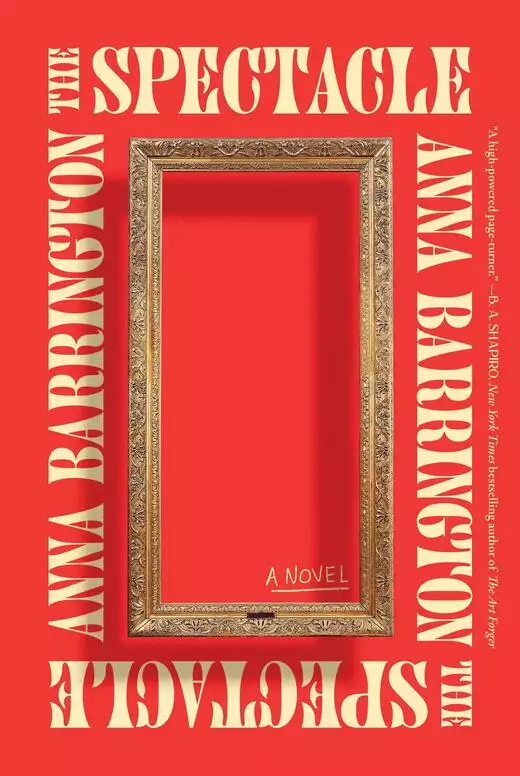
A powerful art dealer who presents a convincing portrait of international success pulls an idealistic young gallery assistant into his web of lies. This sharp, edgy social thriller explores the price of ambition in the decadent underbelly of the high-end art world.
Nobody knows quite who Rudolph Sullivan is, or how he ascended so quickly to the glittering top of New York’s art scene. When aspiring artist and struggling gallery assistant Ingrid meets the charismatic dealer at a party, she falls fast—Rudolph offers her a seductive taste of luxury and an escape from her humdrum existence. But Rudolph is hiding much more than his dazzling facade lets on. With insatiable tastes and a need to keep up appearances, his debts mount rapidly, and he turns to double dealing to stay afloat. As his adversaries close in, Rudolph realizes his fall from grace could cost him more than his reputation. Panicking, paranoid, and willing to sacrifice anyone to maintain his precarious foothold, he plans his most audacious gambit yet—and Ingrid is at the center of it.
Release date:
July 8, 2025
Publisher:
Union Square & Co.
Print pages:
368
Reader says this book is...: emotionally riveting (1) entertaining story (1) international intrigue (1) plot twists (1) suspenseful (1) thought-provoking (1)
* BingeBooks earns revenue from qualifying purchases as an Amazon Associate as well as from other retail partners.
ALL POWERFUL MARRIAGES INVOLVE A DEAL WITH A DEVIL, PAUL Bernot was always saying, whether both parties know it or not. Paul, who prided himself on going into things with his eyes wide open, had known it—even if his own powerful marriage had ended in failure because he was unwilling or unable to pay that price. (His ex-wife said it was because he couldn’t stop fucking twenty-two-year-olds.)
Watching him stride about the gallery office, going on about deals and devils, Ingrid had a moment of pity for him. Talking, talking, talking. It was like, Ingrid thought, he expected her to write down what he was saying, to record it for posterity. As though he considered himself the center of a history instead of the footnote in someone else’s, as she secretly knew him to be.
But earlier tonight, when they’d been going over the numbers, Paul’s mouth had twisted into a sullen pout. He’d put his head in his hands. For a moment, he had looked almost tragic, like he was about to cry.
No more Mommy, Ingrid had thought.
“We need new artists, fast,” he had said. “This Dermott Dermott Critchley—I want you to go to his opening tonight. Find me people of value. Is there hard money behind the guy? Enough for us to bother poaching him off Duma?”
Cut off from his ex-wife’s inheritance, Paul was alone, and his hands on the beautiful desk were bunched up with veins. The cold November sun slid slowly down, flashing over the signet ring on his pinky finger. That was the business.
By evening a brown fog had wrapped itself around Manhattan, hiding the cantilevered sparkle of the Jenga Building behind a dank drizzle. Hurrying down Walker Street, Ingrid felt a thrill go up her spine. Value, value. Paul was always searching for people of value, but this was the first time he’d ever trusted his twenty-five-year-old assistant with the task. It seemed proof that something important was about to happen, something that would justify her entire life so far. She wove in and out of the traffic, marching behind the commuters with a feeling of vague importance in her step. Nobody else seemed to notice. Everyone kept their faces muzzled, in black coats and scarves, with their eyes glued to their devices. Nothing visible but an abstract pattern of tiny squares in the dark, a Mondrian painting of cell phones, glowing smokily through the twilight.
Duma Gallery was newish, owned by a pair of promiscuous Israelis rumored to be linked to the mob, and it operated like a club right down to its tight security and drug-fueled after-parties. From the frozen street where Ingrid stood shivering, her nose pressed up to the rain-spattered glass, the gallery seemed to cast a shifting underwater light. She gave her name to the boy intern at the door, whose eyes ran doubtfully over her wet clothes.
“That name isn’t on our RSVP list.”
“It’s Groenfeld, Ingrid Groenfeld.” She started to spell it. “I-N-G—”
He cut her off.
“Yeah, and as I told you, it’s just not on the list.”
“Well, it should be.”
“Well, it isn’t,” the boy mimicked, imitating her voice.
Ingrid looked at him. He had on a wool sweater that looked as though it had been ravaged by a pack of angry house cats and then sold for six hundred dollars, which was probably the case. Beneath it his skin was the color of sour milk, concave.
Why wasn’t she on the list?
Ingrid breathed out. The money required to play in the art world had recently reached new heights, new levels, though when you were riding high off the chem trails of other people’s jets, there always was another level. But Paul had reached that level, a long time ago. Unless. Unless he was slipping.
The boy gave her a sympathetic little half-smile.
“I’m here on behalf of Paul Bernot Gallery,” she said, louder. “Check the list.”
He blinked, twice.
“Oh,” he said. “I see.”
And reluctantly he lifted the velvet rope.
Inside, beautiful people in pleated Japanese silks drifted among the waiters, who were offering out semolina cakes and champagne. Only a few graying critics bucked the trend, announcing to the world with their messy tufts of hair and square-framed black glasses that they were far too cerebral to care about such petty vanities. They stuck their faces up to the walls, moving with the natural arrogance of the tastemakers of a modern empire at the apogee of its powers.
Tonight, Dermott Dermott Critchley was their man. Enormous canvases stretched along the vast white walls. Acrobats, abstract splashes, the odd Freudian symbol—a parsnip, a couple of vulvic flowers—whirled across the paintings. To Ingrid, they looked as though someone had thrown hair at the canvas and snipped haphazardly with a pair of garden shears, but what did she know? Ugliness. The art world loved ugliness. Pretty was so boring to look at, and everyone here hated to be bored.
December 2016. The defiant mood vaguely surprised Ingrid. Election night: people had been crying, screaming. What the hell was going on? Everyone they knew had voted for Hillary, so who was out there clapping for the loudmouth?
Somehow the other side of the country had become a shadow, a black outline. People were still wandering the streets of New York with dazed and confused faces, stunned by the extent of their collective misjudgment. So Ingrid might be forgiven for expecting to see fear, sadness, maybe even impotent guilt, in this room full of liberals in the weeks post-election. Or maybe that just showed how little she still knew about the art world, even after two years as Paul’s assistant—because by the week after Thanksgiving, its denizens had already begun to flicker onward, like snakes shedding their scales.
“It’s no wonder they can’t understand the benefits of a progressive culture, you know?” a sleek PR woman in a white pantsuit wondered aloud. She was sipping a glass of the free Cristal provided by the German bank that was the evening’s sponsor. Now she winced. “Ugh. I hate champagne. Do you hate champagne?”
“It always makes my breath stink,” her friend agreed. “But to your point. It’s so important to empathize. Can you imagine the conditions his voters live in? You really can’t blame them for not being able to identify their own interests.”
“No. No, I’m just disappointed. I mean, they live in fucking food deserts, just imagine like, buying from Walmart all the time. Zero access to high-quality produce, let alone fresh pasta.”
“No Dean and DeLuca.” White Pantsuit rolled DeLuca deliciously over her tongue.
“No Citarella either,” the friend giggled. “Ugh, I feel so bad for them.”
“Me too. Just so guilty!” cried White Pantsuit. “But can’t they see that it’s their own tired values holding them back?”
She gestured with her flute at the window, as though this block of polished glass was the only thing stopping the unwashed masses from storming in and joyously partaking in the champagne.
“What I really can’t believe are the prices at this show.” The friend spoke out of one corner of her mouth, while attempting to remove with a cocktail napkin an errant blob of goat cheese encrusted to her chin.
“So inflated! Forty thousand here, a million at auction—”
“Soon I won’t be able to afford art at all!”
Laughter. She had one of those voices cultivated to sparkle like sugarplums, rich and weighty. Ingrid noticed that the room was barely half full. As usual, there had been no need for an exclusive guest list.
Ingrid saw Dermott’s lowered head from a distance, surrounded by an older couple in furs. Wearing the paint-stained overalls he liked to bring out for these occasions, he’d affected a pensive expression and was stroking the goatee he’d grown to look more intellectual.
“Tell us,” the woman said in a hushed tone. “These paintings. They’re so genius. Can you talk a little bit more about your process?”
Dermott sighed. Ingrid could feel anxiety radiating off him in waves. Lights, camera, action—the moment that every artist longs for. After all those years of struggle and self-doubt, finally, finally the Establishment sees you, wants you, is desperate to eat up a slice of your heart and soul. It’s classic transference: they hope to swallow you up to prove they’re more amusing, charming, cooler, and more sophisticated than all the other bankers and CEOs and partners in their boring Excel-based lives. Tonight, they’re not just paying for paintings; they’re paying for you. What to say?
“The impetus behind these paintings was my connection to Picasso. You know, I’ve always been fascinated by certain motifs, like the head. Or like a woman’s breasts.”
The man and woman nodded.
“And then one day I just had this bolt of, like, lightning. I thought, how crazy would it be if I reinvented these motifs for the twenty-first century? Reflect the grittiness of the city, the chaos of the street. Picasso did it his way, I’m gonna do it mine.”
“Well, we think they’re incredible. Just incredible.”
Dermott let out a self-deprecating little laugh: aw, shucks, me?
“I struggled. Truly I struggled. It was a long way toward finding a signature style.” He paused, readying himself to launch a new line. With gravity, he said: “My work is a punch in the face. It’s almost like being mugged, it’s so intense—so—so against the grain.”
Had it landed? Hopeful, Dermott checked for signs of a successful sound bite. The banker shrank back into his glossy snow jacket with a vague look of alarm, but his wife leaned in. Her cheeks were flushed, eyes alive.
“It’s like how the cavemen used to paint with blood,” the woman said, “at the caves of Lascaux. So primal, so—so raw. Isn’t it, sweetie?”
“But the references you use,” the man wanted to know, “how does all that data stick in your head?”
“Um?”
“The references,” the man persisted. “Chinese gymnasts, Picasso, the political whatever… I just wondered how you manage to bring out all that data in the paintings? Do you use a spreadsheet?”
Uncertainty flickered across Dermott’s face.
“Um, it just comes out. It’s like all the things you’ve ever seen are locked inside you, waiting. Your memories, feelings—they’re alive, they’re part of you, but you don’t know what they mean until you start painting. In some ways you never know.”
The collector nodded unhappily. Christ, for forty thousand dollars you’d think an artist would come up with better than that. Calculation, forethought, planning, these were the methods he knew of justifying a price. Art should be like sustainable yoga pants: a beautiful palliative for a dying world.
When a silence fell, Ingrid took the opportunity to congratulate Dermott. “The show’s incredible,” she said, watching the collector steer his wife away. Was there jealousy in her voice? She squelched it. The woman kept glancing behind her husband’s shoulder, her eyes searching for Dermott, desperate to soak up the juices of his celebrity.
“You think so?”
“Yeah. I love the references to Mayan art.”
Dermott’s face darkened with blood.
“Hey, don’t mention that to anyone,” he whispered, his hand closing tight on her arm. “The absolute last thing I need right now is to get accused of cultural appropriation. It’s hard enough being a white male artist these days. I’m really trying to emphasize that this is one hundred percent original, all right?”
“Oh, got it. I mean, I totally get that,” Ingrid stumbled. “Sorry, I didn’t mean to say anything wrong.”
Seconds later, Dermott’s black expression vanished: he’d spotted a silverback collector lumbering off behind Ingrid’s shoulder. He put on a large artificial smile. “It’s an easy mistake to make! What must you think of me, this crazy neurotic artist? Though it kinda comes with the territory, right? So, where’s Paul, eh?” he asked, scanning the room rapidly. “Is he here?”
“Paul couldn’t make it,” she explained, wincing a little. It was insulting, no doubt, that Paul had decided to go see Hamilton and ditch the exhibition, sending a lowly minion like herself instead. She bumbled on: “He had a dinner at the Whitney. Guest of honor, unfortunately—”
“Cool, cool,” Dermott said, losing interest. “Sorry, I just—I have to go talk to that woman over there. She’s on the board of the MoMA—you understand?”
Left alone, Ingrid decided to wander off. Dermott had been spoken to, and the rest of the evening could be whatever she wanted it to be. She walked slowly toward the strange blue glow. Originally, she’d thought it was the spotlights, but the light appeared to thicken behind a partition about forty feet away. At the back of the room, Ingrid found herself staring at a tank. It was filled with gel. Within the tank floated an enormous brown cow, spotted white. Its eyes were wide open in death, staring accusingly at Ingrid as if to express a general astonishment at the banal disappointments of the afterlife. Eternity frozen inside a shitty two-bit gallery. What a fucking nightmare.
“These things are so passé,” said a bored voice behind her.
A shadow had appeared in the glass. His accent was nationless, those flat unplaceable tones of an international school, and she peered around the glass to find its source.
A tall slim man was leaning insolently against the tank. He had auburn hair, a jaw like cut glass, and cool green eyes the palest shade of malachite. She had a confused but immediate impression of a wolf in human clothing. Then her gaze dropped down over his suit: expensive, meant to tailor over sharp shoulders and terminate on witty orange socks, and it clicked. The socks. Yes, it was the socks that marked him out to her as a member of the culture industry: that carefully crafted flash of eccentricity you wouldn’t get in just a regular finance guy.
Vain eyes, she thought, looking at him. Eyes that knew exactly how beautiful he was.
“Rudolph,” he said, offering his hand.
“Ingrid.” She took it.
“You work for Paul Bernot?”
“Yeah. How’d you know?”
“I was in line behind you at the door,” he explained. “The guy was a dick.”
She nodded, shrugged to show she didn’t care.
“So what do you make of all this?”
He smiled at her. In the silence, she stared into his eyes, feeling the impulse for speech leave her body. Later she’d realize it was his greatest gift—the way his attention crystallized on you, as if there was nothing he wanted to know more than what you were about to say—because who really listens to us, who really cares? But tonight, she was simply tongue-tied.
“I thought the market for Hirsts totally crashed, anyway,” she said vaguely. “And isn’t it supposed to be a shark?”
He snorted. “Well, yeah. But you know they have to replace these things?”
“Really?”
“Of course. The skin’s drilled with formaldehyde, but they still rot. They replace them every five years when the old corpses disintegrate, make the collectors pay for it. But what happened was, the owner was some hedge funder who got nailed by the SEC. He was too cheap to buy a new twelve-thousand-dollar shark—hedge funders are the cheapest guys you’ll ever meet, believe me—so he replaced it with a cow to advertise his Wagyu beef farm. Two birds one stone, you get me? Anyway, he’s in jail now, so they’re trying to flog it off to some gullible fuck as a limited-edition piece, and God knows they’ll manage.”
“A match made in heaven. Dermott Dermott Critchley and a sacrificial cow.”
Ingrid was red with embarrassment before she had even finished, hating the artifice, hating the low-hanging fruit of her lame joke, but no, he was laughing with her.
“I take it you don’t like his stuff.”
Ingrid shrugged. She’d meant how the collectors swarmed over Dermott, but she felt pierced by a sudden desire to act rebellious, to impress him with her irony, her contempt. Maybe it was the white wine, but she was feeling much more confident than usual, much more alive, and she finally got up the nerve to ask him if he wanted a cigarette.
“Oh God no, I don’t smoke. Quit years ago.”
He hesitated. In that moment a well-heeled man came up and tapped him on the shoulder, and she could see that he was about to leave her behind. Her stomach burned.
“Rudolph! We’ve been trying to get you round to our place for weeks now.”
But he surprised her by saying a few brief words to the man and turning back to her. The ghost of a smile drifted over his face.
“Well—maybe just this once.”
Outside, they smoked and watched the trail of visitors ebb and flow, trading commentary on the people they recognized. Ingrid barely knew anyone. She had never been very good at the oozing and schmoozing she should be doing. But Rudolph seemed to know everybody worth knowing.
“So, I’m sorry. You know I work for Paul, but what are you doing here? Just taking in our great city’s rich cultural offerings?” she asked.
“I’m a dealer.” He laughed.
“That’s funny?”
“I guess I just thought you’d already figured it out.”
“Was I supposed to?” She blinked innocently at him. “I’m way too jejune to know the ins and outs of the art world.”
“Think you’re some kind of child bride?” He slowly picked a stray thread off her elbow. Feeling his hand graze her inner arm, she tensed—it was that little shock of someone else entering her periphery without permission. She hoped he wouldn’t smell her coat. It was thrift-store Margiela, not half-bad either, if you ignored the lingering odor of mothballs. “Anyway,” he continued, “seems like you’d be good at that kind of thing.”
“What kind of thing?”
“Sussing people out.”
“Me?” She laughed. “Oh, no. I’m on the wrong side of the business. I actually tried to be an artist for a few years—selling paintings on the street, that sort of thing. But, uh, it didn’t work out,” she said.
He smiled. “So here you are.”
“Here I am,” Ingrid said dryly.
“That the chip on your shoulder, huh? Daddy’s not a close personal friend of the boss?” He took a drag of one of her American Spirits. “Let me tell you something. Everybody thinks they’re an outsider. You’re on the inside, trust me.”
Ingrid’s heart buzzed. The wine was rambling about in her stomach, making it harder and harder to repress a dark, familiar echo: Simone’s voice on that nightmarish day two years ago Ingrid had packed up and left. There’s nothing wrong. I just want to be alone now.
Behind her a famous art dealer said comfortably, “Geffen has exquisite taste. Real connoisseurs are now being born in Los Angeles.”
“I just think there’s something sick about it all, don’t you think?” She nodded at the dealer. “Look at all these people, heaped with praise for buying things, as if blind consumption gives you some kind of profound sensitivity to the world. As if anyone from West Virginia or Indiana who’ll never be in anything but alien abduction tabloids couldn’t have great taste, too, if only they had the stylists and PR people and decorators to buy it for them.”
Ingrid stopped; Rudolph was staring at her. Out loud her voice sounded pissed off, maybe a little drunk, and she cringed at herself while trying to smile. Playing the awkward, bitter naïf? She wished she could melt into the ground. But Rudolph simply changed the subject, flicking a hand at her cigarette.
“Why do you smoke? Everybody’s cut it out since I moved back from London.”
“You’re from London?”
She couldn’t tell. He shook his head, still gazing at her, but didn’t clarify where he was from or what he had been doing in London.
“Well, I don’t know,” she said. “I guess it started in art school. But then—it sounds stupid—but as a woman you’re inundated with products. Magazines and wellness ads and gummy vitamins trying to whip you up in a frenzy of fear, make you feel so fat and old and ugly you’ll do almost anything to make it go away. That’s what it means to be a woman, isn’t it? But I hate that. I don’t care about fighting some battle to stay young and attractive.” She waved her cigarette, its embers singeing the air. “Bodies age. Life ends. Let me be free to just live it.”
“You say that now, because you are young and attractive.”
Ingrid ducked her head. Her face felt feverish under his laughing green eyes. Rudolph dropped his cigarette, which sizzled on the dull ice before he crushed it out with one polished loafer.
“Hey,” he said, and hesitated. “Do you want to come to a party tomorrow night?”
“A party on a Thursday?” she said without thinking.
He smiled at her, two dimples appearing in his cheeks.
“Worried about school the next day?”
Ingrid’s heart fell.
“Sure, whatever,” she said quickly, trying to regain her previous froideur. “As long as you’re not, like, a serial killer or something.”
“You don’t trust me?”
“You could be anyone.” She eyed him coolly. “Patrick Bateman, not even trying for a disguise.”
He winced. “That bad, huh?”
When he asked for her number she raised her eyebrows, a rush of confidence fueling her on until he began to shuffle around the frozen pavement with visible awkwardness. Finally she relented and typed it into his phone.
Bashfully he said, “I hope that you’ll answer.”
Ingrid walked over to MacIntyre’s, a lit cigarette in hand. A nervous excitement was bubbling up in her lungs—a crush, a weak-at-the-knees kind of crush, the kind that didn’t happen very often these days. You’re on the inside, the man had said. Trust me. But she didn’t. Perhaps that was part of the excitement: his foreignness. It was the type of encounter she had always wanted to have in New York, but it had never happened until now.
MacIntyre’s was a low-lit Irish pub chain with shuddering windows and bad drinks, nearly deserted but for a few grizzled old regulars. She and Richard had started coming here during college, on day trips to New York City—half because they were too broke and intimidated by the roaring concrete jungle to go elsewhere, half because they didn’t know any better. What brilliant successes they’d planned of their lives! And they’d always said it just like that: New York City. With a radiant faith they had hoped would pay off into the future.
Richard was waiting for her in a torn leather booth. Olives beaded his empty martini. Seeing Ingrid’s sweaty face, he widened his eyes.
“Were you just running?” he asked. “Your face is so red.”
“It’s freezing outside,” she said, embarrassed, and sat down. She recalled something an ex-boyfriend had once said: Your feelings are always written all over your face. No knack for mystery, for dissimulation and fantasy: honesty could be so distinctively unsexy.
“Did you order me a drink?”
“The service is terrible, you know that. How else can you explain the existence of the last dive bar in this shitty overpriced neighborhood?” But he generously slid over a glass. “How was the opening?”
“Oh, just the usual inane bullshitting.”
Ingrid picked at a dried-out bowl of nuts on the table. Richard was talking, talking, about his boyfriend and why he didn’t like him so much anymore, while Ingrid drifted into space. She was remembering this hysterical Reagan-era propaganda novel that she’d once read in high school about a girl who accidentally ate a bowl of peanuts covered in acid. Later, locked in a closet by some concerned friends and family members, she had torn out her own hair and nails scratching at the door. Which reminded her of something. Seeing Dermott’s anxious expression tonight, when he’d struggled to answer the collectors’ question—why do you throw yourself at the canvas, day after day after day?—Ingrid had kept up the polite smile that her job now required. Inside, though, she had been seething. She’d wanted to grab his hand, to cry out, I know!
Only once, in the false dawn of a cheap studio, had she ever come close to what Dermott had described. Swirling the colors over the canvas, she had felt the city’s undercurrents channeling down through each brushstroke, so fast her hands could barely keep up with the urge to paint. There had been a force, a force and a power in her inner mind. But never again had she heard it, this secret scream pitched to the ultrasonic soul of New York, no matter how hard she sought it out.
“… and I just want to shake him sometimes!” Richard was saying. “I want to scream at him. He literally sits there smiling at me like a big hot lump, like a big old Ken doll while I’m wallowing in a pool of wine and self-pity. It’s just not enough, you know? And his friends, I hate his friends. Did you hate Brian’s friends? They’re so shallow and self-absorbed. Like, they’ll say, Oh, I have the best apartment in Tribeca and I go to the best parties at Art Basel—when, dude, they barely even got into the general section at Art Basel—not even asking you a word about yourself for hours—”
“Yeah.”
“What’s wrong?” Richard poked her arm accusingly. “Are you hungover or what? You’re not listening to my story.”
“What? Yes I am.” Ingrid was fiddling with her straw, folding its tiny squares into one clenched palm. “I just, uh, I met this really hot guy.”
“Really? Who?”
“An art dealer, I guess. Not really sure where from.”
“Art dealer?” he repeated in surprise. “Hmm. But what about…”
“Brian?” Contemplative, she ate a peanut under his gaze. “Oh, horrible. Absolutely vile. I loathe him and we’re done, completely done. But this guy, this guy…” She couldn’t say his name yet; it felt too intimate. Instead she told Richard about the party tomorrow. “Want to come?”
“Sure!” Richard said brightly. “Maybe let’s wait, though? See what he texts you?”
“I just thought there was a vibe.”
“Of course there was,” Richard reassured her. “I just don’t want you to ride off into the sunset looking like a bunny boiler.” And he began singing out a twangy Shania Twain song about a lover gone bad.
Reluctantly Ingrid laughed. It was offensive that Richard thought she was so ready to drop everything for this stranger, albeit a stranger whose voice still murmured in her ears. But when she looked up, Richard was still gazing at her. He had the far-off stare of a chess player, gaming out the scenarios of love in his mind. She watched him raise a finger. Testing the winds, he rotated it slowly in the air. Ingrid felt breathless. She prepared herself, body and mind, to receive his advice, this shaman, a divine prophecy from the gods of dating. Then he blinked: the answer had come.
“Play it cool,” Richard said finally.
IT WAS A COMMON ENOUGH THING IN SALES TO FUCK YOUR WAY TO THE middle and stay there. But Rudolph Sullivan was proud to say that he had never participated in such desperate, muddy slithering—or at least, no more than was strictly necessary.
One o’clock on Thursday afternoon. Rudolph stood over his brand-new (antique) Bauhaus desk, searching its polished surface for flaws. He lifted a magnifying glass. Examined the wood for chips, dents, scratches, before moving his eye down over his own suit. It was beautiful, tailored, English, flannel, perfectly matching the chestnut suede loafers from a niche Florentine tannery. Stray hairs? There were none.
Satisfied, he replaced the glass in its drawer and stood up. The desk had been shipped overnight from Sweden for today’s meeting with the German investors, which had obviously cost a fucking fortune. But when the meeting you’d been waiting your whole life for dropped into your lap with a jingle of coins, you leapt up in the air to grab them. You couldn’t expect to be taken seriously in this business without the necessary expenses—the coldly beautiful girl casting vicious glances at frightened tourists over the front desk; the light-filled gallery in the heart of Chelsea; the library of dusty-looking academic tomes to indicate one’s belonging to an elite historical tradition that you (you hopeless rube!) could never even aspire to understand.
Rudolph snatched up the phone and dialed Madison, the hot new Barnard grad he’d recently hired as eye candy for collectors. Not for Rudolph, though—first rule of business: don’t shit where you eat.
“The investors here yet?” he demanded.
“Uh, no, sorry, Rudolph. But the accountant did say it’s pretty urgent you call him back.”
Rudolph exhaled. There was a sudden tight pressure in his chest. He wanted to call the accountant like he wanted to fuck a chicken.
“Just let me know when the Germans arrive,” he said.
Slowly, reluctantly, Rudolph dialed voicemail. The accountant’s quivering tones rang out: Uh, hi Rudolph, I don’t want to bore you, but we do need to talk about—
When someone prefaces a statement with I don’t want to bore you, chances that you will be bored suddenly leap into the ninetieth percentile.
He paced the vast concrete halls of his gallery—adjusting a painting hanging slightly off-center, brushing a grain of dust off an El Anatsui tapestry—before stopping to admire the jewel in his collection: the 1981 Bélizaire.
A frisson of satisfaction ran down Rudolph’s spine. Taking in its enormity, he allowed the calm of possession to wash slowly over him. It was big—at least five feet tall by four feet across, and abattoir red with impasto. Slick, almost violet in its globs of encrusted paint, like a prime rib leaking blood onto a
We hope you are enjoying the book so far. To continue reading...

 Please log in to recommend or discuss...
