
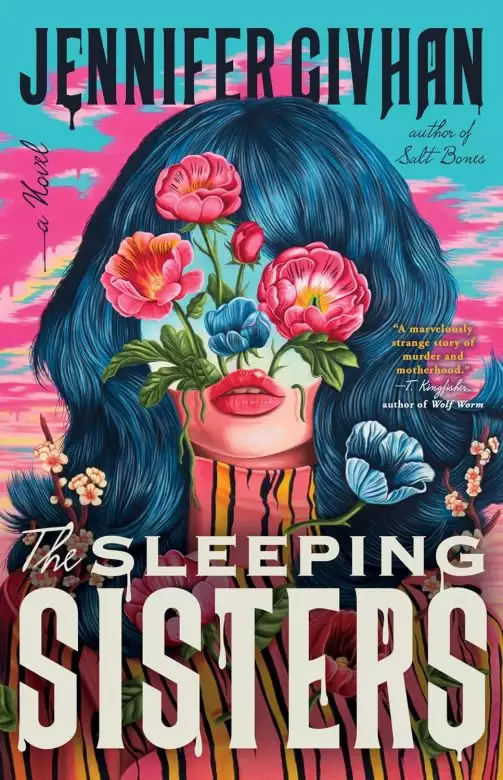
The Sleeping Sisters
- eBook
- Paperback
- Audiobook
- Hardcover
- Book info
- Sample
- Media
- Author updates
- Lists
Synopsis
A threatened mother and relentless detective collide in this mesmerizing novel from a rising voice in literary horror, perfect for fans of Gabino Iglesias, Carmen Maria Machado, Augustina Bazterrica, and Stephen Graham Jones.
A mother’s love is the oldest curse
Fortuna Miércoles has finally moved her family to a better neighborhood across the Rio Grande, desperate to outrun the curse that’s stalked her bloodline since her greatest grandmother crossed the desert with a cactus thorn splitting her throat. But burying a family’s violent legacy isn’t so easy. Twenty years ago, girls and women vanished into the Albuquerque night, their bones later unearthed on the mesa. The so-called Reaper was never caught. Now, beneath the dormant volcanoes called the Sleeping Sisters, the killings have begun again.
Detective Jeanette Palacio has spent decades chasing the ghosts of her murdered cousins—alongside the memory of the other women she couldn’t avenge. When a new body turns up in Fortuna’s backyard, both women are pulled into a dangerous, ancient plot. Are the Sleeping Sisters awakening—or has someone in Fortuna’s family set a trap?
Inspired by true events and shot through with a Chicana-Indigenous reimagining of the legend of the headless woman, The Sleeping Sisters is a fevered, feral hymn to motherhood and the monstrous bargains we make to protect those we love.
Release date: August 18, 2026
Publisher: Little, Brown and Company
Print pages: 416
* BingeBooks earns revenue from qualifying purchases as an Amazon Associate as well as from other retail partners.
Reader buzz
 Please log in to recommend or discuss...
Author updates
The Sleeping Sisters
Jennifer Givhan
The detective thinks I’m a psychotic mother who would do anything to keep her kids safe, even commit murder, and I suppose in too many regards that’s true. Only context is queen, and I have trouble unspooling mine.
When I was a girl, I had a terrarium. A glass box with a lid to grow my white rabbit’s-foot fern, carpet moss, and Fittonia—or NERVE PLANT as the tag on the pot said, and I imagined the red veins crossing its wide flat leaves as tributaries of annoyance, as if the plant might throw a fit when anything got on its last nerve, the way my mother used to say.
The dense greenery of plants spreads, feathery and delicate, across the humid biome, sponging into silky spots of condensation against the glass walls. Before the trial, my father would bring home all variety of sporing moss from the nursery where he worked. It was what I loved most about him. I try not to think about my homelife outside of the terrarium, because when I do, something nasty happens. There’s a splitting. Stitches loosen; veins unthread.
At bedtime, my daughter used to trace the scar on my neck like a relief map, her tiny fingers gliding over the thick knot etching itself into my skin as if she were reading a story I couldn’t bear speaking aloud. Until the time she and her brother witnessed my unstitching, when they were still small enough to reconcile it to dreamworld. It was awful. I watched their stricken faces from my viscous pool on the floor, sideways. Mongo might’ve tried taking them away from me if he’d seen. So I pulled myself together.
And their terror taught me I could never let them see me like that again. I had to hide the ugliest parts of myself. I had to find a different way to warn them, the way my mother had tried to warn me, however ineffectual.
But that’s why I must sort this all out. If I don’t, I risk doing to my children what my parents did to me. And all the other girls…
The home I created at Mongo’s and then carried with me inside a little glass sphere of protection around my family was nothing like my parents’ house, where my mother wove stories until she burned us like pages in books. Had she meant to hurt me?
Part of me wants to talk this through with her. Our motherhoods spiral then parallel in horrifying ways, which I couldn’t have imagined the last time I saw her, seventeen years ago. Even so, I can’t understand her rage. She endangered her daughter. No matter what I’m capable of, I could never do that.
But I’m still rushing ahead, unraveling. I need to dig through the soil and figure out what happened. If the detective pins this on me, that’s one thing, but I’m worried she has just cause to turn the blame on my children. And that would splinter the glass protecting our world.
Maybe it is my fault, though. I’m the one who bought the lottery ticket.
I asked the lotería for El Mundo and drew La Muerte.
I should’ve known better than trying to transport Mongo’s little apartment, where I’d raised our kids, soothed fevers, thickened bottles with rice cereal when Hawthorne’s reflux made him all but allergic—first to my breast milk, then to formula—and eventually homeschooled both kids, relearning everything from arithmetic to world history so I could teach them, except in literature. That I always excelled in.
With Mongo’s library card, I’d been reading thick novels aloud since our toddlers could first crawl across the playpen, absorbing the cadence of my voice more than the meanings of the words—One Hundred Years of Solitude, The House of the Spirits, Like Water for Chocolate, Ceremony. But I’d reached my limit. They needed more than I could give.
What mother wants to admit that?
So I started with scratchers, taking a quarter from the bowl on the counter where Mongo drops his spare change, scratching my way through stacks of Gold Rushes, Lucky 7s, or Treasure Hunts and wiping away like pencil lead the little boxes that could’ve changed our fates.
Sometimes I won enough to buy groceries or take us all out to the Frontier—the New Mexican diner across from the university that Hawthorne dreamt of attending in a couple of years. If I let him. He’d need paperwork. He’d need his prints in the system.
Poe would order the biggest cinnamon rolls, two or three of them if I acquiesced to her sweet tooth. Her father never minded. He let me be in charge of it all.
Our children. Our home. The rules that kept us safe.
Either we moved as a unit, or we didn’t move.
Mongo was the exception, of course. He had a job outside the home that paid the rent, utilities, food—all those weighted tangibles. Mine paid in the more ephemeral and precious, since I was the homemaker (or, at least, not the homebreaker). The one who nurtured our children, who tended their chaotic ecosystems.
And if I couldn’t lock a door behind us, if we were out in the world, we stayed together.
“Aren’t we getting too old for Hansel and Gretel?” Hawthorne would say, and Poe would nudge him in the ribs.
“We’re not a fairy tale,” Poe would correct him. “We’re a myth.”
“Let me tell you the story of Coatlicue again,” I would rejoin. “The story of my great-great-grandmother as many greats back as you can imagine…”
I’d woven my children our stories as protection spells over warm tortillas with butter, in the car on the way to the grocery store, feeding the geese at the neighborhood park before they terrorized Poe, at bedtime, stringing them from my children’s bedroom ceiling as twinkling night-lights through my broken memory. Sometimes I shuffled them wrong, remixing bits of dreams or all my pent-up rage and whatever my mother had left behind. I tried to tell the stories better than she had so that my kids would listen and understand how important they were.
That day, though, I wasn’t storytelling. I was buying a box of tampons for Poe at the gas station, where I changed gambling tactics at the cash register for Hawthorne. He wanted to learn to drive, which naturally meant he needed a driver’s permit. And other things a teenage boy wants: to go on dates and meet other teens. Then, college after high school. He was growing up.
“You can’t keep him like a dart frog in your terrarium forever,” Mongo had griped one night behind our closed bedroom door, and I’d hissed back, “Dart frogs are poisonous.”
“Exactly.”
The Powerball caught me at the register. It was one of those monsoon afternoons where the sky tantrums, shimmering the blacktop with an oily rainbow. The kids would’ve thought it was pretty when they were little. Maybe they still would if I’d pointed it out. Sometimes I wondered how much they’d actually changed and how much was a figment of my fear.
The cashier stared at her ragged fingernails as I scribbled the kids’ birthdays for the numbers—ominous bloody days but worth writing down since there’s not a birth certificate between them. She scraped a flake of polish from her thumb and asked if I wanted the PowerPlay, so I fished through my purse for another crumpled bill, all the while thinking at least I could tell Hawthorne I’d tried to make his dreams come true.
He couldn’t blame me that we didn’t have the money for college. That it was better to play smaller in life anyway. When you inevitably lost, there was so much less at stake.
It wasn’t until the next day I even began to realize what that could mean.
At sunrise, my feet hit the floor with a squelch, right into a pile of dog shit. Milkweed, Poe’s emotional-support chihuahua, left little gifts on my bedroom floor. I scraped the turds from between my toes with a disinfectant wipe, clicked her leash to her rhinestone collar, then grabbed the pack of cigarettes I smoked only on the enclosed patio, lighting up while Milkweed relieved herself on a skunkbush with globs of blood-red berries that reminded me of Christmas.
Across the street, a few errant geese shook their wings and waddled into the pond at Boca Negra Park. I should’ve taken it as a sign. When Poe was little, we checked out a book on geese, and she discovered they have spiky tongues. Now she hates the damn things since they’re nothing like Mother Goose. The truth is razor-sharp flesh and glinting with teeth. I should’ve thrown the lotto ticket in the garbage.
After I fed the dog, I headed for the one bathroom we all shared. Toothpaste and an unholy mixture of gunk smeared across the cluttered sink. I pulled out another disinfectant wipe and scrubbed until I could reckon with myself in the mirror: rosacea blooming across my wide-set nose and cheeks. Hair stringing across my cheekbones in gaunt contouring. I ran my fingers through the tangles, fluffing it out. My skull an aviary of sharp, rustling wings.
I remember thinking how glad I was Poe takes after her father and not me. Maybe that would save her. After all these years, I still resemble a lost girl in a grocery store poster, imploring HAVE YOU SEEN ME?
In the kitchen, I heard my mother’s voice calling for me, “Fortuna?”
That was impossible. Bea had no idea where I was. No one did. But for a second, I swore she was really in the kitchen, where I was making avena, yelling over my shoulder, her voice drilling through childhood and into my eardrum. Lately, I had been reading in my psychology texts that there are whole families inside us, squabbling or compensating for our quirks, picking up each other’s slack, covering for one another’s misdeeds. Perhaps that’s why my mother’s voice had come that morning; she was merely a manifestation of the part of myself that needed a mother where none could be found.
Hallucination or not, I shut her down before Mongo’s place could become the one my parents destroyed, a few blocks from Central, neon signs blinking HISTORIC ROUTE 66 beside a run-down gas station, wildflowers clawing through the cracks in the cement.
“Fortuna,” she tried again in a whisper. She named me that, hoping it would summon good fortune to ease the curse she swore strangles the women in our family, clamping its grubby hands around our throats and squeezing until blood burbles from our choked mouths.
A hiss crept into my awareness, sputtering and gurgling from the stove.
Mongo waved his hands in front of my face. “Earth to Fortuna.”
I shook my head. I’d dropped cinnamon-soaked avena all over the kitchen floor. Poe hunched over a sudoku I had printed for her at the library, tapping her pencil against the wood. Milkweed, curled at her feet, perked up with each tap, her sharp ears flicking. Hawthorne was reading The Catcher in the Rye.
“You get enough sleep?” Mongo asked, though he knows very well why I act the way I do. Sometimes it’s a relief he’s seen me at my worst. Other times, it’s a skin I long to shed. I wonder if other couples feel that way—if marriage is a true mirror or a fun house distortion.
“Yeah, sorry, just zoned out.”
I grabbed a sponge. The kitchen’s nutmeg and scorched milk now reeked of Mongo’s vulturic death stench. Eau de postmortem. I let him kiss my cheek but held my breath. His hair was clumped and damp with sweat from his hazmat suit, his bloodshot eyes sunken into recessed shadows from whatever mess he’d cleaned from sundown to sunrise.
Let me explain how I feel about my husband if I can. It’s still hard for me to understand:
While homeschooling the kids, we had listened to a podcast about people with extrasensory gifts. (The hosts had no clue what we’re really capable of, but it was enlightening enough. Educational. Mildly entertaining. And I was always on the hunt for lesson plans.)
One episode stuck with me: A woman devoted to her warm, friendly, super-dad of a husband had noticed something strange. He’d started to smell sour. Not after the gym or before he’d brushed his teeth. Him.
At the same time, his whole demeanor changed. Overnight. His yeasty stench matched his irritability. Sweet turned sharp. He growled or yelled at his kids. Stopped kissing his wife hello and goodbye. He wasn’t the man she married, not even close. And he reeked.
Turned out, her nose was a medical marvel. This woman could smell illness, the way dogs can sniff out cancer. She’d detected her husband’s Parkinson’s disease a good decade before doctors could with their machines.
And I’d felt a jolt of recognition. Not because Mongo was sick. What I smelled on my husband was not illness. It was death. He’d spent all his time with it. So I think it had finally crawled inside him.
I love him. But I’m accustomed to loving monsters.
Deep down, I don’t trust my love.
By the time I finished scooping avena into bowls, Mongo was sagging against the fridge, staring at a snapshot of us like we were strangers and not his family smiling back at him, then reached out, turned it around, and clipped it backward to the magnet so we were nothing but a blankness. He does this at every site he cleans. It depersonalizes the victims, making them objects that can be wiped. It’s Mongo’s job to erase every last vestige of violence so the place can be sold or rented. Only we’re not victims or objects.
As a city-contracted crime scene remediation specialist, the places he scrubs are normal, domestic even, until blood pools on linoleum or brain matter streaks ceilings. An apartment mushrooms with trash where a man decayed in the summer heat. They’d had to rip out the carpet and cut through the subfloor to reach the soaked plywood. Mongo hadn’t flinched describing how the man had melted into the floor. But I’d heard him retching in the bathroom afterward.
The lottery morning, he drained his coffee without another word (as though he’d forgotten his family was even in the kitchen, or didn’t care), then headed for our bedroom and clicked the door shut, taking his stench with him. All that decay.
Hawthorne snorted from behind his book. “What’s his problem?”
“He’s been cleaning other people’s nightmares all night. Cut him some slack.”
“Not our fault he hates his job.”
“No, but it’s our fault he’s stuck in it.”
That’s when I remembered the ticket.
I plucked it from my purse and smoothed it against the counter. My phone screen glowed as I navigated to the New Mexico lotto page. I double- and triple-checked. How on earth? My hands shook as I Googled the payout for five white balls and the PowerPlay.
“We won,” I whispered, turning to face my kids.
“Won what?” It was the first Poe had spoken all morning.
The ticket wavered in my hands. I released a nervous laugh that bounced through the kitchen. “The lotto. We won.”
Mongo emerged in the doorway. “What are you raving about?”
“I’m not raving. We won!” I was smiling, but tears leaked down my cheeks.
He crossed the room in three strides and snatched the ticket from my trembling hand. Milkweed leapt to her feet and barked as Mongo scanned the numbers on my phone. It’s not that I’d never thought about how money begets attention begets investigation, which we certainly didn’t need. It’s just that I didn’t expect such a windfall all at once.
“How much did we win?” His voice came out as husky as the first time we made love. I sensed the fear behind it then too.
“Two and a half million.” I wiped the salt water from my face, trying to catch my breath.
Hawthorne spat his avena across the breakfast table. “Holy shit!”
Mongo gripped the back of a chair. He let the ticket fall to a place mat, where Poe scooped it up, grabbed my phone, double-checked the numbers herself, and nodded. “It’s real.”
“We can send the kids to private school,” Mongo said. “College, even.”
Hawthorne bolted to the front door, threw it open, and yelled, “We’re rich, motherfuckers! We’re outta this shithole!”
“Get back here!” I ran after our son, laughing as I clamped a hand over his mouth before the neighbors could hear. We didn’t need someone calling the police.
Milkweed dashed after us, her high-pitched barks ricocheting down the street.
“We’re millionaires, Ma!” he mumbled against my palm, eyes wild.
“They’ll take out a butt-load of taxes,” Poe said, pragmatic as ever. She stayed rooted in a dining room chair, the ticket extending from her like a brittle tree branch, her eyes hollow bird nests after the birds had fled.
Detective Jeanette Palacio hits the Twisters drive-thru for her dry-ass breakfast burrito and unsweet tea. Ever since acid reflux hit so hard her GI doc threatened surgery, she’s had to cut out green chile—or any chile. As a Native New Mexican descended from Indigenous and Hispano ancestors, she knows how bizarre it is that she can’t stomach chile anymore. She always asks for extra cheese to make up for it, but there’s never more than a few mealy strings gluing together the eggs, potato, and ham.
Sometimes she wants to say screw it and order a smothered atrocity, but she’d end up rolling around the bathroom floor of the station, convinced she’s having a heart attack. The guys haven’t let her forget the last time that happened. Assholes. No wonder she doesn’t want to head in. Her alarm didn’t go off this morning. Subconsciously, maybe she “forgot” to set it.
The adjacent Blaze Bodyworks parking lot mocks her as she drives past, resentful of everyone working up a detoxing sweat without her. She stuffs her mouth with a hunk of tortilla to spite them all. She could cram in a session tonight before heading to her brother Ethan’s and sister-in-law Aria’s weekly dinner. Her one-year-old nephew Briar might finally say Tía Jeanette. She’s certain he said “T-Jen” once, even if Ethan called it babble.
The station sits on the Westside, near Rio Rancho, a beige stucco box wedged between a bus stop and the fire station, across from the Walmart and Cielo High. Asphalt and fryer grease waft over from the fair-food cart they just opened in the mall parking lot nearby. She won’t admit how many corn dogs and funnel cakes she’s stopped for. Carbs help her think.
Her office window overlooks stray shopping carts and the occasional strays weaving between cars, both dogs and people. The bus stop nearby pipes not just transient folks but every ass-buster who can’t catch a break through Albuquerque’s arteries. It’s free to ride thanks to the city’s zero-fares policy, helping those who need it most. A few bucks, sure, but it matters.
Since adding security, buses are safe enough. It’s the bus shelters where shit goes down: fights, deals, ODs, the occasional slaughter, but shit happens everywhere.
Case in point. Across the street where students pour into the brick high school—earbuds in, backpacks slung low—little purple ribbons cling to the chain-link fence in an RIP for two girls gunned down right outside, across from Walmart and Party City. Every time Jeanette passes the descanso for this set of cousins who never made it home, the ghost girls claw at her.
An ex-boyfriend of one of their moms had been obsessed with the teens, stalking them like some nasty-ass Humbert Humbert. The mom had a restraining order, but it didn’t stop him. Their murders were quick, brutal, and senseless. Afterward, the perp shot himself in the head. Sick fuck. There’s no justice, just tattered ribbons waving in the morning breeze.
All dead girls cling to Jeanette, but especially primas. She doesn’t have a soft spot for cousins; she has a gashed wound.
“That’s still an understatement, Jenni,” her prima Valeria howls, curled so tightly into Rachelle they’re practically conjoined twins, which is how they often acted in life, mimicking each other and Jeanette relentlessly. A two-headed chorus of snark that follows her wherever she goes. She’s not sure she deserves anything less.
One of their arms reaches toward her burrito for a bit of potato or ham, but like one of those rigged claw machines that never picks up the stuffed animal, try as it might, it comes back empty. Jeanette wishes they could materialize long enough to touch this world.
She’s still hunching in the parking lot, mid-bite, not exactly dreading the station, just not ready to face anyone until she has a few more calories, when her phone buzzes in the cup holder.
“Detective Palacio,” she answers, crumbs scattering into her lap.
“Palacio, you’re needed at a scene on Central,” the dispatcher says, brusque. “Homicide.” They lower their voice. “Poor girl. I heard it’s grisly.”
A chunk of ham lodges in her esophagus. She swallows hard. “Who’s on-site?”
“Uniforms and CSS just rolled in. Scene’s still fresh. Chief wants you there ASAP.”
Jeanette crumples the wrapper of her half-eaten burrito and tosses it into the bag.
She’s not surprised Chief Mata’s calling her in, but she wasn’t expecting it. Not that she’s botched cases—she hasn’t—but she doesn’t let them go. She still keeps the case files for the Sleeping Sisters in her bag; carries them with her wherever she goes. It’s earned her a reputation as sentimental she doesn’t deserve. It’s also meant the chief’s reluctant to let her do her job. He’s got a stick perpetually up his ass, like a dog getting its temperature taken and Jeanette’s the one bitten. “Too emotional,” Mata’s called her after a particularly rough interview with a trafficking survivor. “Heart on sleeve.”
As if it’s a sin to care what happens to girls and women.
You know, mijita, I’ve always hated that they call them the Three Sisters, when there are five. It’s a small thing, maybe, but it’s the small things we notice when the worst has happened. Settlers always trying to tame things with their own beige names, deeming them Butte, Bond, Vulcan, JA, and Black. But in our mouths, they are the Sleeping Sisters—dark-lashed, basalt-skinned, curled in restless slumber here on the edge of the West Mesa, holding their breath as they watch us. Volcanoes don’t die, mija. They go quiet and pensive, like you, puzzling it all out.
Poe, remind me, baby. You looked all this up for homeschool research. Geologists say they last spewed around 150,000 years ago, right? Part of a fissure eruption stretching more than five miles through a curtain of fire. Molten song shaped the land we walk with black rock, ash fields, and towering escarpment. This place is more than geology. It’s one of our last remaining sacred sites not paved over.
It’s where the world began.
Around 1300, our ancestors carved petroglyphs into the living rock faces—spirals, stars, horned serpents, flute players. These are not decoration but memory. Map and medicine.
I can’t say out loud what they mean, but you know.
Our bloodline is both Mexica and Pueblo. Your bisabuela from El Norte was born near Bernalillo. Before that, her people followed the turquoise trail from Tenochtitlán, where Coatlicue swept her serpents north across the desert.
Somewhere in the Jornada del Muerto our ancestors met, trading cacao for turquoise, macaw feathers for stories. And the stories wove together. They entangled.
Pueblo oral tradition says these volcanoes are a sacred center where prayers release into the spirit world. This is where the dead begin their journey.
And I need you to understand—this is also where the desecration happened.
The Reaper wasn’t a god. He wasn’t creating ceremony. He was a vile man. I may have loved him once. I can’t remember that part, although I can tell you for certain: The girls and women he buried in the volcanic soil were not sacrifices. They were daughters. Defiled.
But the land takes even what men destroy. That’s the thing about memory. About love. That’s the thing about sweeping evil across the place we have bled, where we’ve birthed our best hope. What Mother told me, I implore you to believe. The basalt holds every spirit who ever passed through. The volcanoes, even quiet, are listening.
So I’ve brought us to the foot of the Sisters, not asking for forgiveness.
I’m asking for fire. For the ground to split.
I’m pressing my cheek to the black rock and begging the earth to spit —
You’ve heard these stories I’ve told you since you were little. About the woman whose husband couldn’t stop tugging at the green ribbon she always wore around her neck.
How he just had to know what was underneath. How he pulled at the knot as if it held a secret meant for him. And off rolled her head—plop—right into her lap. That’s where her story ends.
But it’s where ours begins.
My head cocks. A loaded gun.
My head unscrews and flies out the window. My body rocking, rocking.
You once asked, “Why would she keep wearing the ribbon if it was so dangerous?”
And I told you the truth, although you were too young to understand. “The ribbon wasn’t just a ribbon. It was a warning. A boundary. A lineage.”
Your brother scoffed. “It’s just a story, Ma.”
“Is it?” I asked. “Then why do you keep listening?”
The green ribbon goes back all the way to your bisabuela’s bisabuela’s bisabuela—Coatlicue, goddess of death and rebirth, of the cyclical nature of creation and destruction, of the forked stories and bifurcated tongue. The earth herself.
She crossed the Jornada del Muerto with the ribbon knotted tightly around her neck. Only it wasn’t fabric; it was a cactus spine, a living string of thorns, green and barbed. Throat fruit she bled and kept on sucking as she trudged all the way up the volcanoes. All the way to us.
We don’t wear our green ribbon for beauty but to keep our heads.
And when men tug as they do, we hold the knot tighter. We press our fingers to our ribboned bouquet of jugulars and remember who we came from. When our heads fly off, baby girl, they don’t land in our laps but roll through generations, passed down with the curse.
You used to cry when I told you this story.
I’m sorry for that.
As I piece the fragments together, I revisit the funfair over and over in my mind. How one of those kids is dead. How I’ve assured myself I did everything I could to protect my own, even if that meant damning someone else’s. How I believed my terrarium stretched to include our lavish new lifestyle after I’d carried it, trembling, across the city in my crackling glass globe.
That night, the Ferris wheel spun its bright bulbs against the night bosque, a dark smudge of forest beyond the carnival that stretched across Rio Grande Prep’s pristine riverfront campus.
“Public schools might’ve scraped together a bounce house or a taco truck,” I remember saying, “but this place went all out.”
Mongo squeezed my hip and handed me a snow cone and a bag of popcorn. “Private school’s a hell of a drug.” He took a sip from my cup and grimaced. “Jesus. Tastes like melted batteries. Want me to grab you a beer from the Walgreens across the street?”
“Don’t tempt me.”
“I thought that was my job,” he said, and winked. “Look at them, fitting in.”
“They’re surviving,” I corrected, my stomach queasy as I watched Hawthorne and another boy rocking the Ferris wheel bucket at the top, making all the girls shriek. “He’s such a doofus. Already Mr. Popular.”
He’d been hanging with that tall wheat-haired kid, Brig—pretty-boy face, linebacker body, but still soft underneath all that muscle. A cake that hadn’t set. They were teasing a group of girls too hard. The girls’ voices rose above the carnival music, bright and feral.
Mongo laughed. “The kids call that magnetism rizz.”
“Rizz?” I snorted. “More of a fizzing bottle of testost. . .
We hope you are enjoying the book so far. To continue reading...
