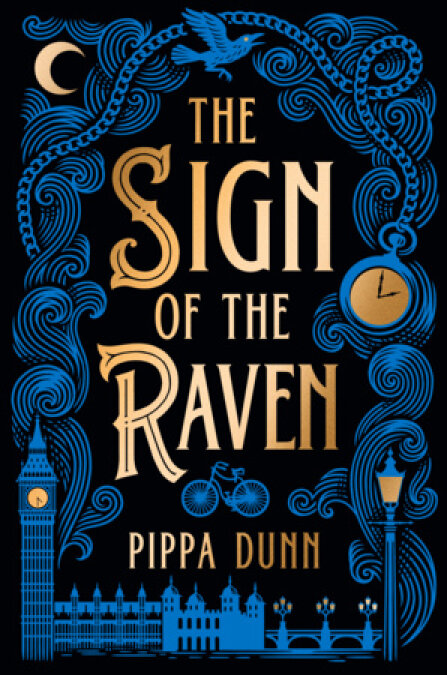
Dreams may be more real than we think, as one intrepid dreamer discovers in this YA historical fantasy set in nineteenth century London—perfect for fans of Emily J. Taylor and V. E. Schwab.
LONDON, 1889.
Ashlyn Threadneedle leads a double life. By day she works as a government messenger. By night she escapes into vivid lucid dreams, navigating the Stream—a world in which the only boundary is her own imagination. But when her long-dead mother unexpectedly appears in a dream, Ashlyn is certain the Stream is hiding secrets, ones that contradict everything she knew about her past—and threaten to undo the future of everyone she loves.
In her quest for answers, she joins the Corvi Signum, a secret society of dreamers fighting to protect the Stream from an insidious enemy powerful enough to manipulate people’s thoughts and seize control of London. For Ashlyn to have any hope of preserving her own mind, she must first unravel the mysteries of both her family and the Stream. But a world of dreams is a treacherous place. Time slips backward and forward as easily as sand through an hourglass, and if Ashlyn and her fellow dreamers fail in their mission, then nowhere—neither waking nor sleeping—will be safe.
Release date:
November 10, 2026
Publisher:
Viking Books for Young Readers
Print pages:
320
* BingeBooks earns revenue from qualifying purchases as an Amazon Associate as well as from other retail partners.
Chapter 1 The minute hand of the Great Clock on the tower of Big Ben meant that Ashlyn could no longer ignore the fact that she was extremely late. She pedaled hard as she rounded onto Westminster Bridge, dodging the piles of horse muck steaming in the winter chill and weaving through the pointed stares and occasional shrieks of pedestrians. Her bicycle always caused a stir among London’s well‑to‑do. She threw a cheerful grin in the direction of a scandalized woman wearing a particularly obnoxious hat and promptly found herself on a collision course with a crowded omnibus. She swerved just in time, but not before a child leaning out of one of the windows made a swipe for her cap with its fat little fist. She wobbled, her heavy leather satchel causing the bicycle to lean dangerously to one side, and slammed on the brakes to avoid a cart piled high with squawking chickens. As she finally tumbled to the filthy paving, she saw on the clock that it was four minutes to twelve. Rolling to avoid the clatter of horseshoes and carriage wheels, Ashlyn scrambled back to her feet and rescued her bicycle, wheeling it toward the relative safety of the bridge’s balustrade. She cursed the fact that her jacket would need cleaning yet again. Thank goodness the satchel and its precious contents seemed unscathed by the experience. The seconds were ticking away, but Ashlyn couldn’t resist taking just two of them to look out across the water. She loved the bridges of London holding the churning neighborhoods of north and south together like laces on a boot. In the summer, the river belched with the stench of the city, but in the winter Ashlyn usually took her time if her delivery rounds sent her across the Thames. Today, however, was not one of those days. The misshapen little package nestled at the bottom of her bag was sealed with bright red wax: an urgentclassified delivery. She’d never made one of those before, and her fingers itched to peel away the seal. Perhaps she could adjust the corner of the burlap wrapping and steal the smallest peek . . . She glanced back toward the clock—and then shuddered as she thought about Simkins. She could just imagine his arrogant smirk as he consulted his pocket watch, itching for the golden minute hand to tick over the hour so he could dock her pay for the third week running. The vivid mental picture sparked new determination. She pushed her curls back into her cap, tightened the red woolen scarf at her neck, and with a deep breath launched the bicycle back into the fray. Westminster Palace floated above the haze on the river ahead of her, but only the clock tower rose above the surge and sludge of life below. Big Ben was called the Whitaker Tower, officially, after President Whitaker, though thirty years ago it had briefly been the Victoria Tower after the old queen. The queen had been shot on the day she’d cut the ribbon, and from the turmoil the Republican Brotherhood had emerged triumphant. No one called them that anymore, of course. They were just “the Party” these days. As she hurtled once more toward the Great Clock, Ashlyn remembered a story her aunt Miranda had told her when she was small. The original hands that marked the minutes and hours on the clockface were made of cast iron, but the clockmakers discovered too late that they couldn’t tick. They struggled so much under their own weight that the hands could only waver between midnight and one minute past, and time itself hung in limbo—just like the country. The hands were replaced with lighter copper ones six weeks later. Ashlyn often wondered what had happened to all that time: London’s lost six weeks. As she reached the north bank of the river, Big Ben began to ring out the hour. Much as she loved the sound, she grimaced: she had less than a minute until the final bell. Not for the first time, she wished that the clock might somehow stop mid-chime; in a choice between Simkins’s pinched face and taking her chances with the lost six weeks, she knew which she’d pick. Careering around the corner at breakneck speed, she cut across the square outside the palace before abandoning her bicycle against the cast-iron railings. Clutching the bag to her breast, she sprinted toward the Peers’ Entrance of the House of Lords, ignoring the cries of the various armed guards as she plunged through the gateway and the open oak doors. She reached the porters’ desk just as the bell’s final peal died away. “Made it,” she gasped out, panting for breath as she slung the satchel onto the polished wood with a dull clunk. She doubled over with the exertion, her lungs screaming with each gulp of musty air. When she lifted her head, cap askew and curls tumbling from their pins, she saw that Simkins was holding his pocket watch so tightly that his knuckles burst from his bony hands like knives. His eyes flashed with barely concealed glee. “You, Miss Threadneedle, are late.” Ashlyn fought to protest through her still burning chest. “But the chimes . . .” “Have concluded. Which makes you late. Again.” Simkins removed his pince-nez with studied affectation and fingered the British presidential seal embossed on the tough leather of the satchel. “Would it be too much to assume that the item in question has been safely conveyed?” Ashlyn gritted her teeth. “The archbishop’s private secretary gave it to me himself.” Simkins raised a single eyebrow and Ashlyn felt a tiny thrill of satisfaction. She knew that would touch a nerve. His glare, newly vicious, never left her face as he unbuckled the satchel and removed the small object wrapped in burlap and fastened with that red wax seal. Ashlyn could tell its weight surprised him; it had surprised her too. As a messenger for President Whitaker’s government, she rarely had such interesting assignments. It was mostly folios of documents being ferried between the various presidential palaces: Westminster, of course, Whitehall, Lambeth, St. James’s, and the Tower of London. It was rare she had to venture as far as the Ministry of Defense at Hampton Court, but occasionally when there was a call for a military document, she’d make the most of the leisurely ride downriver. This had been different, though: an urgent telegraph an hour before, just as she was due to go off shift. A classified item to be collected from Lambeth Palace Library and delivered to headquarters before the midday chimes, a delivery she had been granted special dispensation to make—though it was above her rank—to ensure the item’s fast passage through the city. It should have been an easy job too, but the archbishop’s private secretary had taken an age with this particular item. He had disappeared for a good forty minutes before returning with permission from the archbishop himself to release it to Ashlyn. The whole thing had been extremely tiresome, and she had been desperate for her shift to finish, but whatever this thing was, it was special. And she wanted to know why. “I am trying hard to understand, Miss Threadneedle, why you remain in my presence. I have already clearly illustrated that since this item is late, and its lateness must therefore be accounted for to your superiors, that there will be no coin for you. In fact—” Simkins broke into a wide, malicious smile. “In fact, I believe that this might be worthy of afine, which would put your account with our president’s government into”—he savored the word—“arrears.” Ashlyn flashed white-hot. She allowed herself to clench her fists, but it took every ounce of willpower to keep herself from using them. Reacting against the injustice of it all would get her nowhere, so she simply said, “I’ll check with accounting, sir.” She hoped he could hear the steel in her voice. “You would be wise to do so, Miss Threadneedle. I am sure you understand the implications of governmental debt.” He handed the satchel back to her and reached for a rope hanging behind his desk. Pulling it would summon one of the clerks and send the delivery on through a maze of corridors to whichever peer or minister had requested it. She’d never see it again. Ashlyn burned with curiosity, and in a rush she spluttered, “But, sir, shouldn’t you check the item before it’s sent on?” As soon as she spoke, she chided herself for being so obvious. “Since,” she continued, thinking fast, “since there seemed to be some . . . confusion about the courier request at Lambeth.” She looked up at Simkins with as much innocence as she could muster. “I wouldn’t want you to send on an incorrect delivery, sir.” Simkins paused, his hand inches from the bell pull. She could see the cogs turning behind his eyes as he weighed up proper protocol against the importance of due diligence. The scales tipped in diligence’s favor. “You do have an appalling track record of breakages, Miss Threadneedle.” She buried a smile as Simkins moved his hand away from the rope and broke the wax seal in one terse movement. He unwound the burlap deftly and precisely to reveal a dull brass instrument. It was a little bigger than Ashlyn’s palm and a tangled jumble of spools and reels and knobs and dials. It looked almost like a telegraph machine except for one extremely unusual adornment: As Simkins pulled the burlap clear, a small bell on a metal arm tinkled clear and strange and bright. The hairs on Ashlyn’s forearms stood on end. She had heard that sound before. As Simkins peered at the contraption through his pince-nez, she rapidly tried to place the faint scrap of memory that the sound had conjured, but it was just out of reach, as if it were on the edge of one of her dreams. An impossible thought prickled in the back of her mind. “Well,” said Simkins, “it is plain that this”—he looked up at Ashlyn and cleared his throat—“artifact, yes,artifact, will need to be sent for full inspection following its initial, ah, transference.” Simkins obviously had no idea what on earth the contraption was. He reached once again for the bell pull and tugged hard before wrapping the thing back up. As he folded the burlap, his wrist caught the bell again, and it rang out its shining silvered chime. “You are dismissed, Miss Threadneedle.” He drew out a ledger to mark the delivery as complete, and this time Ashlyn knew that this particular interview was over. Hooking the satchel over her shoulder, she turned back toward the main gates of the hall. She had been longing for hours to finish her shift but now found herself in no hurry to leave. That little device was still gnawing at her attention, the chime ringing in her mind as if it were calling to her. The impossible thought itched again and she tried to push it away, but still it tingled:She had heard it in a dream. If only she knew what that odd little machine was for. As she made her way toward the gates, she noticed the dark narrow corridor that led off the hall toward the Peers’ Robing Room. Like everything in the House of Lords, it was framed by two elaborate Gothic pillars—pillars that were almost exactly the right width to hide a sixteen-year-old messenger. A dangerous idea emerged and—stealing a glance back toward Simkins, who was still buried in his ledger—Ashlyn darted behind one of the pillars and into the shadows. Painfully aware of the sound of her own breathing and the scratch of the satchel’s buckle as it brushed against the stone, she stood as still as she could manage, occasionally checking behind her down the gloomy corridor. She was grateful that a round-faced boy with a thatch of blond hair quickly appeared to answer Simkins’s summons. Ashlyn recognized him as Trevor Barlow, a fellow messenger who had something of a soft spot for Ashlyn. He was earnestly ever trying to please his superiors—though what good it did, Ashlyn couldn’t tell. Simkins was as bitter to Trevor as he was to everyone else. She watched as he approached the porters’ desk and flattened herself closer to the stone wall as Simkins looked up from the ledger. She strained to hear what they were saying, but she caught only fragments: fragile and Yes, sir and Black Rod’s Corridor. And when she dared to peek round the pillar, she saw that Trevor, now clutching the burlap bundle, was heading toward the passage that led into the House of Lords itself. The female messengers weren’t allowed that way. Ashlyn knew she had only an instant before the building would swallow both boy and package deep into its endless winding passages. There was an instinct in her she didn’t fully understand, a logic that she couldn’t quite follow, an impulse that felt like a memory that told her tofollow the chimes of that bell. With a surge of adrenaline, Ashlyn darted out from the shadows. She strode across the lobby with what she hoped was the kind of nonchalant purpose that allows one to move hidden in plain sight. Her heart was clamoring in her rib cage—if Simkins so much as glanced up from his books, she’d be out of a job. The polished marble tiles seemed to stretch and contort until—after a handful of endless seconds—they swept her behind the columns on the other side of the arched doorway, where she rapidly realized that her new situation was more precarious than her last. She was at the foot of a wide flight of stairs, lushly carpeted in deep red pile. The walls were swathed in tapestries, and gleaming banisters spiraled toward a vast landing above. Trevor was already halfway up, his pace a keen trot, and Ashlyn knew that there were likely countless different doors and passageways he could take once he reached the landing. Dimitri had once told her that there were more than a hundred staircases and a thousand rooms in Westminster Palace—but then, Dimitri was a journalist and had always been prone to a bit of sensation. Still, she shuddered at just how easy it would be to get lost in that labyrinth of power—would she ever be found? Would the punishment for trespassing mean she’d ever want to be? The deep murmur of male voices from above brought Ashlyn starkly back to her present predicament. She shrank farther into the gloom before cursing silently to herself. This was going to be more challenging than she’d realized. Stuffing her hair back into her cap, she paused for a split second as the picture on the nearest tapestry came into sharp and sudden focus: a unicorn impaled on a trident wielded by a menacing mermaid. A siren. Ashlyn swallowed. She didn’t believe in omens but found herself thinking that this couldn’t be a good one. Turning back to the staircase, she looked up toward the top step. It was empty. Trevor—and the package—had disappeared. She felt her resolve drain away like sand through an hourglass. Frustration welled up to take its place as she cursed her momentary lapse of concentration, cursed Trevor and his eager trot, cursed the mermaid and her trident and the whole House of Lords. She leaned back against the tapestry, deflated— —and the next thing she knew, she was lying in a crumpled heap on a cold flagstone floor. Somehow she had toppled backward straight through the tapestry. Struggling back to her feet and rubbing at what would almost certainly become a nasty bruise on her hip, she saw that she was standing in a narrow chamber, empty but for a tight spiral staircase cast in iron at the far end. In front of her were three stone steps, at the top of which was a solid oak door. It was standing open, curtained by the heavy swag of the tapestry beyond. The little light that filtered through the cloth gave the place an otherworldly reddish tinge. Doors hidden behind tapestries weren’t the kind of thing that were meant to be found, especially by errant messengers, and—thrilling as such a discovery might be—she didn’t fancy explaining herself to whoever it was that had forgotten to close this one. This whole endeavor had been foolish: What had she been thinking? She needed to get out before it was more than just her job she might lose. As she began to steal her way back toward the open door, her boot slipped with an alarming slap off the smooth worn edge of the bottom step. She froze, just as a strand of conversation pierced the veil of the tapestry. “Well, you saw him at the last vote, didn’t you? The election next year has him riled. He’ll fight tooth and nail to quash the . . .” The soft tread of footsteps on the stair carpet faded into the floors above, and Ashlyn let out a long low breath as she wondered who saw who at the last vote and what they were attempting to quash. An image rose in her mind of the Palace of Westminster as nothing more than a vast mill by a river; instead of spinning cotton into yarn, it spun whispers and gossip into policies and laws. Information spun to power, and all to keep that very information in the hands of already powerful men. She bit her nails into her palm. With slow, deliberate steps, she climbed back up toward the open door before springing back in alarm as fresh commotion began to flicker behind the tapestry. “. . . got that wrong, old chap. I hear that Whitaker himself has authorized . . .” “. . . the press won’t catch a whiff of it, mark my . . .” “. . . suffrage? If you ask me, there’s rather too many with the vote as it is . . .” Footsteps were beginning to thrum like rain patter before a coming storm, and the stairs, silent a moment ago, were fast becoming a brook of tumbling voices. She backed into the chamber as she realized with sinking dread what had warranted the sudden flurry of activity; she had made the delivery at twelve noon, and the House sat at half past. Lords and ministers would be streaming in and out of the Peers’ Entrance and up and down the staircase for the rest of the afternoon. There was no way she could slip back through the tapestry now, not until they all retired to their clubs and cigars—and even then, how would she explain where she’d appeared from to the night porter, or, God forbid, to Simkins, burning the candles low in fervent devotion to his precious ledger? She was trapped, stuck in this airless chamber with only a tapestry hanging between her and certain discovery, unless— Ashlyn jumped as a sharp prod caught her right in her spine; she had backed all the way into the banister of the spiral staircase. She turned and looked up the steps into the murky darkness above. Not completely trapped, then . . . Perhaps the safest way out was through. She felt a familiar surge of reckless confidence, the kind that often got her into trouble but usually got her out of it again too. And what was it Dimitri always said?The truth is always worth causing trouble for. Casting a final look back toward the open door, she saw the mermaid and her spear just visible in reverse. She shivered and began to climb.
We hope you are enjoying the book so far. To continue reading...

 Please log in to recommend or discuss...
