- Book info
- Sample
- Media
- Author updates
- Lists
Synopsis
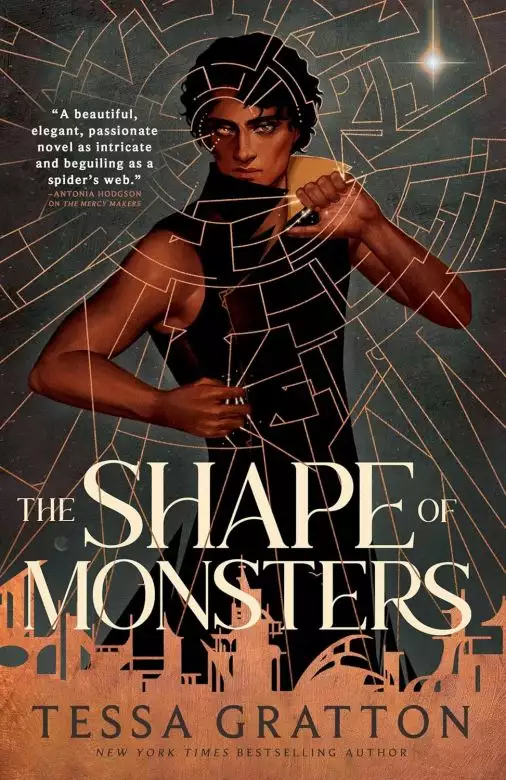
A talented heretic and the emperor she both loathes and loves will learn what monsters are really made of in the second installment of the Moon Heresies trilogy by New York Times bestselling author Tessa Gratton.
Iriset—prodigy, outlaw, now sunderer—has broken the Moon-Eater god’s prison at the heart of the empire. But the consequences of her actions land her in a city of monsters where the heretical magic of human architecture is freely practiced, and the only person she knows—and can trust—is Lyric, the emperor she’s lied to and loved in equal measure. As scheming kings and capricious gods drive them towards different extremes, they soon realize that to find their way home, they must remake the world…at the risk of breaking it forever.
Praise for the Moon Heresies trilogy:
"Laced with a vivid sensuality." —Jacqueline Carey, New York Times bestselling author of Kushiel's Dart
"A beautiful, elegant, passionate novel. A triumph and a delight from start to finish." —Antonia Hodgson, author of The Raven Scholar
“Sensual and suspenseful.” —Publishers Weekly
"A lush story of dangerous intrigue in an intricate and utterly unique world." —C. S. Pacat, author of Captive Prince
Release date: June 16, 2026
Publisher: Orbit
Print pages: 560
* BingeBooks earns revenue from qualifying purchases as an Amazon Associate as well as from other retail partners.
Reader buzz
 Please log in to recommend or discuss...
Author updates
The Shape of Monsters
Tessa Gratton
Bright enough to challenge the sun, its blaze is not warm and golden like that very sun, nor tinged pink like the light of the pink-silver moon. No, it is an eerie, even white light that draws the viewer in to look more closely, to wonder, if they squint or stare or perhaps just tilt their head, can they see behind—or through—to a rainbow prism or another world?
Everyone for miles looks up, shading their eyes. From the commander-philosopher of the College of Intrinsic Foundation to the students studying in the Cult of Hopeful Design near the mouth of the Lapis River, everyone inside flees to windows. In the streets, merchants and artists, small kings and revolutionaries stop to stare, mouths parted, while combat-designers activate force-shields and design mercenaries drag their wards to shelter. The sudden surge of forces causes bridges to tremble and the force-eddies mingling over the city to knot, blowing hard winds that rip razor petals and translucent leaves from the garden canopies. Feather foxes hunker low in their alleys while rep-cats and copper apes leap as high as they can into trees and trellises and balconies. Avian creatures of every kind burst into flight, heading away. Away from what? The light’s point of origin, of course, over the center of the crater.
Even the Moon-Eater frowns in his palace in the heart of the monster city, distracted by the weird gleam directly above. He says, “Eliri, find out who is doing that and bring them to me,” and is obeyed.
The Moon-Eater is always obeyed.
As the light fades, a star remains. It glimmers, hangs against the plain blue sky.
And the star begins to fall.
Lyric is falling.
He can’t see, eyes burning with white-cold light; his ears ring, but beyond that is a terrible roar of wind. There is a body in his arms, and he huddles around it, blood in his nose, trembling unstoppably. He makes himself a ball, wrapping around her body like he is a nest and she is a fragile egg.
He falls and falls, even as forces pull and pull. Lyric is the heart of something, a great disk of design, an array the width of his city spinning and spinning with him at the axis. The spinning array pushes outward with tight centrifugal power, dragging at his dominant inner rising design. The array and his rising force slow them down in their fall, turn him from an axis point into a shooting arrow. A focus. An anchor.
The anchor hits the ground before Lyric does, piercing sharp and hard deep into the crust of the world. Its shock wave slides back up the lines of force and catches him like a massive hand.
Lyric touches down almost gently against red rock and thin crystal sand.
His ears still ring, but the wind is gone. It’s only his pulse hammering in his skull, his body alive with popping ecstatic force. His skin tingles and his head aches.
Lyric sucks in a huge breath and sits up.
A whimper chokes off, and through painfully wincing eyes Lyric looks at what he’s cradling.
She’s curled against him, hands fisted in his robe, blood across her jaw and mouth.
Iriset, he tries to say, but nothing comes out.
Her lips move, too, and bloody teeth glint. Her body convulses once, a wretched whine tearing free.
The altar—Lyric remembers the altar in the Moon-Eater’s Temple and the numen and Iriset standing bold and awful with her arms outstretched arguing to break the Holy Design—
And a dart slammed into her.
It jabs out of her ribs just under her left breast, blood darkening the orange shift she’s wearing. Lyric makes a noise that still isn’t words as he presses his hand around the wound. She gasps, face contorted, and coughs up blood.
Ecstatic force blinds him for a panicked moment and Lyric seethes his breath slowly through his teeth, controlling himself. He lays her carefully across his lap, her head on his folded knee, and rips at the thin shift where the dart tore through. Cloth comes away, making a shredded gap for him to see.
Blood pools and spills around the shaft. Iriset trembles and her breathy gasps are too shallow. Coughing blood could mean the dart is in her stomach or her lung, and Lyric can’t save her.
Lyric’s first real memory is huddling in the lee of the Moon-Eater’s altar with a large fossil molar pressed to his stomach. Outside the dark pocket of the temple, people yell his name. They sound furious and Lyric curls around the tooth, making himself smaller. He doesn’t remember why he slipped out of his bedroom before dawn, why this place drew him, why he hid and didn’t simply ask to come. The attendants would have said yes, his mother would have said yes, his uncle the Moon-Eater’s Mistress would have said yes.
But he didn’t ask, and now they’re angry at him, and he’s afraid to crawl out from behind the altar even though nobody will hurt him.
The voices and chaos move away until he’s alone. They don’t look in the Moon-Eater’s Temple. When the sun rises, Lyric’s uncle sweeps in, snarling at his attendants that he’ll be fast. Lyric hears the rustle of cloth and a soft brush of skin on stone. His uncle leans on the edge of the stone slab opposite Lyric, propped up with his left hand, his head fallen back to show his long throat to the starry midnight dome of the temple. Lirdal méra Niyah, the Moon-Eater’s Mistress, is disheveled, his wavy dark hair unbound, his sleeveless robe mussed and pulling as if it’s not on quite right. He closes his eyes and breathes shallowly, his right hand hidden by his body as he begins.
Lyric doesn’t want to bother him, and remains still, on his knees behind the altar. His uncle’s back and shoulders loom up, like a broad statue, and Lyric remembers he has one of the teeth—the Moon-Eater’s teeth!—and they belong on the altar.
Gently, Lyric lifts the rough tooth, fingers in the grinding furrows. He holds his breath as he places it beside the others with the tiniest scrape of stone to stone.
The Moon-Eater’s Mistress freezes. Lyric ducks down, huddled back into a ball.
A soft sigh reaches him, and then his uncle moves. Hands grasp him and he’s pulled up into a lap. “Lyric, you’ve scared everyone.”
Lyric shakes his head, again and again.
“I need to take you back.”
He darts out his hand to grip the hem of his uncle’s open robe, clenching his fingers tight.
“You want to stay.” There’s something Lyric doesn’t understand in his uncle’s voice. But Lyric leans into Lirdal’s chest. “Very well, little moon. But I must put you down.”
Lyric allows himself to be settled on the ground again, and spreads out to lie flat beside the base of the altar. His uncle brushes hair back from his forehead tenderly and murmurs, “Maybe you will feel him, too.”
Closing his eyes, Lyric listens to the soft sounds of skin and stone, matching his breath to his uncle’s even as it picks up, rhythmic and shallow, and when the Moon-Eater’s Mistress finishes, Lyric’s ears pop. He isn’t afraid any longer, and takes his uncle’s hand to be led back to the Seal tower. If he is punished for hiding in the temple, he doesn’t remember it.
Lyric is seven years old when his father brings him into the mirané hall for the first time and sets him on his feet in the seat of the throne. “Do you know what this is?” Esmail méra Niyah His Glory asks.
The Vertex Seal is tall and broad, mirané-brown skin painted in long white and blue stripes stretching from his hairline down over his eyes and cheeks. The stripes skip his short beard to pick up again under his chin in those colors of ecstatic and rising forces. As usual, he wears layered robes in all four force colors and his hair is pulled into a high tail, from which tumble black curls with the barest hint of auburn. Standing like this on the throne, Lyric can look directly into his father’s crater-red eyes.
“This is the throne of the Vertex Seal,” Lyric says quietly. He always speaks quietly, because everyone else is loud. “The center of the empire.”
“Correct. My throne, and one day yours.” Esmail plants fists on his hips. “Do you know what it means to be the Vertex Seal?”
Lyric frowns and stiffens his fingers where they brush against his plain black skirt. Its narrow pleats fall to brush the tops of his slippered feet, and this morning his mother tied him into a sleeveless vest embroidered with her favorite fat red flowers. Lyric likes them, as well, because they look like his baby sister’s cheeks when she smiles. And Ama is always smiling—unless she’s screaming. She is the loudest person Lyric knows. “To lead,” he finally answers his father.
“It means you must be the best miran there is.”
Thinking about that, Lyric nods. It makes sense. He doesn’t realize for years that while to him the best meant he should be just and good and proud and compassionate, Esmail only meant for his son to be strong.
To Esmail, to most Vertex Seals before him, strength comes from conquest and domination, expanding the empire in Aharté’s name without needing to care about what’s destroyed in the process. Want more, be greater, do better, get stronger. That is what Esmail demands of Lyric. A single-minded perfection ignoring the quiet parts born in his son. Esmail would say he hones Lyric’s natural inclinations into the sharp weapon a Vertex Seal needs to be, shaving back unnecessary thoughtfulness, polishing away curiosity, dulling wonder.
In Esmail’s image, Lyric would grow to be as unmemorable as his father.
A year later Lyric wakes before the sun again, clear-eyed and eight years old. It’s his birthday, but miran don’t celebrate such individual things, relying instead on the anniversary of the birth of all miran four hundred years ago to mark the passing of time.
Lyric had been dreaming, and the dream rests quietly in his mind, all sound and song, no imagery. He knows what it means and turns his face to the boy sprawled beside him in bed, uncertain about waking the other or letting him sleep. But in the end Lyric prefers to give everyone their own choices when possible, so he shakes Garnet gently and says, “I’m going to the Silent Chapel.”
Garnet, also eight, nods and drips out of the bed to tiredly put on his slippers. He doesn’t ask why. Lyric drifts like a ghost through the darkened corridors of the palace complex with Garnet trailing behind. The young body-twin whispers to the Seal guards and sleepy attendants where they are going, and they gain a small entourage that Lyric ignores until they reach the gate of the chapel and he looks back at them, miran all but Garnet, their red-brown skin gleaming under the dim light of Aharté’s moon. It’s a thick wane this time of night, steadily fading into half by the moment of true dawn.
“Stay,” Lyric tells everyone quietly, and pushes open the gate with a firm shove. Garnet ignores him, but Lyric expected that. Although most people assume they get along because of similar interests and seriousness, it’s because Garnet knows how to be just as quiet as Lyric—when he cares to. It’s almost as if Garnet can read the other’s mind sometimes, sensing or guessing what the heir needs or wants without Lyric having to speak. Everyone else in Lyric’s life demands noise of him, whether it’s answers to oral exams for his tutors, or reports on what he’s read for his father, or opinions on how beautiful his mother is and his favorite foods for her to arrange, or if he prefers to focus on breath work or footwork or strength training with his combat instructor, or some vocal acknowledgment to redirect Ama’s constant babbling. Soon he’ll be required to speak up at meetings of the mirané princes. His uncle has promised that once such meetings begin, Lirdal will make it his daily mission to tease a laugh out of the serious little boy. Lyric is unsure how to explain to his uncle that he often feels joy, he simply doesn’t let it out. An instinct deep inside him—a core knot in his inner design—tells him to pull his feelings thin, to weave a shell of them. Especially around his father.
Garnet understands all that. And so Lyric allows him to remain at his side even when drawn to the Silent Chapel by his dreams.
The priest who greets them is an old mirané woman with wiry white hair and more wrinkles on her mirané skin than there are stars in the sky. Her sleeveless red priest robe is as plain as any, and she has nothing painted on her face, nor any mask. It is the way of Aharté’s priests, for they give everything to Silence, including honesty and even their own names.
“A Lyric to Bridge the Silence,” she says softly. Of course she knows him.
And Lyric knows her: This is the Holy Peace herself, most revered and blessed priest of Silence in the empire. Yet she crouches down so her knobby knees stick out like any grandma, and takes his hands when Lyric tries to touch his eyelids in respect.
“Not to me, little Seal,” she says with a smile. “Not to anyone but your parents, and one day, your children. When you meet Aharté, do it with your full gaze.”
Garnet remains at the gate as the Holy Peace leads Lyric by the hand deeper into the chapel grounds. Only the silver-pink moon lights their way, through circlets of flow and rising force-steeples that gather the pretty moonlight and reflect it bright enough to see clearly. The Silent gardens are simple, filled with elegant columns climbing with vines and plinths spilling night-blooming eris flowers. Tiny water features ripple quietly at the movement of frogs, and the fountains draw Lyric’s attention because their design is so exact that water arcs in perfect quiet. No splash. No ripple.
Lyric finds it so very easy to breathe here.
The Holy Peace takes him to the great labyrinth at the heart of the garden and sets him on its path.
He walks it for more than a day.
Hunger focuses him in his body, and the gradual ache of his feet, until everything else falls away and Lyric hears only his own peaceful thoughts. Then even those thoughts quiet, pulling thinner and thinner, and he feels it: Silence.
The very moment Silence arrives, it dissipates, but Lyric notices.
Though the Vertex Seal is apathetic to his son’s devotion, Lyric’s mother Diaa is pleased, and reminds her husband that Silence is the strength of the empire. Lyric will be the Vertex Seal Esmail molds him into; let Lyric be Silent for himself.
She pulls her son to sit on her lap though he is too gangly to fit. She reads to him Word of Aharté and Writings of the Holy Syr, and inquires after a tutor from the Silent Chapel to instruct him once a quad. By the time Lyric is eleven, every word of Word lives perfectly in his mind, and then follows Writings.
Lyric is fourteen the first time he feels jealousy. He’s tending the young garden on his balcony, which he keeps to remind him of the herb garden in the Silent Chapel.
He breathes carefully as he touches the soil at the base of the blue sage to assure himself of its lingering dampness, and is about to move on to pinching lemony basil leaves because the plant grows furiously and every day he harvests a basket for his mother’s rose ice tea. The desert gentians aren’t blooming, but they prefer the drier parts of the summer.
A shriek resounds from inside the suite he shares with his sister Amaranth and their body-twins.
“Lyric! Listen!” Ama shoves the lattice screen away, bursting onto the balcony with her inner trousers bunched over her heart, holding her loosely tied breast-binding in place. Her hair is a shocking mass of black curls and her eyes alight. “I was expecting it soon because I’m hairy now, and sweatier? And, well.” She drops her arms away to reveal still-small breasts under the thin binding cloth. “But it’s finally happened!”
Lyric raises his eyebrows in question.
“Menstruation!” Ama cries loudly enough everyone in the complex below their petal probably hears the future Moon-Eater’s Mistress’s news. “I was hot all night, but then forgot and was just standing there getting dressed, and this sensation started gathering in my guts, but not really my guts, in the cup of my hips, and it felt strange, not really unpleasant. It drew all my attention.”
“Ama.” Sidoné appears beyond Ama’s shoulder. The skinny mirané body-twin has been wearing her hair in a puffy halo recently, and it makes her seem taller than she is. “Must you subject everyone to these details?”
Lyric winces slightly, predicting the reminder will only make Amaranth more visceral in those very details. He puts a stop to it by saying, “Congratulations.”
“Thank you,” Amaranth says laughingly, spinning in place, her trousers once again held to her breast.
The delight suffusing his sister’s entire being brings an answering smile to Lyric’s lips. “Have you sent anyone to inform Uncle Lirdal?”
Amaranth freezes, and as she stares at Lyric, her mouth drops open and her eyes grow watery and wide with luminosity. “Oh,” she breathes. “The Moon-Eater!”
That is the moment the jealousy curls through Lyric, like saw-creeper vines around his lungs.
He wants that. To belong to a god. To be able to wake one morning and find his body has prepared him to serve that god. Lyric has to work so hard just to brush against Aharté. His devotion is real but difficult to touch when he is so busy with becoming a great Vertex Seal, inundated with noise. He longs for the ease of giving body and sex and release to the Moon-Eater. Instead Lyric can only work and work and work to barely understand Aharté’s Holy Design.
He watches his sister and vows to himself that he will succeed. He will understand Silence and make himself part of it, until there is no difference between himself, the Vertex Seal, and the Holy Design of Aharté’s empire.
Lirdal turns the work of the Moon-Eater over to his niece when she is fifteen and Lyric sixteen. Their uncle leaves Moonshadow for the city of Ilistrum in the north, to enjoy the snowy winters, he says. Really he’s there to whip the mirané governor into shape and excise festering corruption. He only visits his family again four years later when Esmail dies and Lyric is invested as the Vertex Seal. He says to Lyric, “May you live to step down one day. I’ll teach you snow sculpting.”
But Lyric is brimming with the pressure of an entire empire dropped suddenly and solely on his heart, as well as grief, and he speaks with brutal honesty, “I cannot imagine voluntarily subjecting my child to this.”
Lyric does not mean to implicate his uncle, but that is how Lirdal takes the words, and once he returns to his new husband and home in Ilistrum, he never comes back.
Lyric has been the Vertex Seal for less than two years when a skull siren drops onto his balcony, its wing battered, a leg broken, and a tiny fracture lining the blunt curve of its skull between gaping eye sockets.
He crouches, priest-red robes pooling on the glazed white tiles, and his hand hovers over the trembling little body.
“There, little one,” Lyric murmurs. It wails a sorrowful song, and Lyric starts to call for Garnet, working in the study.
He stops. The skull siren will die. It’s suffering.
Just four days ago Lyric commanded the army to put down riots by the most efficient means in a town three ribbon hours away. Next quad he will choose the names to receive relief during the Days of Mercy. He has learned well how to kill via command, and walks the labyrinth of the Silent Chapel again and again, struggling to know how to think of himself, when he can be responsible for such violence by proxy, or such mercy by his own word. What is the Holy Design of this?
Lyric picks up the bird and it flails, slicing his palm with its delicate talons. He holds on, murmuring lines from a Silent prayer. He can do this. He can snap its neck. If he can kill seven people at such a distance, he should be able to kill a small bird in his hand.
Its body flutters, one little talon hooks under his skin and stays there. The song spilling from its bony beak is woeful and weak.
Do it, Lyric thinks. You can. It’s suffering.
His hand doesn’t move.
Lyric feels his own pulse throbbing as if his skull has moved outside his flesh like the strange face of the skull siren.
He’s learned a quad of ways to kill a person on a battlefield: barehanded, with force-blade, with baton and staff. Those motions are part of his muscles and instincts after years of training.
His hand doesn’t move.
Lyric stands, the bird cradled against his chest. His indecision only prolongs the suffering of the creature. Decide! he commands himself. Act! You must. Help it.
He doesn’t kill it.
When he can delay no longer, he hurries inside and offers it to Garnet, who grew up among griffons and has never killed anything by word or deed. Garnet crushes the bird swiftly.
Lyric méra Esmail His Glory doesn’t manage to kill anything with his own hand for six more years.
Silence exists in every shadow of his thoughts, holds between his heartbeats. It is there when he has strange dreams, when he struggles to choose how to align his empire with his faith. When his sister manipulates behind his back, when she gloats, when he faces a numen chained behind his throne and doesn’t set it free. He has Aharté as he writes letters to a wife he’s never met, hoping to seduce her with his conviction. Silence throbs with his inner design during drawn-out meetings and mirané conflicts, long nights, pestilence in the south and blight in the west, armies from the Bow reemerging, rebellion in the streets of his capital city, and the revelatory cries of human architects invested in a new prodigy who flaunts her apostasy.
When the balance of Holy Design frays at the edges of his mind, or the knots pull taut in his guts, he walks the labyrinth until he recalls it in the repetitive motion of his feet and the longing rise and pinging ecstatic charge under his skin, feels it reverberating in the globe of his skull like the sea he’s never heard caught in the slick pink curve of a shell.
When Lyric is twenty-seven, he meets a young woman in a garden who tells him he’s wrong about everything. Maybe that’s why he falls in love with her.
He’s the same age when she dies.
Helpless, Lyric presses against the blood spilling from Iriset’s ribs. The dart jerks with her agonized gasping and Lyric tries to push it all back in, take it back, he never would have commanded this, but that doesn’t matter, it happened anyway, and Iriset mé Isidor is going to die again. In his lap.
He puts his other hand to her forehead, brushing sweaty hair away, and holds her against the crook of his knee. “I’m sorry,” he says, “I know it hurts.”
Iriset’s lashes flutter and her hand flings up to grasp at his shoulder, digging in hard.
Lyric remembers a skull siren, fluttering, too, and grasping, and he knows he can’t kill Iriset any more than he could help that dying remnant of apostasy. But he’s stronger now. He can make it faster.
Rubbing his thumb at the crease of her brow, as if that could possibly offer comfort, he wraps his bloody hand around the dart and, without hesitation, pulls hard.
It slips, and he grits his teeth as she whimpers. He tries again: The dart jerks free, and Iriset’s mouth gapes open on a hoarse, choking cry.
“Pressure,” says a voice in Lyric’s ear, and he instinctively obeys, flattening his palm to the wound. Hot blood seeps through his fingers, filling the nail beds and finding every wrinkle in his knuckles. No, wait, this isn’t what he was doing, he was trying to help her die faster, easier. Who said that?
Lyric whips his head up: He’s in a small crater in mirané-brown rock, and scrambling down the wall toward him is a monster.
He presses harder in shock and Iriset groans. The monster is vaguely human-shaped, covered in rough green scales, from the clawed feet digging into the rocks as it skids down the crater wall to the sharp spines lining its elongated skull instead of hair. Tattered pink cloth covers its hips and ties around its neck like a little cape, beneath which are powerful shoulders over two pairs of arms with four-fingered hands tipped in claws with a wicked hook where a thumb should be. The lower arms are smaller, attached to the ribs with extra elbows of some kind, and Lyric cannot stop gaping.
Its eyes are huge, round, and bright as verdigris with no white at all. The pupils are tight slits in the bright sunlight, hooded by thick brows of sharp scales, like an alliraptor. Its cheeks are scaled, too, in ridges as along its jaw. It has a lipless mouth but a scaly human nose. All its exposed skin is yellowish-green, like an old bruise.
That lipless mouth is moving, speaking to him, and the longer arms reach toward Iriset but Lyric leans away, pulling Iriset, too. He is staring at a human-alliraptor hybrid creature and he can only think of the alliraptor that appeared with Aharté and the Holy Syr in those stories from the end of the Apostate Age—the alliraptor She Who Loves Silence also loved, and Lyric says, “Aharté.”
“Aharté,” the monster answers, and then says more, and its head turns to look at another person carefully sliding down the edge of the crater. This one is human, a young woman with Osahar-peach skin stretched too tight around colorless lips as if she were recently ill. She arrives and does not shy away from the monster, but touches its shoulder to nudge it aside, speaking to Lyric with horrible, penetrating looks. Lyric wants to cover his eyes, wants to demand they both cover their eyes, put on a mask, anything to stop staring at him, but he can’t. The woman’s eyes are luminous gray and large over sharp cheeks, and her red-brown hair is cut bluntly across her forehead and equally straight at chin-level.
“Aharté,” she says, and her voice is quiet. She kneels and Lyric flashes his gaze finally down at Iriset in his lap. Blood coats the corner of her mouth, a smear of it spread down her jaw and staining her collar. Then the woman tears at the remains of Iriset’s shift. The rip echoes through the ringing in Lyric’s ears and as he watches, the woman flexes her hand, her fingernails gleaming like quartz, like the tips of design styli, and she uses small crystal claws to draw a force-net right there in the air, over Iriset’s ribs, a little cage she twists in both hands and pinches into the edges of Iriset’s bloody gash. With a bright click of something, teeth maybe, the cool air surrounding Lyric coalesces in an ecstatic charge, raising hair all over his body.
Ecstatic snaps together in a visible flash and burn and Iriset arches, head lolling against his knee. Then the design net is gone, and the ozone flavor fades from the air.
The tears in Iriset’s robe are wet with blood, but he pulls them away to find no gaping puncture, no bleeding. The edges are welded together, bright red like burns. His hand trembles as he touches the hot skin. Her ribs expand with breath. Lyric bends over her as pure joy shivers through him, bringing a wave of exhaustion behind.
The woman is speaking again. Lyric raises his head. Her voice remains soft, urgent and earnest. He can almost understand.
“Is she all right?” Lyric says. “Will she be…?”
The monster murmurs something and he glances fearfully at it, willing himself to be calm, to swallow his discomfort. No—to be honest it’s disgust and horror, and the monster who is maybe also a human turns away as the young woman speaks again, but slowly.
Lyric recognizes a word, then another. It’s not mirané, but he does know it, he—
Old Sarenpet.
The words form in his mind: He’s fluent in reading it, but he’s never attempted speaking it before.
“Wife…” he hears, and “needs help” and “go”—or “leave”?
Lyric says in Old Sarenpet, “Help… up.” He shakes his head, frustrated. The language has no personal pronouns, and in reading that’s easy because the sigil for whatever the subject or object of a sentence is can simply be repeated. It will take practice to teach his ears and tongue to understand and speak smoothly. Do they use personal names for me and I and us and them?
Someone else speaks, maybe a question, and he hears the word moon or star and maybe man. Lyric looks beyond the woman and monster to the edge of the crater as another voice joins the discussion, which grows swiftly into an argument.
Standing around the rim of the small crater are a quad or so of people staring down at them wide-eyed, whispering. None are miran, but they could be Osahar and Sarenpet, colored like southern sand and sun-baked browns and freckled desert peach, dark hair in braids and strange short-chops. They wear sandals and pleated skirts knee- or calf-length with layered tunics instead of the robes and trousers of Lyric’s people. Dark paint lines most of their eyes and some lips, some have chunky jewelry, their hair bound up in heavy combs; others have shade-fans tied into elaborate braids. Most with the fans and braids wear a uniform pale purple: attendants, Lyric guesses from a lifetime of being attended. The rest give the impression of finery and expense. They must be nobility or of a high caste.
None of them wear actual masks, but they do have elaborate face paint that looks like scales or flowers along cheeks, and two have headdresses involving elegant feathers, and another’s eyes are so bright a pink they almost glow.
And Lyric slowly realizes it isn’t face paint or headdresses or impressive illusion: That man has scales, and those women have feathers instead of hair, crested like a bird from the Bow, and the eyes ar
We hope you are enjoying the book so far. To continue reading...