- Book info
- Sample
- Media
- Author updates
- Lists
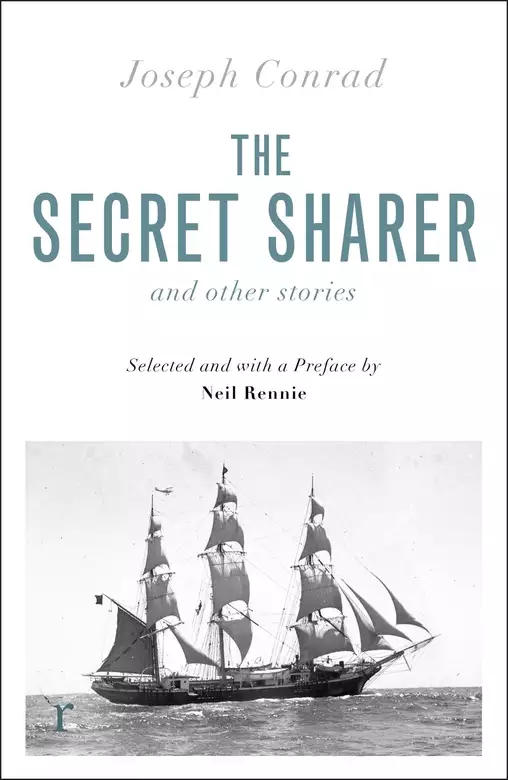
Synopsis
'Sailing away, he survived at sea, then on foreign land, and then by writing - re-living his life, many times, many ways, in English fiction' Neil Rennie, from his preface to The Secret Sharer and Other Stories
The stories in this selection show the intense influence of Conrad's many voyages and his varied reading. He was able to dramatize his personal international experiences as he journeyed from Europe to Africa and the East, while absorbing the influence of Stevenson's adventure romances, and the realism of Flaubert and Maupassant.
'An Outpost of Progress' is a response to what Conrad witnessed in the Congo; 'Youth' turns to his early days at sea; 'Amy Foster' explores the strangeness and hostility of England to foreigners; 'The Secret Sharer' charts his time as a ship's captain; 'A Smile of Fortune' returns to the island of Mauritius; and 'The Planter of Malata' opens in a great colonial city in Australia.
Neil Rennie's preface examines the interweaving of Conrad's life and work, and the development of his art.
Release date: March 27, 2025
Publisher: Quercus Publishing
Print pages: 400
* BingeBooks earns revenue from qualifying purchases as an Amazon Associate as well as from other retail partners.
Reader buzz
 Please log in to recommend or discuss...
Author updates
The Secret Sharer and Other Stories
Joseph Conrad
Conrad Behind the Scenes
UP THE THAMES, at Bessborough Gardens, London, in 1889, ‘a slight mist, an opaline mist’, turned ‘into a woolly fog’ up a river in Borneo.1 That was how Conrad began writing his first novel, while lodging in London and remembering Borneo. At his rented room at Bessborough Gardens, Conrad had taken a ‘jump’, as he called it – one in a series of jumps, from Poland to the international oceans, from a Polish sailor to an English author, from action to fiction.2
Because he had spent his youth reading widely as well as sailing, Conrad’s writings combined his personal international experiences with international literary influences. I have chosen the six stories in this anthology because I liked them, by themselves and in combination, and I shall consider them here in the chronological order of their composition and publication. They can be read, of course, as they were originally, without knowledge of Conrad’s personal and literary sources. But Conrad’s stories were distinctive because of his voyaging and reading, which I shall explore in this introduction, by peeping behind the scenes of his stories, by reading between his lines.
Before his African Congo turned into his English Heart of Darkness, Conrad wrote a short story in 1896, ‘An Outpost of Progress’, which was a stark, sarcastic response to what he had actually witnessed in the Congo and to what he had read of adventurous romances such as Stevenson’s Treasure Island (1883) or Haggard’s King Solomon’s Mines (1886). ‘It is a story of the Congo,’ Conrad informed the prospective publisher of ‘An Outpost’.3 ‘There is no love interest in it and no woman.’ That was in conformity with the Anglo-American genre of colonial adventure, romances without women – romances for boyish men who loved treasure more than love.
Conrad’s fictional heroes of colonial progress in the Congo are given the names of two men Conrad had actually encountered in the Congo, Kayerts and Carlier, but Conrad’s heroes are literary characters, not real colonists. Conrad knew the French writers Flaubert and Maupassant, as well as the conventions of Anglo-American colonial romance. Kayerts and Carlier are derived from Bouvard and Pécuchet, the idiotic heroes of Flaubert’s last, unfinished novel, Bouvard and Pécuchet. ‘An Outpost of Progress’ could be called ‘Bouvard and Pécuchet in the Congo’. Flaubert’s aspirational simpletons have travelled in Conrad’s story from France (or Belgium) to the Congo, where they are managers of a colonial outpost and educate themselves by misreading literature, like Flaubert’s couple. ‘In the centre of Africa they made acquaintance’ of the characters in The Three Musketeers, by Dumas, and of Hawkeye, the hero of Fenimore Cooper’s romances of the American frontier, such as The Last of the Mohicans.
The two European managers of Conrad’s outpost are outmanaged and colonized by their black assistant from Sierra Leone, who sells the company’s ten African labourers in exchange for ivory, and alienates the helpful local chief, who has been supplying the colonists with the provisions they have been unable to grow. Conrad has named this local chief Gobila, after a real Congolese chief, ‘stout of form, hearty and genial’, a fat man with a tall staff, encountered by Henry Stanley, the explorer and adventurer.4 Conrad’s inspirational sources were sometimes real, such as the Congo he had personally experienced, and were sometimes written and published books, by Stanley as well as Flaubert.
Conrad’s chief, like Stanley’s, had ‘a staff as tall as himself’, but is not fat. He is ‘thin and black, with a white cloth round his loins and a mangy panther skin hanging over his back’. Conrad’s story is not exactly, anthropologically African, of course, more a savage caricature of that horrid oxymoron: the Belgian Congo (the Congo Free State, King Leopold’s personal colony). In a dispute about their last few lumps of sugar, Kayerts shoots Carlier dead, then hangs himself. When the Director of their company comes to inspect colonial progress at the outpost, he finds Kayerts hanging. With his stiff corpse apparently ‘standing rigidly at attention’, Kayerts is ‘putting out a swollen tongue at his Managing Director’. This rude protrusion at the end of Conrad’s story may have been borrowed from another self-hanged man who closes a Maupassant story with his ‘tongue poking horribly out’.5 But, whatever Conrad’s sources, his story was not passively colonialist. He too was poking his tongue out.6
Conrad wrote ‘Youth’ in 1898, turning back before his Congo experience to his earlier years at sea in 1881–3. Aged twenty-three, he had signed on as second mate of a sailing ship, the Palestine, which set out several times to transport a cargo of coal from Newcastle to Bangkok. After repeated attempts to make this voyage, the unseaworthy Palestine nearly reached its destination, but off the coast of Sumatra its cargo of coal ignited – a case of ‘spontaneous combustion’, according to the official ‘Inquiry’.7 With the Palestine ablaze and sinking, her crew abandoned her, sailing in small boats to Muntok, which Conrad later described as ‘a damned hole without any beach and without any glamour’.8 Muntok, not Bangkok, was his actual introduction to that Western mirage, the marvellous East.
‘Youth’ follows the events of Conrad’s real voyage but Conrad the writer has distanced his older, authorial self from his younger, seafaring self by inventing his narrator Marlow. It is an older Marlow who tells the story of the younger Marlow to a circle of experienced men of the sea, a listening crew, sharing a bottle and ‘the strong bond of the sea’, an audience for a conversational narration, a yarn, a sailor’s story.
Marlow the narrator is wiser than his younger, sailor self, who is entranced, on arrival at Bangkok, to see ‘the East of the ancient navigators, so old, so mysterious, resplendent and sombre, living and unchanged, full of danger and promise’. This East is not the actual ‘damned hole’ of Muntok, but an exotic fantasy, a collective construction of European culture, a creation by travellers and writers, such as Conrad. But Conrad’s older Marlow is sceptical of the East that appeared to his own ‘young eyes’: an East ‘of romance, of glamour – of youth’. Marlow is himself, of course, a narrator who can play a role as a sensible, English storyteller. He can convey, colloquially, not only his younger self, but also darker characters than himself, alter egos, other selves – Jim in Lord Jim, even Kurtz in Heart of Darkness.
Narrators were conventional in short fictions (the tellers of The Canterbury Tales, for example, or Maupassant’s narrators in many of his short stories) but Conrad’s Marlow left a legacy. In 1924 Scott Fitzgerald rented a villa at Saint-Raphaël on the Mediterranean, where he finished writing The Great Gatsby, narrated by a character, Nick Carraway, not by Gatsby, nor by Fitzgerald. A friend who was staying at the villa came down one morning in August to find Fitzgerald standing on the balcony, staring out to sea. When he noticed his friend behind him, Fitzgerald turned and said, ‘Conrad is dead.’9
Conrad, the international sailor who became an English author, had married, in March, 1896, Jessie George: English, a typist, much younger at twenty-three than Conrad at thirty-eight. She was lower-middle-class and had no expensive education. Sadly, as Jessie Conrad recalled, ‘On coming out from Barker’s’, the London department store, a few years after her marriage, ‘I slipped the cartilage of both knees at once and fell on the pavement’.10 That fall in January 1904 left her handicapped and, as a lesser but embarrassing consequence, she visibly put on weight. When Virginia Woolf, in the privacy of her diary, spoke of Conrad’s ‘lump of a wife’, she meant lumpish physically as well as intellectually.11 Lady Ottoline Morrell, Bloomsbury hostess, less cruelly called Jessie Conrad ‘a good and reposeful mattress for this hyper-sensitive, nerve-wrecked man’.12 Jessie endured and cushioned Conrad’s temperament, typed his manuscripts and bore him two English sons, but – as he knew when he married her – she was not the intellectual and artistic companion, the ideal shipmate, for his writing life.
It is appropriate to introduce Jessie Conrad because in May–June 1901 Conrad wrote ‘Amy Foster’, for which he had used the working titles of ‘A Castaway’ and ‘A Husband’.13 Conrad’s story has its antecedents, if not its inspiration, in the historical circumstance of Peter the Wild Boy, found in 1827, in woods in Hanover, Germany. Peter was feral and vegetarian, speechless and walking on all-fours. He was transported to England, to become a temporary sensation. Whether Conrad had heard of Peter or not, his immediate source was the man-of-letters Ford Madox Hueffer (who later changed his German surname to Ford, becoming Ford Madox Ford). In his Cinque Ports (1900) Hueffer told a tale he said he had heard, of a German who survived a shipwreck off the coast of Kent, swimming heroically ashore, but improperly dressed and speaking only German, to be repelled as a madman.14 In his memoir, Joseph Conrad: A Personal Remembrance (1924), Hueffer/Ford informed posterity that ‘Amy Foster’ was originally a story by Hueffer, ‘which Conrad took over and entirely re-wrote’.15
Certainly Conrad rewrote Hueffer’s story to include Amy Foster herself, a woman, who was not in Hueffer’s account. In any case Conrad’s story has potential significance for Conrad himself, personally. Conrad’s castaway character, called Yanko, was, according to Conrad, ‘Austro-Polish’, a Pole from an Austrian-ruled part of Poland.16 The name Yanko is a familiar rendering of the Polish name Jan (John). Conrad’s Yanko often repeated that he was a mountaineer, using the word ‘Goorall’ (Polish góral, ‘highlander’), so we can deduce that he came from the mountainous south of Poland. Conrad’s Yanko survives a shipwreck off the Kent coast, only to be shunned by all the English natives. He is treated, in Conrad’s insistent imagery, as ‘a sort of wild animal’, until a simple girl, Amy Foster, identifies him as human, not animal. When he has been locked up, she unfastens the door, sees that he is good-looking and offers him ‘half a loaf of white bread’. She marries him and they have a son, but her Polish husband becomes again monstrous in her eyes, so she rejects him, running in sheer fear from his foreignness – which is fatal.
The philosopher Bertrand Russell, who was Lady Ottoline’s lover, met Conrad and attentively read ‘Amy Foster’. Sympathetically, he raised a natural question about Yanko, wondering ‘how much of this man’s loneliness Conrad had felt among the English’.17 Of course Conrad must sometimes have felt a stranger while sailing on English ships, and while living in England, and especially while writing English literature, even if he was not spurned by the English as his Yanko is. To the English, Yanko seems as bestial as Africans sometimes did, to Europeans in Africa. Certainly Yanko’s England is as uncivilized to him, as strange and hostile, as the Congo might appear to a European traveller. ‘And this also’, as Marlow says of England in Heart of Darkness, ‘has been one of the dark places of the earth’.18
Conrad wrote ‘The Secret Sharer’ in a few weeks during November to December 1909. The plot is not exactly autobiographical but, for the realistic nautical context, Conrad reverted to the early days of his first command as captain, of the Otago, in Bangkok, in 1888. The story is narrated by a nameless ship’s captain, who is new to his ship, and the title alludes to what he calls ‘the secret sharer of my cabin’, a sailor from another ship whom the captain conceals aboard. Conrad was using the literary theme of the ‘double’, distinctively Gothic, deployed in stories by E. T. A Hoffmann and Edgar Allan Poe, for example. The literary ‘double’ was suggestive of the supernatural or the ‘uncanny’, as well as probing more realistic psychological questions about identity or split personality. Realistic or not, ‘The Double’ by Freudian enthusiast Otto Rank was published in 1914 and Freud’s own essay, ‘The Uncanny’, in 1919. The Freudians were rewriting Gothic fiction – and so was Conrad. Polishman, sailor, Englishman, author, the ‘double man’, as he said, ‘has in my case more than one meaning’.19 Conrad’s story is redolent of the uncanny and of psychology, but he sets it firmly in a credible shipboard world, so that some of its excitement derives from the practical difficulties of the captain in hiding his ‘double’ from his crew. His ‘other self’ has to be concealed, like a mental illness.
Conrad is invoking the literary mysteries of the ‘double’, but he had a factual source for his story. This source was the circumstance aboard the famous tea-clipper, the Cutty Sark, in 1888. Captained by James Wallace, with Sidney Smith as first mate, the ship was rounding the Cape of Good Hope, entering the Indian Ocean, when Sidney Smith killed an incompetent, perhaps disobedient sailor, giving him a fatal blow to his head with a metal capstan bar. When the Cutty Sark reached the port of Anjer, Indonesia, Captain Wallace apparently helped Smith to escape arrest and judgement by absconding to another ship. Conrad did not borrow what followed on the Cutty Sark for the plot of ‘The Secret Sharer’, but what followed historically was relevant to Conrad’s story as a significant consequence of a captain’s choice between doing his duty and helping a fellow seaman. A few days after sailing from Anjer, Captain Wallace, with a truculent crew and a bad conscience, or a fear of an inquiry, gave a routine order to the man at the helm. ‘Check your course’, he said, and stepped overboard, deliberately, decisively, to drown.20
Conrad’s captain similarly protects a murderer by sheltering the fugitive sailor Leggatt, who has swum a considerable distance to escape from another ship, on which he was mate and killed a crewman. The captain who is Conrad’s narrator is alone on deck when he discovers Leggatt. They have many coincidental similarities, of age and size, for example, and another affinity. The captain was nearly as new to his ship as Leggatt and ‘was almost as much of a stranger on board’. Leggatt is repeatedly called ‘my double’ by Conrad’s narrator, for whom Leggatt is ‘my second self’. They share at different times the captain’s bed, in which Leggatt ‘must have looked exactly as I used to look in that bed’. Indeed, ‘At night I would smuggle him into my bed-place, and we would whisper together’. The bed-sharing is suggestive of a sexual relationship, perhaps secret and adulterous, but this is another Conrad story with ‘no woman’. ‘No damned tricks with girls there’, as Conrad remarked, triumphantly, in a letter to a friend.21
Conrad’s captain’s identification with Leggatt, and his protection of him from discovery, are in tension with the captain’s responsibility to his ship and crew, whom he endangers, by sailing perilously close to the shore so as to enable the safe escape overboard of Leggatt, who is ‘a good swimmer’, an ‘amazing swimmer’. Conrad’s captain has been taken possession of by Leggatt, but Leggatt ‘lowered himself into the water to take his punishment: a free man, a proud swimmer striking out for a new destiny’, life on an island off the Cambodian shore. Leggatt thus escapes ‘his punishment’ as a murderer, and Conrad’s narrator escapes too, sailing away as ‘a free man’, released from his possession, his domination, by ‘the double captain’, his ‘secret sharer’.
When Conrad wrote ‘A Smile of Fortune’ in summer 1910, he returned fictionally to the Indian Ocean island of Mauritius, a British colony to which he had sailed, for a cargo of sugar, as captain of the Otago in 1888.22 He stayed more than seven weeks, from 30 September to 22 November, at the harbour of Port Louis. As a fluent French speaker, he spent some time ashore with a Franco-Mauritian family, of the kind he describes in his story, ‘one of the old French families, descendants of the old colonists’. Mauritius had been a French colony until the Napoleonic Wars, when it was invaded by the British. According to a tradition in the family that befriended Conrad, brothers and sisters in the Renouf family, Conrad politely asked one of the brothers for the hand of one of the sisters, Eugénie Renouf, only to be informed that she was engaged and would soon be married, as she was, in January 1889.
This Mauritian marriage that Conrad did not make is less significant for ‘A Smile of Fortune’ than another Mauritian connection Conrad made, with a stevedore, James Shaw, an Anglo-Mauritian who worked at the harbour. He had a house in Port Louis with a notable rose-garden and he had also a daughter, Alice Shaw, who was sixteen when Conrad was in Mauritius.23 According to Jessie Conrad, ‘A Smile of Fortune’ ‘was largely founded on fact’, to which she added that Conrad ‘used to accuse me of being jealous of Alice’.24 So Conrad’s central character, also called Alice, had a real original. There was an Alice in Mauritius who contributed at least her name and her garden to ‘A Smile of Fortune’.
Guy de Maupassant also made a contribution to Conrad’s Alice. In ‘A Smile of Fortune’ Alice has black hair, ‘a mass so thick and strong and abundant that, nothing but to look at, it gave you a sensation of heavy pressure on the top of your head’. Why does Conrad use a non-English idiom, ‘nothing but to look at’? Because Alice’s heavy hair has been translated from the heavy hair of Francesca, in a story by Maupassant, ‘The Rondoli Sisters’. Francesca’s hair (in my translation) is so ‘strong and long that it seemed heavy – you had only to see it to feel the sensation of its weight on the head’.25
Maupassant’s Francesca is Italian, and characteristically responds to Maupassant’s French narrator, Pierre, ‘with her eternal che mi fa [what’s that to me] or with her no less eternal mica [no, not at all]’.26 Maupassant’s narrator, mockingly but affectionately, addresses her as ‘mademoiselle Mica’.27 Conrad’s Alice similarly responds to Conrad’s anonymous narrator, the sea captain, with ‘an angry and contemptuous “Don’t care!”’, so he calls her ‘Miss Don’t Care’. Maupassant’s narrator (because ‘men are weak and stupid’) finds himself attracted to Francesca’s repellent petulance, so that he comes to love ‘the pout of her mouth’, from which she delivers her rudeness.28 Conrad’s captain likewise (‘How weak, irrational, and absurd we are!’) becomes ‘seduced’ by Alice’s ‘scornful words; by the perpetual pout of her closed lips’. Conrad’s Alice is a composite of two real Mauritian women, Eugénie and Alice, and also of a third, a fictional woman, Maupassant’s Francesca. Only Conrad could make a Maupassant character into a Mauritian character. Some ‘damned tricks with girls’?
When Conrad’s captain falls out of love with Alice, he falls out of love with Mauritius, although he is fortunate that his private cargo of potatoes, which he reluctantly, questionably, bought from her father, sells in Australia for a good profit. Like his fictional captain, Conrad never returned to Mauritius, where Eugénie Renouf married a pharmacist and Alice Shaw a ship’s captain.
Written in November and December 1913, ‘The Planter of Malata’ opens among a circle of English expatriates ‘in a great colonial city’ (identified in Conrad’s manuscript as Sydney, Australia). Renouard, the planter, comes to this social circle as an isolated individual inhabiting a Pacific island with no indigenous islanders, where he runs a plantation and a schooner with hired ‘Kanakas’ (labour recruited from Pacific islanders). From the contrast between Sydney society and the island of Malata, where he is for a while the only white man, a story emerges, of Renouard’s secret, undeclared love for an English society lady, Felicity Moorsom, who brings him no happiness.
The drama of Felicity and Renouard, or society and solitude, civilization and isolation, has a potential subtext, or counterpoint, in recurrent imagery associating them both with classical statuary. Felicity is imaged as a ‘chiselled’ Venus (or Greek Aphrodite, ‘foam-born’) and Renouard imaged, trans-sexually, as Minerva (or Greek Pallas Athene), in ‘his resemblance to antique bronze, the profile of Pallas’. They are ‘a well-matched couple’, both ‘statuesque’. By paralleling his two characters, Conrad is setting them directly against each other. In their climactic encounter on Renouard’s island, Felicity is associated by Renouard with the ‘foam’ of the birth of Venus and also, pejoratively, with the ‘brilliant froth’ of society that her own father had identified as her natural element, where she ‘moved, breathed, existed’. ‘Your father was right’, Renouard tells her. She is ‘mere pure froth’. She abandons Renouard on his island, but he cannot live without her.
In French, ‘renouer’ means ‘to retie a knot’. Perhaps Renouard was a ‘re-tier of knots’ who could not untie the knot of engagement that Miss Moorsom had already made, with another man, or the knot she had tied herself in, her entanglement with civilization. Conrad’s implications are mysterious, but his correspondence at the time is not about imagery, but money. His house was rented by writing. ‘I began a short story on a sudden impulse’, was how he informed his agent about the beginning of ‘The Planter’.29 ‘I send you here a portion of it’, he continues. ‘If you feel you can send me £10 against that please do so.’
Before Conrad began writing at Bessborough Gardens, Stevenson had travelled to the Pacific islands – and beyond Treasure Island. In Stevenson’s The Ebb Tide (1894), his white South Sea character, Herrick, slips at night from a schooner, suicidally, ‘into the starry water’ of the Pacific, to follow a star: ‘A very bright planet shone before him’, a ‘radiant speck’.30 ‘He took that for his line and followed it’, but is unable to drown himself, swimming instead to the island shore.31 Similarly, derivatively, Renouard, swimming at night from his island to his schooner, ‘set his direction by a big star’ that he swims towards. ‘It was easy to swim like this beyond the confines of life looking at a star’, but he rejects this easy ending of his life. Only later does Renouard fatally and finally ‘set out calmly to swim beyond the confines of life – with a steady stroke – his eyes fixed on a star’. Leggatt ended ‘The Secret Sharer’ as ‘a free man, a proud swimmer striking out for a new destiny’, to start a new life on an island, but Renouard swims from his island ‘beyond the confines of life’ – to end it.
Conrad did not succeed in ending his life with a revolver as a young man in Marseilles. The bullet, aimed at his heart, missed and came out of his back. Instead, he took a different jump, boarding an English ship. Sailing away, he survived at sea, then on foreign land, and then by writing – re-living his life, many times, many ways, in English fiction. Long after his death a questionnaire he completed was found in Mauritius by descendants of the Franco-Mauritian lady who married another man, not Conrad. The questions were in French, including ‘Que désirez-vous être?’ (‘What would you like to be?’).32 His answer was in English: ‘Should like not to be.’
Neil Rennie
1. Joseph Conrad, A Personal Record, ed. Zdzisław Najder and J. H. Stape (Cambridge University Press, 2008), p. 73.
2. Ibid., p. 108.
3. Conrad to T. Fisher Unwin (22 July 1896), The Collected Letters of Joseph Conrad: Volume 1: 1861–1897, ed. Frederick R. Karl and Laurence Davies (Cambridge University Press, 1983), p. 294.
4. Henry M. Stanley, The Congo and the Founding of its Free State: A Story of Work and Exploration, 2 vols. (London: Sampson Low et al., 1885), 1, 507.
5. Maupassant, ‘Le Petit’ [‘The Little One’], Contes et Nouvelles, vol. 1, ed. Louis Forestier, Bibliothèque de la Pléiade (Paris: Gallimard, 1974), p. 962 (my translation).
6. Conrad’s plots are still as shocking as they were originally, but his language has become more shocking than it was, when it reflected the usage of his times, more than a century ago.
7. ‘Appendix B: The Palestine Inquiry’, in Norman Sherry, Conrad’s Eastern World (Cambridge University Press, 1966), pp. 297–98 (p. 298).
8. Conrad to Richard Curle (24 April 1922), The Collected Letters of Joseph Conrad: Vol. 7 1920–1922, ed. Laurence Davies and J. H. Stape (Cambridge University Press , 2005), p. 457.
9. Gilbert Seldes, quoted in Nancy Milford, Zelda: A Biography (New York: Harper and Row, 1970), p. 123.
10. Jessie Conrad, Joseph Conrad As I Knew Him (London: William Heinemann, 1926), p. 51.
11. The Diary of Virginia Woolf: Volume Two: 1920–1924, ed. Anne Olivier Bell and Andrew McNeillie, p. 49 (23 June 1920).
12. Ottoline: The Early Memoirs of Lady Ottoline Morrell, ed. Robert Gathorne-Hardy (London: Faber, 1963), p. 241.
13. Conrad to J. B. Pinker (3 June 1901), The Collected Letters of Joseph Conrad: Volume 2: 1898–1902, ed. Frederick R. Karl and Laurence Davies (Cambridge University Press, 1986), p. 330.
14. See Ford Madox Hueffer, The Cinque Ports: A Historical and Descriptive Record (Edinburgh: William Blackwood, 1900), p. 163.
15. Ford Madox Ford, Joseph Conrad: A Personal Remembrance (London: Duckworth & Co., 1924), p. 120.
16. Conrad to H.-D. Davray (2 April 1902), Collected Letters: Volume 2, p. 399.
17. Bertrand Russell, Portraits from Memory and other Essays (London: George Allen, 1956), p. 83.
18. Joseph Conrad, Heart of Darkness and Other Tales, ed. Cedric Watts, Oxford World’s Classics (Oxford University Press, 1998), p. 138.
19. Conrad to Kazimierz Woliszewski (5 December, 1903), The Collected Letters of Joseph Conrad: Volume 3: 1903–1907, ed. Frederick R. Karl and Laurence Davies (Cambridge University Press, 1988), p. 189.
20. Captain Wallace, quoted by Charles Arthur Sankey, in Anna Tillenius, ‘A True Story of Mutiny, Murder on the High Seas’, in the Winnipeg Free Press, 14 May 1957.
21. Conrad to Edward Garnett (5 November 1912), The Collected Letters of Joseph Conrad: Volume 5: 1912–1916, ed. Frederick Karl and Laurence Davies (Cambridge University Press, 1996), p. 128.
22. On Conrad in Mauritius, see: Savinien Mérédac, ‘Joseph Conrad chez nous’, Le Radical, 7 August 1931; and P. J. Barnwell, ‘Conrad, Joseph (1857–1924)’, Dictionnaire de Biographie Mauricienne: Dictionary of Mauritian Biography (March 1942), No. 4, pp. 109–10.
23. For Alice Shaw, see Barnwell, ‘Conrad, Joseph’.
24. Jessie Conrad, Joseph Conrad As I Knew Him, p. 139.
25. Maupassant, ‘Les Sœurs Rondoli’ [‘The Rondoli Sisters’], in Contes et Nouvelles, vol. 2, ed. Louis Forestier, Bibliothèque de la Pléiade (Paris: Gallimard, 1979), p. 137 (my translation).
26. Ibid., p. 154.
27. Ibid., p. 152.
28. Ibid., p. 153.
29. Conrad to J. B. Pinker (7[?] November 1913), Collected Letters: Vol. 5, p. 301.
30. Robert Louis Stevenson and Lloyd Osbourne, The Ebb-Tide: A Trio and Quartette (London: William Heinemann, 1894), p. 194.
31. Ibid.
32. Quoted in Savinien Mérédac, ‘Joseph Conrad chez nous’.
An Outpost of Progress
THERE WERE TWO white men in charge of the trading station. Kayerts, the chief, was short and fat; Carlier, the assistant, was tall, with a large head and a very broad trunk perched upon a long pair of thin legs. The third man on the staff was a Sierra Leone nigger, who maintained that his name was Henry Price. However, for some reason or other, the natives down the river had given him the name of Makola, and it stuck to him through all his wanderings about the country. He spoke English and French with a warbling accent, wrote a beautiful hand, understood bookkeeping, and cherished in his innermost heart the worship of evil spirits. His wife was a negress from Loanda, very large and very noisy. Three children rolled about in sunshine before the door of his low, shed-like dwelling. Makola, taciturn and impenetrable, despised the two white men. He had charge of a small clay storehouse with a dried-grass roof, and pretended to keep a correct account of beads, cotton cloth, red kerchiefs, brass wire, and other trade goods it contained. Besides the storehouse and Makola’s hut, there was only one large building in the cleared ground of the station. It was built neatly of reeds, with a verandah on all the four sides. There were three rooms in it. The one in the middle was the living-room, and had two rough tables and a few stools in it. The other two were the bedrooms for the white men. Each had a bedstead and a mosquito net for all furniture. The plank floor was littered with the belongings of the white men; open half-empty boxes, town wearing apparel, old boots; all the things dirty, and all the things broken, that accumulate mysteriously round untidy men. There was also another dwelling-place some distance away from the buildings. In
We hope you are enjoying the book so far. To continue reading...