- Book info
- Sample
- Media
- Author updates
- Lists
Synopsis
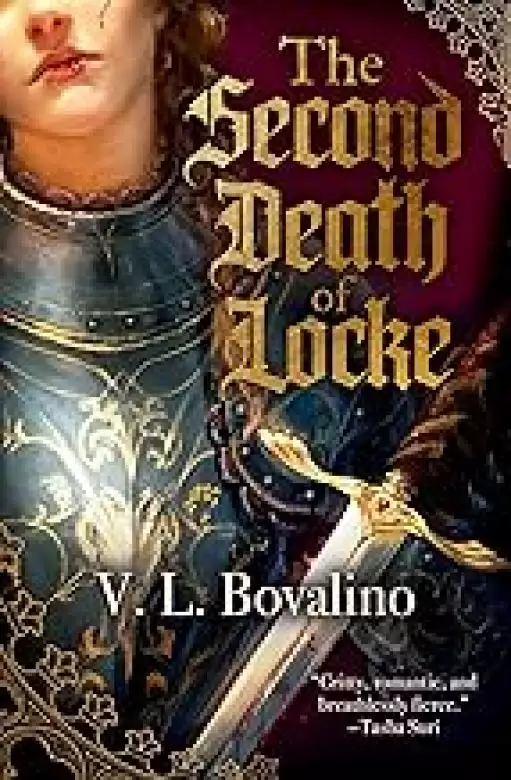
The Second Death of Locke is a devastatingly romantic epic fantasy and about the undying bond between a knight and their mage, perfect for fans of Gideon the Ninth and The Six Deaths of the Saint.
Love. Loyalty. Sacrifice.
Grey Flynn has dedicated her life to her mage, Kier.
She will be his blade on the battlefield, his healer and protector. The deep well of raw power inside her is Kier's to use. Grey would do anything for Kier - be anything for him - if he would only ask.
When a quest to protect the child of an enemy kingdom pulls them into the dangerous heart of their nation's war, Grey and Kier will need to decide what they are willing to sacrifice to protect their secret.
For Grey is no ordinary magical well, but heir to the lost island of Locke - the root of all power. If she dies, all magic dies with her.
Release date: September 23, 2025
Publisher: Grand Central Publishing
Print pages: 432
* BingeBooks earns revenue from qualifying purchases as an Amazon Associate as well as from other retail partners.
Reader buzz
 Please log in to recommend or discuss...
Author updates
The Second Death of Locke
V. L. Bovalino
They were not meant to be apart, and they took that duty seriously.
Each step across the sodden camp felt like a perpetual battle with some unseen enemy, as if the blood of those they’d fought and those they’d lost was determined to claim her boots for the bones buried below. Equally uncomfortable was the fluttering of her heart in her chest, the lump in her throat—she wasn’t anxious, really, but the station she and Kier shared required a sort of unhealthy co-dependency that Grey only allowed herself to think about very late at night when she was certain that Kier was asleep.
She didn’t know if the captain fostered the same reactions in her absence. She’d never asked.
Grey slipped through the flap of fabric into command—which wasn’t one tent at all, but rather a shoddy collection linked together with otherworldly tunnels of fabric. She thought it had once been the color of natural canvas, but it was now a dingy gray with smoke from the campfires outside and speckled brown with mud. She hated the tents. They smelled like damp and mold, the inescapable result of rain seeping into every crevice, and it always made her skin itch. In other assignments, they were sometimes in one of Scaela’s many old fortresses, surrounded by candlelight and thick stone walls and real floors, but this was not the case with Mecketer. It wasn’t even near a city—the encampment was its own entity, and though it had persisted for most of the years of the war on the border between Luthar and Scaela, it had been burned down or shifted too many times for anything permanent to remain. It existed now, as it always had, to defend the supply road from the sea that ran between Scaela and one of Luthar’s old ports, constantly changing hands between the two nations.
What she wouldn’t give to be back in one of those fortresses, with a roof over her head and stone underfoot. What she wouldn’t give for dry boots and a warmer cloak.
The clerk looked up as soon as she entered, exhaustion plain on their face—they weren’t really a clerk at all, but either a typic being punished with secretarial work or a young person-at-arms too injured for patrolling. They stood, inclined their head to Grey, and said, “Can I help you, Hand Captain?” in the flat tone of someone who’d stopped caring a dozen deaths ago.
“I’m here to join Captain Seward,” Grey said. She had not been summoned by Attis or Concord, but she didn’t have to be. If Kier was here, she was meant to be, too.
The clerk sighed, but led the way out of the administrative tent, through three drenched, gauzy passages, stopping at a tent flap marked with the High Lord of Scaela’s seal: an open hand, palm out, making the sign of justice over a light blue field. There, they paused and squared their shoulders—Grey tried not to read too much into this—then called, “Master Attis, Hand Captain Flynn is here.”
No sound on the other side. Master Attis was powerful with standard magics and the well she drew from was strong enough to make a difference, so she was able to hold a sound shield long enough to keep most of her business private. She was thorough. Grey appreciated that, even if the woman herself vaguely terrified her for reasons she hadn’t yet gotten to the bottom of.
Finally, a voice called, “Enter.”
Grey muttered a quick thanks to the clerk. She noted their limp, the way they favored their left side—she thought about directing them to visit Leonie, but the healers were already overworked.
She shook it off and slipped past Scaelas’s seal, inclining her head to Master Attis and her Hand before moving in further. Her ears popped slightly as she passed through Attis’s shield, and it took a lot of effort not to wrinkle her nose or rub her ear.
Like most other tents at Mecketer, there was barely any furniture within, and certainly nothing that could count as permanent or well constructed. An open brazier blazed on one side, filled to the brim with light purple magic-fed flame, and Grey relaxed slightly in the warmth. It was a small tent, containing only a table laden with maps, a desk, and two chairs. Attis sat ramrod straight on one side of the desk, her salt-and-pepper hair pulled back into a tight bun that rendered her features even more severe, her Hand lurking against the back of it like a badly angled shadow. Kier had the other chair, somehow giving the impression of rumpled insouciance even sitting straight and prim as Attis herself. It was something about the untidy curve of his mouth, the lock of his hair that never quite managed to stay where he put it.
“Apologies for proceeding without you, Hand,” Attis said, not sounding apologetic at all. She barely even looked at Grey as she straightened the papers on her desk.
Who am I to delay you? Grey wanted to say, but she’d already gotten in trouble for her tongue more than once here. The mud made her irritable, and the constant salt scent of the sea a few miles off made her antsy, but Attis was no treat either. It was one of the many reasons this assignment grated on her: that she had to keep her true feelings quiet unless it was only Kier within hearing range. Usually, with only the fate of either a violent death or a lifetime of battle looming ahead, their masters had a better sense of humor.
Grey nodded once, turning her attention to Kier. Grey scanned over him quickly, as she always did when they were reunited, even after the shortest period. It was another one of those anxiety-induced habits. The shape of Kier was committed to her memory, as familiar to her as her own reflection: the uneven hazel of his eyes; the deep, rich brown of his hair, curlier than usual, like it was when they were children, with the salt in the air; the variations of his skin, leaning darker olive whenever they had more than an hour of true sunlight in the day (but not now, because at Mecketer, there was rarely any sunlight, and Kier, who loved the sun as much as it loved him, was uncharacteristically pallid). The fullness of his lips and the crooked line of his nose, the shadow of his eyelashes over his cheekbones.
Nothing new broken. No wounds besides the scrape along his jaw from a skirmish the week before.
She slipped into place behind him. For his part, Kier’s shoulders relaxed when Grey was there, if only a fraction.
In the practiced pose of mages and their Hands, their wells, their power, Grey rested her own hand on Kier’s left shoulder, fingers curving so the tips just barely grazed the line of his collarbone, her thumb the merest inch from his skin over the collar of his cloak. Submission and protection. Fealty and power, all in one.
“As I was saying, this is not going to be easy,” Attis said.
“It rarely is,” Kier allowed in his calm, lovely voice, so far removed from the terror of what he could do. The small part of Grey that still tittered with anxiety quieted immediately. “But please, continue.”
Grey glanced over the papers on Attis’s desk. Most were maps: annotated with arrows and wins and losses, showing how the Scaelan army was spread across the borders. The main one showed all the nation states that made up the island of Idistra. Grey’s gaze traced over the corners: knots of fighting between their own nation of Scaela and the northern nation of Cleoc Strata, then to the east with Eprain, the south with Luthar. The western border with Nestria was quiet, thankfully—their new High Sovereign had no taste for blood—but who knew how long that would last.
It took her a half-second to realize that the paper on the desk between Kier and Attis was yet another map, badly marked up in an untidy hand, much smaller than the others that blanketed Attis’s large table. She didn’t lean close to scrutinize it—that was not her job. Thinking was not her job. Strategy was not her job.
Grey was a well, and beyond that, she was Kier’s official Hand, the well dedicated for his use. As such, she had two roles: the first, to feed her mage the power he needed to perform magic. The second, no matter what, to keep him alive. In the past, being a Hand was a lifelong position, requiring a ceremony of binding, but that practice had long since fallen out of favor, and recently had been forbidden.
“This is their path,” Attis was saying, tracing her finger along a marked ridge, clearly in the middle of a conversation Grey had missed. “And this is where the resource is. They are traveling with a retinue of eighteen mages”—which meant eighteen wells, too, because within the system of Idistran magic, one could not operate without the other, but Attis didn’t mention the Hands, and Grey couldn’t keep her gaze from flicking to Attis’s own Hand—“and seem to be operating in shifts for constant movement. Four identical carriages, equally guarded. A complete decimation is the desired outcome, as ordered by the High Lord.”
Kier didn’t even flinch. After years and years of this, of course he didn’t. Grey had lost count of the lives on their hands, the blood staining every single skirmish they only just scraped out of.
“Decimation might be tricky,” Kier said. “How many am I taking with me?”
“Your full company, Captain.”
He made a small noise. “Everyone?”
“The High Lord’s orders.”
Grey didn’t realize how much her fingers were digging into his shoulder until he subtly dipped it, their signal to let her know she had tensed.
There had always been significantly more wells than mages in Idistra, but with the constant wars and waning power, that was no longer something to count on—even in Scaela, the nation that held the most power when everything changed.
“Based on the last census of wells, it doesn’t seem like good strategy—” Grey started.
“It may be more sensible to leave some of our wells behind,” Kier agreed, taking the fall for her boldness, smoothly covering her misstep. She felt a tug on the tether between them, a pulse of caution, and pressed her lips together. Though she and Kier were as balanced as a pairing could be and treated one another as such, not every mage saw the relationship with their power source as one of equals.
And, of course, she knew what else Kier would say to her if they were alone: If you keep calling authority into question, you will draw attention, to which she usually replied, We always draw attention. It’s your fault, for being so alarmingly grotesque, to which he would almost certainly respond, Alarmingly striking, you mean.
Attis shook her head, aiming a warning glance at Grey before she turned back to Kier. “Not every specialty is as developed as yours. Every mage in your company must be accompanied by their Hand, with enough typics to match and cover, and all will move with you. I am not taking any risks.”
Kier had no protest to that, but Grey knew what he was thinking. In the time when magic was strong across Idistra’s nations, mages were only limited by the power of their wells. But now, everything had changed—everything had weakened. Though mages had always had affinities for flesh and blood, or materials, or natural forces, they were now restricted in what they could do with that magic. The mages with affinities for flesh and bone all had a specialty, a body part they had an ability to affect within their opponents; materialists could only home in on one type of metal or wood or object. In her time working as a healer in Scaelas’s army, Grey had seen the whole bloody assortment of it: those with the ability to cut off air to the lungs, leaving the dead blue-lipped and haunted; flesh affinites who could stitch giant ropes of skin over the mouth that Grey had to cut through with narrow blades, covered in sluices of blood; bone mages who could lock jaws and break bones with barely a look. Though internal affinities were rare, when they occurred, what they were capable of was utterly ghastly.
Perhaps Kier’s affinity with the heart was better. Clean. They had limits, of course—a full aortal separation took so much of her well of power that they could only do ten an hour, maybe a dozen at a push, but there were other ways to harm the heart. Other ways to ensure the enemy did not fight back. And though Kier’s affinity lay with the muscle itself, he had every other benefit of basic magic.
“They’re taking the trade route here. If they take the resource across the river into Luthar, we have no way to recover it. Do you understand, Captain Seward?”
“Perfectly,” Kier said, frowning at the map. Which was fortunate, because Grey understood very little. She sent a pulse down the tether—they could not fully form sentences between them, but they had been paired as mage and Hand for long enough that Kier could read her intentions by how she shaped her feelings as she pushed them through the tether of her power, and he could reciprocate in kind. He caught her curiosity and understood easily.
“And what exactly is the resource?”
“Not for you to know, Captain Seward.”
There was a short pause. Grey wished she could see his face instead of trying to imagine his expression based on the back of his head. Very carefully, Kier said, “Master Attis, surely… you must understand that I cannot retrieve the resource if I do not know what it is.”
Another pause. Grey kept her eyes straight ahead, face blank, trying once again to fit into the picture of a perfect Hand, more befitting of Kier’s station. Across from her, Attis’s Hand was doing the exact same thing. Her name was Mare Concord, and she was thirty-eight years old. She’d been Attis’s Hand for eighteen years, long enough that even her thoughts had become someone else’s. Grey had learned these facts when Attis had borrowed her two years ago, on another assignment, when Mare was injured in the field and required medical attention.
“You’ll know it when you see it,” Attis said, clipped. “That’s all you need to know. You set out before first light. Is that understood?”
A pause, and Grey knew Kier wanted to press. He knew better. That was the difference between them—Kier knew when to stop.
“Yes, Master,” he said.
“Good,” Attis said, already accepting the next paper from her Hand, already turning to the next task. “Dismissed.”
For just the barest of seconds, the Hand Master’s eyes locked on Grey’s. Grey remembered the skin of Mare’s face, gray with blood loss, her lips cracked and chapped as she’d drunk from the cup in Grey’s hand. Mare was unconscious while Grey sutured the wound in her liver, but by the time she moved to the external wound, the anesthetic draft had worn off and Mare’s gaze was empty, feeble as Grey stitched up the jagged gash over her ribs. She remembered what Mare had told her when it was done, the other woman’s bloody hand clenched around her wrist: Get out. Now. As soon as you can. They never need you as much as you need them.
She’d told Mare then that Kier was different and was rewarded with a pitying gaze so motherly that it made Grey’s heart ache. None of them are different.
Mare made a full recovery without infection, thanks to Grey’s careful action. That night, alone in their quarters, Grey lay awake long after Kier’s breathing evened, studying his face.
We’re going to die in this armor, Mare had told her, gripping her hand, slippery with blood. We’re going to die under Scaelas’s banner, and for what?
For what they did to Locke, Grey did not answer then, even though the truth of it echoed all the way to her bones.
Dismissed, Kier was already moving, and Grey fought her way out of her memories and hurried to follow. He set off across the room, then through the tunnels and out of the tent. Grey kept as close behind him as she could—they didn’t match mages and wells based on stride length, but perhaps it should’ve been taken into consideration—as they stepped out into the clamor of the camp.
“Kier—” she started.
“Hold on,” he said, not turning. He didn’t need to. She was so closely attuned to his voice, so firmly aware of him, that she was able to hear it even as a whisper in the middle of battle.
They stopped at one of the fires for hot tea and food, then headed to their tent with wrapped bread and cheese and jerky in their pockets and tea clasped between their hands. As they passed the infirmary, Grey couldn’t tune out the cries of pain from the injured. She itched to help, but she did not. Her duty did not lie in that tent or any like it, hadn’t since she was pulled from her post as a healer six years before and assigned as Kier’s Hand. She still helped in her free time, but they were both already low on sleep, and judging by what she’d heard of the conversation, they would not have much more of it tonight. Onward she pressed.
They cut through the camp, the sea of faces all different but ground down into familiarity through exhaustion and the long-lasting post-battle weariness. As was the case in the rest of Idistra, Scaela had no uniformity of appearance—a thousand years ago, the whole Isle was uninhabited, until the first ships came, and the magic came with it. Before its wars, the nation states were known for their fishing, textiles, and northern trade; nearly everyone here had heritage linking somewhere else, and the appearance to match the mix of it. Grey herself was a mosaic: if anything, she could trace her lineage to Lindan, maybe a bit of Ruskaya; more relevantly, to the older families that had reached the Isle and learned its magic. The cool steel of her eyes, paleness of her skin and dark brown of her hair blended in here, among the mix of soldiers from all over Scaela, as it never had when she was growing up on the coast, where more were descended from Isbetan and Maroushan traders, who shared Kier’s coloring.
Back in their tent, it was easy. It always was when it was just them, when the trappings fell away and she didn’t have to think.
Calm as always, Kier undid the pin at her throat and helped her out of her cloak, then hung his on top of hers. He dragged the small brazier over to the space between their bed pallets and grabbed her hand as he lit it. She felt the siphoning, a pinch and then a trickle of warmth down her spine. He didn’t have to touch her to use her power, but it was always easier when there was some sort of contact between them: he used less of both of their energy, and when they were alone, there was no point in siphoning without contact. Who would care?
She took off her boots and tucked them next to her pallet. He shifted over to make room for her on his, moving the blankets of his bedroll to make a cocoon for her. Grey crawled up and sat cross-legged, knees warmed by the fire, Kier’s left side pressed to her right. He’d dragged the small table over for their cups of tea and food.
“So?” she asked.
He made a low noise in his throat, eyes miles away. She nudged him with her shoulder, and he handed her a piece of cheese and a hunk of bread as if to say, Eat, I’ll get to it.
“I don’t like the sound of this one,” he said finally. “Feels off.”
“What about it?” Grey asked.
“The High Lord, for one thing. It can’t mean anything good if he’s involved.”
Grey chewed her lip. He had a point—Grey and Kier were fighting in the southern border, against Luthar; the High Lord, known only as Scaelas, in the fashion of all Idistra’s sovereigns, was in the northeast. For him to be involved, their mission had to be big.
That wasn’t the only thing that bothered her about the High Lord’s involvement, and possibly bothered Kier, too. Grey and Kier and his brother, Lot, had grown up in a village on Scaela’s northeast coast, close to the capital and the High Lord’s seat. It had been years since Grey had worried about the presence of Scaelas in her life.
“It means you’re trusted,” she said.
Kier shot her a look. “It means we’ve been noticed.”
“It could be a good thing,” she said decidedly.
“Do you trust me?” Kier asked, which was absolutely the most pointless question he’d ever posed to her.
“Eternally,” she said. She watched his fingers as he dissected his bread. They were long and scarred, and he wore a single silver ring on the middle finger of his right hand even though he really wasn’t supposed to, given the constant, looming risk of degloving in battle. It had once belonged to Lot, before he died in a skirmish against Eprain.
Kier sighed, setting the gutted rind of his bread aside, tossing a few crumbs into the fire. “I’m afraid of this one. I have a feeling that… I don’t know, Grey. I don’t like it.”
It was the use of her name that gave her pause. He did it so rarely that her knee-jerk reaction was to say, “I didn’t know you gained the gift of prophecy while I was bathing.”
That was enough to get a half-smile out of him. Grey studied his face, the lines at his eyes that had only appeared recently. He’d started going gray at the temples last year, a fact that she teased him about relentlessly even as it made her stomach ache. At twenty-six, he was one of the youngest captains in Scaela, and she hated how every day of his duties made that fact less and less clear.
Kier frowned. “I didn’t like the look on Attis’s face… and there was something else on her desk. I know I shouldn’t have read it, but I did.”
Grey shouldered into him. “Kier Seward, you charlatan. Reading the master’s secret correspondence? That’s not like you.”
He smiled, but it didn’t reach his eyes. “It looks like Luthar found something that they think can make more wells. Fight the waning. If they believe they’ve found something that could generate wells, restore power… well, I can see why the High Lord is involved.”
Grey stiffened for half a second—Kier was watching her intently, taking in the planes of her face, and he would catch her the second unease flickered across. So she didn’t let it. “The only way they can restore power,” she said, “is if they found the heir to the Isle.”
“I know,” Kier said.
Grey fidgeted with the edge of her blanket. She did not want to think of what it would be like if they found the heir to the Isle of Locke, a feat that had long since become improbable, since someone had attacked the Isle, the source of the five other nations’ power, and reduced it to nothing.
Detonated or submerged, when the Isle of Locke had descended into the sea sixteen years before, any fragile peace that existed between the remaining nation states dissolved completely—and the hunt began in earnest when Scaelas received a letter from Severin of Locke, signed with his true name, proving that the heir apparent had survived the decimation.
Grey remembered the patrols through the villages, Scaelan soldiers interrogating every boy between twelve and twenty, just in case. She remembered one of the half-dozen times when they came for Lot, and his blank look when he returned from his questioning late that night. She remembered listening at the door, stacked with Kier, as Kier’s ma quietly answered Lot’s questions about the war: Why did they question me? Because you’re a boy of about the right age. What are they looking for? The only person who can end this war—but even he is just a child. What would they have done to me? What will they do to him? I don’t know, love. I don’t know.
It was an unfortunate truth, and one that had led to the war between the remaining nation states that made up Idistra. The Isle of Locke had always been the root of power for Idistra’s other nations: Scaela, Cleoc Strata, Nestria, Eprain, and Luthar. As the foundation and source, it supplied wells from those nations with the power needed for mages to draw from.
No one knew exactly why or how Locke had been destroyed, nor which nation was guilty of the destruction, but one thing was clear: without it physically existing, without the heir being able to tether to the source, there had not been a single well born in Idistra in sixteen years.
Kier persisted. “Unless they found some other way. Maybe an ancestor? With shared blood? A forgotten cousin?”
“I don’t think that’s how the power works,” Grey hedged. “That sort of connection, a lost cousin of the Isle, would not be strong enough to restore all the power that was lost.”
“Someone more direct, then? A bastard?”
“Everyone with the Isle’s blood was killed,” Grey said sharply.
Each nation had individual alliances with Locke, but Scaela was bound to the Isle by blood and vows. Scaelas, the High Lord who bore the nation’s title, was the first to go to war in an effort to uncover the fate of Locke’s lost son—first with Epras for going after any cousin with the Isle’s blood within reach, and then with Nestrias for killing the High Lady of Locke’s sister after the destruction of the Isle—and then it was only a matter of time before Cleoc Strata and Luthar followed.
Kier was quiet for a long moment. “I don’t like to think about that part.”
It was impossible to forget, when it was the very reason they were at war. But: “I know,” Grey said.
“So they think they found the heir, then,” Kier said, twisting his ring. “That’s the only explanation.”
“I suppose it is.”
He shrugged. “Not my job to worry about it. Not yours, either. We’ll retrieve whatever it is they want and go from there. It’s a fool’s errand, but if Attis thinks we’re able to do something big, then it at least reflects well on your power. Maybe they’ll move us somewhere kinder.”
She raised her hand to his temple, skimming over the silver shooting through his thick, dark hair. He was due for a haircut—they’d been on the defensive nonstop for weeks as Luthar pressed for possession of the supply road that went from the bridge across the river and wound down on their side all the way to the port. Kier was in charge of sixty others (though he always said, “You’re just as much in charge as I am,” and she always laughed at that), so it made sense that a haircut was the last of his priorities. If she was a better Hand, a more militant Hand, she’d handle it now. She had the kit in her bag. But for all her dedication to their duty, she so loved the feeling of his too-long hair curling against her fingertips.
“Attis gave us the assignment because we’re capable,” she said.
He sighed. “She gave us the assignment because you’re the best well we’ve got, and she’s finally figured that out, though it pisses her off to admit that you’re stronger than Concord.”
Grey shrugged. There was no true response to that. “Rest easy, Captain,” she said. Then, because there were duties she did have to carry out for his health, she nudged his hand toward his bread scraps. “And eat.”
Kier grimaced, but he obeyed.
They’d been at war for nearly two decades now, the unrest ruling their memories for most of the time either of them had been alive. Before, back when Locke was there as neutral territory, the six nation states that made up Idistra were as peaceful as the continent. Grey couldn’t remember what that felt like.
Grey’s parents and brother were casualties of the war. Following the tradition of Scaela, the orphan girl who washed up on the shore on that gloomy day, found half starved and feral in the woods, was given to a widow of the war. It was hoped that it would ease suffering—and it solved the issue of what to do with orphaned children, giving them a home despite the distinct lack of caretakers. It was certainly less helpful that Grey’s new guardian was newly eighteen, only just married and widowed just as quickly, and barely able to look after herself, let alone a grief-stricken child.
So it was a stroke of luck that the kind couple next door to Imarta had two boys just a bit older than Grey and the capacity to love two more unmoored stragglers. Grey barely remembered her first days in Imarta’s house besides a few snippets: Kier’s ma stirring a great pot on the stove as his mom tied the laces of Grey’s boots, checking them for a sturdy fit; how the older boy misheard her name the first time she said it and then exclusively called her Grape; sleeping tucked against Imarta, barely able to get through the night without screaming terrors; rifling through a pile of hand-me-down shirts as the younger of the boys peered at her from across the table.
She was glad she remembered meeting him. She was glad she had half a memory of life without Kier, if only because it reinforced the understanding that she felt unmoored without him. They’d known each other so long, grown into each other like roots of neighboring trees rather than neighboring children until Kier was so intrinsically tied with her understanding of magic that she sometimes had trouble separating the two.
Maybe that was fate. Self-fulfilling prophecy. Now, Kier was as close as she would ever come to true magic herself.
It was late evening when they were finally alone again, after a strategy discussion with their officers for the ambush and a round of sparring.
Sore and tired, Grey lay on her back on the scratchy rug that protected
We hope you are enjoying the book so far. To continue reading...