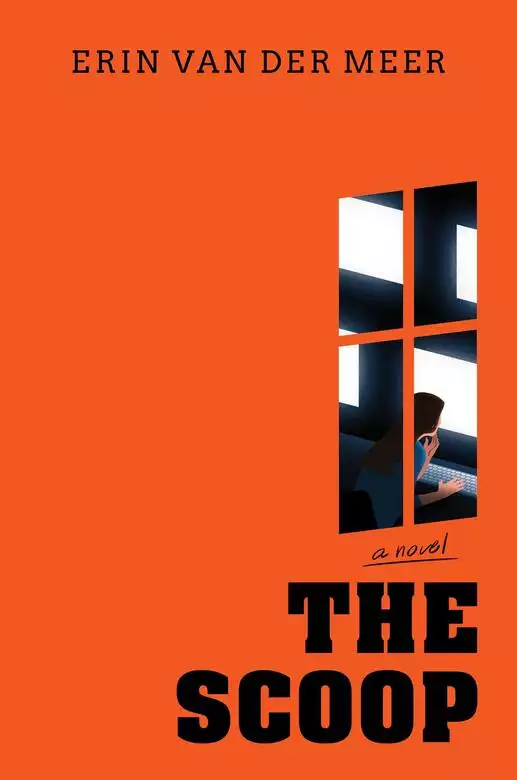
A piercing satire about a journalist working the night shift at a tabloid and the explosive consequences of her “harmless” clickbait.
Washed-up New York journalist Frankie Miller is getting desperate. Since the twenty-nine-year-old lost her dream job at a glossy magazine three months ago, her days have been filled with overdue bills, cereal for dinner, and a flood of rejection emails (not to mention her ex has a new girlfriend). So when she’s offered a job at The Scoop, a notorious tabloid website run by tyrannical editor-in-chief David Brown, she can’t exactly afford to say no—even if it means swallowing her pride for clicks. Besides, for Frankie, it’s just a paycheck, a temporary detour. It’s not forever.
But the deeper she’s pulled into the breakneck world of tabloid journalism, the blurrier the line between ambition and morality becomes—until she crosses it. When her reporting humiliates a beloved pop star and dredges up grief over her late mother, Frankie sets off a chain reaction that spirals beyond her control. In an industry where reputation is currency and outrage sells, how far is Frankie willing to go—and how much is she willing to lose—to win at this ruthless game?
Sharp, witty, and unflinchingly bold, The Scoop is a searing exploration of ambition, exploitation, and the human toll of the 24/7 news cycle.
Release date:
April 21, 2026
Publisher:
Grand Central Publishing
Print pages:
320
* BingeBooks earns revenue from qualifying purchases as an Amazon Associate as well as from other retail partners.
THE RETIRED DETECTIVE BEING INTERVIEWED in the documentary about the murdered child beauty queen was describing how an undigested piece of pineapple was found in the girl’s stomach. This fruit clue, he explained, helped investigators establish a timeline of her death. I shoved another sticky red handful of Swedish Fish into my mouth, considering as I chewed: If I were to die right then on the couch, what would the medical examiner think of what they’d find inside me?
Twenty-nine years old and eating cereal and candy for lunch, I imagined the doctor saying, tsk-tsking as their gloved hand fondled my small intestine, my secret shame exposed in the most undignified and unlikely of ways.
I swore to start eating healthier.
The intercom rang. Audrey—she was early. I peeled myself off the couch, the backs of my limbs sticking to the leather in the sweltering August-in-New-York-City heat, buzzed her in, clicked off the TV, closed the window, and turned on the window AC unit, even though Patti and I had agreed to use it only to sleep. (“The city’s electric grid is more fragile than most people realize,” my climate-activist roommate had said. “Also, I’m saving for Europe.”) But Audrey grew up rich, and so wasn’t hardy enough to handle such a hot afternoon with only the squeaking ceiling fan for comfort.
I opened the door to see Audrey clutching the banister, panting after climbing my walk-up’s four steep flights of stairs, blowing strands of blond hair out of the pale oval of her face.
“I wasn’t expecting you until—”
“You were so upset on the phone,” Audrey said, still out of breath. “I was worried.”
It made me cringe to remember how, two hours earlier, I’d called Audrey on the verge of hyperventilating, babbling garbled words through tears, unable to bear my moment of need and grief alone.
I stepped aside to let her in, feeling sheepish. Audrey was a Manhattan girl—she lived in the West Village and worked in Midtown—and often acted as though the part of Brooklyn where I lived was in another state. It touched me that she’d take the subway across boroughs for me.
“You took the 2/3?” I asked as I went to the sink and poured a glass of water, feeling bad it wasn’t cold as I handed it to her. She dropped her bag to the floor and kicked off her shoes.
“God, no. I took a car—I’ll expense it.”
Oh, the casual excesses of the gainfully employed. Meanwhile, I’d spent the morning googling How often can you donate blood plasma? and What happens if you donate too much blood plasma? and How much money for selling my eggs? and If I sell my eggs, could my genetic descendants find me in the future?
I went to the fridge and took two of Patti’s cans of Modelo, adding them to the running list in my head of her things I’d used and needed to replace (I saw it as “keeping the tab open”—not that Patti had agreed to, or knew anything about, this tab). I put one of the cold beers on the coffee table in front of Audrey, who had collapsed dramatically on the couch and was fanning herself with a copy of The New Yorker, and collapsed rather dramatically myself on the other end. Audrey didn’t really like beer, but at least it was cold, and I wanted an excuse to drink. Audrey didn’t ask if I had something else. She knew I wasn’t well. That’s why she was here.
“You didn’t have to come,” I said pathetically, a performance. We both knew she had to come.
“What happened?” Audrey asked, putting The New Yorker down, looking concerned.
I took a large swallow of beer, let out a deep breath, felt the tears threaten to start again.
“I thought this was the one.”
Audrey reached across the couch and patted my arm.
“I thought I was done. Done looking, done with the apps, done with doing my hair and makeup, putting on my best outfit, and going to meet a stranger, hoping to feel a spark, and instead knowing after less than five minutes of stilted conversation that it’s not going to work.”
“I know you did,” Audrey said, voice full of sympathy.
“Done with trying to prove my worth, prove I’m good enough. Done with trying to be enthusiastic and hopeful, while trying not to get too attached because of the risk of rejection. Done with waiting days, sometimes weeks, to hear from them again, only to receive some trite message saying that while they think I’m great, they’ve decided to go with another candidate.”
Maybe I was overreacting to the news I’d missed out on the role of editor at The SuperYacht Times, a boutique magazine for boating enthusiasts. But it had been three months since the layoffs at Marie Claire, when I lost my job as features editor and Audrey lost her job as senior features writer, only the latest round of jobs to be slashed across the media industry, and I was starting to worry. Unlike most of the white people I’d met working in magazines, I wasn’t rich. In fact, I was broke. The measly severance payment was almost gone, the state benefits I’d been receiving would soon run out, and I barely had enough in my bank account to cover a month of rent and bills. Then there was the matter of my several maxed-out credit cards, the total of which had recently blown out to five figures, on which I’d stopped making payments months ago (I’d had to block the numbers of Discover and American Express just to get some peace).
I couldn’t ask my parents for money. My mother had been dead seven years, and I was estranged from my father, who left when I was twelve to move to Hawaii for a woman he met online (when she was still alive, my mom joked he had to go all the way to Hawaii to find someone who didn’t know what an asshole he was). I got a one-line email from him every five years or so, presumably to check I was still alive—less often than a Pap smear, and more uncomfortable. I had no siblings; the only family I was in touch with were an aunt and uncle in San Francisco who sent a card every year on my birthday, which always included lots of warm sentiment, but never any cash. I didn’t know what I would do if I didn’t find a job soon. I’d heard people sold their dirty underwear, or pictures of their feet, and while the prospect of setting my own hours was appealing, I was the kind of person who worked best in a team. Also, I had a journalism degree and still believed that meant something.
Audrey nodded, pouted sympathetically, but she didn’t get it. She was doing so well, couldn’t have been doing better. Within weeks of the layoffs, she was announced as The New York Times’ new media reporter, a position that was either her birthright or nepotism, depending on how you looked at it (growing up, I’d watched her dad anchor the nightly news and saw her mom’s head atop a national newspaper column). The day Audrey called to tell me about her new job, I was glad she couldn’t see my face as I did my best to hide my private torment, like I’d accidentally bitten into a chili at a wake, smiling politely through the burning pain. I wanted to be a good friend, wanted to embody a generous spirit, wanted to believe there was plenty to go around. But the success of someone so close to me as I smarted from the hot sting of rejection, after rejection, after rejection, felt like a spotlight shone cruelly on my own failures. I could hardly stand it. I’d swallowed down my envy, hung up the call, and screamed into a cushion.
“This is ridiculous,” Audrey said now, indignant on my behalf. “What reason did they give? You’re a Marie Claire journalist, for god’s sake. You would’ve been doing them a favor.”
It hurt to remember Susan, the recruiter from the small publishing company I’d been dealing with through weeks of calls, interviews, and writing tests. Forget any relative living or dead, ex-lover, or guy that ghosted me, lately my thoughts had revolved around one person and one person only: Susan. It was Susan I longed to hear from, Susan to whom I sent messages both electronic and telepathic at all hours of the day and night. I felt sick as I told Audrey about Susan’s email. It had started off well, thanking me for my “patience and enthusiasm”—the praise, from Susan of all people, had made me beam—but that was the end of the good cheer. Susan regretted to inform me, but informed me nonetheless, that they had gone with another candidate, “someone with more boating-industry experience.” She had signed off by wishing me luck in my future endeavors. Insultingly generic, I thought, given all we had been through.
“More boating-industry experience?” Audrey repeated, almost offended, as if Susan had talked shit about her mother. “Please, any chump can learn about boats. Starboard, port, nautical—”
“I think there’s more to it than wearing striped T-shirts,” I said.
“I hope the next time Susan goes boating someone pushes her overboard.”
“Audrey,” I scolded, though after the way she had betrayed me, it was hard not to take pleasure in the image of Susan flailing about helpless in the open seas.
“You’re too good for them anyway. Moving on. What other jobs have you applied for?”
I led Audrey through the haunted house that was trying to get a job as a journalist in the summer of 2014 when you hadn’t been born into media royalty. Aside from the one editing a magazine about superyachts, there was a gig at a weird lifestyle website writing oddly specific lists: 47 cheese puns for Instagram captions or 72 sweet things to text her in the morning. Cheat codes, I assumed, for people who outsourced their personality along with their laundry.
Then there was the writer role at Surviving Cancer, a small medical magazine.
“We need someone to write the short, snappy articles that keep things light in between the features about chemo,” the editor had explained on the phone, weariness in his voice.
“Celebrities with cancer, bizarre misdiagnoses, that kind of thing. The editor in chief is a difficult man, so you do need a thick skin. But you’d have job stability. More than five thousand hospitals subscribe, and chemotherapy is a long, boring process, so we have a captive audience.”
“Unless they find a cure for cancer,” I’d said, my attempt at a joke. He didn’t laugh.
“Grim,” Audrey said when I was finished.
“Or is it hopeful?” I considered. “The magazine is about surviving cancer.”
“It’s still a magazine about cancer.”
“True.”
“What about BuzzFeed?” Audrey asked.
“Hiring freeze.”
“HuffPost?”
“They just made a bunch of hires.”
“Have you talked to Abigail at New York Magazine? She’s great. Maybe she can help.”
“I got her out-of-office reply. She’s on some long summer sojourn. Does she think she’s French?”
“Summer is the worst time to look for a job. Everyone is at the beach.”
“I wish they would wash the sand out of their cracks and come back already.”
I didn’t want to admit it, but I was losing hope. I was coming to the realization I was part of a micro-generation in the media, those of us who graduated around 2008. We were too young to have a steady enough foothold to ride out an era of such tumultuous change, but also too molded in the old ways (and too expensive) for entry-level digital roles, the only kind opening up with any regularity. My magazine editor pedigree increasingly meant little in a digital world.
Because she was a good friend, Audrey pivoted the conversation to one of the few things that could cheer me up: people who were doing worse than I was. We spoke like octogenarians at a wake, somberly trading names of recently deceased acquaintances. Alex from GQ is writing SEO content from his parents’ basement in rural Ohio. Such a loss. Jenna from Elle is telling everyone she’s “freelancing,” but everyone knows that’s just something journalists say when they’re out of work. Tragic. Celeste from Harper’s Bazaar is illegally selling all the samples and gifts she’s been sent from brands, spread out on a rug at McCarren Park on weekends. Just awful.
Audrey also regaled me with a story about a recent encounter with the well-known Vogue and Atlantic writer Elizabeth Waites. As the daughter of media royalty, Audrey often had juicy anecdotes from her rarefied plane of media existence, which I always lapped up greedily.
“She’s involved in this thing, like Avon but more pyramid scheme-y,” she said. “She’s trying to rope half the Upper East Side into a multilevel-marketing network. Can you believe it? Elizabeth Waites tried to sell me an electric foot massager. The woman won a Pulitzer!”
I laughed, but it felt hollow, something about this gossipy offering leaving me not scandalized as intended, but sad. If Elizabeth Waites was forced to sacrifice her dignity to pay the bills, what hope was there for the rest of us? For me? I considered asking Audrey to put in a word for me at the Times, or with one of her parents’ media power broker friends (I suspected this was how Audrey ended up at the Times, though she would never admit it) but I bit my tongue. Audrey had offered to help, once, a few weeks into my job search, but I’d blown off the suggestion, saying I had it handled. Audrey had helped me get my job at Marie Claire, putting in a good word for me with the editor when I was still a junior nobody at Cosmo, and my ego couldn’t bear the implication I needed Audrey to survive in the industry. Months passed, and I’d realized how childish this had been, to refuse her offer to help me, like a toddler on their tippy-toes in an elevator, insistent on reaching up to press the button all by themselves to the chagrin of the waiting adults. Audrey didn’t offer her assistance again, and I was much too proud to ask.
Outside the apartment door I heard the jangle of keys. Patti was home from work.
“Happy Friday, am I right?” she said too cheerfully as she stepped inside, her eyes wide as she took in the scene: her unemployed roommate drinking her beers with an unexpected visitor, the AC running full blast even though it was nowhere near bedtime. She struggled in, carrying under one arm a stack of large painted cardboard signs; I knew she had been at her girlfriend Sarah’s place to paint ahead of the climate march happening in the city next month.
Patti, a lawyer at a nonprofit, had met Audrey only once before, at birthday drinks I’d had in the spring, even though I’d always hated birthday parties (mine, at least), and had organized only because I was newly single and in need of a photo of myself looking hot, happy, and surrounded by people to post on social media for Josh to see, should my ex look me up to try to find out how I was doing after he fell in love with another woman at work. I’d found out thanks to a balled-up note in the clean laundry, which had somehow survived the washing machine and the dryer, the paper disintegrating between my fingers as I unwrapped it but still intact enough for me to read: me too, I am suffering here without you. Found out, Josh had been sorry, begged for my forgiveness, offered to go to couples therapy, to quit his marketing job at the record company, but I wasn’t about to stick around and wait for him to do it again, to “pull a Hawaii,” metaphorically speaking. Two weeks later, I’d found the apartment with Patti and had spent the past year wondering if I’d done the right thing, denying my doubts to anyone who asked.
It would be an understatement to say that Patti and Audrey did not hit it off. Audrey represented everything Patti despised—rich people and their kids who got the sort of opportunities most others could only dream of, and who were largely insulated from the suffering of others. I’d told Patti that Audrey was different, that she understood her privilege, that she volunteered, that I’d spent four years sitting beside her at Marie Claire and could vouch for her good character. But Audrey could sense Patti didn’t like her, and so of course Audrey acted cool toward Patti, which only confirmed Patti’s assessment that Audrey was a snob.
“I came over to check on our girl,” Audrey said by way of explaining her presence.
“What happened?” Patti said, dumping the signs beside the front door and staring at me.
“Nothing. I found out I didn’t get that magazine editor job. That’s all.” I said this with an air of nonchalance, as though I hadn’t been sobbing on the phone to Audrey a few hours ago.
“I didn’t want to say it,” Patti said, calling out as she went into the kitchen, “but I didn’t think that job was right for you. You grew up in western North Carolina, four hours from the ocean. ‘Fake it ’til you make it’ doesn’t work when it comes to maritime jargon and sea legs.”
Audrey scowled, looking like she was about to start prattling on about hulls and jibs and ports again. It occurred to me only then that Audrey’s parents had a summer home in Sag Harbor, that there was a boat tied to the private dock. I’d seen it the handful of times I’d visited.
Patti, probably figuring she ought to drink one of her own beers before they were all gone, not to mention get her money’s worth of the excessive daytime AC use, returned from the kitchen holding a frosty Modelo can in her hand and settled herself cross-legged on the rug.
“Audrey, you’re at The New York Times now, right?”
“Yes!” Audrey replied politely, nodding, though I could see she was already on guard.
“Tell me: what is going on with the climate change coverage at the Times?”
Audrey blinked back at her.
“What do you mean?”
“There’s no sense of urgency in the reporting, despite how, well, urgent it is.”
“The Times has a dedicated climate change reporter, who’s done some great work—”
“But the stories are always buried! It should be on the front page! Every day!”
I watched as Audrey’s smile gradually morphed into a grimace as Patti went on.
“Climate activists are only ever portrayed as loony outlier extremists, even though they’re just everyday people concerned about their families and their communities. It’s the trivializing of civil rights and anti–Vietnam War protesters all over again. Meanwhile, where is the scrutiny of the fossil fuel companies? If the Times doesn’t ask them the hard questions, hold them to account, then who will? And can someone please shake the photo editors? A story on a heat wave will show images of people eating ice cream, when it would be more accurate to show people sick with heatstroke, or dead animals lying by a riverbed gone dry from drought…”
There was nothing I could do to save Audrey. Once Patti got started, there was no point trying to stop her—you just had to let her get it out. As I sipped my beer and watched Audrey squirm through Patti’s polemic, my mind wandered to what Audrey had told me earlier, the story about Elizabeth Waites pestering media elites to join her MLM. The way Audrey said it, the mix of shock and pity, made it sound like Elizabeth was panhandling barefoot outside Penn Station. Audrey had been trying to make me feel better, but wasn’t I just as pitiable? Just as pathetic? Weren’t our industry friends probably talking about me like that? What was I going to do? Should I join an MLM? No, there were so many unemployed journalists around, everyone we knew had surely made enough pity purchases of Tupperware and essential oils to last a lifetime.
“Be right back,” I said, slipping my phone into my pocket and going to the bathroom, ignoring the desperate plea in Audrey’s eyes begging me not to leave her alone with Patti.
Perched on the edge of the tub, I stared at my phone, consulting it like an oracle, thumbs poised. I would figure this out the way I’d figured everything out, alone, for a long time now. I’d been on my own since Mom had died in my final year of college, a heart attack caused by her chronic lung condition killing her when she was only fifty-two, mere months before she would have seen me graduate. The summer after she died, I’d cleared out and cleaned her house and, when it was time to go, slipped the key for the real estate agent under the door. Then I’d sat in my car at the top of the hill, the back seat piled with boxes of her belongings I wanted to keep. The plan was to take the boxes to a storage facility, drive the car to the person who’d agreed to buy it, then take a taxi to the airport and fly to New York to start my new life. After a few minutes of tears, I turned the key in the ignition, ready to go. But the car wouldn’t start. After a few tries, I realized that because the gas tank was almost empty, and I was parked with the nose of the car facing downhill, the engine wouldn’t catch. I sat there, wondering what to do. I could have called AAA, but they wouldn’t have come for at least an hour, if not longer, and if I’d waited that long I risked missing my flight. Nothing was going to make me miss that flight.
Before I could think about it, I released the handbrake. An action that would later frighten me, once I had a fully developed frontal lobe. I didn’t think about the risk of driving head-on into the tree at the bottom of the hill where the road curved, the risk of my skin being cut open by shattered glass, the risk of bruises, broken bones, or worse. The car began to roll forward, slowly at first, then gaining speed. I kept one hand gripped on the wheel and with the other I turned the key in the ignition. As the car picked up speed, I turned, turned, turned it again. The steering wheel was locked. The bend at the bottom of the hill got closer. I was headed straight for the tree. I pressed my foot on the brake, but with the engine off it didn’t work. I gained more speed still. And then, with only seconds to spare, the engine roared to life. I hooked the wheel to the right, pressed my foot hard on the gas, and sped toward the highway. Now, at twenty-nine years old, I was no longer so reckless. But I was no less determined, no less wired for survival.
There was one job I hadn’t mentioned to Audrey, because I knew what she would say. I’d received an email from a recruiter at Johnson News, the conservative media company that owned dozens of newspapers and websites around the world, as well as the infamous cable channel, America Now. I’d ignored it, the words Johnson News conjuring images in my mind of the loudmouthed America Now hosts spouting lies, rumors of sexist executives insisting female hosts wear skirts and dresses, never pants, of Walter Johnson, the company’s creepy elderly cartoon villain of a CEO. But had I been too quick to dismiss it? I reread the email. They were looking for a news editor at The Scoop, a website that had launched the year before. The recruiter wanted to know if I was available for an interview with the editor in chief, David Brown.
I opened a browser window and found The Scoop. I quickly discovered it was about as unserious as a news website could be, as though a group of bored and horny teenage boys suffering from brain injuries was in charge. The top story was about a woman in Australia who had broken the world record for drinking the most beer from a shoe; I reasoned it was important to celebrate women’s achievements in male-dominated domains. Other stories on the home page included a priest in Italy going viral because his knee, from a certain angle, resembled the face of John Travolta, and feverish speculation on whether a certain reality show star’s ass was looking bigger, again (the universe was expanding, and so was Kira Vincent’s butt).
No. I couldn’t, could I? Not Johnson News. I was a Marie Claire journalist. But then I remembered the box under my bed, the one that held the personal items I’d carried out the day I got laid off, still unpacked. Glaring proof that I wasn’t a Marie Claire journalist, not anymore.
I hit reply and started typing. Thank you for reaching out! It sounds like a great opportunity. I would love to learn more.
Audrey knocked on the bathroom door.
“Frankie? You okay?”
I swallowed, my finger hovering over the send button. Was I really going to do this? It was the media-industry equivalent of the weirdest guy in the dive bar offering to buy you a drink. But if you have been lonely long enough, you will probably say yes. It feels good to be wanted.
Audrey knocke. . .
We hope you are enjoying the book so far. To continue reading...

 Please log in to recommend or discuss...
