'One of Singapore's finest living authors'South China Morning Post
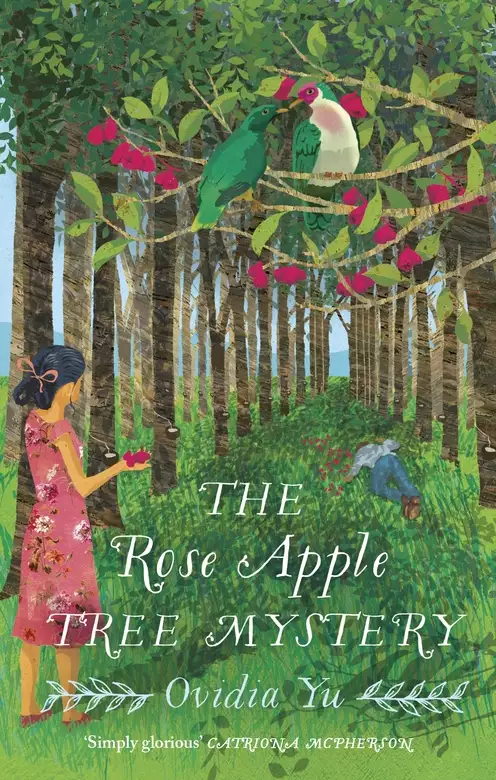
'One of the most likeable heroines in modern literature' SCOTSMAN ________________ What does the immediate future hold for Su Lin and Le Froy? Singapore 1947, and Su Lin and Le Froy start their married life with a honeymoon in the Cameron Highlands, an idyllic pocket of English countryside in the tropical rainforest, on assignment to protect a rubber plantation owner and his wife who fled there after the murder of their neighbours. Threats and ghostly sightings follow Boss Max and his wife, escalating after Elfrieda vanishes, leaving nothing but a cache of rotting fruit from the rose apple tree outside her lodge. Boss Max is desperate-his precious emeralds are missing along with his beautiful wife... Trapped in the isolated area until the monsoon floods subside, Su Lin had hoped to use the time to get to know her new husband but then when Boss Max is founded murdered in a locked room with more rose apples scattered around the corpse, she and Le Froy must work together try to prevent further deaths --including theirs.
Praise for Ovidia Yu:
'Chen Su Lin is a true gem. Her slyly witty voice and her admirable, sometimes heartbreaking, practicality make her the most beguiling narrator heroine I've met in a long while' Catriona McPherson
'Charming and fascinating with great authentic feel. Ovidia Yu's teenage Chinese sleuth gives us an insight into a very different culture and time. This book is exactly why I love historical novels' Rhys Bowen
'A wonderful detective novel . . . a book that introduces one of the most likeable heroines in modern literature and should be on everyone's Must Read list' Scotsman
'Unassuming, brilliantly observant' SCMP
'Ovidia Yu's writing helped me peel back the layers to understand Singapore. The story and Chen Su Lin's initiative and tenacity, set against a backdrop of wartime Singapore, intrigued both the historian and the mystery lover in me' Kara Owens CMG CVO, British High Commissioner to Singapore
Release date:
June 5, 2025
Publisher:
Little, Brown Book Group
Print pages:
80000
* BingeBooks earns revenue from qualifying purchases as an Amazon Associate as well as from other retail partners.
My left knee hurt, but the familiar pain was almost comforting. I was kneeling, head bowed, holding a cup of tea in both hands. Le Froy, on my right, was in the same position. If I was crazy enough to be in love with this man, at least he was crazy enough to be in love with me too . . .
‘Only goondus go around looking for trouble,’ my grandmother grumbled, resplendent in her intricately embroidered sarong kebaya. Goondu, from a mix of Tamil and Malay, means ‘idiot’ in Singlish. ‘Aiyoh! Why are you two so goondu?’
Aiyoh expresses all the annoyance and exasperation of a sigh, but with more force. Which sums up my grandmother’s approach to life: even if you don’t like what you have to do, you must do it with all the energy you can summon.
Not exactly typical wedding good wishes.
‘Please drink some tea, Ah Ma,’ I said, offering her the tiny cup with both hands.
My grandmother accepted it. The tea had been brewed in the proper traditional manner with red dates (for good luck), rock sugar (for a sweet union) and dried longans (for male rather than female offspring) but, from my grandmother’s expression, you’d think I’d handed her kitchen swill in one of her best, reserved-for-special-occasions porcelain teacups.
‘When people are fighting and getting murdered, any normal person would run far away,’ Ah Ma muttered, ‘not run towards – like asking to get killed faster!’
A sharp tongue click made us all jump. It came from Gan Jie, the black-and-white amah who’d supervised the tea-ceremony preparations. It was the same warning she used, with an even sharper pinch if you didn’t jump to respond, when servant girls or house boys behaved badly. I saw them grinning. With the rest of the Chen Mansion household, they were standing in a row behind my grandmother and Uncle Chen as part of our wedding ceremony – which was as much for show as for luck and blessings.
Gan Jie was probably the only person my grandmother was afraid of. Ah Ma might be the head of the Chen family, but Gan Jie ran Chen Mansion.
My grandmother plastered a smile on her face, ‘Congratulations. Please try to stay alive.’
This wasn’t how I’d expected my wedding to be. I’d never been the kind of girl who dreamed of a fancy one, but I’d certainly not anticipated everything happening so fast.
Traditionally, the tea ceremony should have been carried out using my mother’s wedding dowry tea set, which would then be passed to me, as the eldest daughter, to bring to my new family as part of my dowry. That there had been neither a tea set nor any dowry underlined how good my grandmother had been to take me in and bring me up.
After disgracing the Chen family by eloping, my father and his Japanese wife had died while I was still a baby. Their deaths, added to the polio that had crippled my hip and one of my legs, was why neighbours and fortune-tellers had strongly suggested that the best thing Chen Tai could do to cancel the bad luck I’d carried into the household was put me down a well. Instead my grandmother had not only raised me as her granddaughter but sent me to learn to read and write English at the school set up by the ladies at the Mission Centre.
‘If you can’t get married, at least if you know English you can earn your living,’ she’d explained. But learning to read and write, as well as speak, English, had opened up a world of possibilities for me. And not only that: attending the Mission Centre school had led me to Le Froy and this moment.
It was the best thing she could have done for me and I wondered if Ah Ma realised and regretted that.
‘Chen Tai, please drink some tea,’ Le Froy said, in Hokkien, He proffered his cup of tea as Ah Ma handed mine, now empty, to Gan Jie.
‘Congratulations.’ Ah Ma managed a smile for him without being prompted. ‘After this, you can call me Ah Ma.’
‘Thank you, Chen Tai,’ Le Froy said.
That brought another genuine smile from my grandmother. ‘Thank you for being part of our family. Please look after my granddaughter. You must make her behave herself and try to keep her out of trouble.’
‘Don’t ask for the impossible,’ Uncle Chen muttered.
‘I will try my best, Chen Tai.’
Another nod and a smile. Women found Le Froy charming and even my grandmother wasn’t immune from it. Another reason why our marriage wasn’t going to help my popularity in local circles.
When I’d first met him, Le Froy had been out east so long that he was tanned dark enough to pass for a local – which he’d done when he’d gone undercover as a drain inspector to expose gambling dens – although probably not as often as the stories suggested.
Since his imprisonment by the Japanese he’d lost a foot and most of his colour. There was no mistaking him for a local now. But though his skin was paler than it had been, he still looked tough and wiry, like an invasive root that’s been unearthed but cannot be pulled out. The dark hair he’d had when we first met was streaked with silver now but was still thick. And still lovely. As far as I was concerned, he looked better now than ever before.
That was one blessing the war granted us: the ability to see how incredibly beautiful a person was just by virtue of being alive.
Best of all, Le Froy and I were married.
Of course I’d not expected Ah Ma to be happy about such a rushed marriage. But I believed – or hoped – she would put a good face on it. It was my wedding day. And, after all that Le Froy had done for me and my family before and during the war, she could hardly disapprove of him. I suspected she felt that if she could delay our marriage long enough, that day might never come. I might yet agree to be matched with a nice young Chinese man from a respectable Chinese family or Le Froy might leave the island to marry an ang moh.
‘How do I look?’
To sign my marriage contract, I was wearing a Western-style cotton frock with pink and blue flowers on a cream background. There hadn’t been time to find a bridal dress or a traditional ceremonial gown.
‘You look okay,’ Little Ling said.
‘Is Ah Ma ready yet?’ I looked out of the front window hoping to spot Le Froy’s car. The driveway outside Chen Mansion was long enough that you could see automobiles before you heard them. ‘Do you want to come in Le Froy’s car with me, or wait and come with Ah Ma and your pa?’
We were going to be early for our ten-thirty appointment at the Registry of Marriages, but both Le Froy and I preferred to wait than to be waited for when it came to something so important.
‘Ah Ma’s not going,’ Little Ling said. ‘My pa also said he’s not going.’
It wasn’t a big deal, of course, just an appearance at the registrar’s office to sign the marriage certificate before witnesses. But it was the only wedding I would have, and I’d hoped to have my family with me to share it.
‘I’ll talk to her,’ I said. I started for the corridor to Ah Ma’s room. ‘It won’t take long. We can go somewhere to eat afterwards.’
It felt almost more important to me that my grandmother should share a meal with Le Froy and me once we were legally married rather than when we were signing the register. That was my Chinese side speaking: sharing a meal would mark it as a special occasion and eating together as a family would bond the relationship between Le Froy and my grandmother. I was thinking we might go to Wing Choon Yuen, the banquet restaurant we’d gone to for my uncle’s fiftieth-birthday celebration.
‘No! Stop!’ Little Ling grabbed my arm. ‘Please don’t, Su-jie! You mustn’t. Ah Ma doesn’t want to see you!’
‘What?’ I realised I hadn’t seen – or heard – my grandmother all morning. At home she was usually bustling around giving the servants instructions, telling me and Uncle Chen about something she’d heard on the radio or from a neighbour, or asking Little Ling what she wanted to eat. I’d been too wrapped up in my plans and packing to notice. ‘I only want to go and tell her I’m leaving now.’
Little Ling shook her head. ‘Ah Ma doesn’t want to see you,’ she repeated. ‘She told me to tell you she and Pa both don’t want to see you.’
Part of me wanted to bang on Ah Ma’s door until she let me in, even if she was angry and yelled at me. All my life my grandmother had told me exactly what she thought of me, but she had never turned me away.
I couldn’t deal with that now, though. I could hear Le Froy’s tyres grinding along the gravel outside.
‘Would you like to come?’ I asked Little Ling. ‘We can go for ice cream afterwards, if you like.’ I didn’t like ice cream, but I really wanted someone from my family to be at my wedding.
‘I need to stay here to talk to Ah Ma,’ my cousin said. ‘You go now. But you must come straight back here for lunch afterwards. Promise! You and Le Froy must come here. Don’t go anywhere else first.’
There was no way Little Ling could talk our grandmother out of her sulk by lunchtime, but I was touched that she meant to try. And if I was wrong, so much the better.
‘I promise,’ I said.
Little Ling gave me a quick hug as I left.
‘Everything okay?’ Le Froy asked, as I got into his car.
‘Everything’s good,’ I said. And I meant it.
I’d known for a long time that Thomas Francis Le Froy was the only man I ever wanted to marry. Unfortunately I wasn’t alone there. Chief Inspector Le Froy of the Criminal Intelligence Department had been a legend in Singapore and the rest of the Crown Colonies before the war, and finding him a wife had been a principal pastime of expatriate ladies. I’d heard them compare him (favourably) to the film stars Rudolph Valentino, Douglas Fairbanks and John Barrymore.
He was still good-looking. I don’t think anyone could have noticed that he walked, hiked and even played a little badminton on a prosthetic foot, unless they already knew. We were a matching pair of cripples, given my polio-damaged hip and leg.
‘Everything is perfect.’ I smiled at my husband-to-be.
It was only three days previously that Le Froy had proposed to me, if you could call it that. And it had only come about because of the Emerald Estate Murders.
The Emerald Estate was the rubber plantation up north in Perak, Malaya, where two white planters and their families had been murdered. According to the Malayan Tribune, brothers Jonathan and Samuel Walker, with Jonathan’s wife Brenda and Samuel’s wife Melinda, had been found dead by their estate manager on his return from a night in town.
There had been rumours of Japanese soldiers hiding in the jungle after the Allied forces’ victory. According to the stories, they refused to believe Japan had surrendered or would ever surrender. Their orders were to terrorise the people until the Imperial Army returned and, if defeat seemed inevitable, to take as many of the enemy with them in a glorious suicide.
To be honest, I’d never met anyone who’d encountered one of those hold-out soldiers. In fact, all the Japanese military I’d met seemed as exhausted and fed-up with the business of war as we were.
Some locals said the workers were angry with the Walkers because they were laid off at the start of the monsoon season and told to leave. Most boss planters let the tappers stay on the property even if they are not yet hired for the following season. But the Walkers made them all leave. A lot of them had come from India or Indonesia and were desperate, but even many locals had nowhere else to go.
All of the victims had been shot, as well as stabbed. According to the local authorities, Evidence shows the killers used both imported and local weapons, pointing to Communist vigilantes hiding in the jungle surrounding the rubber plantation.
I’d also heard rumours that the vengeful spirits of local girls assaulted and driven to suicide by the Walker men had been seen around the plantation: they had driven the Walker brothers mad so they’d killed their wives and each other.
That wasn’t surprising – the stories, I mean, not the murders. Ang moh men had a reputation for forcing themselves on local women, which made the British authorities and local parents wary of European–Asian relationships like ours.
‘The governor had me over for drinks this afternoon,’ was how Le Froy began. We were sitting on the porch after dinner at Chen Mansion. ‘He’s worried about the situation upcountry.’
‘He’s trying to call you out of retirement?’ I guessed.
It had become increasingly clear that the British were having trouble in reimposing order on their colonies. It was hard to distinguish fighters for Asian independence and members of the newly illegal Communist party from petty criminals and troublemakers. Given that Le Froy had set up and run Singapore’s criminal-intelligence network and pretty much wiped out gang activity, it had been only a matter of time before the struggling British administration turned to him for help.
‘What did the governor offer you? And what did you say? You’ll haggle with him before you accept, right? You can’t just go back at the same salary – think of inflation! You’re in Singapore so you must bargain.’
Le Froy’s reluctance to do so was one of his only faults. Like many British, he didn’t understand that bargaining was a game and a challenge. It was about balancing the social currency of supply and demand and getting the best deal for all involved. Every local child knows that if you see someone selling rose apples from his roadside tree, you’ll be asked to pay a lot because jambu, or rose apples, are almost impossible to buy commercially: they decay too quickly to transport. On the other hand, if you offer to hawk the fruit to passing traffic or chase off marauding birds and squirrels, you might get a share of the money you collect, while eating as much as you like of the fruit.
‘He wants me to look into the murders at the Emerald Estate.’
‘The governor wants you to go up to Perak? In this weather?’ It was never a good idea to travel during the monsoon season. ‘But that’s old news. They’ve already caught the Communist vigilantes who did it, haven’t they? What do they expect you to do?’
‘The new estate owner is getting death threats,’ Le Froy said, ‘from the same people, it seems.’
‘What?’ If the new owner of the estate was being threatened, the authorities had either arrested the wrong men or more of them were still at large. And since the murderers had no qualms about killing white men, they wouldn’t balk at bumping off an ang moh police investigator.
‘The monsoon is bad this year. Roads may be washed away. It’ll be difficult to get there and you may not be able to get back until after the rainy season.’
Le Froy nodded, clearly distracted. I suspected he was already thinking about the case.
‘When do you start?’
‘I’ll be officially reinstated once I sign the contract. But he mentioned that some people have issues with my violating some of the conduct clauses.’
‘You? Like what?’
‘In particular, the one that prohibits associating with undesirable elements of society . . .’
‘He was talking about my family.’
I knew the Chen family had a not entirely undeserved reputation for running the local black-market. My late father had been the notorious Big Boss Chen, who united the local tongs and convinced them to work with instead of against each other. That was why Uncle Chen, despite his size, was known as ‘Small Boss Chen’ even twenty years after his brother’s death.
But it was Ah Ma rather than Uncle Chen who managed the family businesses and property rentals, though she always referred to it as ‘helping neighbours’.
‘Those conduct rules were drawn up with gambling, opium and prostitution in mind. Family members, however questionable, are exempt.’
I couldn’t process what he was saying. Was Le Froy telling me this was goodbye? I’d never considered such a possibility until now. I turned to him and saw he wasn’t looking at me. Instead, he was fumbling clumsily in his pocket. Fumbling? This man who could whip off his prosthetic foot mid-stride and throw it like a precision weapon? He finally pulled out a little crime-scene-evidence canister. It looked like one of those used to collect bullet casings and tooth fragments.
‘Something that belonged to my mother,’ he said.
‘You’re not carrying your mother’s—’ I was trying to decide whether teeth or kidney stones would be worse, when I saw what he was holding out to me.
‘Green and blue sapphires set around white diamonds,’ Le Froy said. ‘She wore it till the day she died. Will it do?’
‘Will it do what?’ I took the ring automatically, but my mind was blank.
‘For a wedding ring,’ Le Froy said. ‘My mother asked me to give it to the woman I married, with her love. See if it fits.’
It did.
‘I know it’s not new—’
‘I like that,’ I said quickly. ‘I like knowing that it belonged to your mother. But tell me what this is for. You just said you can’t see me any more.’ I’ve never been good at romantic moments.
‘Family members are exempt from the clauses. I have the right to consort with my wife’s family,’ Le Froy said. ‘It’s the perfect solution. What do you think? Will you marry me?’
I thought it was a brilliant solution. Would I marry him? Ever since I’d learned Le Froy felt for me as I did for him, I’d dreamed we would, someday, somehow, be married and live happily ever after. But, given our circumstances and the British administration, I’d not been able to see how this could happen.
‘Of course I’ll marry you!’ I wasn’t ladylike but I was honest. ‘When?’
‘As soon as possible. I want us to leave together for Perak. We can get on the Sunday-morning train. By the way, I love you.’
‘I love you too.’
And that settled it.
‘If you want to change your mind this is the time,’ Le Froy said. ‘When we come out of there,’ he gestured at the Registry of Marriages, ‘it’ll be too late.’
I realised we’d arrived and parked in one of the slanting lots in front of the offices.
So, here I was on my wedding day. I would have worn a white dress for a Western-style wedding or a red outfit for a Chinese ceremony, but I was getting married at a government office in an almost-new cotton frock.
‘I don’t want to change my mind.’ I climbed out of the car and smoothed my dress.
I knew I was doing the right thing. I just wished my family could have accepted it.
It wasn’t the kind of wedding most girls dream of. Still, I believe it’s better to marry the right man in the worst circumstances than to marry the wrong one in the best. The look on Le Froy’s face as we stepped back into the sunlight after the brief ceremony showed me his thoughts were running along much the same lines.
He held out his arms and I moved into them, surprised by how comfortable, familiar and right it felt. Even though we had embraced before, this felt like coming home.
‘A celebratory lunch in the Farquhar Hotel for my bride?’ Le Froy suggested.
‘I promised Little Ling we would go straight home for lunch after signing,’ I said. ‘I would like to. I hope you don’t mind.’
I didn’t know if there would be any lunch for us at home. But with Ah Ma’s disapproval still hanging heavy over me, I didn’t feel up to facing the judgemental looks we’d attract. Wealthy locals in their Western finery would whisper about sarong party girls as any Westerners pretended, with pitying disdain, not to recognise Le Froy.
I wasn’t imagining things. I’d seen all these reactions when my best friend Parshanti was out with Leasky, her Scottish doctor husband.
And that was yet another drawback to getting married at such short notice: Parshanti and her parents were spending three months on Langkawi Island, where Dr Shankar, her father, and Dr Leask were studying the medicinal properties of various roots, bark and sap used by locals in traditional healing. This had started as a passion of Leasky’s but Dr Shankar was now just as enthusiastic. I was sure they would have come back to witness my wedding if they could have made it in time, and I knew they would be happy for me when they got back, but it wasn’t the same.
‘I think Little Ling is trying to persuade my grandmother to say something nice to us before we leave, but I don’t think she’ll manage it.’
On the way back to Chen Mansion, I told Le Froy about Ah Ma refusing to see me, and hoped she’d have got over it, but I had to prepare him in case she hadn’t. To his credit, he didn’t tell me she would come round or that everything would be all right. He knew Ah Ma – and me – better than that.
‘I would like to pay my respects to your grandmother,’ he said, ‘and invite her, with your uncle and Little Ling, to join us for wedding-day laksa – crab meat as well as prawns. What do you think?’
‘Wedding-day laksa?’ I laughed. ‘I’ve never heard of such a thing!’
‘Because it only exists on this one day. From next year onwards it will be known as anniversary-day laksa.’
It was wonderfully ridiculous, and I felt instantly more cheerful. It’s almost impossible to feel sad when eating – or even thinking about eating – laksa lemak. There’s something about the rich savoury sauce and slippery white noodles that transports you to a place where life is safe, luxurious and full of delicious surprises, like cockles in the bottom of your bowl. So, I was feeling positive as we drove eastwards along Mountbatten Road. Even if Ah Ma and Uncle Chen couldn’t be persuaded to join us – highly likely, given they’d refused even to see me that morning – there was a chance they would come round in time.
All of that was driven out of my mind when Le Froy had to stop because the driveway to Chen Mansion was blocked by three huge lorries trying to turn out onto the main road. What was happening? You saw those fourteen-foot canopied lorries only when they were transporting funeral-wake equipment or seizing confiscated property. Were they here to seize our furniture? My grandmother wouldn’t move out of Chen Mansion – she had always said she would die in the house where her husband had died. What could have happened since I’d left that morning? Was Little Ling all right?
Even though the war was over, I still had nightmares of Japanese soldiers breaking in and rounding us up to be shot.
‘What’s going on?’ Le Froy looked tense as he watched the vehicles negotiate the turn onto the main road. There wasn’t room for them to complete the manoeuvre in one go and each had to reverse and adjust its position several times.
At . . .
We hope you are enjoying the book so far. To continue reading...

 Please log in to recommend or discuss...
