
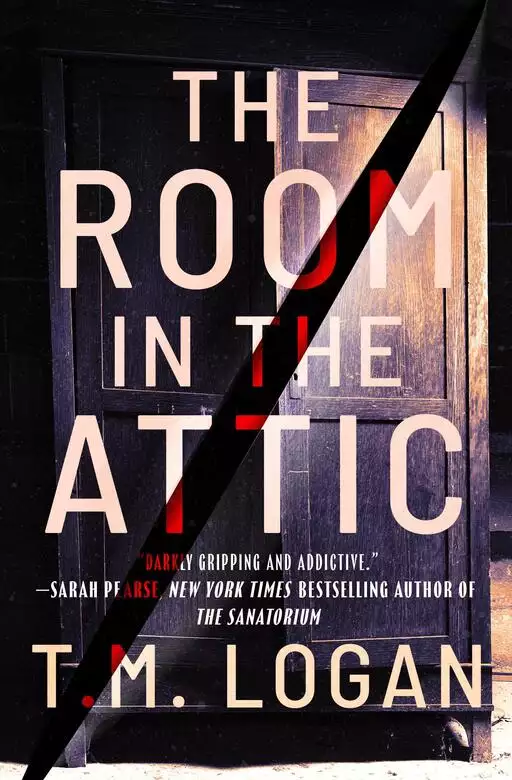
The Room in the Attic
- eBook
- Paperback
- Audiobook
- Book info
- Sample
- Media
- Author updates
- Lists
Synopsis
A "darkly gripping and addictive read" from a Sunday Times bestselling author, wherein a new homeowner faces the dark secrets buried inside a hidden room—perfect for fans of Mary Kubica and B.A. Paris (Sarah Pearse, New York Times bestselling author).
It was everything they wanted...and more than they bargained for.
Adam and Jess move into a new house—a rambling Victorian villa at the very top of their price range—with their three young children. Before long Adam discovers a door hidden behind a fitted wardrobe, concealing a secret room . . .
Inside Adam, discovers a collection of forgotten items: a wallet, an expensive watch and an old mobile phone. Jess thinks they should throw them away. But Adam resists. He is fascinated by these items and how they came to be inside the hidden room.
But like the house, Adam has his secrets too. And soon he will find himself setting in motion a series of events that will place his family in terrible danger . . .
Release date: January 20, 2026
Publisher: Grand Central Publishing
Print pages: 416
* BingeBooks earns revenue from qualifying purchases as an Amazon Associate as well as from other retail partners.
Reader buzz
 Please log in to recommend or discuss...
Author updates
The Room in the Attic
T.M. Logan
A day full of lifting and carrying and making cups of tea for the removal team, of going up and down the broad staircase a hundred times, of unloading boxes, building bedframes, and giving the children small jobs to keep them occupied. A nonstop day bringing this old house back to life.
It still doesn’t quite feel real, even as Jess and I are debating where to start with the decorating. None of the rooms have seen fresh paint or new carpet for decades. A fixer-upper, the estate agent had said with a hopeful smile. But we had fallen in love with the place on the first viewing, had both known it was something special, this rambling Victorian house with its high ceilings and tall windows, its soaring chimney stacks and half-timbered gables, the date in delicate raised stonework over the big front door: 1889. Six bedrooms, three bathrooms, two reception rooms, a cellar, a pantry, a den—there was so much space.
We knew it needed a lot of work; that was one of the reasons we’d been able to afford a house in this part of the city. The Park, first named for the old deer park next to the castle, maintained for the king’s hunt—now an enclave of grand nineteenth-century houses and wide-spaced streets, a tree-lined oasis of walled gardens and leafy calm right in the heart of Nottingham.
By late afternoon, I’m clearing left-behind rubbish from the second floor. My legs are heavy, my back starting to ache after going down two flights of stairs carrying stacks of old newspapers, an ancient rollaway bed that had been left on the landing, a broken bookcase, boxes of tiles, and bin bags of musty clothes. In the smallest of the top-floor attic rooms, where the air is stale with neglect, the carcass of an old fitted wardrobe hangs off the wall. Its chipboard shelves are splintered, one door is jammed shut, and the other has fallen off its runner completely. Nails and screws protrude from the broken frame, ready to catch small hands. The whole thing looks like it might collapse at any moment, and it doesn’t take me long to pry it away from the wall with a crowbar, flattening the nails and breaking the whole wardrobe apart, stacking the broken wood in the corner.
Every room in this house seems to have some quirk or curiosity that we hadn’t anticipated.
And this room is no exception.
Because the wall behind the fitted wardrobe is not painted plaster, or wallpaper, or brick. Instead, it’s paneled in dark wood like the hallway on the ground floor. Panels of walnut or teak stretch floor to ceiling across the width of the room. It’s a big improvement on the fitted wardrobe, a shame to have hidden away this handsome facade behind something so ugly. The whole thing is seven panels high and a dozen or so wide. The workmanship is very fine, each piece seamlessly fitting into the next, the only blemishes a handful of holes where the wardrobe had been attached.
I run my hand over a panel, the grain of the wood smooth under my palm. Standing back to admire it, I snap a quick picture on my phone to show Jess what I’ve discovered. The late afternoon sun coming through the skylight makes the wood almost glow, like burnished bronze, as if carved from a single piece of—
I look again at the picture, then back at the paneling. Comparing the high-definition image with the reality in front of me.
The way the sun catches it in the photo, at just the right angle, I can see the workmanship is not quite perfect. Not all the way along. Perhaps there’s been some movement over time, the house shifting its old bones slightly in the years since this wall was added. In the phone image, there is a very fine vertical line running between two panels at the far end of the wall.
But with the naked eye, I still can’t make it out. I run my hand up and down the right side of the wall, between two of the panels. I don’t see it. I feel it. My fingertips brush an almost invisible join, a seam in the wood. I run my hand up higher, then down to the floor. Up again, across, down.
Not just a seam.
It’s the outline of a door.
Perhaps there was old pipework behind here, the wood paneling a smart solution to disguise it, with discreet access if there was ever a problem. Or perhaps a little extra attic space beneath the eaves of the sloping roof.
There doesn’t seem to be any kind of keyhole, or lock, or latch, or anything that will open or close it. I spend a minute feeling all the way around the seam again but there is nothing at all to give any leverage, to pull or push or turn. No button or handle.
In frustration, I place my palm flat against the middle panel and push.
With a reluctant click, the door opens toward me. Just half an inch. I pause for a second, taking a breath, then pull it open all the way on silent hinges.
Over the threshold, there is total, perfect darkness. The air is musty and stale, a blunt spoiled smell of old bricks and slow decay that has not been breathed in a long, long time. My heart beating a little faster, I take the phone from my pocket and flick the torch on, white light throwing leaping shadows over an armchair, a side table, a dresser pushed up against the wall, all of it thick with dust and cobwebs.
It isn’t just a panel to hide ugly pipework.
It isn’t extra storage space either.
It’s a whole new room, hidden behind the wall.
I knew something about this top bedroom wasn’t quite right.
The dimensions seemed a little too small; the wall didn’t quite match the one in the bedroom next to it. This hidden space is small and cramped like a hide, a priest hole—but the house was nowhere near old enough for that. According to the stonework over the front door, it was built in 1889 and I knew it had been extended at least twice since. On my phone, I pull up the floor plan from the estate agents’ website and zoom into the top floor layout, checking the dimensions of this bedroom—ten feet by twelve, give or take a few inches. That looks about right to me. No indication of more space to the side, of a hidden annex that must have been built into the fabric of this place so long ago that people forgot it was even there. An extra four feet of width that had been turned into something else.
Ducking my head, I step through the door.
The air is thick with years of dust, smells of old timber and crumbling brick that catch at the back of my throat.
A floorboard creaks beneath my feet and I freeze. There is the weird sense that I’m somehow intruding on someone else’s private space. I know it’s ridiculous. We own this house now—and everything in it. From the swirling 1970s carpets on the top landing to the stack of rust-crusted paint pots in the cellar, the fading cookbooks abandoned in the pantry and the stippled Artex ceiling in the sitting room, stained a dull yellow from years of cigarette smoke. All of it left behind by the elderly previous owner. All of it belongs to us now.
The bright light from my phone throws dancing shadows as it sweeps over the room, cobwebs filling every corner. Old rugs nailed to bare brick on one side, the slope of the eaves on the other. There’s a low, tatty armchair with a tiny side table next to it, a brown ceramic coaster where someone long ago might have placed their cup of tea. A battered Welsh dresser crammed against the wall, the wood dark, almost black.
A bare bulb dangles from the ceiling. I pull on the cord but nothing happens; the bulb is long dead.
The dresser has a single large door on the right, with eight small drawers to the left, in two columns of four. I pull the handle of the door and it opens with a rusty creak.
Empty, except for more cobwebs and the cocooned carcasses of dead insects. I try the top drawer. Locked. As is the one beside it, and the one below.
Curiosity piqued, I feel a small spike of frustration added into the mix—a dangerous combination for me ever since I was a child. A locked dresser, a hidden door, a secret room. Now I definitely need to see what’s inside. Maybe there was something valuable hidden here, money or jewelry, a stash of gold coins, or the key to a safe deposit box at a private bank. All of which would come in extremely handy, especially now.
I’m pretty sure I can lever the drawers open if I use a little brute force and ignorance. I bend to duck under the low doorway and back out into the main room, to my toolbox on the landing, where I find the biggest flathead screwdriver I’ve got, an old chisel, and then—as a last resort—my crowbar, the steel smooth and heavy in my hand. Dumb, dumber, dumbest.
I start with the chisel, sliding the blade into the gap between the top drawer and the wooden frame. Levering the handle back, putting my weight into it—
With a dull snap, the blade of the chisel breaks off.
I’m left with just the old wooden handle in my clenched fist. I pull the broken blade free and study the dresser with a new curiosity.
This old thing was really well made. Before I mangle this antique with the crowbar, I should at least have a proper look at it.
I make my way down both sets of stairs to the Minton-tiled hallway on the ground floor, taking a sixty-watt bulb from one of the boxes labeled “MOVING SUPPLIES” in Jess’s neat capitals. In a bowl on the windowsill are a bunch of house keys handed over to us on the day we exchanged contracts, for the front and back doors, the garage, the shed, and some others I haven’t identified yet.
I take them back up to the hidden annex and go through them one by one, trying to fit them into the locks by the light of my phone, perched on the edge of the old armchair.
None of the keys work.
None of them are even the right size to fit into the eight identical keyholes of the small dresser drawers.
I let out a sigh and shove the bunch of keys back into the pocket of my jeans, the pulse of my curiosity beating stronger now. In all likelihood the right key was lost forever in a box or a cupboard or an old jar of odds and ends. Or buried beneath a ton of rubbish on some landfill site, separated forever from the drawers to which it belonged.
Or… maybe not. Would you go to all this trouble to create a hidden place, but then keep the key in plain sight? Where it might be easily found?
I replace the bulb and pull the light switch again, blinking against the glare for a moment while my eyes adjust. The room seems older, less grim, and more functional in the wash of white light. Everything is more unnerving in the dark, I suppose. Using the torch on my phone for extra illumination, I play a beam of light all around the dresser, on the wall behind it, the wooden door frame beside it.
A floorboard creaks beneath me again and I crouch down, testing each dusty plank to see if one might be loose. Studying the rows of bricks, I run my fingers over rough mortar to seek out any gaps. The bricks are flaking, the mortar unevenly applied, but I can’t find any obvious place for a key to have been tucked away. The exposed wooden frame around the doorway is like the back of a stage set, the side of the wall that no one ever sees, the timber raw and unfinished. But it’s very solid and it is wide enough to accommodate a key.
I reach up to feel around the top of the frame and almost immediately there is a sharp stab of pain in my index finger.
Pulling it back with a curse, I see a dark orb of blood rising from the skin of my fingertip.
Shining the phone torch directly onto the frame, I can see what I’d missed: nails that have been hammered through from the other side. Half-inch points showing through around the door, on the wooden panels, some above my head in the sloping ceiling. A dozen at least, dotted around the small space, tiny traps for the unwary.
I stand back, sucking the blood from my punctured finger, staring at the dark wood of the dresser, the untouched layer of dust on every surface. Each of the small brass handles on the drawers taunting me, goading me.
They’re probably empty. But that’s not the point.
There’s something else weird about it, I realize: it’s too big to have fit through the doorway into this little room. It’s not a huge piece of furniture, but it’s still too large, too tall to have been manhandled through such a small opening—the angles are all wrong. Ditto the old, low armchair I’m sitting in. So they were put in place before the extra wall was built, bricked in here with no prospect that they would see the light of day again. Stuck in here for good.
I heft the thick steel crowbar in my hand, ready to wedge it into a gap in the drawers and crack the wood, break the lock to force it open.
This old thing was not going to beat me.
I jerk up at a sound behind me, banging my head on the low ceiling.
“You going to smash that up, Dad?”
Behind, me, silhouetted in the light from the bedroom, is a slight figure in jeans and a T-shirt, ducking her head under the wooden door frame. My eldest daughter stares around the small space, nose wrinkling at the smell.
“Hey, Leah.” I put the crowbar down. “How’s your unpacking going?”
“Slowly.” She peers into the gloom. “What is this?”
“Some sort of storage room, I think.”
“Storage for what?” she says. “Stuff you never want to see again?”
“Perhaps,” I grunt. “I think maybe it was just forgotten about, years ago.”
“Creepy.”
“I know, right?”
“Maybe we could put Callum in here,” Leah says with a mischievous smile. “When he’s naughty?”
She leans in further and I hold a hand up. “Don’t come in; there are nails sticking out of the wood all over the place.”
“You’re bleeding,” she says, pointing at my hand.
“Just a nail.” A thin red line of blood tracks through the creases in my palm and drips from my wrist, dark drops spotting the floor. “There are some paper towels on the landing; could you grab me some?”
She disappears for a moment and returns with a couple of sheets.
“Probably better if you don’t come in here for the time being, OK?” I wrap tissue around my bleeding finger. “Not until I’ve flattened these nails and made it a bit safer. And we need to make sure your brother and sister don’t either.”
“Sure.” She nods, already losing interest. “Oh, Mum says what are you doing and can you come down to sort out the thingamajig.”
“The what?”
“The thingy, you know. The boiler, or whatever. She just said to come down.” She flashes me a grin. “When you’ve finished smashing the antique furniture.”
She turns and is gone, the lightness of her footsteps receding onto the landing.
I turn back to the old dresser. Now this weird little room has drawn first blood, maybe I will break it open with the crowbar.
But not yet.
I nudge the tools out of the way, making space so I can kneel down and reach behind the dresser—feeling my way carefully to avoid any more sharp surprises—and heave it toward me. It’s heavy, the feet making a loud scraping protest on the bare floorboards as I shift it away from the wall. A whisper of something on my skin as a spider runs over the back of my hand.
I kneel down and pull again, opening up a gap of about a foot between the bulky dresser and the brick wall it has stood against for years, batting away a new cloud of dust as it rises into the musty air. The back of the dresser is not a single flush piece of wood but sunken slightly into its own frame, solid right-angled thicknesses of wood that are nothing like IKEA furniture: no MDF, no fiberboard, no tiny panel pins to keep the back on. I lean back to allow the light from the bulb to shine on the back panel, the wood thick with old cobwebs and the curled remains of desiccated insects waiting for the spider’s return.
Something else, as well.
In the bottom of the frame, an inch-long trench has been gouged out of the wood with a chisel or a blade.
Nestled in the shallow indentation is a key.
The key is short and thick, a stub of dull, dark iron barely two inches long. Brushing cobwebs out of the way, I lever it out of its hiding place and blow on it to shift some of the dust. It looks like the key to an old jewelry box or a desk drawer, the metal cold and surprisingly heavy in the palm of my hand.
Almost as if it’s been waiting for me, all these years.
From far away down the stairs, I can hear Leah calling for me. But tucked away here on the top floor, her voice is hardly audible at all.
I’ll go down in a minute.
I slot the key into one of the top drawers, on the left-hand side.
The key slides in smoothly and turns in the lock with a dull click.
Pulling on the little brass ring, I ease open the top drawer. It’s stiff, but it gives to a little bit of pressure, the wood scraping. At first, all I see is the faded floral lining paper just like my grandma used to have in her Welsh dresser, crinkling and curling at the edges. But then I see it: an old wallet, brown leather curled and creased with age. I pick it up, my fingers tracing the initials DF stamped in the corner. It’s empty. In the next drawer is a scarf of purple-checked wool, folded neatly. I turn it over in my hands, the wool still soft to the touch. The faintest smell of perfume catches in my nose—the ghost of a scent, like a flower pressed flat between the pages of a book. The soft fragrance is a delicate counterpoint to the dry, dusty air.
The next drawer down holds an old black leather dog collar without a lead. The small circular tag is scratched and worn, a name etched into the metal. Woody. On the flipside is 167 Sumner Street, above a landline phone number without an area code. I don’t know the area well enough to know how close we are to that address, and presumably dear old Woody is long gone.
Another drawer rattles slightly as I open it to reveal a couple of rings, a plain gold band and a slim signet ring with a black stone inlaid. Neither of them look particularly fancy. Each of them is threaded onto the key-ring loop of a single brass key, a door key by the look of it, attached by a thin metal chain to a key ring in the flat shape of a two-dimensional tennis ball. Maybe a key to our own front door? I need to get another set cut but it will be handy in the meantime to have an extra one for my brother. I pocket the key, making a mental note to try it later.
I pull open the fifth drawer. This has become like some strange, badly lit version of an old TV game show. What’s in the Box?! Deal or No Deal. Or a weird Antiques Roadshow in which none of the exhibits are actually worth anything. In this drawer is a pair of glasses with slender tortoiseshell frames and rectangular lenses, the arms folded as if someone has just taken them off for bed one night, put them in the drawer for safekeeping, and forgotten all about them. One of the lenses has a thin crack across the bottom half, like a single strand of hair laid across the plastic. I take them out and extend the arms, peering through powerful lenses that have the dull patina of age and dust and old grime like everything else in here. I fold the glasses back up and put them back as I found them, checking for a glasses case I might have missed. But there is nothing else.
The next drawer down appears to be empty at first. Angling the phone torch inside, I see a dull edge of metal and glass. A watch, its thick brown leather strap dappled with age. I shine my light on it to make out the words in the center of the dial, below the symbol of a crown. Rolex Explorer. I don’t know much about watches but I know Rolex is an expensive brand. Somebody probably hunted high and low for this watch. But judging by the dust covering everything, probably not for a very long time.
I take it out of the drawer and lay it in the palm of my hand, smooth metal cool against my skin. The hands frozen at ten past eleven of some long-ago day. A year ago? Ten? Twenty? Squinting in the dim light, I can just about make out the date window, digits stopped on the twenty-fifth of the month. Engraved initials on the back above a date. EJS 11–29–75. A treasured possession that no longer did what it was designed to do and probably cost too much to repair, but nevertheless was too precious to throw away—and so it had ended up here, forgotten and lost, in limbo. I knew what that was like. Our old garage had been full of similar bits and pieces, old bikes and gadgets and toys with sentimental value.
Or junk, as Jess called it. Most of ours had only gone to the landfill when we came to move house and Jess finally put her foot down.
I give the watch a shake. Nothing. But it certainly is a handsome piece of precision timekeeping, a real classic. Whoever EJS was, they had been a lucky person to have owned such a beauty. Absentmindedly, I wind it up and—to my amazement—the watch starts ticking again. It works. Not broken. Just abandoned, then. Put in here for safekeeping and forgotten about.
There are only two drawers left. Something small and solid rattles when I open the one on the left. The light from my torch beam bounces off dull silver plastic and it’s a moment before I realize what it is: an old mobile phone, its silver casing dulled with age. My very first phone had been similar to this one, a flip phone with a clamshell design, back when I’d thought it was so cool. Now it’s obsolete, discarded in a drawer and forgotten about like millions of others. Somewhere I had three or four old phones too, each one upgraded at the end of a contract and kept, just in case. Jess always sold hers on eBay but I liked to keep my old handsets in the event my new one got dropped or lost or stolen—even though that has never happened.
The little Motorola feels small and dense compared to my iPhone, more like the size of a small chocolate bar. It flips open with a satisfying spring, the screen on the inside blank and tiny, barely bigger than a postage stamp. Below it, an old-school twelve-button keypad and a handful of other buttons, phone icons for accept call, hang up, four arrows pointing up, down, left, and right. It can’t be that old but it feels like a museum piece, a relic of a simpler time when these things were meant only for making phone calls and sending the occasional text.
I shake my head and smile. God, I sound like my dad.
But it’s a novelty to handle a mobile with any buttons. This style of handset was so old, so out of fashion that it had actually come full circle and attained a kind of retro cool, like vinyl records and Polaroid cameras. One button on the right-hand side even has the on/off symbol, a short vertical line enclosed in a circle. Curious to see the display, I hold it down with my thumb.
Nothing happens. The little screen stays black. Of course it does—it’s probably not been charged in years, the battery drained flat long ago. The charging socket is small and circular but I reckon that somewhere, packed away in a box, I probably still have an old charging cable that will fit.
The last drawer is empty except for the faded floral paper liner. I reach all the way to the back, a little dip of disappointment that there is nothing left to find in this curious corner of my new house.
I sit carefully down in the old armchair, springs squeaking under my weight, and run a hand down the dark wood of the dresser with newfound interest. It’s a fairly random collection of items, made strange by the fact that each one has a drawer to itself. Almost like the way a child might arrange a collection of favorite objects; each particular thing in its proper place. I lock each drawer individually and push the dresser back into its original position against the wall. We’ll have to figure out what to do with this room, this old stuff, at some point—but not today.
There is a sudden frenzy of noise from somewhere below me in the house, running footsteps on the stairs, my children’s voices rising in a competing babble, and Coco barking enthusiastically in reply.
I turn to leave and then, without really thinking too much about it, I unlock the bottom drawer again and take out the little flip phone, holding it in my hand for a second, feeling the dense weight of it, a shape familiar and foreign at the same time. The quaint, simple charm of technology that had been cutting edge when I was a teenager, but was now antique.
I slip it into the pocket of my jeans and duck as I head out.
What I should have done was close that door and nail it shut. Board over the whole side of the room, cover it with new shelves, and forget the dusty annex was ever there. Because some things are better left buried.
But it was already too late for that.
The brass key with the tennis ball keyring doesn’t fit the front door or the back door, or anywhere else in the house. I guess it must be from a time before the locks were changed. I drop it into the key bowl by the front door. It must fit somewhere.
For our first meal altogether in the new house, I pick up Styrofoam boxes of fish, chips, and mushy peas from a chippie on Derby Road. The dining room table is soon spread with paper plates and unwrapped meals, salt and pepper sachets strewn about; the air fills with the tang of vinegar as we eat, mouth-watering steam rising from freshly battered cod and salty thick-cut chips. I hadn’t realized how hungry I was; lunch had been half a sandwich and an apple, wolfed down as I worked with the removals guys to bring in load after load from the lorry.
Everyone, it seems, is as hungry as me. Even Daisy tucks in without complaint, dipping chips into a large pool of ketchup as her older sister leans over to cut her scampi into bite-sized pieces. Callum has discarded the wooden knife and fork from the takeaway, holding a piece of cod like a chicken drumstick as he devours it.
Jess stands at the head of the table, holding her phone up to capture a selfie for posterity.
“Come on then, everyone,” she says. “Cheese!”
Leah pulls a face. “Really, Mum?”
“First supper in our lovely new home.” She stands with her back to us to take a picture, then another. “This is a special occasion.”
Daisy gives her best cheesy grin while Callum leans around behind her, his tongue sticking out. I hold up my plastic cup of Prosecco in a toast at the far end of the table.
Jess takes a couple more then sits down and Leah leans over her, index finger swiping quickly through the pictures.
“Not that one,” our elder daughter says, swiping through the images. “Or that one. That one’s awful. You can post the last one if you absolutely have to but don’t tag me in anything.”
Jess smiles and gives our daughter a peck on the cheek. “I wouldn’t dream of it, darling girl.”
Daisy stands up in her seat. “Let me see, Mummy!”
Our youngest grins at the sight of her own smiling face on the screen, the novelty of a selfie still fresh and fascinating to her four-year-old eyes. The rest of us return to what remains of our fish and chips as Jess types rapidly on the phone before the chirruping ping of an uploaded post.
I study a stack of cardboard boxes as I sip my Prosecco, the sweet bubbles fizzing on my tongue. Without curtains or carpets or any decoration, under a single bare bulb, the high-ceilinged room feels echoey and unloved—like a space that has been empty for . . .
We hope you are enjoying the book so far. To continue reading...
