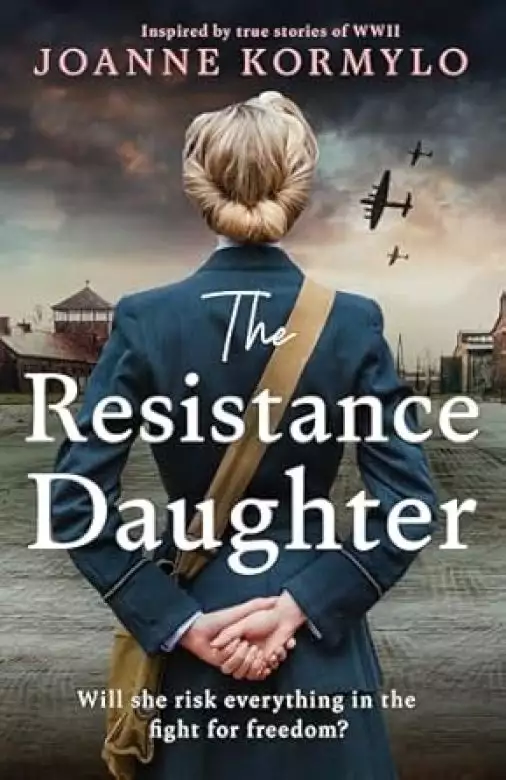
Poland, 1942. After witnessing the destruction of her hometown in Warsaw, Anna Kowalski joins the Polish Resistance. She is tasked with smuggling as many children as possible out of the Warsaw Ghetto through the sewers and relocating them to safety.
Through her work, Anna meets Johnnie Nowak, an RAF pilot who had managed to escape from a prisoner of war camp. He's not safe in Warsaw, so Anna leads him out of the city to protect him...
But suddenly Anna is caught by the SS and sent to Ravensbrück concentration camp where she is surrounded by even more horror and despair. A female guard, known as The Beast, is renowned for her violence and aggression towards her prisoners, and she's set her sights on Anna.
When Anna is relocated to a different camp, she finds herself reunited with Johnnie Nowak, the pilot she had saved. Desperate to escape, the two of them devise a plan, that if caught, could mean a fate far worse than death.
Will Anna and Johnnie finally find freedom, and survive the war together?
Inspired by true stories of WWII, don't miss this emotional and poignant historical novel of courage against all odds, perfect for fans of Anna Stuart and Soraya M Lane.
Release date:
April 17, 2025
Publisher:
Hodder & Stoughton
Print pages:
320
* BingeBooks earns revenue from qualifying purchases as an Amazon Associate as well as from other retail partners.
Five glowing lanterns formed a cross, illuminating the drop zone in the dew-soaked clearing. Hidden in a pine forest near Warsaw, Anna Kowalski waited with her back to the trees, gripping her light.
When the thundering roar of engines broke the eerie silence of the night, her brother, Michal, flashed Morse code signals to guide the pilot in. The plane, a Wellington bomber, was coming in too low. Anna bolted into the clearing, thrusting her lantern into the air, swinging it back and forth as high as her trembling arm could reach so the pilot could see the trees.
Air vibrated. Hot exhaust swept over her as the pilot pulled up at the last second. Overhead, propellers sliced through the pines, tossing heavy branches to the ground.
She stood transfixed, watching the plane climb hard to gain altitude and circle back over the drop zone. The bomb bay creaked open, sending clusters of containers tumbling out. Parachutes deployed and the cargo floated to the ground.
The plane returned one last time to tip its wings. It looked to Anna as if the pilot were saying goodbye. She raised her arm high and again swung her lantern in the air as the plane disappeared into the darkness, the sound of its engines fading.
Papa drove his battered Fiat truck out of the woods. He jumped out, door left open, engine running.
Wet grass brushed against Anna’s ankles as she ran to meet him. Papa looked more worn than his Fiat. Michal, so much like their father, with his square chin and fair hair—minus the wisps of gray—had fought with the Underground Resistance every day since the German occupation had begun.
They dragged tubular metal containers through the grass to the pickup.
“I can help,” Anna offered.
“It’s too heavy,” Papa said.
“I’m not a child. I’m seventeen.”
“You’ve done enough.”
With no time to argue, Anna climbed onto the tailgate, crawled into the open truck bed, and huddled against the rear of the cab. She reached for the wool blanket heaped in the corner and spread it over her lap. Kicking off her wet shoes, she tucked her feet underneath her to warm them.
Papa and Michal opened the containers and loaded burlap bags of tightly wrapped cargo into the back of the truck. Anna didn’t need to see beneath the burlap to know what they contained: Sten guns and explosives.
“Your mother would be very proud of how brave you were tonight,” Papa said as he threw bales of hay on top of the weapons.
Inside her trouser pocket, she touched the beads on the rosary she carried everywhere. Her most treasured possession had once belonged to her mother.
Life as she’d known it had shattered during the Siege of Warsaw. September 25, 1939, to be exact. Black Monday. The day the Germans razed her neighborhood in the bombings.
Tonight, she had fought back. Instead of waiting at home alone, she’d been hustled out to the forest at the last minute to fill in for the Weiss family members who had disappeared. Maybe it wasn’t much, standing in a field and swinging a lantern, but she’d helped the pilot avoid the trees and find the drop zone. And it felt good. Exhilarating even.
Papa stepped up into the truck, followed by Michal. Doors slammed and tires spun as they pulled out of the meadow and onto the dirt road. They sped along the Vistula River valley in east-central Poland, past the willow and poplar trees that graced her sandy bank, evading checkpoints on their way back to Warsaw.
Leaning against the back of the cab, Anna studied the constellations overhead. She imagined the Wellington darting in and out between the stars and wondered what it was like inside the airplane.
CHAPTER TWO
0400 hours
september 2, 1942
Johnnie Nowak peered down from the cockpit of his Wellington bomber into darkness blanketing the Netherlands. Although no lights were visible, he knew there were buildings below. Enforced blackouts were intended to disorient the pilots flying overhead. Without visual bearings, he had to rely on his navigator, Tubby Edwards. Crammed into his tiny workstation in the belly of the plane, he was plotting their flight path using charts, a compass, and the stars. Any minute now, they would cross the Dutch coast and soar out over the Zuider Zee to the North Sea. Nine hours into their mission, and Nowak almost had his crew of three Brits and a Yank back to base safe and sound.
Almost.
Not many crews could have achieved what they had four hours earlier, deep inside enemy lines. Nowak’s first assignment with the Special Operations Executive—the British agency formed to aid the Underground Resistance. They’d taken off in the twin-engine bomber on a moonlit night from a secret airfield camouflaged to look like an old farm at RAF Tempsford, England. Round trip, 2,000 miles. The exact coordinates of the drop zone so secret that only Nowak and his navigator had been briefed in case they were shot down and captured.
It felt damn good delivering crates full of arms and ammunition for the Home Army, the military arm of the Polish Underground Resistance. They called themselves the Armia Krajowa or AK for short. Men, women, and children desperate to defend themselves against the Nazi bastards destroying the country he was born in twenty years ago. After his father’s death, he had left Poland as a child with his mother and sister to start a new life in Canada. But his grandparents had stayed behind in Warsaw.
He felt a sense of kinship with the people who had risked their lives to guide him into the drop zone. A swinging lantern had warned him of the pine trees. He’d pulled up just in time, skimming the treetops.
His four crew members, at first jubilant after the successful drop, had been quiet in the hours since. Nowak knew that they, like him, were counting the minutes until they passed through the Kammhuber Line—a coastal chain of enemy stations with radar units, searchlights, and anti-aircraft fire from 88mm flak guns—and saw the Thames Estuary on the English coast, welcoming them back. He rotated his broad shoulders and stretched his neck to release the tension while he waited for his navigator to let him know when they reached the coast.
“Pilot to crew.” Nowak spoke into the bomber’s intercom, the only way to communicate over the thundering roar of the engines. “Who’s buying when we land?”
“Bomb aimer here,” said Freddie Yates, whose job now was aiming supply containers out of the bomb bay. “You are, Skipper. Forgotten last night’s poker game already?”
“I was hoping you’d forget,” Nowak replied. “We’ve got a lot of celebrating to do. It’s your last night as a free man.” Once back at base, Nowak planned to eat breakfast—a post-operation tradition of bacon and eggs—catch a couple of hours’ sleep, and then head down to the local pub. He’d been planning Freddie’s surprise bachelor party for a month.
“Navigator to Pilot,” Tubby said, cutting in. “Passing over enemy coast.”
“Roger Wilco.” Nowak checked his instrument panel. He still had enough fuel to make it across the sea thanks to the installation of additional tankage. Then he patted his vest pocket that held the lucky rabbit’s foot his sister had slipped into his kitbag the day he crossed the pond for active duty overseas.
Brilliant beams of light shot straight up from the ground in front of him, sweeping across the night sky, blinding him as an intense cone of searchlights swallowed the bomber.
“Damn it!” Nowak took evasive action in a corkscrew to starboard by slamming the yoke on the control column forward and pushing the nose of the bomber into a steep dive as arcs of white tracers and exploding munitions surrounded them.
Red, yellow, and orange anti-aircraft fire spewed from the guns below, forming a curtain of flak that burst into thousands of metal fragments. He pulled back on the yoke with all his strength and began a steep climb to port.
He thought about the words Freddie had painted in red over the door of their Wellington—Nil Bano Panico. Above All Don’t Panic. The only thing that mattered now was getting his crew back to base. He had to get higher, try to get out of the range of the deadly guns. The torque of the ascent threw him back into his seat as he watched his altimeter, his fingers gripping the throttle. Twelve thousand feet. Twelve fifty. Thirteen thousand. Thirteen fifty.
Bam.
An exploding shell ripped through the airframe, and the bomber reared as pain shot through Nowak’s shoulder and chest. A rush of frigid air filled the cockpit. Fire burst from the port wing, igniting the plasticized lacquer on the fabric-covered exterior. Flames streamed rearward.
“Petrol cocks!” Nowak shouted into his microphone, ordering his crew to shut off the flow of fuel to the burning engine. “Port engine on fire.”
Nowak yanked the lever activating the fire extinguisher, pulled back on the throttle of the burning port engine, and gave the starboard engine full throttle. They swung with a severe starboard yaw. Applying full rudder, he fought with the yoke to stay level.
Freddie edged his way into the cockpit from his position in the nose. Another explosion rocked the bomber and he slumped to the floor.
“Freddie? Freddie?”
No response.
“Petrol cocks. Petrol cocks!” Nowak repeated. Adrenaline surged through his body. “Somebody divert the fuel. Bloody hurry.”
“Rear gunner here. I can do it, Skipper,” Edwin Branch said. Nicknamed Twig, only eighteen years old and just two weeks out of training, he had to rotate his turret and crawl in the dark along the narrow catwalk leading into the fuselage to shut off the petrol lines.
“Pilot to Navigator: How far are we from land?”
Silence.
Nowak called out a second time. “Tubby, you there?”
No answer.
“Wireless Operator, what’s happening back there? Check on Tubby. See if he’s plugged in.”
“Tubby’s hit,” Raymond Cooper said in his East Texas drawl. He’d moved his family across the border into Canada to join the RCAF a good two years before the US joined the war effort. The navigator’s table was immediately aft to his station. At twenty-three, he was the old man in the crew. “We’re on fire.”
Through his earpiece, Nowak heard Ray tapping out an SOS in Morse code on his wireless radio set. Dit Dit Dit Dah Dah Dah Dit Dit Dit.
“Strap Tubby in,” Nowak said.
At six-foot-five and lean but muscular, Ray would have no trouble moving Tubby’s hefty frame from the navigator’s table to the fold-down cot. After fastening the straps and securing him, Ray would activate the inflation bottle on Tubby’s lifejacket and top it up by blowing into the mouthpiece. Nowak trusted he could do it.
Smoke and the acrid smell of explosives filled the air. Intense heat rose through the floor. Out of the corner of his eye, he saw movement. Freddie clambered to his feet, blood oozing from his forehead.
“Tear out the wires. Break the circuit. Douse the flames,” Nowak shouted.
Freddie grabbed the fire extinguisher from behind the pilot seat and unscrewed the cross handle. Pumping it fast, he splashed retardant on his way out of the cockpit.
The flak stopped somewhere over the North Sea. Without his navigator, Nowak wasn’t sure where he was, but he knew it would take at least another hour to reach the closest point on the English coast. They’d never make it. His men couldn’t parachute into the cold water this far from shore. That would be suicide. They’d all die from exposure.
As pilot and captain of the aircraft, Nowak was responsible for the safety of his crew. They called him Skipper, a title he was proud of, and they trusted him. He wasn’t about to let them down. Not now. Not ever. He had only one way to save them: make an emergency landing on the water and hope like hell the rubber dinghy inflated on impact.
“Prepare to ditch, fellows. We’re going in,” Nowak said, as calmly as he could.
His crewmembers all knew the ditching drill. Remove the astro-hatch in preparation for escape. Secure the pilot’s shoulder harness. Jettison loose equipment. Destroy secret papers. Pack emergency supplies. Radio location back to base. Assume ditching position crouched in the belly, backs against the wing spar, hands clasped behind their heads.
The altimeter spun counterclockwise, leaving Nowak without an accurate reading of his altitude as he piloted the plane toward the choppy sea. He had to land on the crest of the swells, parallel to the troughs. He flipped the switch for the landing lights to judge his height. They didn’t work. If the nose smashed into the surging waves, the Wellington would disintegrate on impact.
He tore off his leather flying gloves to wipe his sweaty palms on his trousers, then dumped his fuel, lowered the flaps, and pulled back on the throttle. He wrestled with the yoke to keep the nose of the shuddering bomber up and the wings level, with only the reflection of the moon on the water to guide him. If a wing tip hit the water first, it would cartwheel like a leaf dancing in the wind.
“For Christ’s sake, boys, hold on,” Nowak hollered over the deafening roar. The bomber plunged downward. In his mind, he made the sign of the cross and thought about his mother and sister back in Canada, Freddie’s wedding set for Saturday, and Ray’s kids.
The tail hit the sea first. Then the belly. A second later, the nose smashed violently into the waves. Saltwater rushed into the cockpit and the plane lurched to a stop.
They had one minute, two max, before the damaged plane sank. Nowak pulled the pin to release his harness and jumped out of his seat, ripping off his goggles and leather helmet. Freddie and Twig rushed into the cockpit and clambered out of the escape hatch over the pilot seat. Ray was right behind them with Tubby slung over his shoulder. He boosted Tubby up through the hatch to Freddie and Twig, who pulled him out. Ray squeezed through next.
Nowak crawled out behind Ray, pulling the cord to inflate his lifejacket as soon as he emerged. He was relieved to see Freddie and Twig already crouched on the partially submerged wing, trying to keep their balance as the waves pounded them. Ray inched his way down with Tubby in his arms.
Scrambling along the top of the bomber, Nowak slipped on the wet surface and recovered by kicking his foot hard through the fabric. By using the basket weave construction of the geodetic airframe to grip his boots, he worked his way rearward, counting the seconds in his head. It had already been about half a minute.
He slid down onto the wing. The two hot engines crackled as sea water washed over them, forming a cloud of hissing steam.
The rubber dinghy had inflated on impact, but it floated upside down, attached by a rope to the starboard side. Somehow, they had to right the dinghy, board it, and cut the rope that tethered them to the plane and certain death.
Nowak took a deep breath and plunged down into the saltwater. Gasping from the cold, he swallowed mouthfuls. Freddie followed, crawling onto the capsized dinghy to pull the handling strap as Nowak pushed up on the underside. It slammed back down, forcing him under water. He bobbed up again, sputtering. Eyes burning, he could see the dinghy straining against the rope that tethered it to the plane as the smashed nose of the bomber slipped underwater. Within seconds, the plane would drag their only means of survival to the bottom of the sea.
The two of them tried again, this time succeeding in flipping it right side up. They held the bouncing dinghy steady while Ray and Twig hauled Tubby in off the wing.
“Where’s the bloody knife?” Freddie yelled. “It’s not in the sheath.”
“Who’s got a knife?” Nowak shouted.
Ray whipped a switchblade out of his pocket, flipped it open, leaned over the side and sliced the tether.
Relief and regret flooded over Nowak as he watched his Wellington sink nose first into the dark water. He clung to the side of the dinghy, fighting against the buffeting waves as he strained to lift himself in, but his strength was draining away. His hands slipped on the slick rubber just as Ray grasped hold of the grab handles on his life jacket and heaved him aboard.
His crew huddled together. Tubby lay sprawled between them with his head in Edwin’s lap.
“Tubby’s in bad shape.” Ray used his silk scarf to wipe blood from the navigator’s face. “His nose is damn near shot off.”
“Bloody hell,” Freddie said.
“Apply pressure. Try to stop the bleeding,” Nowak said. “Freddie, find the kit.”
Freddie rummaged through the contents of the metal first aid kit stowed in the dinghy. Pulling out a syringe and an ampoule of morphia, he pushed up Tubby’s sleeve, jabbed him with the needle, and pushed down the plunger. Nowak turned his attention to the rest of his crew.
“Ray, you hurt?”
“Nuthin’ serious.”
“Twig?”
“My arm’s shot up a bit.”
“Freddie?”
“Just this gash.” Freddie touched his forehead. “How about you, Skipper?”
“I’m okay,” Nowak said, then asked Ray, “Did you send our coordinates back to base?”
“Only a guess. Best I could do without Tubby.”
Nowak needed the flare gun and cartridges to shoot a distress signal and mark their position. “Where’s the Very pistol?”
Ray hesitated, then said, “Had it in my bag. Got washed away in a surge of water. Had to make a choice, Skipper. Save Tubby or save the Very.”
“Don’t worry. Air-Sea Rescue will pick us up,” Nowak reassured his men, not wanting to tell them how worried he was. He shivered as he pulled his wet flight jacket up under his chin. Blood from his wounds felt warm as it seeped down his chest.
The dinghy bobbed up and down in the howling wind as raging waves splashed water inside. Freddie bailed it out as fast as it came in. Twig hung over the side, seasick, while Ray held him by the scruff of the neck so he wouldn’t fall overboard. Nowak kept his eyes glued to the western horizon, his fingers clamped around his lucky rabbit’s foot, hoping for rescue. Tubby remained unconscious.
At daybreak, a vessel appeared, and while Twig blew his whistle and waved his arm, the rest of the crew cheered.
Until the black swastika on a red-and-white Nazi flag loomed into focus.
CHAPTER THREE
Kowalski Residence
Old Town Warsaw, Poland
A stone gargoyle rested on the roof of the blue house on Piwna Street. Anna always glanced up at it on her way out and said a silent prayer for the gargoyle to ward off evil spirits, but today, in her excitement, she had forgotten.
Her favorite poet, Krzysztof Kamil Baczyński, a student of Polish literature at the Underground University, was coming to do a reading at her school, so she’d woken early to finish sewing the silk blouse she’d made from a parachute in the air drop. Then she’d polished her only pair of shoes and rushed out of the house to go pick up Ewa Jeska.
It was only a few blocks along the cobblestone streets, just past the Gothic St. John’s Cathedral and the Jesuit Church to the house on Market Square where the Jeska family lived. At five years older than twelve-year-old Ewa, Anna had offered to walk the girl to school after several children in the neighborhood with blond hair and blue eyes had gone missing.
Most days, she took the long way to Ewa’s house to avoid seeing a block of houses destroyed during weeks of relentless bombings, but today she took the shortcut, past the wooden crosses scattered amidst the rubble, fighting the memories they evoked of Black Monday. Wandering for hours among the scorched ruins, panic-stricken and lost until she recognized a bedpost from her parents’ bedroom, sticking out of the rubble. Digging through the debris with her bare hands, calling out her mother’s name, and scraping her fingers until they were bloody by lugging bricks, pipes, beams, and shards of glass to find her mother’s body.
She wiped her eyes before entering the front door of the burnished yellow burgher house on Market Square. As usual, she found Ewa sitting behind the wooden desk in her father’s upstairs office, with a stethoscope hung around her neck.
“Here’s your prescription, slow poke.” Ewa scribbled something on a prescription pad and handed it over with a flourish.
Anna laughed when she read it: Two sugar lumps and a piece of chocolate.
Ewa stepped out from behind the desk, wearing a floral dress with forget-me-not flowers, and fancy new shoes. Both girls wore their wheat-blonde hair in a single braid, but Ewa always threaded hers with a purple ribbon. They looked so much alike that people often mistook them for sisters.
Since the Nazis had banned education above Grade 4, Anna and Ewa had attended secret classes set up by the Underground at a private residence in New Town about two kilometers away. They walked side by side through the pointed archway of the red brick fortification wall that surrounded the Old Town, then down a quiet back street the Nazis usually didn’t patrol. Linden trees flanked the street, branches so low they formed a tunnel, the heart-shaped leaves almost brushing against Anna’s face as they walked underneath. They turned left at the end of the street where a massive oak tree stood.
Ewa talked nonstop as they walked. “Purple is my favorite color,” she said. “What’s your favorite?”
“Blue. Like the sky,” Anna said, looking up.
Ewa stopped beside a cluster of white baby’s breath wildflowers. She lowered her voice to a whisper. “I heard my sister talking to our parents. Zophia said Samuel and his family disappeared. She’s afraid someone told the Germans they’re Jews.”
Anna rubbed the goosebumps on her arms, thinking back to the night at the airdrop. She was worried about her childhood friend Samuel Weiss. Soft spoken and shy, he used to meet her almost every day after school to practice for dance competitions at his mother’s studio before the Germans shut it down. Their mothers had been close friends since meeting at a ballet class when they were children.
“It could be true. The Gestapo are handing out rewards for information on Jews in hiding,” she said.
“Why do the Germans hate the Jews so much?” Ewa asked.
“Hitler thinks everyone should have blond hair and blue eyes.”
“That doesn’t make any sense. Hitler doesn’t even have blond hair.” Ewa tugged her braid and fiddled with her blue ribbon. “But we do and he hates us too.”
“Hitler hates all Poles. He calls Christian Poles like us, Untermenschen.” Subhumans.
“They’re the Untermenschen.”
Anna checked her watch. “We better be quick. We don’t want to be late.” She took Ewa’s hand as they crossed a busy street, checking both ways for German soldiers. “Hurry,” she said to Ewa, quickening her pace.
They turned onto a gravel road that led downhill. A woman wearing a heavy-looking black coat stood at the bottom, and though she looked harmless enough, something felt off. As they approached, Anna noticed a gray dress with a white apron poking out the front of the woman’s unbuttoned coat. It looked like the uniform of the Brown Sisters—the Nazi nurses. She tightened her grip on Ewa’s hand.
“Keep walking,” she whispered, “and keep your head down.” For a moment Anna thought they would pass by safely, but then the woman stepped in front of them.
“Guten Morgen,” she said.
“Guten Morgen,” Anna replied in her best German, while glancing up and down the road.
“Where are you going?” the nurse asked.
“Out for a walk. Such a nice day,” Anna said.
The nurse directed her next question at Ewa. “How old are you?”
Ewa didn’t answer.
“Don’t be afraid, my dear. I won’t hurt you,” the woman spoke in a gentle voice. Digging into her coat pocket, she brought out a wrapped candy bar. “Do you like chocolate?”
Ewa nodded.
“Would you like to have it?”
Anna took a step backwards and pulled Ewa with her. Ewa yanked herself free from Anna’s grip and stepped forward, holding out her hand.
Anna spun around when she heard a rustling sound in the trees, her heart hammering when. . .
We hope you are enjoying the book so far. To continue reading...

 Please log in to recommend or discuss...
