
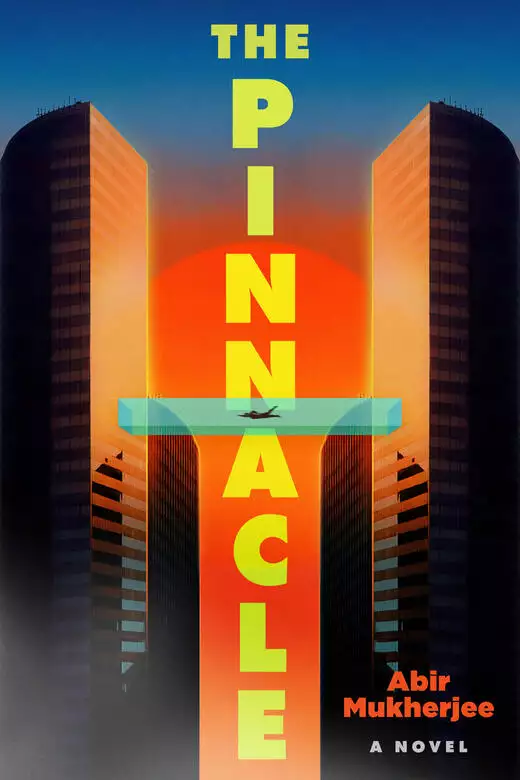
The Pinnacle
- eBook
- Paperback
- Audiobook
- Hardcover
- Book info
- Sample
- Media
- Author updates
- Lists
Synopsis
When an over-the-hill American actor finds his wife, a rising star in Bollywood, dead in their Mumbai high-rise, he quickly becomes the prime suspect in this atmospheric, razor-sharp social mystery; for fans of The White Lotus, Only Murders in the Building and Age of Vice.
Washed-up American heart throb George Abercrombie hates India, even from his apartment on the 68th floor of Mumbai’s grandest luxury skyscraper. He hates the noise, he hates the heat, and just maybe he’s grown to hate his wife, the newest queen of Bollywood, Sweety Sahota, decades his junior. So when George wakes from a drunken stupor (free whiskey, for which he’s the national spokesperson) to find his wife murdered in their bedroom, he knows quite well just how badly he’s cooked. But where is her computer, her cellphone, and where has his personal assistant gone?
The Pinnacle is a dazzling and addictive thriller that’s three plots in one, as George seeks to find the killer, as a conflicted young woman working as Sweety’s P.A. struggles to find out who’s blackmailing her, and as a servant who knows too much goes on the run. A dark sendup of world’s most privileged coexisting with the world’s most desperate, from the winner of the 2025 British Book Awards Thriller of the Year.
Release date: June 16, 2026
Publisher: Little, Brown and Company
Print pages: 320
* BingeBooks earns revenue from qualifying purchases as an Amazon Associate as well as from other retail partners.
Reader buzz
 Please log in to recommend or discuss...
Author updates
The Pinnacle
Abir Mukherjee
He was smiling. This was his smile.
The woman in the crook of his arm smelled of sweat and talcum. At his feet, two men, sprawled among sticks of broken furniture, knocked cold apparently, as, out the plastic window behind them, a red sun pretended to set over the Arabian Sea.
‘Wider plis, George.’
For the love of Hitchcock, any wider and he’d pull a muscle or rupture a tendon, or dislocate a tooth and all that fancy Santa Monica dental work would come crashing out of his mouth like coins from a Vegas slot. Still, he did his best, smiling like some captive in a hostage video.
‘And sip, plis.’
Dammit, he wasn’t some amateur. He was a pro, for Chrissakes, doing this job since before half the kids on set were even born. He knew when to sip and when to smile and he’d tell that to Shankar, the little prune-faced worm, just as soon as this was over.
The fumes from the glass hit him like a spanner to the face, or a backhanded slap from Sweety. It reeked of methanol or ethanol or whatever shit it was they put into the auto-rickshaws out here.
‘Sip plis, George.’
He steeled himself, raised the crystal glass to his lips and swallowed. The stuff burned. You had to respect that. It refused to go down without a fight, slashing his tongue and scratching his gullet, every drop kicking and screaming its way to his gut.
He smiled again, not even waiting for the cue from Shankar. A good smile too. A million dollars’ worth. He’d had barium swallows that had tasted better and yet he’d challenge anyone on set to say he hadn’t enjoyed that sip like it was ambrosia and not what it actually was: an abomination and an insult to the good name of whiskey.
‘Cut!’
He closed his eyes and thanked the gods. It was too damn hot in here even with the industrial fans blowing a hurricane. The goons on the floor stood up, brushed themselves off and began talking in whatever language it was they spoke. The woman extricated herself from his embrace and hurried off, though not quick enough to avoid a slap on the ass from Shankar. Shit. Should he maybe say something about that? Have a quiet word with the jerk? No. It wasn’t worth it. Not his country, not his problem. It was a different culture out here and like they say, when in Rome, it’s best not to piss off the Romans.
‘All good?’
The little director’s grin reached his ears.
‘Shabaash, Mr George! Excellent!’ He looked to the cinematographer – a thin man with a cigarette constantly burning between his fingers. The cinematographer twitched. Shankar turned back to George. ‘We do one more time again, plis.’
He stared hard at the director, what little of him there was to stare at. Five foot three if he had to guess, and even that was Cuban-heel-assisted.
Jesus, how had it come to this? Doing commercials which possessed all the subtlety and artistic merit of prime-time wrestling in the eighties. They didn’t need George Abercrombie, they needed The Rock, or maybe Matt Damon. Think of the money, George. Think of the money.
‘Gimme ten, Shankar.’
He walked off the set, past the gawkers and flunkeys and the girls taking surreptitious snaps on their phones while pretending to look the other way, and headed for his, well, not dressing room exactly, it was more of a broom closet with air conditioning, but right now, in this damn, clawing, soul-sapping heat, it might as well have been a suite at the Ritz.
And where the hell was Amit? He should have been here, waiting for him off set with something cool. A bourbon or something. Dammit, even a bottle of water to wash away the taste of Glen Doone Authentic Indian whiskey. Probably off whistling at some girls in the chorus line on another set. This sort of thing never used to happen with Gemma, but then Gemma was a PA – a proper one – while Amit was just a jumped-up flunkey promoted to fill a vacancy. But Gemma didn’t work for him any more, did she? No, she’d made her choice. She worked for Sweety now.
The bile burned in his chest at the thought, or maybe that was the damn whiskey. Either way, he forced it down and pushed on to what passed for his dressing room.
Closing the door behind him, he crashed onto the worn sofa. It smelled of mildew and other things best not considered. He reached for his phone and brought up Sal’s number. 1 a.m. in LA, give or take. Sal would probably be asleep. Not like the old days when 1 a.m. would see him holding court at Hyde Sunset. Funny what a perforated ulcer did to a man’s reckoning of his own mortality. Certainly put the fear of God into Sal. That and Gabby threatening to walk out the door with the kids and, more importantly, the money if he didn’t cut out the nose candy. Changed man, old Sal Copeland the Third. ‘Older, wiser,’ that’s what Sal said. Older certainly. Fifty was headaches and sore bones and prostate checks. Fifty concentrated the mind. Sal was all clean living now, all Virgin Marys and yoga at sunrise. The thought of it induced mild nausea. He should let the man sleep.
Fuck it.
‘Twenty-four/seven.’ That’s what Sal had said. ‘You sign with me, Mr Abercrombie, and that’s the deal. Day or night. You call and I’ll answer.’
And he did answer. Two missed calls and ten rings later.
‘Hello?’
He sounded like he did that time George had gone to see him in the hospital. Groggy and spaced out as shit.
‘Sal.’
‘George? You know what time it is?’
‘I know what time it is in Mumbai, Sal. I know that too goddamn well.’
He thought he heard a sigh though it might just have been the air-con unit trying not to die.
‘What can I do for you, George?’
‘I’m going crazy, Sal. These fuckin’ whiskey commercials. You sure they’re gonna pay?’
‘George.’ Sal sounded like he did when he was pretending you’d hurt his feelings. ‘Trust me. They’ll pay. You know what’s the fastest-growing market for alcohol in the world right now?’
Yes, he knew; and he knew because Sal had told him a million times already.
‘It’s India, George. They got more drunks than Ireland. And Brigadoon is a very popular brand. The second-most popular domestically produced whisky in the country and they wanna be number one. They got the cash to do it and you’re their boy.’
‘Glen Doone.’
‘What?’
‘The fucking whisky, Sal. It’s called Glen Doone, not Brigadoon.’
‘Whatever, George. Do the commercials, bank the cheque, and think of the bigger picture.’
He closed his eyes and thought of the bigger picture – the biggest picture – his picture: Fragments of a Forgotten Soul. His magnum opus. A decade in the making and who knew how many still to go. Ten years of blood, sweat, tears and cash – a lot of it his own – but it would be worth it, oh yes, as God was his witness, it would be worth it. The financing was finally coming together. God bless Dinesh Dhand, recently divorced tech billionaire, and his $20 mil. He got George’s vision, loved it in fact, and would put in the cash just as soon as George introduced him to J-Lo. Things were looking good. They could finish it all by next fall, and then who knew, maybe the Palme d’Or, an Oscar or two, and that Canadian award, whatever it was called, the one they gave out in Toronto. Yeah, he’d show those Hollywood fuckers – the fucking studios and the fucking streamers, the Netflixes and Amazons that were eating their fucking lunch.
He pictured the headlines.
GEORGE ABERCROMBIE. BACK AT HIS BEST.
Yeah, he’d show ’em. He’d show ’em all.
‘Is there anything else, George?’
Sal’s voice cut through his visions of vindication like a fucking impertinent knife through butter.
‘Just make sure they pay, Sal.’
‘Goodbye, George. And send my love to Sweety. Tell her I’ve got a very interesting role for her.’
‘Tell her yourself,’ he said, though by that point he had a feeling Sal had already hung up.
He’d hardly put the phone back in his pocket when the door rattled and a female voice called out in clipped Indian-English, ‘Mr Abercrombie, sir. You’re required on set.’
Seeing as no one in the country generally had even a passing familiarity with the concept of punctuality, it felt frankly galling that Shankar should see fit to send a runner to come fetch him from his dressing room after what could barely have been five minutes, let alone ten.
Get your shit together, Abercrombie.
He counted to five, opened the door and nodded to the young woman who stood there. She looked like she was keeping her distance from him without wanting to make it obvious that’s what she was doing, and stared at him as though he were wasting her time.
There was a time not that long ago when they’d start queuing at dawn outside a studio just to catch a glimpse of him turning up at noon. What the hell happened to those days and how did he get from there to here?
She turned on her heels and headed back down the hallway, and he followed her like a fucking errant child.
Shankar was talking to a bunch of folks who, by their designer jeans, flip-flops and bedhead hair, were, he decided, junior advertising execs. The guys whose creative vision, in inverted commas, this whole travesty of a campaign was.
He gave them a wide berth, even when Shankar called out to him.
‘George! George. Come come! Here plis! I’m wanting you to meet some very fine guys from Oliver & McKenzie.’
He gave them a smile and a wave.
Screw you, Shankar.
The actress too, the one who was his wife for the day, looked like she was trying to circumnavigate a circuitous route back to the set, one that didn’t pass within range of Shankar’s hands. Seriously, for such a short man, the guy had surprisingly long arms. He spotted her and called her over to meet his advertising buddies – a prospect her face suggested was, in her wish list for the day, slightly below catching syphilis. She tried giving them a smile but frankly, she wasn’t a good enough actor to make it convincing. Shit. He should help her out.
‘Come on, Shankar,’ he said. ‘Final take. Let’s finish the job.’
The director nodded in that ambiguous Indian way, a figure of eight that ran the gamut of meanings between sure and go fuck yourself.
‘Absolutely, Mr George. Final take.’
They took it from the top: the weird Bollywood soundtrack; George coming home to his make-believe apartment; the two goondahs – that’s what they called thugs here – accosting his make-believe wife; the first of them running at him; George, picking up the chair, smashing it on the goondah’s head. There was something deeply satisfying about cracking a chair over a man’s head. He thought about it as the guy went down like a bag of wrenches. Seriously. Better than any therapy he’d had. The other guy, big as a barn, holding his stage-wife – God, she really did look a lot like Sweety – in one arm and a knife in the other, lunging forward, the knife coming within an inch of George’s chest. He dodged left this time, just to mix it up a bit, grabbed the guy’s arm and slammed it into the wall, then smashed him in the solar plexus, or at least where he thought the solar plexus should be – he hadn’t played a doctor since the nineties and these things were foggy. Still, the guy was gracious enough to go down, and the woman – the pretend Sweety – all relief and gratitude wrapped in a diaphanous sari, ran over to him, buried her face in his chest, then passed him the whiskey.
He smiled. He sipped. He tried not to retch. He looked to Shankar, his eyes conveying the subtle yet hopefully unfuckingmistakable message that he wasn’t prepared to do any more takes; that this one was truly and definitively the last, whether Shankar or the little advertising princelings liked it or not.
‘Aaaand cut! Waah! Parrfect, Mr George. Parrfect!’
Shankar was purring like a V8, or maybe a compact. George couldn’t see how this take had been any more parrfect than the previous one. Maybe Shankar saw something in the acting that he didn’t. Maybe the lighting or the framing was better. Or maybe Shankar was as tired of the whole thing as he was. Whatever the case, the job was done, the director was happy, the cinematographer had stopped twitching, the goondahs were rising like twin Lazaruses, and the girl was already walking away from him, fixing her sari and pulling off an earring that looked like a lead weight.
He headed off set and there, finally, was Amit, off to one side, leaning against a couple of crates, sipping a soda and ogling the actress as she headed off.
‘Where the hell have you been?’
Amit grinned at him like a moron.
‘Here only, sir.’
Jeez, the guy didn’t even have the good sense to look sheepish. George thought about tearing him a new one right there and then. Hell, part of him really wanted to, but you couldn’t do that shit these days, not when everyone had a damn video camera in their phone. One perfectly legitimate outburst and your career could go down the toilet, never to be heard from again, like Billy Sapphire or poor Emily whatever her name was. He’d liked her. She’d had talent, even though it was married to one hell of a temper.
‘Car, sir?’
‘What?’
Amit pointed behind him. ‘I call driver? Tell him you ready to go?’
‘Fine,’ George told him, ‘and get me a drink.’
Amit looked at him as though he’d just asked for a wrap of coke.
‘There is no alcohol here, sir.’
Of course there wasn’t. God forbid there should be alcohol on the set of a fucking whiskey commercial.
‘Water, then. Or whatever soda you’re drinking.’
The guy’s face brightened. ‘This is Limca, sir.’
‘Fine. Get me one of those.’
‘And car also, sir?’
‘And car also.’
Amit sipped his drink, then gave him the limpest of nods and wandered off in search of soda and car. George wiped sweat from the back of his neck, tried to just think about the money and failed. He’d speak to Sal. Make sure the cash was banked, then never do another commercial for Glen Doone whiskey ever again. And he’d get a new PA – a proper one – as soon as fucking possible.
Humans adapted. It was what they did. Didn’t matter if it was fire, flood, a hurricane hitting your house or your career tanking on account of a string of movies which generated sub-par returns at the box office because the Great American Public could no longer concentrate for a span of time longer than a TikTok reel; the point was that the average human was surprisingly adept at rolling with the punches. It was why, he reckoned, Homo sapiens were still around killing the planet while the Neanderthals and those Hobbit people from Indonesia – he’d forgotten their name – had gone the way of the dinosaur.
And he could adapt. Had adapted his whole life. He was a fighter, a survivor. Three decades in Hollywood might have made him a little soft around the edges, but the instincts were still there, ingrained, hardwired into him like sarcasm in a teenager. As the saying went, you could take the boy out of Arkansas, but you couldn’t stop him from punching you in the throat if you looked at him funny.
Through the privacy glass of the air-conditioned SUV, he stared out at the chaos of the city. Twenty million people out there. Half of ’em living on nothing but dreams and gasoline fumes. Poor bastards. They adapted, day in, day out. Who the hell was he to complain?
But then he shouldn’t be too tough on himself either. He’d moved here, hadn’t he? Hard to believe it’d been nearly a year. Sweety’s idea of course. Sweety’s and Sal Copeland’s. He could still hear Sal’s words, delivered in that honeyed tone he’d use when he wanted you to think whatever he was suggesting was your own idea.
‘Certainly makes sense, George. Sweety’s got three projects on the go out there. She’s practically India’s sweetheart. And you… as you say, you’re between projects.’
He hadn’t said that, of course. Sweety had said it. He’d pointed out he was working on Fragments of a Forgotten Soul, but neither Sweety nor Sal had given that the weight it deserved.
‘Future’s in the East, George. India, China. That’s where you need to be. And they still love you out there.’
Still.
Fuck you, Sal.
‘And let’s face it, you’re not exactly flavour of the month in the States right now, politically speaking. Shit, the president’s hardly going to be inviting you over to the White House for hamburgers.’
Yes, true, but that was because the president was an asshole, a vainglorious jackass intent on turning the country into an extension of his business empire – a bandana republic. George’s mistake, if you could call it that, had been to say so in public, during an election campaign which the guy had then gone on to win because the electoral college system was a fucking anachronism and because red-blooded, God-fearing Americans really had no choice but to elect a convicted felon as president because it was either that or a woman.
And the president, for a man who went to church about as often as a shark visited a grocery, was nevertheless surprisingly keen on smiting his enemies Old Testament style and with every weapon at his disposal, including the damn IRS who’d suddenly come knocking on George’s accountant’s door one fine Malibu morning.
‘Think of it as a new chapter,’ Sal had said. ‘And you could do a lot more of that charity work you keep talking about. Lots of opportunity to help people out in India. The press love all that humanitarian shit. The UN too. They’ll be falling over themselves to make you an ambassador like they did with Evangelista.’
That was true. That woman was an angel. She must’ve saved, what, at least a dozen Third World kids? Rescued them from Africa and Asia and taken them to LA, and all they had to do in return was call her mommy.
Yeah, and so he’d agreed. For the sake of his marriage and for humanity, because, well, you needed to give a little back to the world, didn’t you? Especially while that oaf was in the White House and the IRS was crawling all over your finances like a heat rash. And this place had turned out to be a surprise. Sure it was a damn nightmare sometimes, what with the smell and the heat and the dirt and the constant, incessant, never-ending noise, but shit, it was still better than Arkansas. Now though it was time to look forward. Things were on the up. Fragments would get made, he’d be back, and then they could move to Europe and live la dolce fucking vita.
Up front, Amit and the driver, Venky – short for Venkatara-something-or-other – were silent. Unusual for Amit but par for the course for Venky. Twelve months, and in all that time he reckoned he’d heard the guy say the sum total of about forty words – one of which might or might not have been his full name. What was that – an average of four words a month? Not a bad thing in George’s view. Hell, there was a lot to be said for an employee who kept his opinions to himself.
Outside, the traffic – that snarl of trucks, cars, auto-rickshaws, scooters, carts, motorbikes and pushbikes, which, as far as he could tell, obeyed no law other than that of the jungle – crept along the narrow lane at the speed of a herd of lethargic cows. It was a typical canyon of a Mumbai street, lined with post-apocalyptic-looking apartment blocks five or six storeys high with monsoon-scarred paintwork and balconies draped in rainbows of drying laundry; ground floors converted into concessions plying everything from cell phones to deep-fried dysentery to a sidewalk of pedestrians, street kids, hawkers and the odd stray dog, all of them in a damn hurry, dogs included. But then, this was a whole city of folks always rushing about their business as though their lives depended on it; which rather begged the question why the hell no one was ever on time.
Thank God it wasn’t all like this. Thank God for Malabar Hill and Breach Candy and the odd quiet corner of Juhu, where, if you got up early enough, or squinted for a moment when the light was right, you might just about convince yourself you were in Bel Air, or maybe even Malibu if you were drunk enough. Places where the noise of the city was turned down a notch or two, and where the hoi polloi were held at bay by high walls and high prices. Places like Altamount Road, where Sweety had found them the penthouse apartment which he’d had no choice but to agree to because she ‘really needed the panoramic views’.
That was harsh. He hadn’t exactly seen anything better. He doubted there actually was anything better, not east of Florence, anyway. Still, they could have rented, but Sweety’d put paid to that. ‘Buy property and never sell it,’ she said. ‘That’s the Indian way.’ Fair enough. Who was he to argue? He was just the sap paying for the thing.
It wasn’t too far away, not as the crow flew at any rate. Not even ten miles, but distance meant nothing here and not even the crows flew straight.
He checked his watch. Still plenty of time to get home, shower and change before the folks from the BBC arrived. But time here had a habit of just evaporating in the heat and he needed to prepare. First time he’d be talking about Fragments. No room for mistakes. Okay, so they didn’t wanna focus on that, but he’d make damn sure they did. And the BBC was the right call. Alice Crabbe-Harrington, the Iron Lady of light entertainment journalism, one of their big hitters. The sort of interviewer who could do insightful. Say what you liked about the Brits, but when it came to intellectual endeavour, they just got it better. The journalists with their double-barrelled surnames and accents straight out of Downton fucking Abbey, they brought a sense of gravitas to an interview that NBC or CBS or, God forbid, Fox, just didn’t. And one day, when the film was finished, that might count for something with the judges at Cannes and Venice. It certainly would at Sundance – they loved all that British crap. He got out his phone, a quick text to Sweety, just in case she’d forgotten, then checked his watch again.
Amit swivelled in his seat and smiled like a snake-oil pedlar.
‘Don’t worry, Mr George. Five minutes. We reach Sea-Link, then all will be fine. No tension.’
Venky shot him a look which suggested that Amit’s estimate was bullshit, and experience had taught him that he should double it and an extra ten per cent on top just to be safe.
‘What d’you think, Venky?’
The driver said nothing, just gave him a nod, then reached out and touched the little shrine of gods that sat upon the dashboard – for good luck, he guessed. There were half a dozen of them up there, little multi-armed and multi-coloured figurines that looked like little religious superheroes. Sweety had many of the same ones in her own shrine in the spare room in the apartment. Back in the US, when they’d started dating, and when his interest in these things was somewhat greater than it was these days, she’d told him the names and job descriptions of each of them; and while he’d now forgotten most of the details, he could still identify the elephant-headed Ganesh, god of good fortune; and beside him, above the digital dashboard clock with its numbers blinking blue, the goddess Kali, her skin obsidian, a garland of skulls around her throat and her tongue blood red and sticking out of her mouth like a Maori doing the Haka. At her feet, the body of a man – a victim, he’d assumed – till Sweety’d explained that she was actually standing on the body of her husband, the Lord Shiva. Now, in the back of the car, he stared at the prostrate spouse and felt something akin to empathy.
Maybe Venky’s prayers were working. George wasn’t a religious man – not these days, not by a long shot – but he had to admit, the car didn’t have a scratch on it, which in this city certainly seemed as big a deal as walking on water. Maybe the gods were preserving Venky for better things, and that was fine by George, though he’d be damned if he knew what those things might be.
And then out of nowhere, the traffic ahead eased, parting like the Red Sea – or was it the Dead Sea? – and there ahead of them stood the bridge, bathed in the glow of the setting sun, a vision in white concrete. It was impressive, not just by Indian standards, but by world standards, hell even by American standards.
A four-mile-long ribbon of concrete, suspended by cables and dancing over the waters of the bay all the way from Juhu to Worli.
Mumbai and Manhattan. Worlds apart but similar, both having their business districts right down at the ass end of their respective islands. Some loud guy at a party once told him they’d built the bridge just so that it wouldn’t take a whole fucking day for the fat-cat captains of industry to get to their offices from the airport up town, which just happened to be surrounded by Asia’s largest slum.
‘That’s the beauty of India,’ Sweety had added with a mixture of pride and defensiveness. ‘In China they’d have evicted everyone, sent them off to some concrete gulag and built a road right through the place where their homes were. But this is India and even slum dwellers have a vote. You can’t just kick them out of the way. So they had to build the road over the sea, despite the extra time and cost.’
It was a nice story but he couldn’t help wondering if the poor bastards who lived in the slum might not have traded their single vote in the world’s largest democracy for the chance of having an actual house or apartment. He’d kept those thoughts to himself of course, for when it came to outsiders criticising their country, Indians were just as chronically thin-skinned as Americans.
The SUV accelerated onto the bridge and then they were high over the grey-blue waters of the bay. He liked the view from here, the needlepoints of downtown looming out of the haze like a Ridley Scott fever-dream, a vista of skyscrapers and tower blocks that stretched on to forever. From the bridge it even looked kind of beautiful, like some massive canvas of the gods. It was only when you got closer and saw the detail – the dirt, the holes, the street-level frenzy – that you remembered you weren’t in some divinely instituted Singapore but rather still firmly stuck in India, with its messy, teeming, chaotic millions who refused to follow any direction set out from on high, whether it be from the gods or even Ridley Scott.
The bridge ended, the SUV shuddered, dumping them back onto dry land. The roads were better here: the shops more expensive; the pavements less cracked. He knew these streets. Walked some of them. In his naivety, he’d even tried to jog them during those first few weeks when he was still unfamiliar with the toxic air and the suicidal traffic and the general fucking stupidity of trying to do anything on foot in the city during daylight hours.
Another twenty minutes and they turned into Altamount Road. The home stretch, past old-world mansions converted into embassies and consulates or sold to developers, razed to the ground and replaced by tower blocks with names that sounded sophisticated – like The Devonshire, The Colonial or The Privé – but which actually meant fuck all.
Venky kept going, right to the top of the road, toward the two marble towers that stood at its end, reaching up seventy storeys and with a Perspex swimming pool slung between them on the fiftieth floor like some aquarium on steroids, the water within bluer than anything in the seas around the city. He stopped at the huge gates, under the fish-eyed gaze of security cameras and beside the sign that spelled out the words ‘The Pinnacle’ in tall golden letters that could kill a man if dropped on him. It was an odd name – factually inaccurate – given there were actually two towers – the East and the West – though no one but him seemed to care or even notice.
High up in the pool and magnified by the water, he made out a pair of fat legs lethargically pursuing a breaststroke like a frog in search of a log. He liked to try and work out which of his neighbours it was up there, just from their legs and torso bobbing up and down. This one, judging by the thinness of calf, the ample circumference of belly and the occasional bobbing of a head with cheeks puffed and eyes closed, was a guy he’d seen in the gym on the thirtieth floor a couple of times and with whom he was on nodding, if not exactly speaking, terms. A businessman, that was it. Something big in poultry. An apartment on one the lower floors – south of thirty definitely.
Venky lowered his window as a surly security guard in a blue shirt walked over. The guy’s name was Ram, George knew that much; took a strange sort of validation from having remembered it. Okay, the guy worked this shift pretty much every other day and his name was printed on the badge on his shirt, but George had sometimes seen him around the upper floors of the West Tower, doing the nightly corridor patrols, and so he was fairly sure he’d have remembered it without the visual assistance. A real stickler for the rules, old Ram. Not a man keen on small talk, or even smiling for that matter, which was unusual. Most of the guards were only too happy to shoot the breeze with him while they carried out their security checks. He liked that. Made him feel like h. . .
We hope you are enjoying the book so far. To continue reading...
