- Book info
- Sample
- Media
- Author updates
- Lists
Synopsis
SOMETIMES YOU LOOK IN THE MIRROR - SOMETIMES IT LOOKS BACK.
Those who belong to the secret society called The Oversight know many things. They know cold iron will hold back the beasts in the darkness. They know it is dangerous to stand between two mirrors. And they know that, despite their dwindling numbers, it remains their duty to protect humanity from the predations of the supernatural. And vice versa.
But two of the society's strongest members, Mr Sharp and Sara Falk, are trapped in the world between the mirrors, looking for each other, searching for a way back home. What they discover there will have ominous consequences both for The Oversight and the world it protects, effects that will make them question everything they thought they knew.
The dark waters rise. The candle is guttering. But the light still remains. For now . . .
Release date: August 18, 2015
Publisher: Orbit
Print pages: 432
* BingeBooks earns revenue from qualifying purchases as an Amazon Associate as well as from other retail partners.
Reader buzz
 Please log in to recommend or discuss...
Author updates
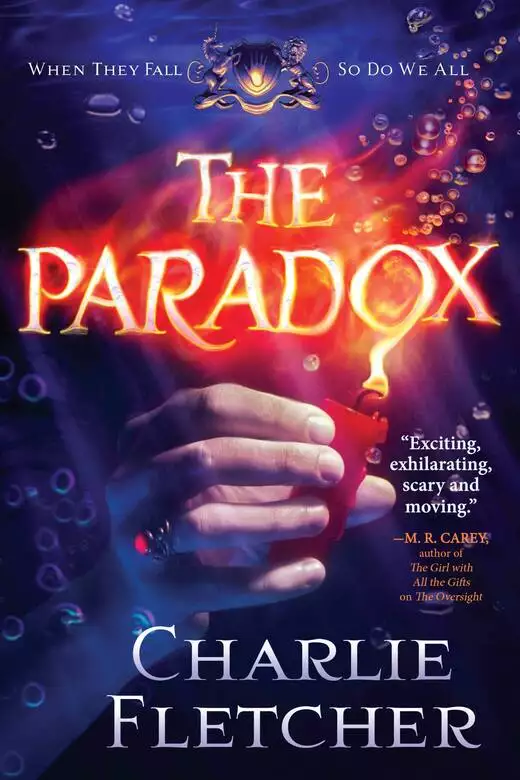
The Paradox
Charlie Fletcher
It was thus a hard first step to take away from them, but she took it boldly and decisively, and she did not go precisely alone, nor without means of self-preservation: she was armed to the teeth, carrying a bright candle in one hand and the Raven on her shoulder. She looked herself up and down in the reflection, taking a brief inventory: slender but stout top-boots visible beneath an oiled silk overskirt that emerged from a black riding jacket buttoned tight around her lean body, her hands bunched inside equally black gloves on top of which gleamed two gold rings. The difference she noticed about her appearance, apart from the unaccustomed weaponry, was that she had taken to wearing her rings on the left hand, her recent travails having involved losing the other one and the rings with it–leading her to nearly expire–until it had been miraculously returned and even more miraculously re-attached. Above all that was her face, taut with exhaustion but still, as ever, decades too young for the prematurely white hair pulled tight into a thick white plait which curled round her neck and hung over her right collarbone. The eyes that looked back at her from the mirror were the grey-green of a midwinter sea and, she was pleased to note, steady and determined, despite the tug of exhaustion and the drumming of her heart beneath the tight coat buttons.
“Right,” she said so quietly that only the Raven heard. “Let us go.”
And she took a firm pace forward into the mirror. She passed through the surface of the glass with less resistance than popping a soap bubble, and then she stopped dead.
She lifted the candle. It seemed to flare brighter as she did so. She stared ahead into the uniform corridor created by the endless reflections of the mirror stretching away to a vanishing point lost in the darkness beyond the throw of the candlelight. When she turned round she did not see the back of the mirror she had just walked through, but an identical tunnel of mirrors now stretching away in the opposite direction until it too became lost in the gloom beyond the light. When she looked down, she saw the mirrored ceiling reflected all the way up into eventual darkness, and when she looked to one side, the same endless multiplication of reflections stretched to right and left.
“So,” she said, “a maze it is.”
The Raven clacked its beak in her ear.
“I know,” she replied. “We shall have to mark the starting point if we are to have any hope of returning. I shall—”
The Raven hopped to the ground and shuddered briefly. Then it lofted back on to her shoulder. Where it had stood was an impressive splatter of bird’s mess.
“… I’m sure that will do nicely,” said Sara. “Or if not quite nicely, adequately.”
Amos Templebane (mute by birth and Templebane by adoption) had blood on his hands. Figurative blood, since the man he had killed was weeks in the past, and possibly even justifiable blood since the tinker in question had been about to cut Amos’s throat the instant before Amos had backhanded him with the man’s own frying pan, knocking him into the turbid canal in which he had drowned. Amos had walked and thought himself across many leagues of English countryside since that desperate night and in the course of that journey had both come to terms with the slaying, and made a vow that he would never, ever take another life. But arguably unimpeachable though his actions may have been, and admirable though his subsequent resolution was, the fact is that Amos had certainly killed a man.
The cold, detailed murderousness radiating from the mind of the grey-haired woman he had freed from the Eel House as she strode ahead of him across the water meadow was a different order of thing: it was as disconcerting as the discovery that she could read his thoughts just as well as he himself could hear what went on in other people’s heads. Until she had spoken to him in his mind as he passed the little brick building in the dark and persuaded him to unlock it and release her, he had until now thought his ability was unique.
Where are you going? he thought.
She answered him in a voice hoarse and reedy from long disuse.
“To the poorhouse. To the Warden’s bedroom.”
The poorhouse. The words reminded him of his own early years in a similar institution in London. The memories were far from happy ones.
What will you do?
“Take what is mine,” she said.
He had no memory of possessions in his own poorhouse. His memories were of being smaller than everyone else, and having nothing except fear and discomfort.
What is that?
“Revenge,” she said. “For a start, revenge.”
Why must you do violence?
She stopped and looked at him, her face implacable in the silvered moonlight.
“Because I must, Bloody Boy, because I must.”
Why do you call me that? I am not bloody, and I am a man.
“You cannot yet be more than eighteen years old, and you already reek of blood. It was the first thing I noticed about you: even before my eyes saw you, my nose found you.”
Her smile was fragile and terrible.
“Death walks with you, before and behind,” she said. “Life taken and life to be taken. It’s on you like a stench.”
I will not take life.
She snorted and turned away.
“Your will does not enter into it, Bloody Boy,” she said. “Not when fate has other plans.”
He wished he had not given her a knife.
As he followed her towards the squat barrack of the poorhouse, he could see her head was full of blood as she planned her actions: she would stop by a water butt and reach down into the inky depths to retrieve a piece of oval glass, a mirror that she had previously hidden there. And then she would enter the back door of the Warden’s dwelling and slip through the kitchen and ascend the backstairs, keeping to the left-hand side of the treads close to the wall so that they would not creak and give her approach away. She would ease open the bedroom door and cross the floor in two or three fast steps to stand beside the large double bed and its hopefully still snoring occupants, M’Gregor the Warden and his wife. And then—
Why kill him?
“Stop looking at my thoughts,” she said without slowing.
What has she done?
“She is worse than him,” she said. “You will help me.”
There was something in her manner, in her single-mindedness, that was not quite human. It was feral, focused and unthinking. It was as if she had been imagining this revenge for so long that it was now more instinct than plan.
Wait, he thought.
“I have been waiting for long enough,” she said. “I have been waiting for longer than you have been alive.”
She slipped through the hedge and into the small yard at the back of the poorhouse.
What is this place?
“I told you. A vale of tears. It is the Andover Workhouse. It is my prison.”
Just as he had seen her imagine it, she retrieved the looking-glass from the bottom of the water butt, leaning right down into it so that her arm was wet to the shoulder and her hair stuck to her face in wet snakes. She shook the water off and slid it into the pocket of her shift.
Why do you need a mirror?
He was beginning to realise she was mad.
“Wait and see,” she said, and turned to the back door.
She worried the lock with the thin blade of the knife in an intent, nimble-fingered way that told him she had done this before. There was a snicking noise and she eased the door open, revealing the shadowy passage within.
Wait.
She turned to look at him.
You don’t have to do this. You could just leave. By dawn you can be miles from here.
“You have no idea what I have to do,” she said. “You must help me.”
He took her arm.
She looked at the knife in her other hand. She looked pointedly back at his fingers gripping her arm.
“It would be foolish and dangerous to stop me,” she whispered, “and quite against your own interests.”
My interests don’t need the slaughter of innocents in their bed.
The thought jumped from him before he could cloak it. And before he could stop her she had the knife at his throat. She stared into his eyes. He felt assaulted by the intensity of her scrutiny as much as by the prick of the blade. She appeared to be devouring everything about him, scanning his face, smelling him, feral again, sensing his warmth, his strength, his vulnerabilities…
She pulled the knife back, her eyes still sharp. She pointed up the stairs with a jerk of her head.
“He rapes the boys in the foundling ward. Mostly the boys, the smaller the better. Sometimes it’s the girls. She knows and says nothing. She keeps the books and steals the money the parish puts aside for food and medicine. People die of hunger here, while that milk-fat bitch sleeps on a chest full of money. More than that, she steals from the inmates if they’re unlucky enough to arrive with anything of value: kerchiefs, boots, whatever–she takes them and sells them. She took my things.”
She had not blinked as she listed the crimes of the M’Gregors. He did his best not to break eye contact and stared right back at her.
“He does what he does because he has disgusting urges he has not the strength or character to resist. She looks the other way just because she likes money. She is worse. She knows and she is a woman, and a woman should be a mother; even if she has no blood-kin, she should be a mother to poor children without their own parents…”
She blinked. And now she was shaking with anger. He could feel it coming off her like a hot vibration in the air between them.
“A mother should protect,” she said. “A mother should fight. A mother should punish those who harm.”
But slaughtering them in their beds? This is mad.
She grinned at him, showing her teeth but no hint of mirth.
“Oh, I know. I went mad a long time ago. They saw to that.”
Then—
“Then nothing. They could lock me up and take away the things whose lack made me run mad with grief and worse, but they could not control what I did with that madness. They could not stop me making the madness my own weapon. And now they will meet the edge of that weapon. Now they will pay.”
Don’t kill them.
For some reason, a reason he could not yet fathom, it was important that she did not kill the people sleeping upstairs. Maybe it was because, whatever she said about herself being the weapon, the edge that the victims would actually meet was the one on the blade he had handed her earlier. Or maybe it was because he had not really bothered to think enough about the dead tinker, and perhaps the weight of that untallied death, pushed to one side as he had walked away from it, was now suddenly crushing down on him.
He shook his head emphatically.
Don’t kill them.
“I do not forgive.”
Don’t kill them.
“They must be punished. I have told you why…”
Yes. But you lied.
She froze. Just for an instant, but long enough for him to pull the knife from his own belt and get it between them. Her lip curled back in a silent snarl, and then, as she controlled herself, dropped back over her exposed teeth in what was–given the circumstances–a reasonable facsimile of a genuine smile.
He does not rape boys. Or girls. Does he?
She said nothing.
She does steal. You did not lie about that.
Her head cocked infinitesimally. It might have been a nod of acknowledgement.
You told the truth about her. But you lied about him.
Again her head twitched.
You looked into my head. You thought you saw my memories. You thought you knew my past. So you tried to make me think he was a monster from my childhood. You tried to make me an accomplice to murder by lying to me.
“Yes,” she said. “Stupid of me. I have been silent so long, alone for such a span of years that I had quite forgot myself…”
She dropped the knife to her side again and rubbed her hand across her face as if trying to wake properly.
“I have spent so many years without talking, just sitting and thinking and listening to snatches of other people’s thoughts that I did not remember that others gifted or cursed like I–as you are–could read my own thoughts quite as easily. It was half-witted of me.”
It sounded oddly like an apology. She shook herself and turned to the stairs.
Don’t kill them.
“It is not that easy,” she said, looking up at the ceiling and hissing quietly as she spoke. “You cannot leave evil unpunished.”
For one as youthful as he was, Amos knew a lot about evil, and a lot about fear. Raised in a London workhouse as an orphan, singled out by the dark colour of his skin, he had been an obvious target for the bullies. He knew well what it was to get through days avoiding blows and ridicule only to find the nights were worse as all manner of indignities and viciousness were cloaked in the meagre blanket of the dark. Adopted by the Templebanes and moved to the comparative comfort of their counting house on Bishopsgate, his lot had in fact worsened. The indifferent, institutionalised viciousness of the workhouse had been general. The cruelty of his new position as youngest of an artificially assembled barracks of adopted brothers, all encouraged to vie against each other in an atmosphere of competition and betrayal, was specific, personal and focused directly on him. He was young but the imposition of terror and the anticipation of worse was a subject he was already a master at. He had been beaten regularly enough to know exactly how and where to apply the blows to another.
Punish them by not killing them. Punish them by making them live in fear and captivity.
She snorted.
“You suggest I go to the Justices of the Peace? You think they are not all hugger-mugger with each other? You think they will believe a madwoman and imprison them?”
No.
“Well then,” she said, and turned towards the stairs, the blade held low at her side, flashing dully in the last beam of moonlight that penetrated the dark maw of the house.
I think you can imprison them in their own minds. Kill them and their suffering stops. Lock them in fear inside their own skulls and they will suffer as you have suffered.
“And how would I do that?” she spat.
And so he told her. And as he told her she smiled.
“I can do better than that,” she said. “I can do something even more incomprehensible to them, something they will think is so impossible that it will make them think they are run madder than I…”
What?
“You’ll see it too. Come.”
Cook’s kitchen was heart and hearth of the Safe House on Wellclose Square. Almost an entire wall was taken up by the sprawling brass-bound behemoth of the Dreadnought Patent Range, a vast cast-iron oven at the centre of which was a grate containing a well-riddled pile of coals burning red-hot. The gas globes had not been lit, though outside it was long past dark, so the fire-glow and a single candle at the centre of the great pine table were the only illumination. A lifetime of repeated scrubbing had whitened the deal tabletop so that it reflected the candlelight up onto the three faces gathered around it.
Lucy Harker and Charlie Pyefinch, the newest recruits to The Oversight, had been shown beds upstairs, where it was hoped they were restoring their energies and resting their minds after their journey to London and the consequent drama of the events that had greeted them on arrival. They were absent not merely because they were tired and bewildered: they were too new to be part of the conversation between the three remaining members of the Last Hand.
The Smith sat with his fingers clasped round a tall pint mug full of spiced hot chocolate. His eyes were fixed on Cook and Hodge. Lit from below, his iron-hard eyes staring out from beneath a thunderous brow through the steam rising from the mug, he looked both still and catastrophically dangerous, as if he might start hurling lightning bolts at the slightest provocation.
Cook had discarded her normal mob-cap for the moment and replaced it with a green spotted kerchief that she wore sailor-style, knotted at the back to keep her hair out of her way. This, coupled with the old scar that ran down her cheek, made her look more than usually like a pirate than a practitioner of the culinary arts. Despite this precaution, a rogue strand of grey-blonde had escaped the bandana, and she kept having to blow it out of her eye as she worked steadily on the third member of the trio.
Hodge looked neither dangerous nor piratical. He looked ruined. His face was speckled with black powder-burns, some of which would now remain with him for life. He had thrown himself in front of a gun to save his colleagues, and though the ball had not hit him as he deflected the barrel, the powder flash had burnt and tattooed his face and, worse than that, blinded him.
He sat patiently as Cook very gently bathed his wounds with soft cloths and a warm decoction of her own devising, held in an earthenware bowl on the table in front of him.
His terrier, Jed, sat on his lap and allowed himself to be stroked, something the normally self-sufficient dog would not abide for more than a moment, preferring a short scratch behind the ears or, if the day’s work was done, a longer and in-depth scratch of his chest and stomach, ideally taken on his back in front of a fire as his right leg jigged automatically in answering pleasure. It was the dog’s only real indulgence, but in this case he knew that Hodge, his friend and defender, was in trouble. And so the terrier allowed this petting, aware that the ruined man was making himself calm by feeling the life and the familiar rough texture of the broken fur beneath his hands. Hodge avoided disturbing the salve on the wound Jed himself had taken on his right flank, having insisted that Cook deal with the dog first. In his own way the Terrier Man had as nice a sense of priorities as his dog.
“Hold steady,” said Cook severely as she thumbed back Hodge’s right eyelid. She looked into the milky, bloodshot orb it revealed. The Smith cocked his head at her. She shook hers back at him.
“You can talk, you know,” said Hodge. “I may be blind but Jed can see you pantomiming away at each other quite clearly.”
And it was true. His gift was to run his mind alongside and within his animals, and though his own eyes were now–literally–shot, Jed’s were sharp enough for the both of them, and Hodge saw what he saw.
Cook turned his face and repeated her examination of the other eye.
“You’re right,” she said. “You’ll not see anything out of the left eye again. This eye… I don’t know.”
“I do,” said Hodge. “I can’t see a damned thing out of it.”
“Maybe not now,” said Cook. “But it’s not as badly damaged as the other. It might come back a bit if you’re lucky.”
“Do I look lucky?” said Hodge, turning the wreckage of his face towards her.
“Yes,” growled The Smith. “You look like a man who avoided having his head blown apart by a pistol ball by the narrowest of inches. You look like a man blinded, but who has access to other sets of eyes. You look like a man with work in front of him and friends to support him in doing it. But you sound like a man who’s sorry for himself.”
Cook looked at him sharply.
“He doesn’t have time for self-pity. None of us do,” said The Smith. “We have, as I see it, only three things in our favour at what is, by anything I can recall, the lowest ebb of this Free Company’s fortunes.”
He pointed at the plain candle at the table’s centre, its base standing in an innocent-looking wreath of twigs which a perceptive eye might notice was of five different trees.
“We have the Wildfire, which is both a strength and a responsibility.”
He held up a second finger.
“We have the Warrandice, and that is more than a strength–it is a lifesaver, for without the Iron Law that it imposes on the Sluagh and others like them, we should be overwhelmed. Our blades would not have the power against them that we enjoy, and we would be hard put to keep them in check…”
“We would be swamped,” said Hodge.
“We have other powers against them,” protested Cook. “And many other enemies than the Sluagh.”
“No enemies as numerous or as well organised,” said The Smith. “And no powers as simple and immediate as their antipathy to Cold Iron. Without it and the repellent power of running water, this city would be a hunting ground for them.”
“Have I mentioned before that in my estimate you have always overstressed the Sluagh?” said Cook.
“You have,” said The Smith, bridling. “And repetition does not make your observation any truer. I have known them longer than you. I have seen where they draw their foul strength. I have seen—”
“You said three,” said Hodge, cutting in with the decisive air of a man stamping on a fuse before it reached the powder keg.
“What?” said The Smith after a moment’s silence.
“You said we have three things in our favour. I’d like to hear what the last one is. I could do with some good news, all things considered,” said Hodge. He had stopped scratching the ears of the dog in his lap. Jed nudged him with his nose, and he began again.
“Go on then,” said Cook. “Don’t mind me. What else do we have going for us?”
“By the skin of our teeth we still have a full Hand,” said The Smith. “Though in truth while we notionally have five last members of The Oversight, two of this Hand are unproven and one of them is also—”
“Is what?” said Cook.
“Lucy Harker is an unknown quantity,” said The Smith. “She is an unknown quantity and our enemies are thwarted but not departed. Whatever happened on the Thames is not an end of anything but the start of what will be a long and dangerous passage in our history. And because of that, we do not have the luxury of self-pity.”
“He’s right,” said Hodge.
“He may be right but you hold still. I’m going to make a poultice and then you’re going to wear it beneath a bandage,” said Cook. “And then you will rest.”
“That I will not argue with,” said the Terrier Man. “I feel like following Jed’s habit after a fight, just curling up by the fire and going into myself for a while.”
“That dog’s got sense,” said Cook.
The Smith took a swig of hot chocolate and grimaced.
“What is that?” he said.
“Chilli and brandy,” said Cook. “And some blackstrap molasses.”
He took another sip, smaller this time.
“What’s wrong?” said Cook in a tone that contained the faintest warning edge, as if her professional credentials were being questioned.
“Nothing,” said The Smith carefully. “It was just a little… unexpected. Rather jolts, as it were.”
“Thought we all needed a little gingering up after the day’s events,” she said. “Get the wretched river damp out of our bones.”
“Well, it’s certainly a… striking combination,” he said, and took another swig. “No. I think it’s growing on me.”
“Good,” she said, with the air of someone carefully resheathing a half-drawn sword. “I’m sure I’m very glad that it meets your approval.”
She turned to the range and removed a pot from the simmering oven.
“We’ll let this cool,” she said as she spooned a thick, green porridge-like substance onto a square of muslin. “And then we’ll bandage you.”
Hodge wrinkled his nose.
“Smells like a pond.”
“Eyebright, mallow, willow bark, wild garlic and some of my Chinese root and what-nots,” she said.
“It’s the what-nots that worry me,” said Hodge. “I’ve seen your medicine box. What some of the dried stuff in there is, no normal person would want to know.”
“Lucky you’re not a normal person then, isn’t it?” said Cook.
“Don’t know where you acquired such a chest full of foreign noxiousness,” he grumbled.
“Effective, practical noxiousness,” she corrected. “The Chinese know more about medicine than most of our jumped-up barber-surgeons do, Royal Society or no Royal Society. I took it from the bowels of a pirate junk that made the mistake of trying to board us in the mouth of the Yalu River. I thought it would be useful, and so it has proved. All the river pirates were very healthy.”
“Were they?” said The Smith.
“Undoubtedly,” she said, her eyes drifting happily upwards to the ceiling to where a notched cutlass hung next to an equally battered colander. “They fought with commendable vigour, and I later had the opportunity of examining their bodies before we burnt their junk. Strong as oxen, to a man.”
“And you learned how to use the foul contents of the chest how?” said Hodge.
“Instinct,” she said airily. “It’s like cooking. Only a blockhead or one of these new-fangled male ‘chefs’ need a recipe: a true cook uses instinct and a feel for ingredients and suitable combinations.”
“So you’ve been healing us all these years by randomly applying these strange barks and dried animal parts according to mere whim?” said Hodge, drawing away from the smell of the cooling poultice in front of him.
“Whim, and the year of training I received from the very useful young pirate girl we spared and took with us,” she said. “She was a lovely thing and once she had stopped trying to kill us in our sleep she became a good friend. She had the way of these herbs and I taught her English in return. Jumped ship in Macau in the end and we never saw her again, more’s the pity.”
She ran her hand unconsciously over the small lacquered chest on the table beside her.
“I wish she was here now.”
“Always fascinating to add another glimpse of your colourful past to the mosaic,” said The Smith, “but now is not the time for romantic reminiscences.”
“Nothing to do with romance,” said Cook. “She was one of us. Had Sharp’s speed and ability with the eyes. If she was here now we’d have another member of The Oversight.”
He grunted and watched as she gently pushed the soft wodge of muslin and poultice into place, carefully making sure it filled the indentation of Hodge’s eye socket before beginning to secure it with a bandage wrapped tightly round his head.
“Your plan?” said Hodge. “You always have a plan.”
The Smith nodded. Then remembered his friend’s blindness.
“Yes,” he said. “The boy Pyefinch knows the city, and more than that his family is known to us. He will be useful and he can be trained quickly. I have few reservations about the boy.”
“But the girl?” said Cook.
“Yes,” said Hodge, cocking his head at The Smith, who grimaced before carefully continuing.
“But the girl is an unknown quantity who has at the very least been worked on to act against us.”
“She made amends—” said Cook.
“She was brought here pretending to be French, pretending to be mute, pretending to be a prisoner. Sara Falk gave her sanctuary which she repaid by sneaking through the house at night and attempting to steal from us, a crime she had clearly been placed here with the express intention of committing. In the course of our discovery of her treachery she escaped through a mirror, breaking the connection so sharply that Sara’s hand, reaching into the mirror to save her, was sheared clean off, and with it the rings that allow her to control her gift.”
Here Cook attempted to interrupt, perhaps to say that she knew all this, but The Smith, now he had started, seemed determined to list the girl’s crimes in full. “Without her rings, Sara wasted away, and we lost Sharp to the mirrors as he endeavoured to retrieve them. So, though the girl Harker is a largely unknown quantity, the one thing we know for certain is that she has acted against us and weakened us, whether by her own will or another’s. And—”
“And we know she made amends by bringing Sara’s hand back,” Cook said.
“And then apparently made amends by bringing Sara’s hand back,” agreed The Smith.
“You don’t trust her,” said Hodge.
“I am going to take her to live with me on the Isle of Dogs. I do not think she should sleep in the Safe House again until she is… trained.”
“You’re going to test her,” said Cook.
“I am going to train her. And yes, I am going to test her.”
“And then?” said Hodge.
“And then we are going to take this fight to our enemies before they can come back to us. We will find out who they are. We will find out what they want. We will find out how they are connected. And then…”
“We will destroy them,” said Cook, tying the bandage off. “That is your plan?”
“You have a better one?”
“No,” she admitted. “But if the Disaster teaches us anything it is that we are better at protection than destruction. We are guards, not soldiers.”
“Then perhaps I have phrased it badly, old friend,” he said. “Think of this as a medical procedure. The healthy body that we are sworn to protect is assailed by a virulent and malicious canker that has whittled us down to a shadow of our former strength. I am not advocating a war. I am preparing a calm and determined excision of an invasive and potentially fatal tumour.”
She looked down the corridor towards the hidden door behind which lay the Murano Cabinet that had swallowed up both Mr Sharp and Sara Falk.
“But our sharpest blades are both gone into the mirrors,” she said.
The Smith follo
We hope you are enjoying the book so far. To continue reading...