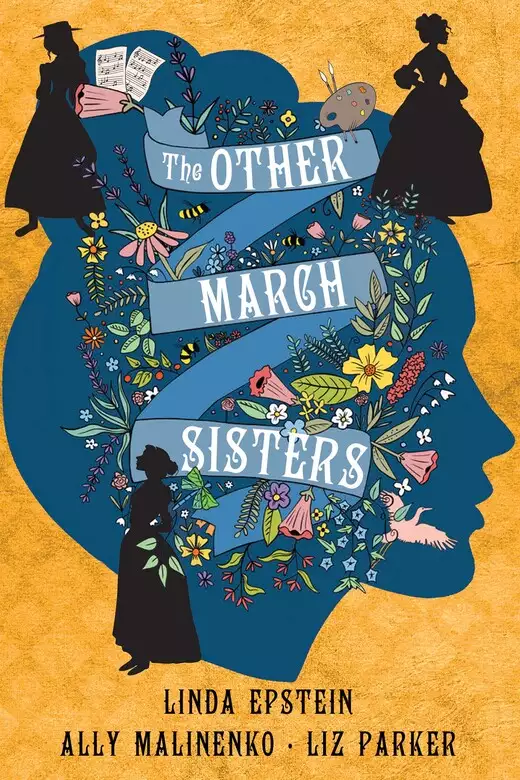
Giving all the “Little Women” the stories they deserve at last, this imaginative historical novel and companion to the much-loved classic draws Meg, Beth, and Amy March from behind the shadow of Jo – Louisa May Alcott’s alter-ego and the “author” of Little Women – as vibrant and unforgettable characters grappling with societal strictures, queer love, motherhood, chronic illness, artistic ambition, and more.
A riveting reimagining for readers of March by Geraldine Brooks, Sarah Miller’s Caroline and Maggie O’Farrell’s Hamnet.
I’m sure you believe you know their story from reading that other book, which told you an inspiring tale about four sisters. It told you a story, but did it tell you the story?
Four sisters, each as different as can be. Through the eyes and words of Jo, their characters and destinies became known to millions. Meg, pretty and conventional. Jo, stubborn, tomboyish, and ambitious. Beth, shy and good-natured, a mortal angel readily accepting her fate. And Amy, elegant, frivolous, and shallow. But Jo, for all her insight, could not always know what was in her sisters’ thoughts, or in their hearts.
With Jo away in New York, pursuing her dreams of being a writer, Meg, Beth, and Amy follow their own paths. Meg, newly married with young twins, struggles to find the contentment that Marmee assured her would come with domesticity. Unhappy and unfulfilled, she turns to her garden, finding there not just a hobby but a calling that will allow her to help other women in turn.
Beth knows her time is limited. Still, part of her longs to break out of her suffocating cocoon at home, however briefly. A new acquaintance turns into something more, offering unexpected, quiet joy.
Amy, traveling in Europe while she pursues her goal of becoming an artist, is keenly aware of the expectation that she will save the family by marrying well. Through the course of her journey, she discovers how she can remain true to herself, true to her art, and true to the love that was always meant to be.
By purposefully leaving Jo off the page, authors Liz Parker, Ally Malinenko, and Linda Epstein give the other March sisters room to reveal themselves through conversations, private correspondence, and intimate moments—coming alive in ways that might surprise even daring, unconventional Jo.
Release date:
February 25, 2025
Publisher:
Kensington Books
Print pages:
368
* BingeBooks earns revenue from qualifying purchases as an Amazon Associate as well as from other retail partners.
There was nothing back home in Concord––or even in Boston or New York––that compared to the Mall at St. James’s Park. The Mall was a place to see and be seen, and St. James’s Park was a thing of beauty, a lovely bit of green amidst the grand buildings of London’s City of Westminster. Amy and her cousin Florence had been invited to promenade the Mall with the Vaughn twins, Fred and Frank, on this rare sunny afternoon in London. It was slightly breezy, and a small flurry of wind pulled at Amy’s parasol, which she wouldn’t dare walk without, lest an intrepid beam of sunlight have the temerity to freckle her fair face. They were to stroll toward Buckingham House, past St. James’s Palace and, Amy hoped, perhaps enter St. James’s Park itself. As exciting as promenading was––and she was excited––what she desperately wanted to do was sketch in St. James’s Park. She yearned to stand on the Blue Bridge and view the famous pelicans. But her aunt and uncle had deemed it improper for a young lady to spend a day sketching unaccompanied, and it was certainly not something Cousin Florence would ever want to do. She was grateful that Aunt Mary and Uncle Edward had invited her to accompany them on their grand tour of Europe. She was sometimes concerned though that she was interested in different things than they or her cousin were. So, she tried to take her pleasure where she could, and today’s enjoyment was promenading.
Although it was a rare occurrence, Amy’s first thought this day hadn’t been about drawing. Instead she had spent hours worrying about what to wear. It was very important that she dress exactly right. Too much, and she’d look as if she was trying to elbow her way into high society, too little and she’d suffer the scorn and judgment of upper-class promenaders who rejoiced at looking down their collective noses. She didn’t know if Fred Vaughn might be the sort of gentleman who would notice a fashion misstep, and she definitely wanted to avoid that kind of attention. As she and Florence had readied themselves earlier in the day, it had been all that Amy could think about, worrying that she’d miss the mark. Finally, she had settled on a cornflower-blue silk walking skirt with a small bustle, a modestly trimmed overskirt in a slightly darker blue, and a paletot over top, cinched at the waist with a simple sash. She’d tied and retied the sash until she’d gotten it perfect. Now, as she and Florence waited for Fred and his brother Frank to arrive, Amy nervously smoothed at the sash. Florence was holding Amy by the arm, and her fingers were beginning to dig into the flesh.
“You’re hurting me, Florence, dear,” Amy said softly, managing to maintain a smile as they spotted the Vaughns.
“I can’t remember which is which,” Florence replied. “Am I really to walk with the handsome one?”
Fred and Frank greatly resembled each other although they weren’t identical twins. Frank was slightly taller, leaner and, truth be told, was more handsome. His lips were fuller, his eyes held more of a sparkle, and he had the most enviable Roman nose. He was always impeccably dressed in the latest fashion. There was something a bit coarse to his brother’s features, who leant so far toward proper and conventional that one might accuse him of being a bit stodgy. As the young men walked toward them, Amy noted that Frank’s hair was the color of golden-hued maple wood, with a healthy complexion to match, whereas Fred was a faded strawberry-blond with a complexion like rising bread. Which was not exactly unpleasant, yet was also not quite as charming. Amy and Florence stood taller and straighter as the young men drew near.
The nervous little sparrow that seemed to have taken up residence in Amy’s chest fluttered against the confines of her rib cage.
“Frank is the one on the left,” Amy replied, giving her elbow a little shake to hopefully loosen Florence’s viselike grip. “And I think they’re both quite handsome.” She wanted to convince herself of this anyway. Amy was too polite to point out that the only reason Florence and Frank had been asked along at all was due to Aunt Mary’s notion that Amy and Fred promenading unaccompanied would be inappropriate. Besides, it really didn’t matter which brother was more good-looking, as the always proper Fred, not the livelier Frank, was the brother who had been paying Amy attention. Comme il faut, thought Amy, practicing her French in her head, correct in behavior or etiquette. That was a good thing, was it not?
As they approached, Amy couldn’t help noticing Frank’s effortless stride. This was a surprise as she remembered he had suffered an injury when he was a boy and had used a cane. In contrast, Fred’s gait seemed a bit stiff. With a slight bow and a tight smile, Fred said, “Lovely to see you, Miss March.” She could tell by his eyes that he was genuinely pleased to see her, which fact was very agreeable to her. He gave a quick nod to Florence.
“Mr. Vaughn,” Amy said, addressing Fred; then, turning her pretty face to Frank, continued, “and Mr. Vaughn!” Amy blushed as Florence let loose a giggle. “You remember my cousin Florence Carrol?”
“Why of course,” Frank said. “Miss Carrol, it’s so lovely to make your acquaintance again.” He bowed with an exaggerated flourish, took her hand, and kissed it. Florence laughed again. Amy hoped and prayed Florence wouldn’t start prattling on, as she sometimes did when nervous. There was a slight breeze, and Amy caught the scent of Fred’s eau de cologne, which had the dry woody scent of vetiver.
Fred cleared his throat and said, “Shall we walk?” and immediately they were paired. Frank and Florence trailed behind as the four of them began their promenade down the Mall.
If Amy could watch herself walking beside Fred Vaughn, her nerves might have been calmed and the frantic bird would have tucked its head under its wing and taken a little nap on its perch. The four young people made a pretty picture––two handsome young men, clearly brothers, accompanying two proper, pretty young ladies. The plainer girl in the finer dress was endlessly chattering to the laughing, dandily dressed young man. The more serious brother held the arm of a very attractive blond girl in a blue walking dress, that perhaps would have been a touch more fashionable the previous season. This fact would have been lost on any observer though, as the young lady was the picture of beauty, poise, and breeding. She walked with the grace of a dancer, her dignified demeanor hiding the actual state of her nerves.
“Have you been enjoying London?” Fred asked.
“Quite,” Amy replied. “I love hearing the chime of the Big Ben and we’ve been to Westminster Abbey, to Poets’ Corner, and the beautiful memorial to William Shakespeare.” A barouche-landau pulled by a pair of high-stepping Hackneys sedately made its way past them, and Fred’s attention wandered to the horse and carriage. In her nervousness Amy had begun to chatter almost as much as her cousin. “Oh, and I’ve been to visit the British Collection so many times now that the guard has begun to recognize me,” she continued. “I’ve gotten permission to sketch there,” she said. “It’s quite glorious! Have you seen the Elgin Marbles?” she asked. Fred nodded at the two young women in the barouche, which had slowed, allowing its inhabitants to make a full appraisal of the young ladies accompanying the Misters Vaughn.
“Well, we are donors to the British Collection,” he answered. Amy’s brow furrowed as she tried to make sense of his response. Did that mean he had or hadn’t seen the Elgin Marbles? She heard Frank and Florence laughing behind them. It sounded as if they were getting on well. The spring breeze picked up again and suddenly a spot of soot found its way directly into Amy’s left eye. “Oh!” she exclaimed, and her hand automatically shot to her face, where she promptly poked herself with a gloved finger. The assaulted eye began watering, and she couldn’t help winking and blinking in discomfort. She gazed straight down the Mall, at the looming Buckingham House, and tried to pretend her eye wasn’t doing what it was clearly doing.
“Miss March,” Fred said, “may I offer you my handkerchief?”
Amy cleared her throat, mortified. “Thank you, Mr. Vaughn,” she replied, taking the bit of embroidered cambric, and daubing at the tears. But it was of no use. Her irritated eye wouldn’t stop watering. She heard Frank’s deep resonant laugh and Florence’s twitter again. Fred said, “Perhaps if I wet the handkerchief in the fountain?” He took the scrap of linen from her hand and proceeded toward a drinking fountain topped by a statue of a boy resting comfortably on a plinth. Florence and Frank came up to her. Seeing her tears, Florence said with concern, “Oh dear, Cousin, you’re crying! What’s happened?”
“What’s the blundering chap done this time?” Frank asked.
“I’m not crying,” Amy said, gently swiping at her tearing eye with the back of her gloved hand. “He didn’t do anything.”
“Allow me, Miss March,” Fred said, now holding a dripping wet handkerchief. Standing straight as can be and holding her breath, Amy wished she could sink into the ground as Fred clumsily blotted at her eye. Droplets of water splattered the bodice of her dress, leaving dots of cerulean on the cornflower silk.
Amy swallowed. “Thank you, Mr. Vaughn,” she said. She was fairly certain the tears streaming from both eyes now were from mortification only.
“Leave her be, Freddie,” Frank said. “You’re making quite a mess of things.” Frank took out his own handkerchief and began to blot at the water droplets on her dress. “Not to worry, Miss March,” Frank said. “I don’t believe the spots will stain.”
“What an unfortunate turn,” Fred said. He looked flustered.
“It’s nothing,” Amy said. She tried to keep the quiver out of her voice but failed. She had worried so about what to wear, about minding her manners, and successfully promenading the Mall. And here she was, being fussed over in such an undignified way by the Vaughn twins, in public. At long last, she convinced Fred and Frank to put aside their handkerchiefs and they resumed their stroll. When her dress dried, which it did quickly enough, you could only see where the water droplets had stained the silk if the light was just right and you squinted your eyes. Or so Florence assured her.
Frank and Florence returned to their laughing and chatter. Fred offered Amy his arm at even the slightest crater or acclivity on their walking path, which at first Amy had found endearing but soon began to wear on her nerves. By day’s end everyone had forgotten the unfortunate soot-in-the-eye incident. Except Amy, of course.
Amy enjoyed being courted. It made her feel grown-up and worldly; as if she was no longer the unsophisticated youngest sister from a small town in Massachusetts who had embarked on a grand tour due to the charity of her aunt and uncle. The enterprise of being courted made her feel she was actively doing something to secure her own future, which endeavor her parents had gently suggested to her more than once before leaving home. She was getting accustomed to meeting with Fred, and as the weeks went by Amy’s anxiety regarding him judging her harshly had lessened. He was clearly enamored of her, which felt quite gratifying. It was only recently though that she’d thought to examine whether her feelings for him were reciprocal.
They weren’t the first people to get spun around in the Hampton Court hedge maze, and surely wouldn’t be the last. But Amy and Fred were, indeed, quite lost. Fred had insisted he knew exactly how to lead them out, but it had been almost twenty minutes now, with him frantically searching for the exit after they’d left the center. Now he confidently strode before her saying, “It’s just a right up here! I’m certain that on our way in we passed this very branch that’s a bit broken.” Amy was getting tired. She daren’t say anything though. Fred seemed a bit upset that he wasn’t in control of this situation, and she certainly didn’t want to add to his dismay. As she’d spent more time with him, she had learned Fred very much liked to know exactly where he was and where he was going.
He continued walking confidently, Amy following behind, skimming one pretty gloved hand on the leaves of the tall wall of yew beside her. She loved the way the light hit the dense, dark evergreen. She trusted that eventually Fred would figure it out and lead them out of the conundrum of the maze. She smiled to herself. There was nothing complicated about Fred Vaughn, and of that she was appreciative.
When they had arrived at Hampton Court, they had first visited the gallery to view Raphael’s Cartoons. Standing before the great paintings Amy had remarked that the original cartoons were actually at the Victoria and Albert, and the ones they presently were gazing at were copies that had been painted in the 1690s by a man named Henry Cooke.
Fred had nodded and said, “Well, I suppose it makes not much difference who paints something then, does it?” Amy tried to explain to him how although a copy of a painting could attempt to capture what the original artist intended, at the end of the day it was still a copy. For Amy, that meant something, especially given that she was learning to be a copyist herself. Having gotten permission to paint at the V&A she had stood in awe in front of a Turner, feeling entirely amateur from her top to her toes. How could anybody adequately copy a Turner sky? The despondency she had felt had been immense, even as she tried and retried.
How much easier it would be to live in the world like Fred Vaughn. Everything was so straightforward for him. Raphael’s Cartoons painted by Henry Cooke were on equal footing with Raphael’s Cartoons painted by Raphael.
She was lost in her thoughts when Fred abruptly came to a halt, as they arrived at yet another turn in the maze where a choice needed to be made. Left or right. Amy stopped just short of running into him. He scratched his head, looked to his left then right. Finally, he turned about to face her directly. “I believe we might be lost, Miss March,” Fred said. His face was red with embarrassment. He cleared his throat. She smiled sweetly up at him.
“Oh, I’m sure you’ve been guiding us quite perfectly,” she genially said. “I think we must be very near the exit.” She pointed left and said, “Isn’t it just around there?” Fred turned and Amy followed him. “Here we are!” he said, as they bid farewell to the maze. “I knew I’d figure it out!”
Amy didn’t tell him that she’d never been lost at all. When Amy and her sisters were children, they had built a small maze of hay bales, and Laurie, their neighbor, had told them about the beautiful Hampton Court hedge maze. Before moving to Concord, Laurie had been to boarding school in England, until he came to live next door to them. Amy had somehow tucked a bit of hedge maze information away for years. Laurie had told them that the hedges had been grown in a fashion whereby placing and keeping one’s right hand along the wall would lead one to the center. And reversed, out again.
She had tried to let Fred figure it out and feel manly, even as she had known where they were the whole time. She was pleased to be able to gently nudge him in the right direction and let him think he was a hero. But it was Laurie who was the true champion, as he had often been for her as she was growing up.
“I knew you would find our way,” Amy said, looking up at Fred, as he took her arm. He fondly smiled down at her, and then they went to find the rest of their party. He stood a bit taller, and had a satisfied look on his face, when they recounted the adventure to their friends and Amy called him her hero.
Amy couldn’t imagine how much money Laurie had spent to send her a message via telegraph. And it only read: Coming to London. Letter forthcoming. Laurie. She knew that more than ten words per message was even more costly, so she didn’t fault him for being brief. But she wished she knew when he was coming. Or, for that matter, why he was all of a sudden coming.
Of course she would be very glad to see him. She had rarely seen Laurie in recent years as he had been at college when she’d left for Europe. He had been part of her family in ways that her cousin, aunt, and uncle weren’t. The Marches only saw the Carrols at holidays, funerals, and weddings. But she had grown up side by side with Laurie. When she was twelve years old, he was the handsome, lonely young man who came to live with Mr. Laurence, his grandfather, their next-door neighbor. Amy’s sister Jo, being friendly and bold––although sometimes over-bearing––had quickly befriended him, as they were nearly the same age. Jo and Laurie became fast friends, but all the March sisters had welcomed him into the warm embrace of their family.
Laurie was there when Beth, her sister, fell ill. And when Amy was sent away, so as not to contract the scarlet fever too, Laurie had made the banishment to her Aunt March’s house bearable. He’d come to visit her every day. That was when she and he had truly become friends, apart from the rest of the family. He had been there for all of the Marches when Mother went to Washington to nurse Father back to health during the war. And Laurie was the dear who sent flowers to her and her sisters on their birthdays, who made certain there was always a beautiful Christmas dinner on the table each year, even when they couldn’t afford it. He was generous and kind and she loved him dearly. They all did.
But what had happened to provoke an unplanned European trip? Why did he send her a telegraph? She hoped he wasn’t in any kind of trouble. She knew Mr. Laurence had extricated Laurie from numerous scrapes whilst in college––one of the privileges of the rich––but she certainly hoped Laurie hadn’t continued with his devilish shenanigans after graduation. She would need to be patient and await his letter. But it was all very curious.
Being in England had been a dream come true for Amy. They had visited museums and galleries, palaces and cathedrals, places that she’d only read about, but had never imagined she’d have the great good fortune to visit in person. She reveled in these travels, eagerly soaking up the art and architecture. There was nowhere she was more comfortable than gazing at a painting or sculpture, immersed in understanding or experiencing it. Viewing art was like being with an old friend. She was also enrolled in a painting class for ladies. Standing at an easel painting she felt quite at home. Amy had always been comfortable meeting new people and visiting acquaintances. She was usually very self-possessed. So the anxiety she had been experiencing since being abroad, was a very new feeling.
None of the March sisters would particularly be characterized as insecure, even though her sister Beth was shy with anyone outside of the family. It was easy to have self-confidence being a member of the March family, even if they were no longer a family of means. Father’s connections in the Concord community were with philosophers, poets, and prominent transcendentalists. Mother had been active in the abolitionist movement, as well as working for women’s suffrage. Her oldest sister, Meg, had seemingly transitioned effortlessly from being an intelligent, patient governess, to being a loving young wife and mother. Amy and her sister Jo had always been strangely competitive and were frequently at odds. Jo was not gentle with Amy. She mocked her and judged her and often made Amy feel small. And dear Beth, although quite content in her own company, was an accomplished pianist. Back in Concord, with the strength of her family’s connections and accomplishments, Amy had been at ease and confident in most social situations. She was one of those people whose charm and beauty drew others to her. She was well-liked and comfortable in that role.
Amy unconsciously touched the lace at the neckline of her dress, as if it might give her some strength or ease her social anxiety. Back in Concord, when they had packed Amy up for this European adventure, Mother had lovingly trimmed Amy’s sky-blue tarlatan herself, adding delicate ivory lace scavenged from one of her own old gowns. It was a remnant from Mother’s youth when she still held a genteel position in society. That was before Father’s poor business decisions had changed everything.
As Amy fretted about the ball, she felt the return of the panicky sparrow in her chest. She wasn’t worried about the dancing, at which she was, of course, adept. What she feared was an inadvertent blunder, accidentally saying or doing something inappropriate, or wearing the wrong thing. She was ever vigilant to the many ways she might misstep and cared greatly about the good opinion of others. And, for pity’s sake, she wanted to avoid another fiasco like the soot in her eye at St. James’s Park.
“Oh, I hope they’ve put a varsoviana on the dance schedule!” Florence chittered, grabbing Amy’s elbow. Florence, Amy, and Aunt Mary strode two paces closer to the ballroom entry, where a servant would take their names to be announced. Past the servant, who was dressed in livery, they could see the widow Lady Willoughby, their hostess, hovering near the entrance, greeting her guests.
Aunt Mary whispered, “Well! I’m certain that won’t be the first dance.” They took another step forward. She continued, “And I’m sure Lady Willoughby has arranged whatever is de rigueur here in London.” She pursed her lips and whispered, “I know Lady Willoughby conducts herself strictly according to the code of good breeding.” As they took two more steps toward the entrance Amy heard the tinkle of a piano and croon of a cornet, shortly followed by a violin and violoncello in conversation with each other, as the musicians readied themselves to play. Aunt Mary snapped open her fan and whispered behind it, “Of course even the slightest departure from the code of etiquette would be a grave offense.” Amy’s gloved fingers left the lace at her throat and moved to the nape of her neck, checking for errant curls escaping the co. . .
We hope you are enjoying the book so far. To continue reading...

 Please log in to recommend or discuss...
