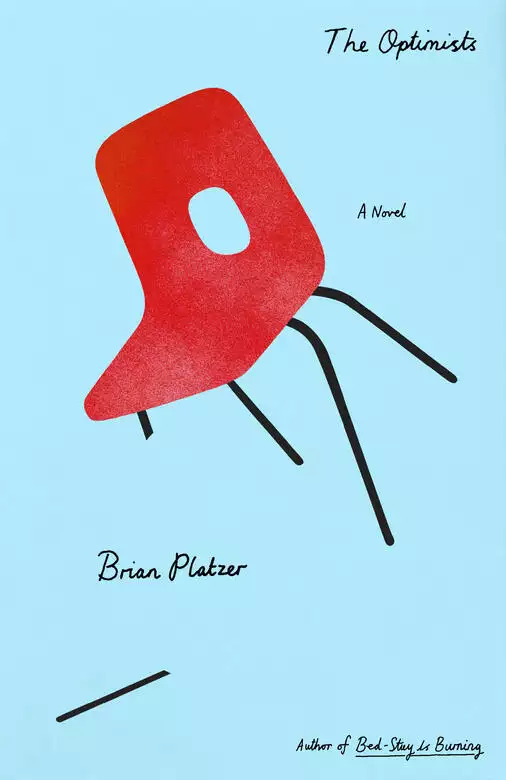
A beloved schoolteacher chronicles the meteoric rise of his most dazzling student in this ambitious, big-hearted work of literary fiction, perfect for fans of Nathan Hill, Susan Choi, and Tess Gunty.
Mr. Keating is an extraordinary teacher: brilliant, dedicated, and possibly a few pages ahead in a book no one else is reading. He’s a magician able to enchant fourteen-year-olds into a love of writing and literature. Yet no student has lived up to the promise of their potential more than Clara Hightower. Over the course of three decades, Clara is a kindergarten thief, a high school genius, a Silicon Valley celebrity, and an animal rights activist turned terrorist.
To tell Clara’s story, Mr. Keating must tell his own, including his courtship and marriage, his dreams of writing and comedy, his days in the classroom in lower Manhattan along with the rivalry and friendship with his Head of School, and his eventual stroke and the isolation that follows.
The Optimists is a love story, a joke book, and a meditation on the meaning of life and death. But mostly it’s a fiercely original novel for anyone who has ever had a teacher or student profoundly affect their life.
Release date:
February 24, 2026
Publisher:
Little, Brown and Company
Print pages:
304
* BingeBooks earns revenue from qualifying purchases as an Amazon Associate as well as from other retail partners.
Clara held a lit candle in a lantern on her lap. For the Synapse of Induction and Elevation, I dressed in velvet black tie, but the classroom blinds were drawn and the lights were off, so the students couldn’t see me or one another. Just Clara, by candlelight. In my left hand was the original Ember scroll, in my right the Palladium Scepter reserved for ceremonies of elevation. In the decade I’d been administering the Ember Exam, Clara was my first student to elevate to Archon.
“In the heart of St. George’s Episcopal School,” I said, “down the causeway through Ember Land, I welcome you to your fourth and final Ceremony of the Synapse of Induction and Elevation, where, after a lifetime of waiting, we have before us a true Archon, with a score of two hundred out of two hundred. Clara Hightower”—and here I tapped her on each shoulder with the Palladium Scepter—“I salute you, your ancestors, and your progeny!”
Her classmates clapped and hooted.
“Brava!” I said once the lights were back on.
“My ancestors and progeny would be proud,” Clara said.
“Really?” I said.
“Mr. Keating,” she said, and shook her head. But then she smiled, so I had done my job.
I understand that Ember Land, Archon, and Synapse of Induction and Elevation might be hard to wrap your head around. That’s fine. It was for them, not you. They were children. And it made sense to them. Especially to Clara. Even if she didn’t want to admit it at the time.
It was all an act but none of it was. Or a better way of putting it: I knew it was silly. Its purpose was to be silly. But part of the silliness was that I was entirely serious. So maybe it wasn’t silly. I’d dedicated my life to this exam. It was important. To the students and to me. That it was important to the students made it important to me. Or vice versa. We middle-school teachers know the value of being silly in order to be serious.
The point is: I used to be able to enchant fourteen-year-olds into a mastery of composition and grammar. I used to be a magician.
In the winter of 1987 I was watching Jeopardy! and eating moo shu beef when the telephone rang.
“Hello,” I said.
“Hi, Rod, it’s Enid.” Enid Smeal was a fellow teacher at St. George’s. She taught art, and, for a short time, we’d made a life together.
“To what do I owe the pleasure?” I said.
“Liquid gold,” Alex Trebek said, “is what Kraft calls this product used in its ‘Shells and Cheese.’”
“Jacob is too inside his own head. I blame it on a lack of male company,” Enid said. “He needs a positive influence around the house more often.”
“What do you have in mind?” I said.
“What is Velveeta,” a contestant said.
“That’s right,” Alex Trebek said.
“Velveeta?” I said. “Is that a real type of cheese? Like cheddar? Velveeta cheese?”
“What?” Enid said.
“Sorry,” I said. “What did you say about Jacob?”
Enid’s apartment was one of four on the third floor of a six-story former paper factory on Wooster Street. I hadn’t been there since I’d moved out a dozen years before. Enid greeted me smiling. She asked me why I continued to wear a jacket and tie even on a weekend. I bowed slightly, an affectation I had had for years that I could not then and cannot now explain.
“Say hi to Mr. Keating,” she told Jacob, who was straining to hide behind her legs.
Jacob looked down to his bare toes, and I scanned the room.
Everywhere crystal animals. There had been a few when Enid and I were together, but now they’d overrun the place. A menagerie of little crystal mice, wolves, giraffes, penguins, elephants, and bunnies were scattered over the tables and shelves, giving the impression that Enid and Jacob lived inside an ice sculpture—an impression exacerbated by the fact that for years Enid had herself been sculpting ice. The blocks—nine feet cubed—were far larger than you’re imagining. They didn’t fit in the elevator so had to arrive by crane through her large loft windows. She set up a tarp on the floor and hacked at these blocks of ice with her knives and chisels until they looked like giant, grotesque versions of these little crystal animals that apparently never stopped arriving in the mail.
If my memory is to be trusted, Enid had a couple of showings in small but well-regarded SoHo galleries that mounted photographs of the sculptures in various stages of melting. There was real tension in those pieces. They were funny and sad in their own way. Enid had talent.
Back to 1987: Jacob was five. A thin, pale boy. Translucent, blue-veined skin. Pale blue eyes. Plump lips and a slight smile. Bare feet and tiny toes.
He kept his gaze straight down.
I thought I might have misunderstood the situation. Perhaps Enid had been trying to tell me that Jacob had something the matter with him. Autism or sociopathy. Though maybe the boy was just lonely. Now Jacob and I both looked down.
“Why don’t you show Mr. Keating your room,” Enid said. When instructing middle-schoolers in art, Enid dressed the part of a schoolmarm with floral blouses buttoned up to her throat. But at home she wore tight jeans and an oversize men’s undershirt.
Jacob took me by the hand in a gesture of such innocence and tenderness that I felt the sting of coming tears, but only for a second. His bedroom was dark, lit by a lamp in the corner. A plain jute rug covered most of the hardwood floor. Jacob knelt by his wooden play kitchen, where he had lined up and organized miniature metal and wooden pots and pans, spatulas and whisks; these were mixed among real, adult-size versions of the same objects. He played in his kitchen. Muttered recipes and ingredients. I sat silent and watched. I grew bored, then fidgety.
“Knock-knock,” I said after twenty minutes.
He looked back at where I sat on his bed.
“Knock-knock,” I repeated.
“Who’s there?” he said shyly.
“Candice,” I said.
“Candice who?” he said, his focus back on the kitchen.
“Candice door open or am I stuck out here in the rain?” I said.
He looked at me, blinked, and resumed his work.
It took an hour, all told, for Jacob to pretend to write down my drink order, pretend to pour and serve me an iced tea, take my food order, pretend to make the food, serve me each imaginary course, change my silverware, pretend to wash the fake food scraps off the plates using imaginary water, and ask me if I needed any change after I paid the fake bill with imaginary money.
During all the time he cooked and cleaned, I told him knock-knock jokes. I’m a great believer in knock-knock jokes. Creativity within restrictions. Before knock-knock jokes, there were do-you-know jokes. A famous one around the turn of the twentieth century featured the jokester walking up to someone and saying: “Do you know Arthur?”
“Arthur who?” the someone would respond.
The jokester would say, “Arthurmometer!” and run off laughing.
To be honest, I don’t really understand that one.
Another: “Do you know Tom?” “Tom who?” “Tom-orrow I’m going to plant a kiss on your sweetheart!”
By the mid-1920s, knock-knock jokes were everywhere. Guests at parties (think Gatsby) told them to show off their wit. Businesses (think AT&T) had customers compete to come up with the best ones for their billboards. Knock-knock clubs formed around the country.
“Knock-knock,” I said.
“Who’s there?” Jacob said.
“A broken pencil,” I said.
“A broken pencil who?” he said.
“Never mind,” I said. “It’s pointless.”
No response.
And like that, every week and sometimes more often, I spent an hour or so with Jacob. Enid, in the living room, chiseled her ice block or sat at her potter’s wheel. Her glass of milk was half vodka, but who was I to judge? She was a good mother, and it had been more than a decade since we’d been together. Enid was alone with her son and her crystals, so if she took this time each week to get some work done and drink to excess, what business was it of mine?
Every three or four weeks, I’d tell a joke that would make Jacob laugh so hard that he lost control over his little body and fell to the floor, holding his stomach and crying with joy. That he was so slight and delicate made the laughter seem terribly powerful. The first couple of times it happened, I felt awkward for him. I thought again that there must be some problem with him. But he was five years old. Laughing hard at jokes was presumably something five-year-olds did.
“Knock-knock,” I said after a month or two of this routine.
“Who’s there?” he said, pretending to scrub a wooden plate. He was squirmier than usual.
“Oink-oink,” I said.
“Oink-oink who?”
“Make up your mind,” I said. “Are you a pig or an owl?”
He hadn’t seen it coming. It was the first time I’d used the who as a stand-in for the hoot noise an owl makes. I’d thought Jacob might like this one, and it landed. We giggled and repeated “Oink-oink who,” Jacob eventually laughing so hard that Enid came in with her vodka milk to check that no one was choking. She tried to understand but didn’t get what was so funny. Her frowns just made us laugh harder. I was in my mid-forties and as happy as I could remember.
I rarely enjoy spending time around young children, partly because I tend to like people in inverse proportion to their eagerness for approval. Performative people of all ages are too often tarnished by desperation. The difference between cute and cutesy is that the cutesy kid wants everyone to see how cute he is. I don’t mind cute, but something in me rebels against cutesy. I gather this is one of the reasons people feel relaxed around their pets. Your cat isn’t trying to impress you, so when it makes a silly face, you can enjoy it without feeling manipulated. Though dogs, I’m not so sure. Dogs might sometimes try too hard to please.
At five years old, Jacob was far more of a cat. I liked him because of his lack of desperation. And the same lack of desperation in his mother is what attracted me to Enid during the months we dated, back when she was only a few years into part-time teaching at St. George’s. She didn’t let school politics—or national politics, for that matter—bother her. She found it tedious to hate Reagan, just as she found it tedious to gossip about our coworkers. She was hard and brilliant but didn’t feel the need to advertise any pride she felt in herself or her opinions.
But the very attribute I was attracted to in Enid made it difficult for me to be with her. Enid was not outwardly proud of herself, so she was not outwardly proud of us, so she was not outwardly proud of me. I grew desperate and needy; I began to dislike myself, and I moved out years before Jacob was born.
I’ve always been needy, just as I’ve always been ashamed of my neediness. Perhaps young children irritate me because they are competition, consuming all attention. Maybe their eagerness to please irritates me because of my own.
Now, in my darkest, most anguished moments, as I lie in my bed or sit strapped to my chair, when my neck is twisted and I’m in such severe pain that I fantasize about Caroline sneaking up behind me with a carving knife and severing a tendon to grant me some relief, I wonder if the universe—some call her “God”—is punishing me for my ego.
The Italians have a term, contrapasso, that I’ve only ever heard used in relation to The Inferno. It means something like “suffer the reverse.” The idea is that Dante condemns each sinner by making his or her punishment uniquely appropriate to the sin. Murderers spend eternity in a river of blood. Flatterers are punished for all the bullshit they spewed in life by being forever sprayed with sewage. Fomenters of scandal and division are repeatedly sawed in half. That kind of thing.
So here I confess to craving attention. I am performative. I am desperate for notice. For approval. I, an eighth-grade English teacher, created a world where I could be the king of my own tiny realm. With Caroline’s son out of the house, I had her to myself. At school and at home, all eyes were on me as I lectured and performed. And now, thanks to a twist of fate—or, to avoid clichés, thanks to a temporary obstruction in my basilar artery just over five years ago—I am unable to move or speak. I am forced to be silent and still.
Dante, that vain son of a bitch, couldn’t have done better himself.
Jacob’s sixth birthday was in early June. The party was to be lunch for eight. Enid made a point of telling me that inviting me was Jacob’s idea, not hers. I was touched to be included. During the weeks leading up to the event, Jacob was coy about it. The menu shifted according to his mood, from peanut butter crackers to lobster soufflé. I never knew whether or not we were pretending. In the end, he settled on a one-course meal of smoked salmon on graham crackers, s’mores, cold hot chocolate, and ice cream soup. I arrived early to help set up. Other than the salmon, which Enid picked up at Russ and Daughters, Jacob made everything himself.
And none of his friends showed up.
No, just kidding. Everyone had a wonderful time.
But, Jesus Christ, are five- and six-year-olds repulsive. They didn’t even know how to drink chocolate milk. They tilted the cups too high over their faces and held them there for too long. The milk that made it into their mouths bubbled back up over their lips and down their chins. They smashed s’mores into their teeth. Some ate the s’mores first, some the melted ice cream, and no one touched the salmon except for one husky boy who ate everyone else’s too. That boy wore a Yankees cap and was so thirsty after eating all that smoked salmon, he drank five or six cups of chocolate milk. Unaccustomed to so much sugar, dairy, and fish, he spent the next twenty minutes running up and down the hallway throwing up.
All the parents had dropped off their kids and escaped, and Enid allowed the anarchy. She sat passively, neither disgusted nor entertained. Jacob wrapped his friends in towels to soak up spilled milk, taking special care to give the biggest, most colorful one to the only girl.
After some time, Enid removed a painter’s tarp to reveal a Happy Birthday, Jacob ice sculpture. The husky boy in the Yankees cap sprinted to it and started licking, turning his cap backward to get his face in closer, and soon everyone else did the same. Even Jacob, who’d seen ice sculptures before, delighted in it.
I found myself furious with Enid for devoting so much time and craft to something that mattered to no one. She didn’t take pictures of it, and no other adults were there to see it. She must have spent the entire night working on it. For Jacob. But Jacob couldn’t read. None of the kids could. So, in a sense, she did it for me, but that wasn’t the case. We didn’t do things like that for each other anymore. It was for Jacob, in Enid’s pigheaded, nonsensical way.
Every aspect of the party made me uncomfortable. It was shameless in the sense that these kids were too young to feel shame.
Jacob was ecstatic. His friends asked for thirds and fourths on soup, which he ladled from a second tub of ice cream I’d heated in the microwave.
The lone girl had light, straight hair and pink cheeks. During the happy birthday song, she positioned herself with her back to the bookshelf, looked both ways, then pocketed a waddle of crystal penguins.
“Who is she?” I asked Enid later, though something about the girl’s manner made me keep silent about the theft.
“Clara,” Enid said. “She’ll be in Jacob’s kindergarten class. She lives in the building too. Her parents are impossible. They’re on the top floor and refuse to get the roof fixed. We’re all supposed to chip in but…”
Here the apartment door swung open and in sashayed s. . .
We hope you are enjoying the book so far. To continue reading...

 Please log in to recommend or discuss...
