
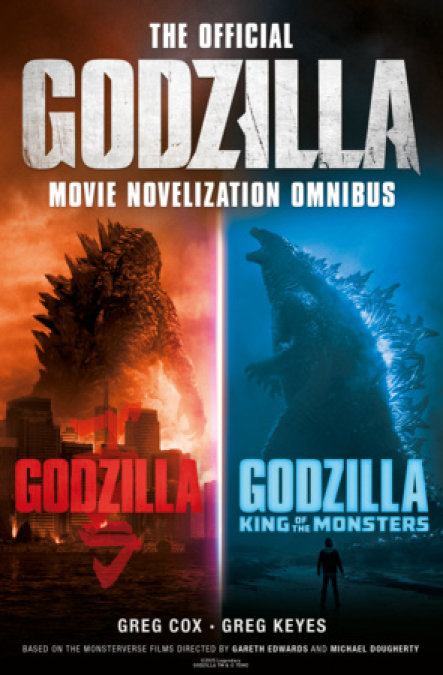
The Official Godzilla Movie Novelization Omnibus
- eBook
- Paperback
- Book info
- Sample
- Media
- Author updates
- Lists
Synopsis
The official novelization of the blockbusters Godzilla (2014) and Godzilla: King of the Monsters, the first two Godzilla films in the Monsterverse franchise.
Two powerful stories of human courage and reconciliation in the face of titanic forces of nature. Humanity stands defenseless when the awe-inspiring Godzilla rises to restore balance.
Godzilla
Ford Brody, a Navy bomb expert, has just reunited with his family in San Francisco when he is forced to go to Japan to help his estranged father, Joe. Soon, both men are swept up in an escalating crisis when an ancient alpha predator arises from the sea to combat malevolent adversaries that threaten the survival of humanity. The creatures leave colossal destruction in their wake, as they make their way toward their final battleground: San Francisco.
Godzilla: King of the Monsters
Members of the cryptozoological agency Monarch face off against a battery of god-sized monsters, including the mighty Godzilla, who collides with Mothra, Rodan, and his ultimate nemesis, the
three-headed King Ghidorah. When these ancient super-species—thought to be mere myths—
rise again, they all vie for supremacy, leaving humanity’s very existence hanging in the balance.
Release date: August 26, 2025
Publisher: Titan Books
Print pages: 624
* BingeBooks earns revenue from qualifying purchases as an Amazon Associate as well as from other retail partners.
Reader buzz
 Please log in to recommend or discuss...
Author updates
The Official Godzilla Movie Novelization Omnibus
Greg Cox
1954
Nature was at peace.
The turquoise waters of the South Pacific reflected a cloudless blue sky. A coral reef shielded a tranquil lagoon from the sea beyond. A handful of tiny islands formed a remote atoll that was barely a speck on maps of the region. Palm trees swayed above a white sand beach. Warm trade winds rustled thatch huts and coconut groves, as the islanders went about their daily tasks. Bare-chested men, their skin baked brown by sun, tended to their fishing nets and outrigger canoes. Women in white cotton dresses wove baskets and looked after the cooking fires. Naked children played in the sand and surf, chasing after crabs, seabirds, and each other. They slaked their thirst with coconut juice and feasted on breadfruit, bananas, and papayas. A young boy, only eight years old, swam like a dolphin in the warm, refreshing waters of the lagoon, enjoying what seemed like a perfect day in paradise.
Until...
A strange white wake entered the lagoon from beyond the coral reef. The glassy blue water churned and swelled, stirred by the passage of some vast, unfathomable mass beneath the surface. The boy cried out in alarm, and dived frantically out of the way, as a huge dark form rose up from the depths. On the shore, startled villagers dropped everything to gape in fear and wonder, shielding their eyes from the sun, as the conning tower of a large gray nuclear submarine surfaced with a blast of salty spray.
Moments later, the rest of the sub came into view, claiming the lagoon like an invading sea monster. More than three hundred feet long, the intimidating steel vessel dwarfed the islanders’ simple outriggers. Paddling in the water several yards away, the boy watched along with his people as a familiar red-white-and-blue flag unfurled via a mechanical winch. Despite his island’s remote location and relative isolation from the world, the boy recognized the Stars and Stripes of the United States of America. It had been less than a decade after all since the Americans and the Japanese had waged war over the scattered islands of the South Pacific, but the boy’s people had largely been left alone since then. He wondered what had brought the Americans back to the islands.
A shiver ran through the boy, despite the warmth of the sun and water. He knew somehow that the world as he knew it had just changed forever...
* * *
Weeks later, Navy helicopters raced away from the island, which had been radically transformed by its new owners. The boy, his friends, family, and neighbors—all 170 natives of the atoll—had been relocated to another island hundreds of miles away. The simple village had been razed. Thatch huts and fire pits were replaced by
temporary utility structures, along with massive concrete bunkers built to protect cameras and other test equipment. Frightened pigs and goats were locked inside cages labeled “Test Animals.” Some had been shaved and coated in experimental lotions—in the interests of science. They squealed and grunted anxiously as the ‘copters departed, abandoning them on the island. An atomic bomb stayed behind to keep them company.
The bomb rested ominously atop a sturdy metal platform constructed by Navy engineers. It was a large, riveted metal egg over eleven feet in length and weighing more than ten thousand pounds. Hand-painted on its nose cone was a snarling lizard, with angry eyes and fangs, pinned inside the cross-hairs of a gun sight.
Fleeing the island, the ‘copters passed over the deck of a massive escort carrier floating several miles away from the test site. The USS Bairoko was a Commencement Bay-class carrier, nearly seven hundred feet long and displacing over ten thousand long tons. Commissioned too late to take part in the War, it had been named after the decisive Battle of Bairoko and pressed into peace-time service. The carrier housed over a thousand souls, including, on this particular mission, a number of scientific observers, many of whom waited tensely on the deck as crucial minutes ticked by. They stared out across the sea at the tiny atoll, which was only a smudge in the distance, and sweated in the heat and humidity. The sun blazed overhead, powered by the same thermonuclear reactions that were about to be unleashed on the defenseless islands.
In the ship’s bridge, a sonar screen tracked a large green dot advancing toward the atoll.
“Countdown commences at thirty,” a voice blared from the loudspeakers. “Twenty-nine... twenty-eight...”
The entire world seemed to hold its breath.
Beyond the carrier, the sea boiled white as a chain of immense, jagged fins broke through the churning froth. Shipboard observers looked on in awe, instinctively backing away from the jaw-dropping
spectacle. Each fin was at least the size of a massive rock formation. The mind boggled at the thought of what they might be attached to.
On the island, the test animals sensed what was bearing down on them. They squealed and bleated in panic, bucking and scrambling in their cages. Goats kicked violently against the bars, bloodying their hooves in their frantic attempts to break free. Pigs pawed at the unyielding metal floors of their cages, trying unsuccessfully to burrow to safety. Seabirds abandoned the islands in a flurry of flapping wings. Brightly colored fish fled the lagoon, preferring the dubious safety of the open sea to what was now approaching. Sharks and other predators fled as well.
On the deck of the Bairoko, the assembled scientists and military brass braced themselves for what was to come. Protective blast goggles were lowered over dozens of pairs of eyes, the better to witness the historic event. Documentary cameras whirred on tripods that had been lashed to the deck with multiple redundant cables. Ordinary crewmen, lacking special goggles, ducked and covered their eyes as the count-down neared its climax.
“Ten… nine… eight...”
A colossal form rose from sea like a living waterfall, hundreds of feet tall. The immense shape was shrouded by torrents of cascading water and foam, making it difficult to make out more than its gargantuan proportions. For a brief moment, a thundering, primordial roar bellowed across miles and miles of open sea, all but drowning out the amplified countdown.
“Three… two… one...”
A blinding flash of light erupted from island, followed by an immense fireball that could be seen from miles away. The glare was so bright that even the tinted lenses of the blast goggles were not enough to
spare the observers aboard the ship, who were forced to avert their eyes. By the time they could turn their gaze back toward the blast site, a gigantic mushroom cloud was billowing up into the sky above the devastated atoll. The sight of the ominous cloud sent an instinctive shudder through all present. Matter itself had just been split apart at its most fundamental level.
A maelstrom of uprooted sand and debris exploded across the atoll, tearing off the tops of trees. The shockwave rippled out across the waves in all directions, racing faster than the speed of sound. The deafening noise of the blast hit the Bairoku mere seconds later: a deep, jarring rumble that shook the soldiers and scientists all the way down to the bone. It was a sound to rattle the very rafters of heaven and make a mockery of peace. The serenity of the islands was a thing of a past, as was, perhaps, the monstrous leviathan that has been briefly glimpsed during the final seconds of the countdown.
Or so the observers prayed.
TWO
1999
Dr. Ishiro Serizawa gazed out the side door of the helicopter as it soared over a lush green landscape. Below him stretched a sunlit tropical rain forest clinging to the rugged slopes of the Philippine highlands. Pines and other evergreens dominated the pristine mountainsides, while mahogany and bamboo groves thrived at the lower altitudes, painting a scenic portrait of pure, unsullied nature. A distinguished-looking man in his early forties, with receding black hair and a neatly trimmed mustache and beard, Serizawa enjoyed the view—until he spied his destination.
The strip mine cut like a gash through the verdant wilderness. Acres of natural beauty had been torn away to expose barren ridges of rock and soil. Ugly metal structures crouched upon shelves of naked bedrock that had been carved, blasted, and bulldozed into the side of the mountain. Shanty towns spilled down the slopes, providing housing for the thousands of laborers toiling in the hot midday sun. Mining, for copper, zinc, nickel, and other minerals, was a growing industry in the Philippines, but it came at the expense of the nation’s precious flora and fauna. Instead of abundant greenery, the mining complex was dirty, brown and lifeless. Serizawa winced at the damage done to the environment. The older he got, the more he thought that Nature was sometimes best left to its own devices.
His eyes narrowed as he spied what appeared to be a caved-in section of the mine. This was what had drawn him to this desolate location, all the way from his native Japan. He eyed the collapsed mine with a mixture of excitement and trepidation. The early reports had hinted at something truly remarkable, well worth this exhausting journey. Serizawa couldn’t wait to see for himself.
The chopper touched down on a flattened stretch of mountaintop, not far from the cave-in. Outside, sweaty laborers operated mucking loaders, scoop trams, and other heavy machinery as they hurriedly excavated loose gravel and sludge from the collapsed mine. The logo of Universal Western Mining was emblazoned on the machinery. Filipino workers backed away from ‘copter, raising their arms to shield themselves from the dust and debris thrown up by rotors’ wash.
Finally, Serizawa thought. He unbuckled his seatbelt and climbed stiffly out of the ‘copter, followed by his colleague, Dr. Vivienne Graham. An attractive Englishwoman in her thirties, she had a dark brown hair cut sensibly short. She had been at Serizawa’s right hand for many years now. Her practical attire was rumpled from the trip.
Three other members of their team also exited the chopper and immediately got to work unloading duffel bags and gear. Serizawa took a moment to get his bearings. It felt good to set foot on solid ground and stretch his legs again. He glanced around, looking for someone to escort them to the discovery.
“Doctor Serizawa!”
A stocky, middle-aged American emerged from the chaos surrounding the mine, shouldering his way past busy workers and machinery alike. Perspiration shone on his ruddy face and had soaked through his clothes.
Serizawa recognized the man as Oscar Boyd, one of the men in charge of the mining company. He and Serizawa had been in touch earlier.
“Thank God you’re here!” Boyd shouted over the whirr of the rotors. He joined Serizawa and his team. “It’s just a mess, I’m warning you. Just a total mess.”
A squad of armed guards, toting automatic weapons, accompanied Boyd. The men had the stony expressions and ice-cold eyes of hardened mercenaries or guerillas. Not exactly the most reassuring of welcoming committees. Serizawa and Graham exchanged worried looks. The presence of the guns and guards was unnerving, but they had come too far to succumb to second thoughts now. Serizawa trusted that the soldiers were only on hand to provide security, even if the amount of firepower on view struck him as excessive.
“They picked up a radiation pocket out here last month,” Boyd said, getting right down to business. He sounded anxious for whatever advice and assistance the scientists might be able to offer. Serizawa’s understanding was that Boyd was from the company’s main office and had not personally been on hand when the disaster struck. He sounded flustered and out of his depth. “And got all excited thinking they had a uranium deposit. They started stacking up the heavy machinery and...”
As he spoke, he guided them down a slope toward a nearby ridge. Serizawa stepped carefully over the rough, uneven terrain.
“The floor of the valley collapsed into the cavern below,” Boyd continued. “Just dropped away. Best guess right now is about forty miners went down with it.”
He stepped aside to let Serizawa and the others see for themselves. The team found themselves on a rocky ledge, looking out over the valley below—or what was left of it. A jagged chasm, at least a hundred feet long, had swallowed up the floor of the valley. Mangled machinery, shacks, boulders, and other debris could be dimly glimpsed within the shadowy rift, which appeared to descend deep into the Earth. Serizawa gazed down at the wreckage for several moments, taking it all in, before speaking again.
“I need to speak with the survivors,” he said.
A tin-roofed storage facility had been converted into an impromptu triage center. Dozens of injured and dying workers occupied rows of cots. Serizawa saw at once that all of the men were suffering from severe radiation burns. Blisters and ulcers and raw red patches afflicted their flesh. Some were still conscious, while the luckier ones had been rendered oblivious by morphine drips. Agonized moans and whimpers echoed off the walls of the building, whose sweltering atmosphere lacked any sort of air-conditioning. Doctors and nurses, overworked and overwhelmed, moved briskly among the rows of patients, doing what little they could to relieve the men’s suffering. Unlike their patients, the relief workers had donned hazmat suits for their own protection. Gas masks covered their faces.
Still in his traveling clothes, Serizawa felt uncomfortably exposed.
Graham inhaled sharply beside him, taken aback by the scale of the tragedy. Serizawa shared her horror. From what he could see of the men’s burns, few of the miners would last the week, while any survivors would be doomed to years of complications, cancers, and deformities before they finally succumbed to the radiation’s pernicious effects. His heart went out to them, knowing there was little that could be done for them at this point.
Steeling himself against the heart-rending sights and sounds, Serizawa approached one of the patients. The man’s face was so badly swollen that he looked barely human. Scorched skin peeled and blistered. His hair was falling out. The burns and swelling made it impossible to determine the patient’s age, but a glance at his chart revealed that the dying miner was only twenty years old.
So young, Serizawa thought, even as he forced himself to focus on the task at hand. Now was no time for sentiment. He needed hard data and information if the root cause of this catastrophe was indeed what he suspected. Many more lives might well be at stake.
One of his aides had rescued a portable radiation detector from their supplies. The handheld device included an external wand. Serizawa unslung the detector from his shoulder and switched it on. Drawing nearer to the cot, he pointed the sensor at the patient.
The detector clacked rapidly. The needle on the monitor spiked upward, into the red zone.
Serizawa backed away warily, alarmed by the results. He flagged down one of the busy nurses, whose face was largely concealed by her gas mask. He grasped the shoulder of her hazmat suit.
“Can you ask this man what happened?”
The nurse nodded. Leaning over the patient, she spoke to him in Tagalog. A hoarse, whispery voice escaped his cracked and swollen lips, but was far too faint to make out. She leaned in closer as the man repeated himself, gesturing feebly at Serizawa with a bandaged hand.
“He says,” the nurse translated, “that people like you… you came here, you raped the earth. You tore holes in her flesh… and now she’s given birth to a demon.”
The miner slowly rolled over in his cot, using the last of his strength to turn his back on Serizawa and the others. Serizawa did not attempt to refute the man’s accusation. He was more concerned with the “demon” the survivor had mentioned. Just the delirious ramblings of a dying man… or a warning?
“Not sure there’s a box for that on the insurance form,” Boyd said.
The foreman’s attempt at lightening the mood fell flat. Lost in thought, Serizawa drew an antique pocket watch from his jacket and quietly wound the stem. He found himself hoping that this was a false alarm, but the evidence against that was mounting. The next step was to see for himself, no matter the risks.
A hazmat suit landed loudly at his feet.
* * *
guide ropes that had been set up for the rescue operations. Their flashlights did little to dispel the darkness as they entered a cavern descending steeply into the earth. The sound of his own breathing echoed hollowly inside Serizawa’s protective hood, which felt heavy and unwieldy. The weight of the suit, and his limited visibility, did not make the downward trek any easier.
Keeping one hand on the guide rope, he held the radiation sensor out before him. The clacking was nonstop now, the needle pegging the dial. Serizawa couldn’t help wondering about the quality and integrity of his hazmat gear. He suspected that Graham and the others were, too. None of them wanted to end up like those wretched souls in the triage center.
While Serizawa monitored the radiation levels, Graham documented the expedition with her digital camera. Periodic flashes lit up the cavern’s murky interior, exposing fractured stone walls and twisted metal debris. She gasped as a flash revealed a lifeless human hand extending from the rubble. Flashlight beams swung toward the hand, which belonged to a bloated corpse sprawled upon the rocks. A contorted face was frozen in an agonized rictus. Cloudy eyes gazed sightlessly into oblivion.
“They sent another fifty men down here to search for survivors,” Boyd explained, his voice muffled by his protective breathing apparatus. “Half the rescuers never made it back up, they were too weak.”
Serizawa did the calculations. That was over sixty-five fatalities so far, not including the doomed and dying men they had just left behind in the triage center. The death count was mounting by the moment and they hadn’t even confirmed the cause yet. He feared, however, that this was indeed far more than just a tragic mining accident.
Graham’s camera flashed again and again, finding additional bodies scattered in heaps through the cavern. Still more valiant rescue workers, Serizawa realized, who had perished before making it back to the surface. He admired their courage even as he mourned their sacrifice.
Squinting in the shadows, he looked away from the plentiful dead and studied his surroundings. Each flash from Graham’s camera offered a glimpse of roughly textured cavern walls and oddly curved calcite formations all around them. It was like exploring the interior of some alien moon or world fresh from the dawn of its creation. The rich, green splendor of the Philippine rain forest seemed very far away.
A work crew from the mine, drafted into service by Boyd, set up globe lights around the spacious interior of the cavern. Serizawa and Graham both gasped out loud as the first of the lights flared to life, giving them a better look at the scene in whole. Thick bands of a porous, calcite-like material ribbed the grotto.
“The rocks, right?” Boyd said, as though anticipating the scientists’ reaction. “I’ve been digging holes for thirty years, but I’ve never seen anything like it.”
Serizawa’s eyes widened as he grasped what he was seeing.
“No,” he said, his voice hushed in awe. “Not geological. Biological.” He raised his flashlight, concentrating its beam on the huge shield-shaped calcite formation that made up the ceiling of the grotto. At least twenty meters in length, its contours were clearly recognizable if you knew what you were looking for. “The ceiling... it’s bone. It’s the sternum. We’re inside a ribcage.”
Before Boyd could process that, the rest of the globe lights popped, flooding the vast cavern with cold white light. Serizawa turned about, taking in the entire scene. Now that he knew what to look for, the impossible truth was right before his eyes. Gigantic rib bones, curving upwards like the buttresses of a medieval cathedral, formed the walls of the “cavern.” A bony spine, composed of huge, boulder-sized vertebrae, ran across the floor beneath their feet, stretching the length of several football fields. Serizawa realized that he was literally standing on the long-buried backbone of some incredibly gargantuan lifeform.
pelting them with questions. Like Serizawa, she rotated slowly to absorb the full magnitude of what they had discovered. Her eyes were wide behind the visor of her gas mask. She drew closer to Serizawa.
“Is it Him?” she asked quietly. “Is it possible?”
Serizawa shook his head. “This is far older.”
A hush fell over the cavern as everyone coped with Serizawa’s stunning revelation. Boyd shook his head in disbelief, while some of the work crew looked like they were on the verge of bolting. Serizawa recalled the myth of Jonah and the whale, as well another legend native to the small Japanese fishing village where he’d grown up...
“Guys!” a voice called out from deeper within the cavern. It belonged to Kenji, a young graduate student who had recently joined Serizawa’s team. “You gotta see this!”
The urgency in Kenji’s voice could not be missed. Serizawa and the others hurried toward him, while trying not to stumble over the rubble and vertebrae. They found Kenji standing under a beam of natural daylight shining down from above. The sunshine lit up more of the cavern’s interior, allowing an even better view of the colossal skeletal remains, but that was not what immediately caught Serizawa’s attention. His eyes were drawn to yet another astounding discovery.
Two gigantic sac-like encrustations hung like barnacles from the colossal breast bone that formed the ceiling of the cavern. Each the size of a large boulder, the sacs had a rough, gnarled texture that might have formed from some kind of hardened resin or other secretion. Even more than the skeletal structure of the cavern, the sacs appeared unmistakably organic. Serizawa, whose background was in biology, thought that they resembled the egg sacs of some unknown organism, albeit of unprecedented proportions.
He aimed the radiation sensor at the closest sac, which elicited a flurry of clacking from the detector, but when he turned the sensor toward the further sac, the clacking died off noticeably. The detector registered only the pre-existing background radiation of the cavern.
Interesting, he thought. Theories and possible explanations began to form within his brain. Although he had devoted much of his career to the covert study of unknown megafauna, he had never encountered specimens like these before. Was it possible that...?
“That one,” Kenji pointed out. “The one that’s broken. It’s almost as though something came out of it...”
Indeed, one of the enormous sacs appeared to have shattered from the inside. Giant chunks of its husk were strewn about the floor of the cavern, dozens of feet below the ruptured specimen. Serizawa made a mental note to have every fragment collected for analysis. The nature of material might provide valuable clues into what sort of organism had produced it.
“Wait,” Kenji said. Fear entered his voice as the full implications of his observation sank in. “Did something actually come out of there?”
Serizawa refrained from replying. There were too many unsanctioned ears present and he had no desire to start a panic. Instead he headed toward the sunlight, joining Kenji in a wide circle of warm golden light. Tilting his head back, he peered upward.
High above his head, a ragged hole in the ceiling opened up onto the outside world—almost as though something had burst outward from the depth of the cavern, leaving the ruptured sac behind. He exchanged more apprehensive looks with Graham. This was far more than they had anticipated.
Hours later, as their chopper ferried them away from the site, Serizawa got a birds-eye view of the giant sinkhole that had broken through the floor of the jungle. Nearly sixty meters in diameter, the hole was even bigger than it had looked from below. But that wasn’t all that alarmed him. Beyond the gaping pit, a massive drag mark stretched across the hilly rain forest,
leaving a trail of crushed and uprooted trees and foliage. Acres across, the trail gouged a disturbingly wide path toward the north end of the island—and the open Pacific beyond.
Serizawa could only wonder what had emerged from the pit.
And where it was heading now.
THREE
1999
The alarm clock jolted Ford Brody from sleep. One minute he’d been dreaming about riding a dragon through outer space, the next he found himself back in his bedroom in suburban Japan. Dawn streamed through the window curtains. Only nine years old, the boy smacked the snooze button on the clock and buried his face back into his pillow. Maybe he could get in a few more moments of sleep before his mom dragged him out of bed.
Then he remembered what day it was.
His eyes lit up and a mischievous smile spread across his face. He slid out of bed and tiptoed across the floor, which was littered with toy soldiers, tanks, and dinosaurs. Just last night, right before going to bed, he’d staged an epic battle between the miniature army-men and a ferocious Tyrannosaurus Rex. As usual, the dinosaur had won...
The glow of a heat lamp caught Ford’s eyes. Despite his big plans for the morning, he detoured over to his terrarium to check on the butterfly cocoon dangling from a branch inside the glass case. To his slight disappointment, the cocoon had not hatched overnight. He impatiently tapped on the glass, trying to provoke a response, but the pupa inside the cocoon refused to cooperate.
Oh well, Ford thought, shrugging. Maybe tomorrow.
In the meantime, he had other business to attend to. There was a reason he had set the alarm to wake him up an hour early. He had a lot to accomplish before his dad woke up.
But as he snuck out into the hall, still in his pajamas, he was dismayed to hear Joe Brody’s voice coming from his office at the end of the corridor. Creeping closer, Ford saw his dad pacing back and forth across the work-filled office, talking urgently into the phone:
“—I’m asking—Takashi—Takashi—I’m asking for the meeting because I don’t know what’s going on. If I could explain it, I’d write a memo.”
Shaking his head, Joe ran a hand through his unruly reddish-brown hair. Early morning stubble dotted his anxious face. Glasses perched on his nose. He threw an exasperated look at Ford’s mom, Sandra, who hovered in the doorway to the office, listening intently to her husband’s side of the conversation. Her short black hair needed combing, and she had a robe on over her nightgown. Ford didn’t understand what the problem was, but he figured it had something to with his parents’ work at the nuclear power plant. The family had relocated from San Francisco a few years ago so that they could both get good jobs at the plant.
“Because Hayato said it had to come from you,” Joe said impatiently.
His mom heard Ford shuffling behind her. She turned away from the office to spot him in the hallway. He crept up beside her, distraught over this unexpected turn of events.
“He’s awake?” he whispere
We hope you are enjoying the book so far. To continue reading...
