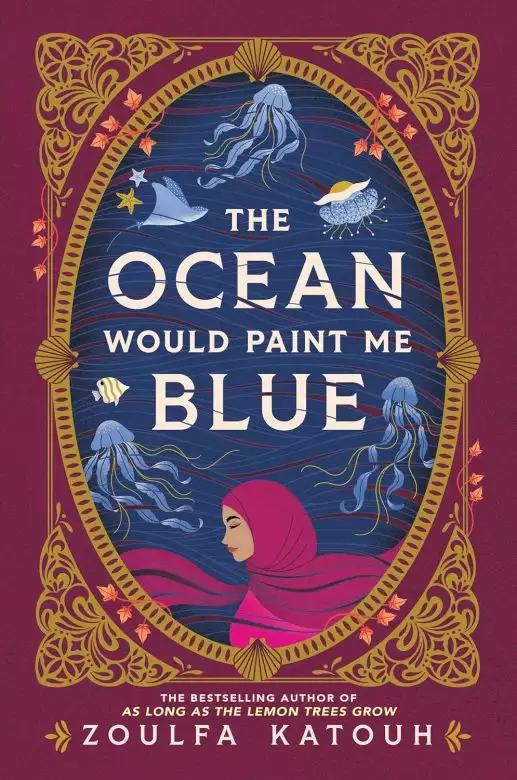
From the celebrated author of As Long as the Lemon Tree Grows comes a poignant novel about a Syrian American girl who uses a magical sketchbook to turn her grief into art, painting miraculous murals of her mother’s life in Syria.
Seventeen-year-old Jihad Dabbagh has always seen life with a heightened sense for colors, one of many magical blessings the women in her family possess. But Jihad's gift changes depending on her mood. When depression sets in, the world is a colorless oasis, and in the wake of her mother's sudden death, the world has become a permanent shade of grey.
Broken by tragedy, Jihad's family doesn't believe her color loss. Her father sends her to the elite Braxton Academy to finish her senior year. There, Jihad's name and hijab put a target on her back. her haven comes in the form of an old sketchbook carved from a tree in her hometown in Syria — a country she only knew through her mother's stories. Jihad hasn't picked up a brush in over a year, but finds herself channeling the colors of her hurt, pain, and grief as she paints the story of her mother's journey in Syria.
When graffiti of that same mural starts magically popping up all over New York, her art goes viral and the world takes notice, the threat of legal consequences is imminent. To reclaim her voice, Jihad will have to paint a new future for herself and Braxton, guided by the resilience of her mother's story.
Release date:
June 2, 2026
Publisher:
Little, Brown Books for Young Readers
Print pages:
368
* BingeBooks earns revenue from qualifying purchases as an Amazon Associate as well as from other retail partners.
I see a speeding car from the corner of my eye. I shiver as if feeling the rumble of the pavement from behind the register.
When I blink, a colorless world unfurls in front of me. For more than a year now, I have been able to see only in gray; all the color has disappeared from my universe.
The gas station Baba works at sits on the precipice of I-80, which connects New Jersey to the beaches of San Francisco. One straight line that leads to the Opus School of Art—the college of my dreams.
It was founded by a winner of the Nobel Prize in Literature who used her earnings to open and fund the school. Those who have graduated from it have gone on to make their mark on the world through photography, painting, and museums. Sometimes during the quiet, boring moments here, I take out my phone, open Google Maps, and follow the line with my finger, trying to imagine the way there. But I can’t fully visualize it. Everything has become dulled, vague, like a pencil smudge.
The only thing that’s been consistent is the burning need inside me to be in San Francisco. Even if I can’t see the blue of the ocean when I reach it, it won’t matter.
Every dashing car is a promise. A wish made on a birthday cake with a flickering candle. I focus on the wishes. The big ones first, then the small ones.
I wish Opus would admit me.
I wish Amal and her husband would find jobs in San Francisco and move with me.
I wish Baba would look at me. Like, actually look at me.
I wish I could finish senior year quickly.
I wish I could see color again.
Once, my life was a burst of color in shades of sunlight yellows, burning reds, forest greens, galaxy purples. My sketchbooks reflected that, painting what my eyes could see and others’ couldn’t. The colors danced. They swirled around me—hues reflected on my skin. They rippled like waves and splashed like waterfalls.
They were my entire life. And now they’re gone, leaving behind an eternal gray.
The swishing sound of the sliding door breaks the train of wishes, and I straighten up. Sam, one of the regular truckers who comes into this gas station, heads straight to the fridge to get his usual four-pack of Red Bulls before coming to the register.
“Evening.”
I ring up the Red Bulls. “Long night?”
He nods, thick eyebrows knitting together. He’s in different shades of gray, but his beard and mustache are a lighter shade than his hair. I can’t seem to remember if his hair is brown or auburn. If his eyes are brown or blue.
I pinch my thigh to focus.
“Have a delivery to Pennsylvania,” he says gruffly before squinting at me. “Don’t you have school tomorrow?”
“School isn’t for another two weeks.” The register clangs. “That’ll be ten dollars and ninety-eight cents.”
He nods absently, taking out his wallet and handing me a couple of wrinkled bills. I watch him walk out, climb into his truck, and drive out the lot, joining the other blurs speeding by.
One day, I think, that will be me.
I rub my eyes. I’ve been here all day, helping Baba with the gas station. Although the real reason is to stare at I-80. It calms my thoughts, quiets the loud emptiness inside me. It’s the only hope I allow myself.
Besides, if I’d stayed home, I’d have been in bed all day. Exactly how I spent the first few weeks of summer break, until my best friend, Alexis, pulled me out of my blanket fort.
Baba walks out from the storage room, ruffling his jacket.
“Yalla?” he asks in the same monotone voice he’s adopted for the past year. One that says he hasn’t been healing, doesn’t want to heal. One that says he’s been operating in survival mode for months. His hair is pale gray, and I wonder how that happened.
Helping around the gas station used to be fun. Baba helped build our fantasies until they became an intricate world that stretched as far as the eye could see. He came from the same town as Mama. His family was of the more practical type. But Mama came from something much more magical. It’s one of the reasons he fell for her. The way she expanded his life to be more than a monotony of going through the motions. She took his hand and showed him her world. His imagination was tentative but strong, and Amal and I spent many days fighting sea serpents and rescuing bags of chips from high ladders here.
We’re the last stop before travelers go on their journey, he used to say. It’s our duty to help them make it to where they need to go, and in a way, it’s like we’re going with them.
In moments like these, words splashed my world in color. They became animated, not frozen. They danced like waves on the sea, shimmered like diamonds, and became alive. The chipped red paint of the gas station became lava, bubbling and moving with the wind. The dull yellow of the walls became as bright as stars, actually spilling to the floor. I could taste the colors.
When I told my parents how the colors whispered their stories to me, how they pulsed and breathed, I was worried they wouldn’t believe me. That this was a figment of a hyperactive imagination. But Mama said the blessing was awakening in my blood.
There are stories in my family. Blessings that brush the line between reality and magic. Passed down through the generations of women in my family like a gift. My great-grandmother’s house in Syria was the only one with sunflowers blooming all year. Through snow and hail, they had their petals stretched out toward the sun just because she grew them. Her daughter, my grandmother, could catch clouds with her bare hands and squeeze the moisture from them for the freshest, coldest water you’d ever drink. The village never went thirsty. Her sister could talk to the trees. They told her of battles never written in books and lost love stories never known. She knew how Arwad and Tartus came to be and when the lemon trees would release one final bountiful crop before passing away.
Mama was the one who could speak to everything that lived in the sea. She knew how to swim before she could walk. The jellyfish were her childhood friends and the Mediterranean her confidant. And even though Baba had never seen her speak to the jellyfish—she’d told him they were shy—he believed every word.
And I could see the colors.
The ones that make up a person, how the character of the person influenced the shades. I could sense sorrow on a stranger’s gray jacket. Taste the joy on a tree’s brilliant green leaves. A song on a daffodil’s yellow petals. Forgotten promises on a faded pink jewelry box. Every shade of every object danced and flared like musical notes, bleeding into one another. I could see people’s cores, the colors that made up their souls and if they were dimmed or bright.
Amal and I grew up with stories from our village. Of vast endless fields and a horizon that stretched on forever. We tried to visualize it in our small two-bedroom Queens apartment. Peaches so sweet you can still taste them hours after you’ve had one. Sun so warm in autumn that a light jacket is the only thing needed. Mountains that rumbled, joining the Athan prayer from centuries-old mosques.
It’s these stories that shaped me, that kept the pain away.
Now it’s these stories that bring the pain.
Now the colors are leeched, stripped forcefully from my sight. All I see are shades of gray. It happened after Mama was gone more than a year ago. I thought I was still stuck in a nightmare. I was too shocked to say anything, praying and hoping the colors would come back. It took me a whole week before I brought it up to Baba. The guilt gnawed at me when he took me to the optometrist because our co-pay is horrible. Even more when the optometrist couldn’t find anything wrong with me and declared it was probably all in my head. I don’t think he believed that.
So this is the world I see.
Baba gets into the car while I close up the gas station. He’s been spending more time at the gas station than at home these days.
I put on my headphones and press play on my playlist before jogging to the car. As soon as I get in the passenger seat, Baba puts the car in reverse and drives out into the road, taking us back into the belly of New York City.
I used to love my town. I was born here, grew up here. This place is all I’ve known. Our neighborhood promised the American dream. A mesh of cultures all coming together from different parts of the world to find opportunity in this land of the free. While everyone spoke English, it wasn’t the most prevalent language. It was a symphony of Arabic, Portuguese, Chinese, and Romanian. And I loved it. I loved how I knew where each creaking stone in the pavement outside my apartment building was. I knew the stray ginger cat in the alley who has given birth to a litter of kittens every single year for the past five years. One that I wanted to adopt but Mama—
I turn up the volume on my headphones until it’s over the recommended range. I don’t listen to the words. They’re a garble against my ears as I lose my thoughts to the drumbeats and guitar strings.
We’re caught in the evening traffic for a solid hour. If there was no traffic, it would have been ten minutes.
The whole ride is silent aside from the buzz of the music I’m listening to.
Finally, finally, we’re home.
I get out, slamming the door, and hurry up the steps of our six-story building. I don’t even look back to see if Baba is following. We’ve become our own islands.
This has been my parents’ home ever since they came to the United States. The building is crammed between others like they are scared children, leaving no room to breathe. It might seem like the building is about to fall, knees wobbling, but I realized long ago this building will be here years after I die. The illusion of weakness doesn’t extend to its insides.
The salon run by our neighbor, Mrs. Gomez, and her daughters, is still open, and the sounds of rapid Portuguese flit out the open windows. My heart hurts, and I push back more memories threatening to play in front of my eyes.
The elevator isn’t working, which isn’t a surprise. I climb up the five flights of stairs, reaching our front door.
Stepping inside, praying I hear her voice. A prayer, a hope bursting in my heart unbidden every time I come home.
Praying the past year was just a nightmare.
But it wasn’t. Of course it wasn’t.
Our apartment is its own island of Syria in the middle of Queens. A two bedroom with a tiny kitchen that never stopped Mama from cooking the most delicious recipes. A wooden cabinet sits in the hallway, protecting the delicate crystal glassware inside. We’ve never used it, not even when we had guests over. We still don’t. The cabinet is draped with embroidered tablecloths Mama got as wedding gifts. She loved them so much; she bought more from Souq Al-Hamidiye when she visited Syria during the summer years ago. They were to be put over the sofa and the TV. And over the arabesque wooden table that sits in the living room. Her art adorns the walls, portraits of me and Amal, the jellyfish in the Mediterranean, and the collections of stone-built homes in Arwad. There are pictures of me and Amal from when we were babies all the way up to Amal’s wedding. Our family photo hangs in the middle. Mama and Baba standing behind the photographer’s couch, which Amal and I were sitting on. I was twelve then and Amal was nineteen.
I hate that picture.
If I look too closely, I can see the red rimming my eyes and the scrunch of my nose as I try not to scowl. The huge pink bow in my hair distracts from all of that. Mama had put me in a black-and-white polka-dot dress with white stockings. Amal plasters a wry smile onto her face. She’s in a long black pencil skirt and a white shirt, her two-piece hijab tucked under the shirt so the bejeweled collar shows. Mama is in her signature gray manto, and Baba is in a suit he probably bought twenty years prior.
I was angry that day for a reason I can’t remember. I do, however, remember I didn’t want to wear that bow. It was too tight on my head, and I wanted it off.
That family photo was supposed to mark the beginning of our new life. One where cancer no longer had a grip on our fears and hopes. Mama was four months into remission. Her lungs were strong enough to breathe air.
But I was twelve, and I didn’t care, because the pink bow was too tight on my head.
Now this apartment is frozen in time.
We didn’t change a thing.
We couldn’t.
If we did, then her ghost would be gone. The wisps of her clinging to this apartment would disappear. Maybe if we left everything as it was, an unknown blessing she had would survive after death, and we’d see her in this apartment. Maybe she’d come back.
I take off my shoes and place them on the rack before walking to my room. The front door opens as soon as I shut my own door.
My room is a burst of turquoise, gold, forest green, and maroon I can’t see. When Amal finally moved out two years ago, it became fully mine. The very first night, I brought out my brushes, stood on my chair, and started painting the ceiling. It took a week to complete, and I had to open the window for some air, but it was worth it. Sea-green waves crashing on golden sands. A San Francisco beach. And then on the walls surrounding me, I painted the redwoods. Their rusty-brown trunks and the rich green leaves.
For now, they’re my reality until I can really see them.
In this room, I can breathe.
I change into pajamas Mama bought in Syria and flop onto my bed. The frills on the side are worn out, and the printed lettering Today and tomorrow is sunshine has faded. Mama, Amal, and I would laugh at the obscure sentences used on Syrian clothing, trying to discern the original intention.
I lie on my bed for a while, staring at the ceiling, until my phone pings with a message and I glance at it.
Lexi: how was the station?
Lexi: wanna come over this weekend?
Lexi: you need to do something other than staying in ur room and working
Lexi: you’ve been doing just that all summer. It’s not healthy
Lexi: u can be sad of course
Lexi: but let me be there so you’re not alone
I bite my lip.
Lexi: any update on your eyes?
Alexis has been asking that every single day. She was the first person I told when the shock settled into grim reality. I told her before I told Amal. Even though Alexis no longer lives in this apartment building, she came over a lot when we were younger. Her mother was still working, and Mama offered to have Alexis here for the afternoons so she wasn’t alone in her apartment. Alexis became very familiar with Mama’s stories and believes them wholeheartedly.
Before I can decide whether to respond to Alexis’s texts, a knock on my door startles me.
“Come in?” I say after three seconds.
Baba opens the door, and I sit up. He doesn’t fill in the space like he used to. He’s somehow shrunk this past year.
“I made dinner,” he says in Arabic, and his voice falls flat. It doesn’t find the crevices in this apartment to settle into but hangs awkwardly. I wonder if what’s left of Mama in this place shudders every time she hears us speak, and maybe that’s the reason our voices are strange in a place that was once home.
“Dinner?” I repeat, dumbfounded.
Baba hasn’t made dinner in ages. And neither have I.
“Yes.” Baba looks suddenly exhausted. Like the few words he’s said have taken up everything in him.
He moves toward the kitchen, and I follow, curious.
I blink a few times, readjusting my eyes, to take in what’s on the dining table. It looks like a pot of simmering shakriyeh, a yogurt-based dish with pieces of meat suspended in it that’s served with burghal. He even laid out two dishes.
We sit, and I notice the chopped onions and pita bread cut in half placed neatly together on a plate. He made an effort.
Something’s happening.
My chest seizes, and I think I might have an anxiety attack. This has to do with Mama and the way she was suddenly taken from us. It has to.
Baba sees the panic in my expression and shakes his head. “No, no. It’s nothing bad. I want to talk about you.”
I blink, but my muscles don’t relax.
Baba takes in a deep breath. “This year…” He closes his eyes, steeling himself. I wonder if a time will come when words won’t feel like they’ll exhaust us to our bones. He tries again. “This past year hasn’t been easy on us. And I…I haven’t been here. But every time I look at you, I think you’re fading away. I was thinking a fresh start would be good.”
I stare at him.
“I talked to Alexis’s parents about the school she goes to,” he says in accented English, like he’s trying to turn the language into Arabic. “They said it’s a great place. You’ll be able to get a very good education. And have a higher chance to be accepted into university here. To NYU.”
My brain feels muddled. “Baba, the tuition at Braxton Academy is thirty-five thousand dollars a year.”
I remember because I looked it up after Alexis gushed about it. My hopes were shattered when I saw the tuition rate.
He waves a hand. “I saved enough.”
“I’m staying at my public school. I don’t want you spending thirty-five grand on me.”
“That is my decision,” he says firmly in Arabic.
“So I have no say, even though I’m the one going to attend?” I snap, and immediately regret my tone. “Sorry.”
He shakes his head. “It’s okay.” He massages the bridge of his nose. “You need advantages in life, yes? And with… with your mother…” His chin wobbles, and I look away.
I can’t bear seeing Baba cry. It’s an anomaly. A scratch in the fabric of my reality. I’ve seen him cry more times than I can count this past year, which has made me suppress my tears. They’re spilled only in private, onto my pillows, to water the redwoods on my walls. Maybe I cried all the colors away.
He clears his throat. “With your mother… gone, and your sister married, there is some money that can be used.”
The words are harsh like a slap against my cheek, and I feel their sting. Mama has been reduced to something materialistic. She was no longer being treated for cancer, but there was money stashed away in case it ever came back.
Now we’ll never use it.
“The cancer savings are just a little over ten thousand,” I say.
“It’s not your problem.” A hint of life sprouts in his eyes. “You are my daughter. You don’t stress about the money. Okay?”
“But still not my decision?” I say dryly.
“No, it’s not.” He sighs. “I thought you’d be happy. You’ll be with Alexis.”
We’d be in the same school for the first time since elementary school.
Braxton Academy.
I don’t know much about it beyond it being a school for rich kids. From Alexis’s Instagram, every face is a different shade of white, in Burberry and Chanel. That is when they aren’t in their school uniforms of gray trousers or skirts, white shirts, and matching gray jackets.
The uniforms aren’t baggy or poorly made but are tailored to each student’s measurements. That’s the kind of school Braxton Academy is.
“They also have art classes. I checked,” Baba says, and I ignore that, lifting the lid from the shakriyeh pot.
It doesn’t smell the way it did when Mama used to make it. But it comes close. It’s a special kind of pain to see parts of her that aren’t fully there—like looking through mist.
Satisfied with our talk, Baba retreats to the shell he’s been living in.
And I realize this is the longest conversation I’ve had with him in a year.
Alexis Williams and I met the first day of kindergarten. I was crying, holding on to Mama’s manto, begging her not to leave me, when Alexis took my hand and in her other held up a Twix.
“Wanna share?” she asked.
I remember because I gather kindness like precious stones. Because friendship doesn’t come easily to me, and all I can do is hope to be noticed.
And Alexis noticed me.
It takes three buses and a total of one hour and twenty minutes to reach Alexis’s house the next day, but I’m happy to do it. Alexis’s house isn’t frozen in time. The sun shines through the French windows, and there’s always something delicious baking in the oven.
When Alexis opens the door, she squeals and flings her arms around my neck.
She’s in cutoffs and a tank top because the August heat has been persistent this summer. I’ve worn my lightest clothes, an oversize summer shirt and linen pants. I remember that the shirt is supposed to be blue and the pants cream. There was no air on the buses, and I sweated well into my shirt.
“I haven’t seen you in ages!” she exclaims. Her chin-length blond hair is tied into a messy, small bun at the top of her head. “We have so much to talk about.”
“How long have you known?” I ask with a raised eyebrow as she tugs me up the stairs.
Her town house has a modern twist to it, with enormous light fixtures and, from what I can remember, monochrome shades of sage. The walls along the hallway leading to the living room are filled with different shapes of mirrors, and there are antique rugs hugging the tiled floors that her mother probably bought from an online store that takes inspiration from the Eastern side of the world.
“A while,” she admits with a cheeky grin.
I roll my eyes. “Shouldn’t I say hello to your parents?”
“Nah,” she says when we reach her room, closing the door and locking it. “They’re busy. It’s fine.”
I nod, rubbing my hands over my arms.
Alexis’s room is bubble-gum pink and teal blue. Though everything is gray right now. Her desk is situated in front of the large windows, where the sunlight streams in, falling onto her queen-size bed. There are potted plants in every corner and one hanging from a basket. She’d asked me to paint the roses and peonies on her walls, back before everything happened. Even her mom was impressed. It took me three full days to complete, and I took the bus every single day, but it was fine. Even though I felt out of place in Alexis’s home most of the time, it was a lull from the anxiety in my home when Mama was battling cancer.
“Your eyes?” Alexis asks, and I look up at her. Her brow is furrowed with concern.
I shake my head.
“Not even like a shade of something?”
I shrug my shoulders. “I’m sorry.”
She scoffs. “What are you apologizing for?” She nods at me and sits cross-legged on the rug. “You can take off your hijab. I told dad not to come up.”
I hesitate for a second before beginning to unwrap my hijab.
I saw the way Amal used to be ostracized by friends for rules and ideologies they didn’t share. I saw the discomfort on her face, but she held strong, not backing down. It didn’t do her any favors, but eventually she was able to find a few friends who loved her for who she is. I didn’t want to be like that, because I didn’t have her free, loud spirit. I wanted to be palatable, so I kept parts of myself hidden. If I were at a Muslim friend’s house, they would understand if I wanted to keep my hijab on because their father or brother was home. And while Alexis never intentionally made me uncomfortable, these aren’t waters I want to test. I don’t want to come off as difficult or weird. Not more than I am.
Alexis leans on her elbows, watching me fluff out my waist-length hair.
I’ve been growing it ever since I was ten, when Mama was first diagnosed with lung cancer. She never touched a cigarette her entire life, yet the disease festered in her lungs. She used to say it was because she’s an island girl, her body and soul craving the saltiness of the sea. The clear island air.
“I know I’ve said this a million times before.” Alexis stares at my hair with wide eyes. “But you would be so popular without your hijab. I feel bad you have to wear it in this summer heat.”
I know Alexis doesn’t mean anything when she says that, because I know what comes after it.
“But you’re still so pretty in your hijab,” she continues. “Like, I don’t know, it makes your eyes bigger, and honestly, they’re like black holes.”
I widen my eyes even more, and she laughs.
Still, a trickle of unease spills down my spine. There are moments in my life, in every Muslim’s life, that happen in seconds, but the effects linger and are revisited again and again, when I wish it had gone a different way. Heartbeats where I have to make a decision and weigh out the consequences.
Moments for me when boys extend their hands for a handshake, and I have to decide whether to shake their hands or tell them it’s not allowed in my religion. And then see them exchanging looks or the embarrassed backtrack.
The first time Alexis made an offhand comment about my hair, I was too caught up in the moment that both lasted forever and ended so quickly. When she said how popular I’d be without my hijab. It didn’t come from a place of malice; it was a genuine thought. I didn’t want to make it awkward by telling her it made me uncomfortable with how she saw my hijab, so I let it slide. And then she started saying it every now and then. Too much time has passed, and there’s no way I can bring it up now.
I loop a finger around a strand. “You think? It’s just hair.”
“It’s so thick,” she says in awe. “Not like my limp straw hair.”
“Come on. Your hair is pretty.”
She rolls her eyes. “I can hear the pity in your voice, Ji. You’re getting me a wig for my birthday?”
“There’s no pity!” I laugh, but already she’s taking my mind off my hair and the reason it exists.
Mama went into remission, and I kept growing my hair because what if the cancer came back? And I was right. It did. And then it went away again. But my hair was always there—her cushion to fall on if she wanted it after her chemotherapy. I kept telling her I wanted to give it to her, and she would run her fingers along it, telling me how beautiful my heart was.
I glance at myself in Alexis’s full-length mirror and try to see what she sees. To my eyes now, my hair is a dark gray. It should be brunette, but brown isn’t just one shade. There is so much more to brown than meets the eye. My hair is umber, the same color as the soil under the redwoods. It would catch the sunlight and turn syrupy. Each strand knows where it should fall in natural waves with some casual frizz. I never blow-dry or straighten it because it takes ages, and we don’t have the money to splurge on weekend blowouts like the ones Alexis and her mom get.
Alexis takes a deep breath, shakes her head. She grabs my shoulders, shaking me. “I can’t believe we’re going to be in the same high school!” She gasps. “Oh my God, I just realized. We began school together, and we’re ending it together!”
“I—I didn’t think of that,” I say, dazed, her giddiness infecting me, but it fizzles out before I can hold on to it. Emotions are hard to catch, but with Alexis, I can’t help the warmth flowing to every part of my limbs. For some reason, it’s easier with her.
“Okay, I need to give you a rundown on everyone at the school.” She grabs her laptop and pats the floor beside her. “Come, child. Sit.”
I snort and scooch beside her.
She types her password, which I know is Bloom1012 because she used to be obsessed with Winx Club when we were kids.
“You know, my parents were surprised when your dad said you’ll be attending Braxton,” she says, squinting at the screen.
“What is that supposed to mean?” I ask, the words coming out of my mouth before I can stop them. They sound harsh, and I wince.
Alexis blinks and glances at me. “It’s just… they didn’t think you’d want a big change after what happened to your mom.”
The tension unwinds, and I nod. “Right. Yeah.”
We’re approaching dangerous territor. . .
We hope you are enjoying the book so far. To continue reading...

 Please log in to recommend or discuss...
